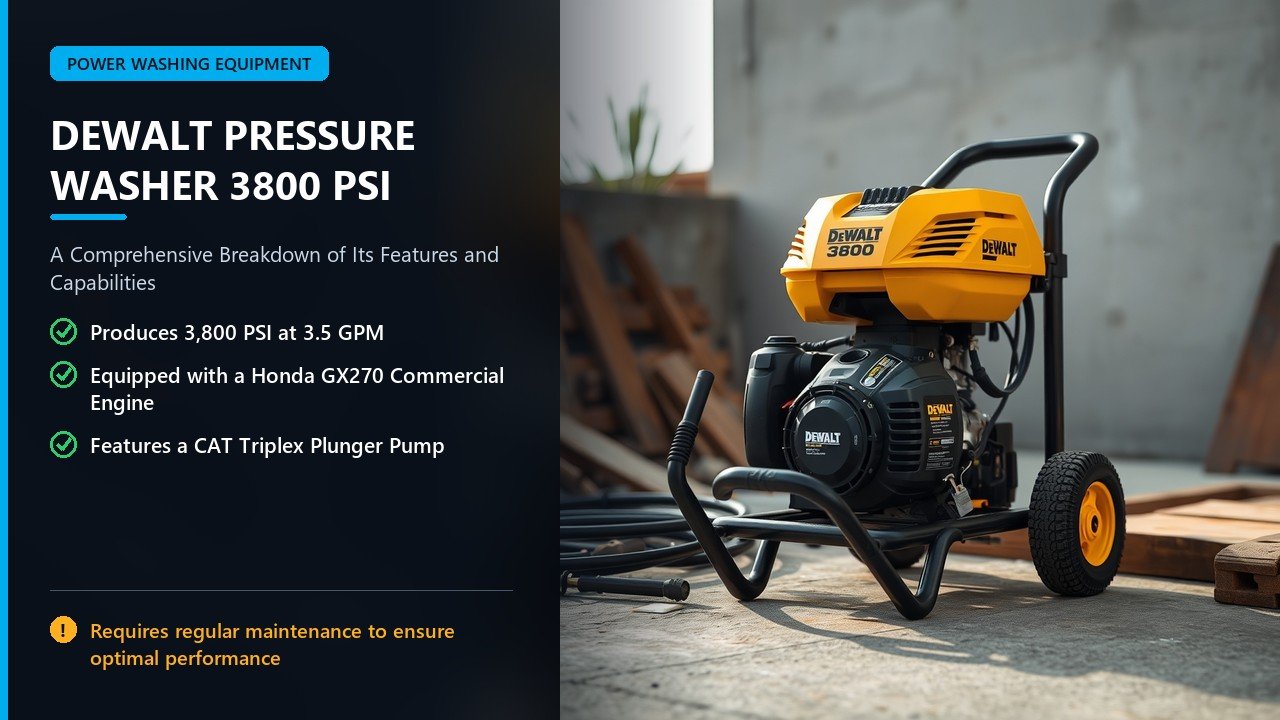
There are household pressure washers and there are serious ones, and the line between them is drawn with engine names and pump names. The deWalt pressure washer 3800 psi model, sold as the DXPW60604 with a Honda commercial engine and a CAT industrial triplex pump, sits confidently on the serious side. It is a gas machine built for pros and demanding property owners, producing 3,800 PSI at 3.5 gallons per minute through a 13,300 cleaning unit rating, on a welded steel frame with pneumatic tires.
This guide breaks down what the DeWalt 3800 actually delivers, what its parts mean, how it compares with other DeWalt models and neighboring brands, and what owners learn in the first season. If this machine is on your list, here is the spec sheet read honestly.
What the DeWalt 3800 Is Built Around
The DXPW60604 is best understood as three decisions stacked on top of each other: a commercial engine, an industrial pump, and a frame big enough to carry both. The Honda GX270 is a commercial series engine with recoil start and low oil shutdown, rated around 8.5 horsepower from 270 cc, and it is one of the most trusted engines in small equipment for a simple reason: it starts, idles, and runs dependably for years with basic care. The CAT triplex plunger pump uses ceramic pistons and a thermal relief valve, and it is the same family of pump that appears on machines costing far more. Together they produce the machine’s 3,800 PSI and 3.5 GPM.
The package details show the same intent. The welded tubular steel frame is powder coated with a 12 gauge engine plate, the axle is solid 5/8 inch steel, and the 13 inch pneumatic tires roll over gravel and curbs without complaint. A pro style gun with a steel wand, a 50 foot 3/8 inch hose with quick connect fittings, five nozzles including the 0, 15, 25, and 40 degree patterns plus soap, and a downstream detergent injector complete the kit. Nearly everything an operator needs arrives in the crate. The full current family of the company’s gas pressure washers is cataloged on the DeWalt gas pressure washer page if you want to place the 3800 among its siblings before shopping.
Reading the Number: 3800 PSI, 3.5 GPM, 13300
The three headline numbers matter in different ways. The 3,800 PSI is the working pressure, the force the stream carries, and it is what lifts embedded dirt, lifts oxidation, and stands up to textured concrete. The 3.5 GPM is the flow, the water volume, and it is what makes the machine feel fast, because flow is what carries soil away and feeds tools like surface cleaners. Multiply them and you get 13,300 cleaning units, the combined measure of cleaning power that lets buyers compare machines of different shapes.
On the surfaces where people feel the difference, the numbers translate directly. At 3,800 PSI this machine prepares wood for paint or stain, strips loose coating, removes algae and mildew from siding and concrete, and lifts stubborn driveway staining. At 3.5 GPM it can run a large surface cleaner without feeling starved, which is the single biggest time saver on flat concrete jobs. That pairing of high pressure and genuinely useful flow is what separates a 3,800 PSI machine that works fast from one that merely sprays hard.
For anyone moving up from a lighter unit, the leap is bigger than the badge suggests. A 2,500 PSI machine at 2.5 GPM leaves a different residue on concrete than this one, and the difference is not just force. The higher flow carries away the material the pressure breaks loose, which is the half of cleaning people forget until they feel it. Fifteen minutes with this machine on a stained driveway explains more about why pros buy triplex pump units than any brochure.
| Spec | Value | Why It Matters |
|---|---|---|
| Working pressure | 3,800 PSI | Lifts tough soil from concrete and masonry |
| Flow rate | 3.5 GPM | Feeds surface cleaners, fast coverage |
| Engine | Honda GX270 | Commercial reliability, easy parts |
| Pump | CAT triplex plunger | Industrial durability, ceramic pistons |
| Cleaning units | 13,300 | Combined measure of total power |
| Hose | 50 ft, 3/8 inch | Usable reach, good flow |
The Engine: Honda GX270 in Practice
The Honda GX270 is more than a familiar name; it is the reason this machine starts the way it does. Commercial series engines are built to a higher standard of air filtration, oil capacity, and vibration control than the economy engines on discount machines, and in daily service that shows up as easier cold starts, smoother idling, and a lower tendency to walk across the driveway as it runs. Low oil shutdown is the practical safety net that owners grow to rely on, because it stops the engine before low oil can do expensive damage.
The maintenance routine for the GX270 is small and predictable: periodic engine oil changes, air filter checks, and fresh fuel. With that much, the engine is the part of the machine that stops surprising you. Because Honda small engines are everywhere, parts and service are cheap and local, and any small engine shop already knows the GX series. On a jobsite machine, an engine you can get serviced anywhere is an engine worth owning.
The Pump: CAT Triplex Plunger
The other name on the machine is the one that decides how long it lasts. The CAT triplex plunger pump here uses ceramic pistons and stainless steel components in an industrial design, and it is a pump class you normally find on machines that cost considerably more. A triplex layout, three pistons working in sequence, delivers smooth pressure rather than a pulsing stream, and ceramic pistons resist the wear that chews up cheaper pump internals. A thermal relief valve on the pump provides protection during extended bypass.
There is an important behavior rule that comes with a direct drive machine like this one. Because the pump bolts straight to the engine and runs at engine speed, it builds heat faster in bypass, when the trigger is closed and water recycles instead of spraying. Owners who run commercial machines treat extended bypass as a real limit, keeping idle time short and shutting the engine down when staging or moving. The thermal relief valve is the last line of defense, not a license to idle. A machine with this pairing rewards the operator who treats it like the pro tool it is.
Direct Drive: Compact and Honest
The DXPW60604 is a direct drive machine, and that choice has consequences worth understanding before buying. Direct drive bolts the pump to the engine, which keeps the package compact, light, and affordable relative to a belt drive rig. There is no belt to maintain, no sheave alignment to hold, and the whole unit is small enough to live in a corner of the garage or ride in a truck bed.
The tradeoff is that the pump runs at full engine speed, works harder, and heats faster in bypass, which is why the machine is best used with the operating discipline described above. A belt drive machine would run the pump slower, run cooler, and tolerate longer idling, but it would also be bigger, heavier, and more expensive. For the user this machine targets, a serious homeowner or a light professional who reaches the end of the job and shuts the machine down, direct drive is the sensible price to pay.
What the Kit Includes and What Is Worth Adding
Home Depot and dealer listings describe the included package accurately: a 50 foot 3/8 inch hose, five quick connect nozzles, a pro style gun with a steel wand, and a downstream detergent injection system. That hose length is genuinely usable, letting the machine sit well back from overspray, and the quick connect tips switch cleanly between patterns. The soap nozzle and injector make chemical application simple, which matters when prepping wood or killing mildew.
Two additions turn this machine into a complete workstation, and owner reviews point at the same two every time. A surface cleaner ridden on the 3.5 GPM flow cleans driveways and patios several times faster than holding a wand, and a swivel in the hose keeps the line from fighting the operator. A longer or better grade hose, chosen by the rules in our high pressure cleaner hose guide, adds flexibility and cuts the up-and-down of moving the machine on large properties.
The downstream detergent system deserves a word, because it changes what the machine can do beyond stripping grime. With the soap tip fitted, the injector draws chemical at low pressure, so a house wash on vinyl siding, a pre-treat for mildew, or a degrease before rinsing all happen without adding a separate step to the day. The flow is also the host for chemical transfer, which is why proper flushing after use keeps the injector clean and the pump protected. It is the detail that keeps the machine useful across the whole property instead of only on concrete.
How the DeWalt 3800 Compares With the DeWalt Lineup
DeWalt sells pressure washers across a wide band, and knowing where the 3800 sits among them makes the purchase decision clear. The consumer 3400 PSI machines, such as the DXPW3400, run axial cam pumps and economy engines. They are fine household tools, but the axial pump and lighter engine are the difference between a machine for weekends and a machine for regular work.
The 3800 with the Honda and CAT sits above those, and it is the model that most clearly targets the boundary between serious homeowner and working pro. Above the 3800 in the line are higher output units around 4,000 PSI that push further toward contractor territory. The sensible way to read the lineup is by pump type: axial cam for consumer machines, and triplex plunger for the ones built to be used. That reading, more than the PSI badge, tells you what you are buying.
| DeWalt Tier | Typical Spec | Pump | Who It Is For |
|---|---|---|---|
| Consumer electric and 3400 gas | 2,500 to 3,400 PSI | Axial cam | Weekend household work |
| Prosumer 3800 | 3,800 PSI / 3.5 GPM | CAT triplex plunger | Serious owners and light pros |
| Contractor 4000 class | 3,900 to 4,000 PSI | Industrial triplex | Daily professional use |
This is also the moment to say something honest about comparing it to other brands. In the same price neighborhood, machines from BE and others pair the same style of pump with a different engine, and the right choice often comes down to which engine and dealer network you trust. The DeWalt 3800’s specific argument is the Honda GX270 engine plus the CAT pump on a stout frame, backed by DeWalt’s three year commercial engine warranty, two year pump warranty, and ten year frame warranty. That is a spec sheet with confidence written all over it.
Against the next rung up, the 4,000 PSI contractor class, the 3800 gives up a little force at the top of the range to gain portability and price. Those machines add weight, cost, and often belt drive hardware for daily professional schedules. The 3800’s position, between the weekend axial pump units and the full contractor rigs, is exactly where a Pro serious about cleaning their own property or running light contract work wants to stand, and the segment is one the market keeps, because it answers the most common question in outdoor cleaning: what is the first machine worth taking seriously.
Surfaces It Handles and How to Use It Safely
At 3,800 PSI, this machine is a surface dependent tool, and using it well means picking the right tip and distance for each job. On concrete driveways and sidewalks it removes staining and oxidation, prepared properly with a surface cleaner. On wood and painted surfaces it preps for paint and stain, but only with the wide tip held at the right distance, because this pressure can mark soft wood and blow out lap joints. On vinyl siding it cleans, and on brick and masonry it lifts grime the rougher products on the market simply smear around.
That distance and tip discipline is the whole safety conversation. A 0 degree tip on a 3,800 PSI machine can cut deeply, and pointing any tip at a person, a pet, or yourself is a genuine injury hazard. Most damage on property comes from a narrow tip held too close for too long, and on concrete the signature mistake is etching, leaving a lighter, textured mark where the stream overstayed. Our guide to home pressure washing walks through safe distances and tip choices for exactly this range of machine, and a wand that lets you swap tips while keeping the right grip is part of the kit for a reason.
Let the machine stand back from surfaces more than you think it should at first. The 3,800 PSI number lets you start two steps farther away with a wide fan and still do the work, and moving in only when the stains demand it is how experienced operators avoid the mistakes that scar decks and streak siding. When in doubt, the wider 40 degree tip at a safe distance does the planning for you, and the trigger can always come closer for the stubborn spots.
Care That Keeps a 3800 Running
The longevity of this machine comes down to a short list of habits. Change the engine oil on schedule and check the air filter; keep fresh fuel in the tank and stop the machine rather than letting it idle in bypass; keep the pump fed from a clean inlet filter; and flush the detergent from the system after every job. The pump oil deserves its own line: the CAT pump wants the correct non-detergent oil checked and changed as our guide to pressure washer pump oil details, because the pump is the expensive part that oil protects.
A machine that gets this routine earns a reputation the way the reviews describe: the DeWalt 3800 starts when called, holds pressure through long cycles, and keeps running season after season. The broader maintenance calendar that production machines follow is worth adopting even for a prosumer unit, and our guide to power washing preventative maintenance lays out the full schedule, from the oil checks to the seasonal protection that keeps a gas machine alive through storage.
Storing and Protecting the Machine
Gas machines are lost to storage mistakes as often as to hard use. Drain the fuel or treat it with stabilizer before long storage, run the machine after fogging the pump with the right protection, and keep the machine out of prolonged weather. In cold climates, winterize the pump so a freeze cannot crack the head, the same discipline that protects any pump that ever held water. A frame with a ten year warranty and a Honda engine will easily see a decade of service, but only if the water inside it is managed season to season.
Answers to the Questions Buyers Ask Most
Is the DeWalt 3800 PSI pressure washer a good machine?
Yes, for serious homeowners and light professionals. It combines a Honda commercial engine and a CAT industrial triplex pump on a stout frame, with strong warranties, and owner reviews consistently report dependable starts and genuine cleaning power. It is a machine that rewards solid maintenance, as all pro units do.
How much does the DeWalt 3800 weigh?
About 112 pounds, which is heavy for a lifting exercise but stable in use. The 13 inch pneumatic tires and solid axle make it roll easily over drives and curbs, so weight is a walk the machine does for you rather than a carry. It lives best on its wheels with the handle down.
Does the DeWalt 3800 have electric start?
No. This model uses recoil start, pulling the Honda GX270 to life with a rope, and the engine is reliable enough that most owners find this a non-issue. Some other models in the DeWalt line offer electric start, so if pull starts are a problem, it is worth stepping up the lineup to a unit with electric start.
What warranty comes with the DeWalt 3800?
Three years on the engine, two years on the pump, ten years on the frame, and 90 days on accessories. That split is telling: the frame is built for a decade, and the engine and pump carry the warranties their classes deserve. It is among the stronger warranty packages in this segment of the market.
What engine does the DeWalt 3800 use?
The DXPW60604 uses a Honda GX270 commercial series engine with recoil start and low oil shutdown, rated about 8.5 horsepower. It is one of the most trusted engines in small equipment, with cheap parts and local service available almost anywhere.
Can the DeWalt 3800 run a surface cleaner?
Yes. At 3.5 GPM it has the flow to run a good surface cleaner without feeling starved, which is the fastest way to clean driveways and patios. A 20 inch cleaner is the practical companion on flat concrete at this flow.
How does the 3800 differ from the DeWalt 3400?
Mainly the pump and engine class. The 3400 machines use axial cam pumps and economy engines for household duty, while the 3800 uses a CAT triplex plunger pump and a Honda commercial engine. For regular use, the 3800 is built to a higher standard and lasts longer.
What kind of pump is on the DeWalt 3800?
A CAT industrial triplex plunger pump with ceramic pistons and a thermal relief valve. The triplex layout delivers smooth pressure, and the industrial class is the same family used on machines costing more. It wants non-detergent pump oil and reasonable bypass discipline.
Is 3800 PSI too much for residential use?
Not if it is handled with the right tip and distance, and it removes the toughest driveway and siding soil that lighter machines cannot move. The risk is operator error, so soft surfaces call for a wide tip held at distance. Many households happily run machines this size with care.
Does the DeWalt 3800 come with everything I need?
Almost. It includes a 50 foot hose, pro style gun with steel wand, five quick connect nozzles, and a downstream detergent system. Most owners add a surface cleaner and a hose swivel, which turns the machine into a full workstation.
Can I use the DeWalt 3800 for a small business?
Reasonably, in the right role. The commercial engine and industrial pump hold up to regular use, and the ten year frame warranty points at how the machine is intended to be treated. For daily multi-wand work or long bypass schedules a belt drive rig is the better tool, but for a one operator light contract workload the 3800 is a proven, affordable start.
What oil does the pump on the DeWalt 3800 take?
Non-detergent pump oil, typically 30 weight, in the crankcase, checked through the sight glass. The engine takes a quality engine oil per the Honda spec. Keeping the two straight, non-detergent for the pump and detergent for the engine, protects both systems, and our pump oil guide gives the full details.
The Bottom Line
The deWalt pressure washer 3800 psi machine, the DXPW60604, earns its place by pairing two proven names on one strong frame. A Honda GX270 commercial engine starts and idles dependably, and a CAT triplex plunger pump delivers smooth, durable pressure with ceramic pistons and thermal protection. On a powder coated steel frame with pneumatic tires and a genuinely complete accessory kit, it is the machine for anyone who has graduated from consumer washers and wants the next real step up without the size and cost of a full contractor rig.
The honest caveats are the ones every direct drive owner lives with: keep bypass idle time short, do the simple maintenance on schedule, and pick tips and distances per surface. Follow that, and this machine repays the investment with fast, powerful cleaning for years, and it holds value the way prosumer equipment does. Pair it with a surface cleaner and a good hose, and the 3800 becomes not just a washer but a complete cleaning station that handles most of what a property has to throw at it.