Marcus runs a two-bay mobile washing operation outside Kansas City, and for three years he cleaned everything with a 4,000 PSI gasoline cold-water unit bolted to his trailer. It did the job on pickup trucks and driveways. Then he landed a contract with a regional freight company, forty trailers and tractor units a month, and within two weeks his routine fell apart. The cold water smeared grease across diesel engine blocks instead of lifting it. His gas engine ran nine hours a day and started burning oil. And the washing bay owner, tired of the cloud of fumes, told him to stop running the machine indoors.
He replaced that gas unit with a diesel-fired hot water machine and, in his words, “it was like switching from sandpaper to a hot knife.” The grease came off in half the passes. The engine shrugged off the long days. And he could burn the same fuel he already kept on the truck for both the engine and the burner. That single change is the reason diesel pressure cleaners occupy their own tier in the cleaning world: they are the machines built for the jobs that quietly destroy everything else.
If you are shopping this class of equipment, or trying to understand why a diesel machine costs thousands more than a gas one, this guide walks through every part of the decision. We will untangle the two separate meanings of “diesel,” compare diesel and gas engines head to head, explain what a diesel burner actually does, lay out the PSI and GPM classes that define each machine, break down real-world applications and cost of ownership, cover fuel and maintenance, and finish with the safety rules that matter most. By the end you will know whether a diesel pressure cleaner belongs on your job site, and exactly which configuration fits your work.
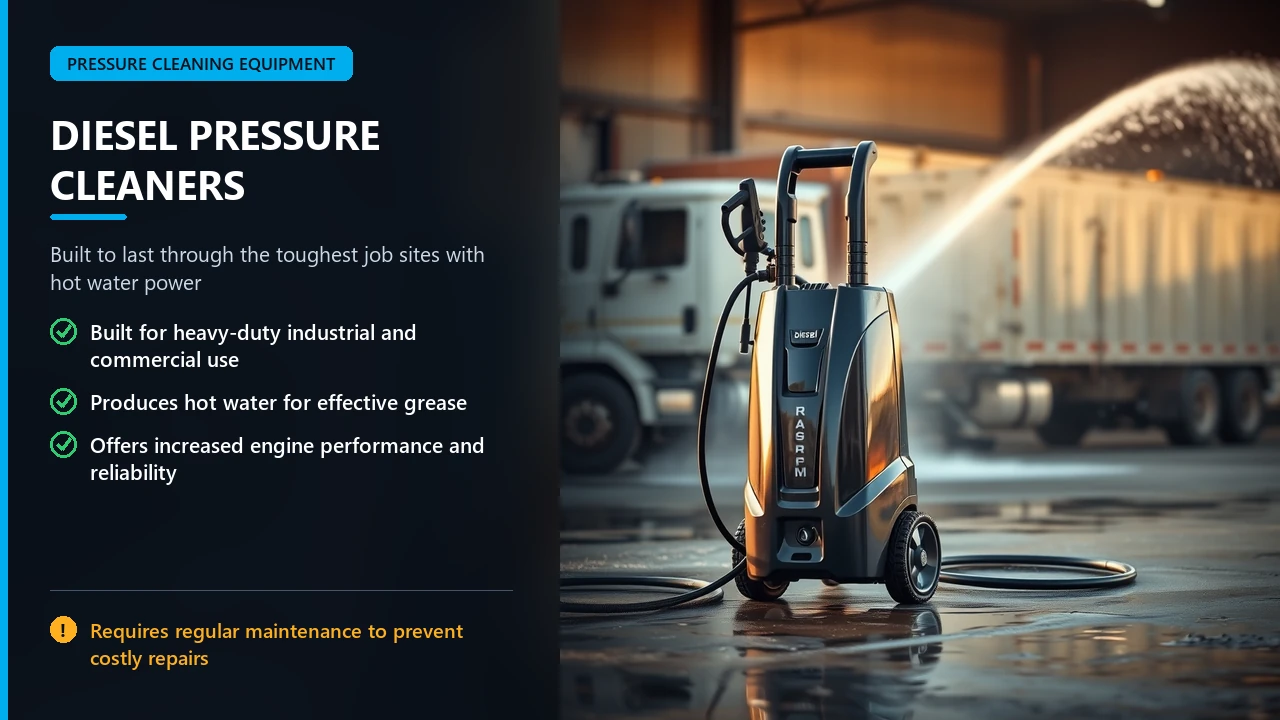
What “Diesel Pressure Cleaners” Actually Means
The confusion starts with the word diesel, because it can describe two completely different parts of a pressure washer. A diesel pressure cleaner is a machine that uses diesel fuel in one or both of these roles:
- Diesel as engine fuel. The engine that drives the high-pressure pump runs on diesel instead of gasoline.
- Diesel as burner fuel. The water heater (the burner) burns diesel to produce hot water or even steam.
Most heavy commercial hot water machines sold in the United States use a gasoline, diesel, or electric motor to spin the pump, paired with a diesel burner to heat the water. Others go fully diesel, with a diesel engine driving the pump and a diesel burner heating the water. Both get called diesel pressure cleaners, which is exactly why reading the spec sheet matters more than reading the marketing headline.
The diesel engine is prized for durability and fuel economy on long duty cycles. The diesel burner is prized for reliable, powerful heat. Together, or in combination with a gas or electric motor, they define the hard-working end of the pressure washing market. What unites every diesel pressure cleaner is purpose: sustained, demanding work where reliability and heat are not luxuries but the whole point. These are not casual tools. They are the equipment professional cleaning outfits, industrial plants, and fleet operations lean on to keep working day after day.
Diesel Engine Versus Gas Engine
The engine question is separate from the burner question, and it comes down to how hard the machine works and how long you expect it to last.
| Factor | Diesel Engine | Gas Engine |
|---|---|---|
| Fuel economy | 25–30% better under load | Higher fuel consumption |
| Typical engine life | 4,000–6,000+ hours | 1,500–2,500 hours |
| Torque | High and steady at low RPM | Peakier power band |
| Upfront cost | Higher (often 15–25% more) | Lower |
| Maintenance interval | Longer (250+ hour oil changes common) | Shorter (50–100 hour oil changes) |
| Cold weather start | Needs glow-plug warm-up | Easier to start cold |
| Best for | High-hour, daily commercial and industrial use | Moderate and intermittent use |
A diesel engine’s core advantage is endurance. Under daily commercial use, a diesel can realistically outlast two or three gasoline engines, which spreads its higher purchase cost across far more working hours. Minnesota-based equipment builders put the diesel engine life band at 4,000 to 6,000-plus hours versus 1,500 to 2,500 for gas, and that gap is the whole argument. Diesel also burns less fuel per hour under load, which matters when a machine runs through entire workdays. The trade-offs are real: higher upfront cost, more weight, more noise, and a need for diligent service. For occasional or moderate use, a gas engine is simpler and cheaper. The choice follows how much the machine actually works, not a preference for the technology. Our companion piece on diesel hot water pressure washer basics covers which buyers genuinely need the premium.
The Diesel Burner and the Real Power of Hot Water
The burner side is where diesel shines for actual cleaning power. A diesel burner heats water to high temperatures, often up to 200°F, and in steam configurations far beyond that. Hot water is what dissolves grease, oil, diesel exhaust residue, and baked-on grime that cold water only pushes around.
- Hot water. Diesel-fired heaters deliver consistent hot water for degreasing, fleet washing, and food-industry sanitation.
- Steam. Some units produce steam, which cleans and sanitizes in ways hot water alone cannot, useful in industrial and food settings.
- Reliable ignition. A well-maintained diesel burner fires dependably and holds steady heat across long jobs.
- Single fuel source. On a full diesel machine, or a diesel-engine machine with a diesel burner, you carry one fuel for everything.
A diesel burner can be paired with any engine type, so a machine may use a gas or electric motor to drive the pump while the diesel burner makes hot water. This hybrid is extremely common in commercial cleaning because it delivers heat where it matters without the cost of a full diesel engine. For most cleaning work, the burner, not the engine, is what turns a machine into a grease-killing powerhouse. The chemistry is simple: heat softens and thins oils and fats, breaking their bond with the surface so the same PSI does far more work. That is why diesel hot water melts away grease and oil while cold water leaves a film.
The Main Types of Diesel Pressure Cleaners
Diesel pressure cleaners come in a handful of configurations, and each one exists for a reason. Matching the type to the work is the first real decision.
| Type | What It Does | Typical Use |
|---|---|---|
| Cold water, diesel engine | Diesel engine drives the pump, no heat | Tough pressure where heat is unnecessary; single-fuel fleets |
| Hot water, gas or electric engine + diesel burner | The classic commercial hybrid | Degreasing, fleet washing, restaurant and shop cleanup |
| Full diesel (engine + burner) | Maximum durability and heat, one fuel | Industrial and high-hour commercial duty |
| Diesel steam cleaner | Produces steam for sanitizing and extreme deposits | Food plants, industrial sanitation, heavy buildup |
A cold water diesel engine machine offers durability without heat, which makes sense where pressure alone is enough or where a fleet already runs diesel. The gas or electric engine with a diesel burner is the most common commercial hot water setup and often the best value, because you get maximum heat without paying for a diesel engine you do not need. A full diesel machine is reserved for the hardest, longest duty cycles. And a diesel steam cleaner is a specialty tool for sanitizing and blasting the toughest deposits. Choosing among them means matching the machine to the work, never chasing the biggest spec on the page.
When Diesel Pays Off, and When It Does Not
Diesel is not automatically the right answer. It earns its price under specific conditions, and it is a waste of money outside them.
- High duty cycle. Daily, long-hour use rewards the diesel engine’s longevity and fuel economy.
- Heavy grease and oil. Work that demands hot water justifies a diesel burner.
- Large-scale commercial jobs. Fleet yards, industrial plants, and food facilities need sustained, reliable power.
- Long-term ownership. Over several years, diesel durability can outweigh the higher upfront cost.
- Assigned diesel equipment. Where diesel is already the fuel on site, a diesel machine simplifies logistics.
Conversely, diesel does not pay off for occasional use, small residential jobs, or tight budgets. A gas machine, with a gas or electric burner if you want heat, is often the smarter buy for moderate work. The honest calculation weighs upfront cost, duty cycle, fuel cost, maintenance, and expected lifespan. A business running a machine every day will find the diesel premium justified; a homeowner or light commercial user will not. Our look at diesel hot water power washer costs helps put real numbers on that decision.
PSI and GPM Classes
Diesel pressure cleaners span a wide performance range, and the class tells you what work each machine suits. Pressure (PSI) penetrates; flow (GPM) cleans and rinses faster. For grease and large areas, flow and heat usually matter more than raw pressure.
| Class | Pressure & Flow | Typical Work |
|---|---|---|
| Starter commercial | 2,000–3,000 PSI, 3–4 GPM | Light commercial, vehicles, small surfaces |
| Mid commercial | 3,000–4,000 PSI, 4–5 GPM | Fleet washing, flatwork, general degreasing |
| Heavy commercial | 4,000–5,000+ PSI, 5–8 GPM | Industrial equipment, heavy grease, multi-gun rigs |
| Industrial / multi-gun | 3,000–5,000 PSI, 8–12+ GPM | Large concrete work, two operators at once |
Notice that the heaviest industrial machines are not always the highest PSI. They are often the highest flow, because a big flow rate paired with hot water strips volume grime fast. Choosing a class means matching both numbers to your real work rather than fixating on the headline pressure. An industrial diesel machine in the heavy class is a different animal from a starter commercial unit, even though both may carry a similar PSI badge.
Real-World Applications and Scenarios
The diesel pressure cleaner exists because a set of industries deal with soil and volume that lighter machines cannot handle. Picture a few of them:
Fleet and truck washing. A tractor-trailer carries months of road film, diesel soot, and oil mist. Cold water pushes the soot into streaks and leaves a gray haze. A diesel hot water machine at 4 to 5 GPM and 200°F floats that film off, and the diesel engine handles the nine-hour days a fleet contract demands. This is the single most common diesel application in the United States.
Heavy equipment and construction. Excavators, dozers, and dump trucks come back coated in dried clay, hydraulic oil, and grease. Hot water plus a turbo nozzle restores them to sellable or letterable condition, and the diesel engine shrugs off dust, heat, and vibration that wear out gas engines.
Industrial degreasing. Food plants, machine shops, and manufacturing floors run on grease and oil that must come off for safety and compliance. Steam or high-temp diesel cleaning reaches into machine crevices and conveyor frames where cold water and detergent fall short.
Commercial flatwork. Parking lots, loading docks, and drive-throughs accumulate oil, gum, and tire marks. A surface cleaner fed by a high-GPM diesel hot water machine covers thousands of square feet in a fraction of the time cold water would require.
Municipal and public works. City fleets, transit buses, and public facilities cannot afford downtime. A diesel machine keeps running through the schedule, which is why transit authorities and public works departments are a steady market for this class. Our guide to commercial pressure washers for municipalities covers that buyer’s specific needs.
Oil and gas, agriculture, and mining. These sectors already run diesel equipment, so a diesel pressure cleaner keeps them on a single fuel and tolerates remote, rugged conditions where electricity is unavailable.
Buying Considerations
Buying a diesel pressure cleaner is a significant capital decision, and the wrong choice is expensive to unwind. Slow down and work through these points before you sign anything.
- Match fuel type to your operation. Decide whether you need a diesel engine, a diesel burner, or both.
- Confirm duty cycle. Buy for real working hours, not imagined ones.
- Pin down PSI and GPM against your single toughest recurring job.
- Verify heat output. For grease, confirm the burner’s temperature range and recovery, not just that it “has a heater.”
- Check pump quality. A belt-drive triplex pump with an oil bath is the long-life standard on serious machines.
- Consider service and parts. A strong dealer network and locally stocked wear parts keep a diesel machine earning.
- Weigh total cost of ownership, not just the purchase price on the invoice.
- Plan fuel and water supply. A diesel machine consumes fuel and, at high GPM, a serious amount of water.
Two questions cut through most of the marketing. Ask the dealer for the machine’s expected hours between service intervals, and for the local availability of the wear parts you know you will replace. Those two answers predict downtime better than any spec on a brochure. Our diesel pressure washer buying guide walks the full decision tree to help you avoid a costly mistake.
Cost and Total Cost of Ownership
Diesel machines cost more upfront than gas or electric equivalents, often by a wide margin, and the burner, heavier components, and rugged engine drive that price. The value shows up over time, so run the whole equation rather than staring at the sticker.
- Fuel cost per hour. Diesel engines use less fuel under load, lowering cost over long duty cycles.
- Lifespan. Diesel engines and industrial triplex pumps last longer, spreading the purchase across years.
- Downtime. Reliability reduces lost jobs, which is invisible on a spec sheet but very real on a P&L.
- Maintenance. Robust but not free; factor service, filters, and parts into the budget.
- Fuel storage. Diesel needs proper storage and handling, a cost that light-duty buyers often overlook.
A common real-world scenario used by trailer manufacturers makes the case concrete: an operation running 200 days a year at eight hours a day. A gas engine at roughly two gallons per hour burns about 3,200 gallons a year; a diesel at roughly 1.5 gallons per hour burns about 2,400. At typical U.S. fuel prices that single gap recovers a few thousand dollars of the diesel premium every year, and the diesel engine keeps running while the gas engine would already be due for replacement. For a business running a machine daily, total cost of ownership usually favors diesel despite the higher price. For lower use, it does not. The formula is straightforward: estimate hours per year, estimate fuel and maintenance per hour, factor in expected lifespan, and compare honestly against a gas alternative.
Diesel vs Propane vs Gas Engine: Picking the Power and Heat Source
Diesel is one option among several, and the right combination depends on where and how the machine will work.
Gasoline engine is the most common choice for mobile work because gas engines are affordable and fuel is easy to find. Gas machines win on upfront price and cold-start ease, which suits moderate and intermittent jobs.
Diesel engine sits at the top for duty cycle. It delivers more torque at lower RPM, runs cooler under sustained load, and lasts far longer, which is why fleet, industrial, municipal, and oilfield buyers default to it. The trade-offs are weight, noise, and a cold-weather glow-plug warm-up.
Electric motor is the choice for indoor and wash-bay work. It produces no exhaust, runs quietly, and is safe to operate inside, though it tethers you to a power source and, for serious output, demands 240-volt service. Many fixed wash bays pair an electric motor with a diesel burner to get hot water with zero exhaust in the room, a setup we cover in heated electric power washers.
For the burner itself, diesel competes with propane, natural gas, and oil. Diesel is the most common choice for mobile and remote work because the fuel is widely available and energy-dense, and because it pairs neatly with a diesel engine on a single fuel. Propane burns cleaner and needs no pumping, natural gas suits fixed installations with an existing line, and oil-fired burners appear mostly in older stationary equipment. Matching the power and heat source to the site, the workload, and the fuel you already stock is more important than any single spec, because the wrong combination creates daily friction no amount of PSI can overcome.
Fuel and Maintenance
Diesel machines reward disciplined maintenance, and they punish neglect more than gas machines do. The fuel system is the first place to focus.
- Store diesel properly. Keep it clean and dry; water and dirt foul injectors and burner nozzles. Diesel attracts moisture and can grow microbes if stored carelessly.
- Replace fuel filters on schedule. A clogged filter causes hard starting, weak heat, and lost pressure, and a clogged diesel filter is one of the most common causes of a machine that will not start.
- Service the engine exactly per the manual: oil, oil filter, air filter, and cooling.
- Maintain the burner. Clean the nozzle, inspect the electrodes, and verify airflow for reliable ignition.
- Change pump oil as specified; a triplex pump’s oil bath is its lifeblood.
- Descale the heater coil if the water supply is hard, because scale insulates the coil and steals heat.
- Winterize to prevent freeze damage, and use the correct cold-weather starting procedure.
- Inspect hoses, seals, and fittings for wear before they fail mid-job.
Fuel quality and burner care are the two areas owners neglect most, and both lead directly to poor heat and hard starting. Keeping the fuel clean, the filters fresh, and the burner adjusted keeps hot water flowing reliably, which is the entire reason for owning a diesel machine. A simple service log, tracking hours and dates, turns maintenance into a predictable routine instead of a panicked response to a breakdown.
Water Supply for Diesel Rigs
A diesel pressure cleaner, especially a high-flow one, needs a serious water supply. These machines consume a lot of water per minute, and a weak supply starves the pump, causing cavitation that damages seals and shortens pump life.
- Flow matching. The supply must meet or exceed the machine’s GPM, ideally with margin.
- Buffer tanks. A tank smooths the gap between supply and demand, protecting the pump during heavy use.
- Large feed lines. Short, large-diameter, crush-proof inlet hoses prevent pressure loss.
- Filtration. An inlet strainer keeps debris out of a costly pump and burner coil.
- Plumbing for heat. Machines with burners and float tanks need inlet plumbing sized for their flow and temperature.
Because diesel machines are often the highest-flow units on a site, they are the most sensitive to supply problems. A buffer tank plus a large feed line is standard practice on serious diesel rigs, and it is what keeps a high-GPM machine running at full strength instead of surging and faltering. Skid and trailer configurations usually pair the machine with a tank sized to the work. For mounted setups, see our guide to skid and trailer mounting, and for a tank-fed rig, the approach in skid-mounted machines with a tank.
Cold Weather, Storage, and Winterizing
Diesel machines are workhorses in the field, but cold weather exposes their one weakness: diesel is harder to ignite cold, and water left in the system freezes and cracks components. A machine without a heater in a northern warehouse needs a real winter routine, not a shrug.
- Warm the engine. Use the glow plugs and the glow-plug count the manual specifies before cranking, and consider a block heater on machines that live in cold climates.
- Treat the fuel. Use winter-grade or blended diesel and a fuel conditioner that prevents gelling in a cold snap.
- Drain and displace water. Flush the pump with a pump protector or antifreeze so residual water cannot freeze and crack the manifold or coil.
- Protect the battery. Cold kills cranking amps; keep the battery charged or stored warm.
- Cover and shelter. Whenever possible, store indoors or under a cover, and never let a heated machine sit with water inside over winter.
This is also the season when a hot water heater for your pressure washer earns its keep, because heat is exactly what you need to dissolve the winter grime and road salt a cold machine cannot touch. If your operation is mobile, the tank-fed, trailer-mounted approach in our hot water trailer build and buyer guide is worth reviewing before you buy.
Safety Rules That Actually Matter
Diesel pressure cleaners combine high pressure, high heat, and a combustible fuel, so safety is not optional.
- Fuel is flammable. Store and handle diesel with care, away from heat and ignition sources, and never refuel a hot engine.
- Exhaust fumes are lethal. Never run a combustion engine or burner indoors without proper ventilation. Carbon monoxide is invisible, odorless, and can be fatal; the U.S. Centers for Disease Control and Prevention maintains a carbon monoxide safety resource every operator should know.
- Hot surfaces and hot water burn. Burners, coils, and heated water cause severe scald injuries. Wear heat-rated gloves when handling hot components.
- High-pressure injection injures. Never point the wand at people or at skin. Injection injuries are medical emergencies requiring immediate attention.
- Electrical safety matters on electric-motor models; keep water away from live parts and use proper grounding and GFCI protection.
- Wear protective equipment. Eye, ear, and hand protection, plus non-slip footwear and heat-rated gloves for hot water work.
Common Mistakes When Buying Diesel Pressure Cleaners
- Confusing engine diesel with burner diesel. Buying a diesel-engine machine expecting hot water, or vice versa.
- Overbuying capacity. Paying for heavy-duty diesel performance the work never uses.
- Ignoring duty cycle. Choosing diesel for occasional use where gas would do.
- Undersizing the water supply. Pairing a high-flow machine with a weak spigot and no buffer tank.
- Skipping total cost of ownership. Focusing on purchase price while ignoring fuel, service, and parts.
- Neglecting fuel storage. Poor diesel storage that fouls filters and burners.
- Choosing a distant dealer. A machine with no local support becomes a downtime problem.
- Forgetting ventilation. Planning to run a combustion machine in a tight space with no exhaust plan.
Avoiding these mistakes is mostly a matter of slowing down and matching the machine to reality. The biggest one is the engine-versus-burner confusion, because it leads buyers to expect hot water from a machine that only offers pressure, or to pay for an engine they do not need. Understand what you are buying, buy for your actual hours, and plan the fuel, water, and ventilation around it, and a diesel pressure cleaner becomes exactly the asset you intended.
Frequently Asked Questions
What is a diesel pressure cleaner?
A pressure washing machine that uses diesel either as engine fuel, as burner fuel, or both. Diesel engines offer durability and efficiency, while diesel burners produce hot water or steam for heavy cleaning.
Is a diesel pressure washer better than gas?
For high duty cycle and heavy commercial work, diesel usually wins on durability and total cost of ownership. For occasional or moderate use, gas is simpler and cheaper upfront.
Do diesel pressure cleaners always make hot water?
No. Only machines with a burner heat the water. A diesel engine alone powers the pump but does not heat water. A diesel burner, paired with any engine type, is what provides hot water or steam.
What PSI and GPM should I look for?
Match the class to your work. Light commercial runs around 2,000 to 3,000 PSI and 3 to 4 GPM, mid commercial 3,000 to 4,000 PSI and 4 to 5 GPM, and heavy commercial 4,000 to 5,000-plus PSI and 5 to 8 GPM. High-flow industrial and multi-gun rigs push 8 to 12 GPM and beyond.
Why is my diesel burner not heating?
Common causes include contaminated fuel, a clogged fuel filter or nozzle, a dirty burner, or airflow problems. Service the burner and fuel system first, and check that the fuel filter is not restricted.
Can I run a diesel pressure cleaner indoors?
Not without proper ventilation. Combustion engines and burners produce carbon monoxide, which is deadly in enclosed spaces. For indoor wash bays, an electric motor paired with a diesel burner and a properly vented exhaust is the safer route.
How long does a diesel pressure washer engine last?
Diesel engines commonly run 4,000 to 6,000-plus hours with good service, versus roughly 1,500 to 2,500 hours for comparable gas engines. The exact number depends on load, maintenance, and operating conditions.
Final Thought
Diesel pressure cleaners are the heavy end of the pressure washing world, built for jobs that demand heat, power, and relentless reliability. The key is knowing what “diesel” means on a given machine: engine, burner, or both. A diesel engine rewards high-hour use with longevity and efficiency, while a diesel burner delivers the hot water and steam that dissolve grease and grime cold water cannot touch. Together, they define the machines that keep industrial, fleet, and commercial operations running.
Choose diesel only when the work justifies it. Match the fuel type, the PSI, the GPM, and the heat to your real jobs. Weigh total cost of ownership across years rather than months. Then commit to disciplined maintenance of fuel, burner, and engine, and plan your water supply and ventilation before the first job. Do that and a diesel pressure cleaner becomes one of the hardest-working, longest-lasting assets in a cleaning operation, earning back its premium every time it powers through a job that would quietly stop a lesser machine. Marcus did not upgrade because he wanted nicer equipment. He upgraded because his old machine was losing him money every single day, and the diesel machine started winning it back the same week it arrived.