A diesel pressure washer sits at the top of the cleaning equipment ladder, and it earns that spot for a reason. Diesel engines are built to run hard for hours at a time, hold their power under load, and burn less fuel doing it. For operators who clean all day, every day, that combination changes the economics of the business. But diesel also carries a higher price, more maintenance, and a few quirks that catch new owners off guard. Understanding exactly what you are buying, and what you are not, is the difference between a machine that pays for itself and one that sits in the shop.
This guide explains how a diesel pressure washer actually works, why the fuel question has two separate answers, how diesel compares to gasoline, what it takes to own and maintain one, and who should buy diesel rather than gas. If you are weighing an upgrade, or simply trying to understand the machines you see on serious rigs, this is the map.
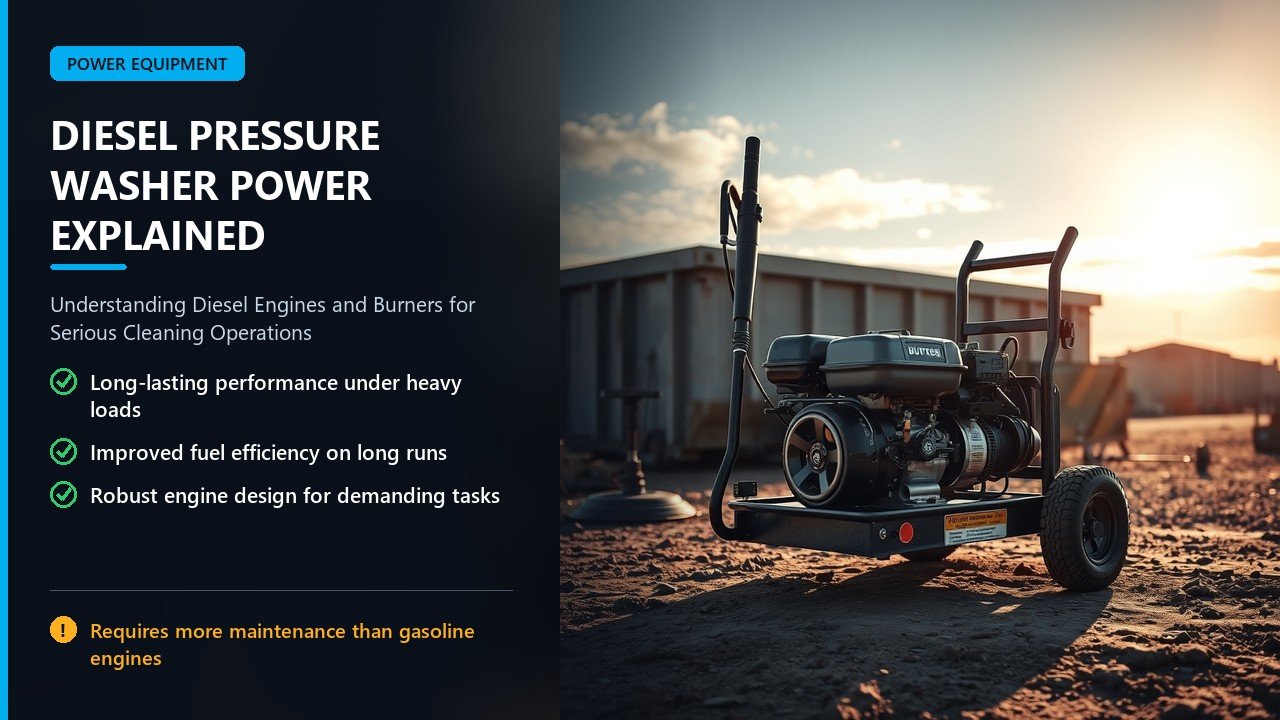
The Two Diesels You Need to Tell Apart
The first thing to understand is that “diesel pressure washer” can mean two very different things, and confusing them leads to bad decisions. A machine can be diesel powered, diesel heated, or both, and each refers to a separate part of the equipment.
Diesel powered means the engine that drives the pump burns diesel fuel. The engine is the power source, doing the same job a gasoline engine does, only with the characteristics that make diesel engines famous: torque at low RPM, long life under load, and better fuel economy on long runs.
Diesel heated means the machine has a hot water burner that fires on diesel fuel to heat the water. The burner is separate from the engine. On many hot water machines, a gasoline engine drives the pump while a diesel burner heats the coil, which is why you cannot judge a machine by the word diesel alone.
So a pressure washer that runs on gasoline can still have a diesel burner, and a machine with a diesel engine can have a gasoline burner or no burner at all. When someone says diesel pressure washer, ask which part they mean. The engine side and the burner side have different costs, different maintenance, and different benefits, and the smartest buyers evaluate each on its own terms.
Diesel Engine Versus Gasoline Engine
If the diesel question is about the engine, the comparison to gasoline is the heart of it. The two engines are not simply different fuels. They are built for different workloads, and the gap shows up most under sustained use.
A gasoline engine is lighter, cheaper upfront, and easier to start in cold weather. It revs higher and produces its power at higher RPM. For intermittent work, a few jobs a day with travel in between, a commercial grade gas engine is an excellent choice and often the smarter one. The weakness appears when the machine runs for hours without rest. Gas engines run hotter, wear faster under continuous load, and typically need major service far sooner than a diesel of comparable output.
A diesel engine is heavier and more expensive, but it produces its torque low in the rev range. That means it holds pressure without straining, runs cooler under load, and lasts far longer before it needs a rebuild. The duel advantage is fuel. Under load, a diesel engine commonly delivers meaningful fuel savings compared with gasoline, and on an operation that burns fuel all day, that savings compounds month after month.
The practical break point comes down to hours. An operator running a handful of hours a day with downtime between jobs gets little from diesel and pays a premium for it. An operator running long shifts several days a week, or an entire crew across multiple machines, steps into diesel’s territory. The more hours the machine runs, the more the diesel’s efficiency and long life outweigh its higher price.
| Factor | Gasoline Engine | Diesel Engine |
|---|---|---|
| Upfront cost | Lower | Higher, often a significant premium |
| Power delivery | Higher RPM | Torque at low RPM, holds load better |
| Fuel efficiency under load | Standard | Better, often by a wide margin |
| Engine life | Shorter under continuous load | Long, often double or more |
| Cold weather starting | Easier | Needs glow plug warm up, gel concerns |
| Maintenance | Simple, common parts | Longer intervals, more complex service |
| Weight | Lighter | Heavier |
| Best duty cycle | Intermittent | Continuous, heavy commercial |
This is not a case of one engine being better in the abstract. It is a case of matching the engine to the duty cycle. The mistake new buyers make is choosing on price alone and then discovering, a season of long days later, that the gas engine is being asked to do diesel work.
Why Diesel Lasts Under Load
The durability of a diesel engine is not marketing. It comes from how the engine makes power. Because a diesel produces strong torque low in the rev range, it can hold the pump’s load without running at high RPM for hour after hour. Lower sustained RPM means less heat, less friction, and slower wear on the moving parts. That is why diesel engines in commercial duty routinely reach service hours that a comparable gas engine would never see.
For a pressure washing business, that longevity has a direct financial meaning. A machine that stays in service is a machine that earns. Downtime for an engine rebuild is not just a repair bill, it is lost jobs and disappointed customers. When you account for the revenue a rig produces, the engine with the longer service life is frequently the cheaper one over its full life, even though it costs more on the day you buy it.
The engine is only half the machine, though, and it is worth remembering that a great engine on a weak pump is still a weak machine. A diesel unit is usually paired with a heavy duty triplex pump, and the pump deserves the same scrutiny, which is why our article on why a diesel engine pressure washer beats ordinary machines looks at the whole package rather than the engine alone.
The Diesel Burner and Hot Water
When diesel refers to the burner, the story is about heat. A hot water pressure washer heats water by pushing it through a steel coil with a burner firing underneath, and diesel is one of the most common fuels for that burner on mobile equipment. Diesel heats water strongly and recovers temperature quickly under heavy use, which makes it well suited to greasy, heavy soil where heat does the work that cold water cannot.
Diesel fired burners share the trail with kerosene, which burns cleaner and produces less soot but delivers slightly less heat. Propane and natural gas appear mostly on stationary machines, and electric heating avoids a combustion fuel entirely for indoor or fume sensitive locations. For a mobile contractor, diesel and kerosene dominate because they are widely available, easy to refuel on the road, and give long run times without swapping cylinders.
The tradeoff with diesel heat is soot. Diesel burns less cleanly than kerosene, especially when the burner is out of tune, the nozzle is worn, or the air intake is restricted. Soot builds up on the coil and acts like a blanket, reducing heat transfer and forcing the burner to work harder for the same result. That is not a deal breaker, but it is a maintenance reality, and it is why diesel heated machines reward a disciplined cleaning schedule. If hot water is central to your work, our guide on how hot water diesel pressure washers clean tough commercial grime goes deeper into the cleaning itself.
A diesel burner can push water temperature well above what cold water cleaning can reach, often into the range where grease and oil liquefy and rinse away instead of smearing. That is why hot water machines shine on restaurant hoods, fleet equipment, engine bays, and any surface coated in oil, food residue, or heavy industrial soil. The heat does the heavy lifting, and the pressure then carries the loosened grime away. On a machine where the engine and the burner both run on diesel, a single fuel source keeps the rig simple to manage.
| Burner Fuel | Heat Output | Cleanliness | Best For |
|---|---|---|---|
| Diesel | High | More soot | Mobile contractors, heavy degreasing |
| Kerosene | Medium to high | Cleaner burn | Operators who want less cleaning |
| Propane | Medium | Clean | Stationary setups, tank refills |
| Natural gas | Medium | Clean | Fixed bays with a gas line |
| Electric heat | Medium | No combustion | Indoor, fume free areas |
Fuel Handling and Storage
Diesel rewards clean fuel and punishes neglect, and most of the trouble owners run into traces back to storage. Diesel can collect water, grow microbes, and degrade over time, especially in a vented tank that sits half empty through changing seasons. Contaminated fuel clogs filters, fouls injectors, and produces poor combustion that shows up as smoke and soot.
The defenses are simple. Keep the tank as full as practical to reduce condensation, seal it against moisture, and use a fuel filter or water separator, replacing the filter before it plugs rather than after. Store diesel in approved containers away from heat and ignition sources, and never mix in the wrong fuel. If the machine sits for extended periods, treat and rotate the fuel rather than letting it age in the tank. On the burner side, a clean fuel filter and a fresh nozzle are the two habits that prevent most soot problems.
Cold Weather Operation
Diesel’s main weakness is cold. In low temperatures, diesel fuel can thicken and gel, which is why northern operators use winter blend fuel or add anti gel treatment, and why a diesel engine needs glow plug warm up before it will start cleanly. A gasoline engine simply does not have that problem, and in a cold climate running winter jobs, that difference is real and daily.
Cold weather also raises the stakes on maintenance. Batteries work harder, fuel is closer to gelling, and a machine left with water in the system risks a cracked pump or heater. Winterizing matters on any pressure washer, but on a diesel rig it is doubly important, because the engine, the pump, and the burner all have parts that dislike freezing. Drain and protect the system before the first freeze, and keep the fuel treated through the cold months. Routine engine and pump care belongs in one schedule, and our guide on power washing preventative maintenance lays out how the pieces fit together.
Maintaining the Engine Side
A diesel engine asks for less frequent attention than a gasoline engine but demands a little more precision when the work comes due. Oil change intervals are typically much longer than on a gas engine, which is one of the hidden savings of diesel ownership. The engine also carries service items a gas engine does not, including fuel filters, injectors, and glow plugs, and keeping those in good order is what delivers the reliability owners paid for.
Beyond the engine, the pump is the part that deserves the most consistent care. Pump oil is the lifeblood of any pressure washer, and letting it run low or dirty is the fastest way to destroy an expensive triplex pump, a point our guide on what type of oil for a pressure washer pump keeps it running explains. Keep the inlet strainer clean so grit never reaches the pump, inspect hoses and fittings, and check mounting hardware for tightness, because vibration works bolts loose over time.
Maintaining the Burner Side
On a diesel heated machine, the burner is a second system with its own schedule. Clean the coil and combustion area on a routine basis, and sooner if heat output drops, smoke appears, or performance feels weak. Soot reduces heat transfer and raises fuel use, so keeping the coil clean is a fuel saving habit as much as a performance one. Check the fuel filter and water separator regularly, and replace the burner nozzle on schedule.
Burner tuning matters too. Air bands set the mix of fuel and air, and a properly tuned burner burns cleanly with no visible smoke. An out of tune burner is the usual cause of white smoke, black smoke, or a strong exhaust smell. The same heater safety rules apply on every machine: keep the burner exhaust away from anything flammable, never run a combustion burner in an enclosed space without ventilation, and obey the manufacturer’s fuel and clearance instructions. Emissions rules may also apply where you operate, and the Environmental Protection Agency publishes guidance on diesel emissions that is worth checking for fleet and municipal work.
Cost of Ownership
The diesel decision is ultimately a math problem, and the math favors diesel only when the machine is worked hard enough. The purchase price is higher, sometimes by a significant margin. But three factors push back the other way. Fuel efficiency under load is better, and on long days that savings is steady. Engine life is longer, which spreads the purchase cost over more hours of service. And maintenance intervals on the engine are longer, which reduces both parts and labor over the life of the machine.
Put together, a diesel unit commonly recovers its premium over a span of months to a couple of years for an operator running full commercial days, and then continues to save money every season after that. For a part time operator running a few jobs a week, the same math does not work, because the machine simply does not run enough hours for the efficiency and longevity to pay back the premium. The dividing line is duty cycle, not ambition.
There is also the matter of standardizing fuel. An operator whose trucks, generators, and compressors already run on diesel gains an operational simplicity from adding a diesel pressure washer: one fuel type across the fleet, one set of storage and safety practices, and one mental model for refueling. That simplicity has a real value that does not show up on a spec sheet.
Downtime is the cost that never appears on a quote and hits the hardest. Every hour a machine spends in the shop is an hour it is not billing, and diesel’s longer service life reduces both the frequency and the severity of those interruptions. Diesel machines also tend to hold their resale value well, because buyers who want one understand exactly what they are getting, which softens the true cost of ownership over the machine’s life.
Who Should Buy Diesel
Diesel suits operators whose work is heavy and continuous. Fleet washing, where rows of trucks and equipment are cleaned on a schedule, is classic diesel territory because the machine runs for long stretches and heat is essential. Municipal and industrial cleaning, mining and agricultural equipment, and large scale commercial degreasing all reward the power, flow, and endurance of a diesel machine.
Gasoline suits the operator who is building a route, working lighter residential and commercial jobs, and running with downtime between stops. A commercial grade gas engine delivers strong power at a lower entry price, starts easily in the cold, and is simpler to service with parts available almost anywhere. There is no shame in starting with gas and upgrading to diesel when the workload genuinely justifies it, and for many operators that is the smart sequence.
There is also a middle path worth naming: a gasoline engine paired with a diesel burner for hot water. That configuration gives you heat, which is often the real reason operators want a diesel machine, without the cost and cold weather demands of a diesel engine. If grease and oil are your problem but your hours are moderate, the mixed configuration can be the best value on the board.
Common Mistakes
- Buying diesel for the wrong duty cycle. Diesel pays back only when the machine runs long hours. For part time work, the premium is wasted.
- Confusing engine fuel with burner fuel. The two are separate systems. Know which part of the machine runs on diesel before you compare machines.
- Neglecting the burner. Soot from an untuned or worn burner quietly robs heat and raises fuel use. Clean and tune on schedule.
- Letting diesel fuel age and absorb water. Poor fuel causes clogs, smoke, and injector trouble. Keep the tank sealed and the filters fresh.
- Ignoring cold weather prep. Untreated diesel gels and a freeze can crack the pump or heater. Winterize without fail.
- Forgetting that the pump still needs oil. A great engine cannot save a pump that is run on dirty or low oil.
- Skipping exhaust and safety rules. Never run a diesel burner in an enclosed space without proper ventilation.
Answers to the Questions Buyers Ask Most
Is a diesel pressure washer worth the higher price?
For operators running long shifts several days a week, yes. Better fuel efficiency, longer engine life, and longer service intervals usually recover the price premium within a couple of years and keep saving afterward. For part time operators running a few jobs a week, a commercial gasoline machine is often the better value.
What is the difference between a diesel engine and a diesel burner?
The engine drives the pump and is the machine’s power source. The burner heats the water for hot water cleaning. They are separate systems, and a machine can have one, the other, or both. A gasoline engine paired with a diesel burner is a common and effective configuration.
Does diesel clean better than gas?
The engine type does not change cleaning power directly. What changes cleaning is water temperature and flow. A diesel burner provides hot water that cleans grease and oil far better than cold water. A diesel engine provides durable power and fuel efficiency, not a different spray.
Can I run kerosene in a diesel burner?
Often yes, and kerosene burns cleaner with less soot, though it delivers slightly less heat. Check your machine’s manual, because burner settings may need adjustment, and never assume a fuel is approved without confirming it with the manufacturer.
How often does a diesel pressure washer need maintenance?
Engine oil change intervals are usually much longer than on a gasoline engine, but the engine adds fuel filters, injectors, and glow plugs to the schedule. The pump still needs regular oil changes and a clean inlet strainer, and the burner needs periodic cleaning, nozzle replacement, and tuning.
Do diesel pressure washers start in cold weather?
They can, but they need glow plug warm up, and the fuel may need a winter blend or anti gel additive to prevent gelling. Gasoline engines start more easily in the cold. In cold climates with winter work, this is a real factor in the choice.
How much fuel does a diesel pressure washer use?
Consumption depends on engine size and load, but diesel is generally more efficient than gasoline under sustained load. The savings grow with hours worked, which is why the fuel advantage matters most to full time commercial operators rather than occasional users.
The Bottom Line
A diesel pressure washer is a purpose built tool for heavy, continuous work. Its engine delivers torque, durability, and fuel efficiency that shine when the machine runs long hours, and its burner, when present, delivers the hot water that grease and oil demand. Neither benefit is free. Diesel costs more upfront, weighs more, needs more complex service, and struggles more in the cold.
The right decision follows the duty cycle. Run the machine hard for long days across many jobs, and diesel’s efficiency and longevity turn its higher price into a lower cost of ownership. Run it lightly with downtime between jobs, and a commercial gasoline machine will serve you well for less. Whatever you choose, remember that the engine and the burner are separate decisions, and that the pump beneath them still needs oil, clean water, and care. Get the configuration and the maintenance right, and a diesel machine becomes exactly what it was meant to be: a workhorse that keeps earning.