Hand Tools in Electricity Work and How to Choose Safe Ones
The hand tools in electricity work are the everyday instruments that electricians and technicians rely on to cut, strip, grip, crimp, and test wiring safely, day in and day out. From insulated screwdrivers to wire strippers and cable cutters, these tools are designed and tested to work on and around live circuits without putting the user at serious risk. Choosing the right ones is therefore a safety decision as much as a practical or financial one.
This guide explains which hand tools belong in electrical work, how insulated tools are rated and tested, how to choose the right tool for each task, and how to inspect, care for, and store them safely. Whether you are an apprentice building a first kit, a professional replacing worn tools, or a homeowner tackling a safe repair, the details below will help you pick tools that protect you and last for years.
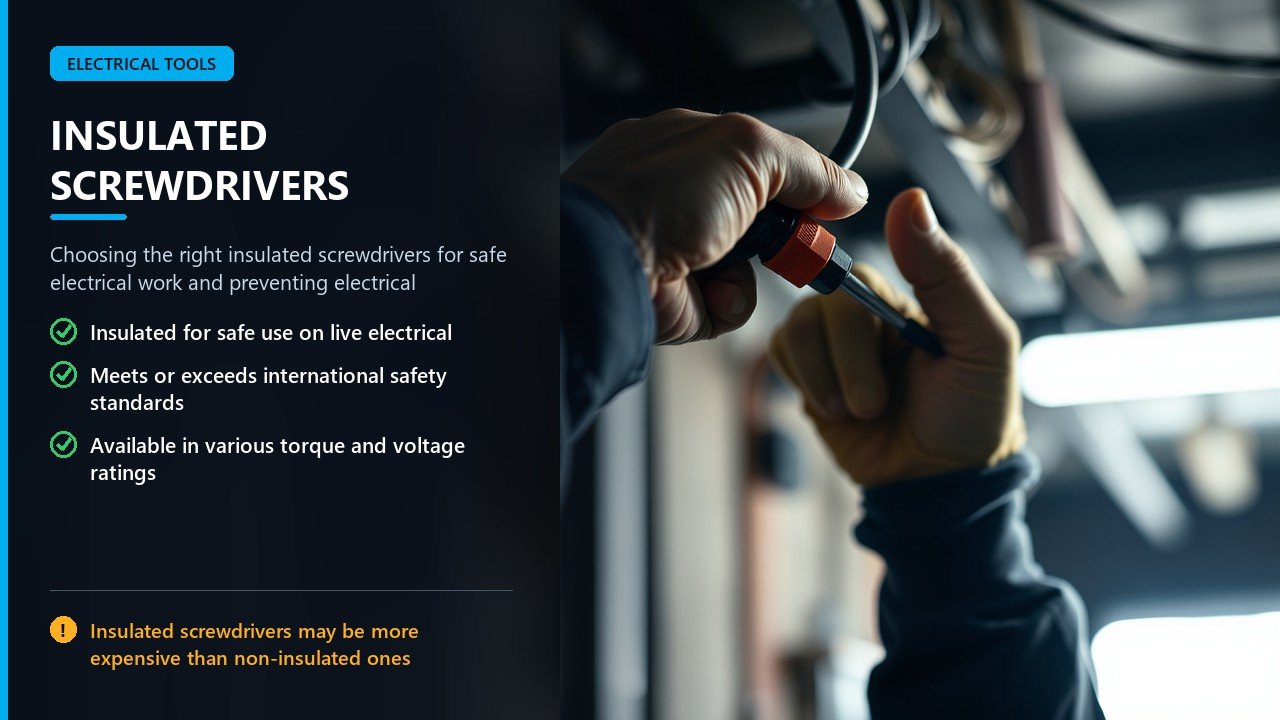
What Counts as an Electrical Hand Tool
Electrical hand tools are the non-powered tools used to work with wires, cables, and electrical components. They include screwdrivers, pliers, cutters, wire strippers, crimping tools, nut drivers, testers, and specialty items such as cable pullers. What sets them apart is that many are insulated to protect the user from electric shock.
Not every tool in an electrician’s bag is insulated. Some, like a hammer or a file, are general tools used during installation. But the tools that touch or approach conductors should be insulated and rated for the voltage being worked on. The difference between an ordinary general tool and a true electrical tool usually comes down to the insulation and its verified rating.
Note: Insulation is not a licence to work carelessly on live circuits at any voltage. Even rated tools should be used with power isolated wherever possible. Insulated tools are a last line of defense, never a substitute for safe working practices, correct procedures, and proper lockout.
Insulated vs Non-Insulated Tools
Insulated tools carry a layer of non-conductive material over the parts that could contact a live conductor. This insulation is tested to withstand a specific voltage, usually 1000 volts for common electrical tools. Non-insulated tools offer no such protection and should never be used on or near live parts.
Insulated tools cost more, but that premium buys protection against accidental contact. For anyone working on or around energized equipment, insulated tools are essential. General tools remain useful for mechanical work and for jobs that are fully de-energized.
| Feature | Insulated Tools | Non-Insulated Tools |
|---|---|---|
| Protection | Rated against shock | None |
| Voltage rating | Typically 1000V | Not rated |
| Cost | Higher | Lower |
| Use on live parts | Allowed with care | Never |
| Best for | Electrical work | Mechanical work |
Common Types of Electrical Hand Tools
An electrician’s kit covers a range of tasks, and each tool has a job it does best. Screwdrivers tighten terminals, pliers grip and bend wire, strippers remove insulation, and cutters trim cable. Testers confirm whether a circuit is live, and crimpers join connectors to wire. Knowing what each tool is for helps you buy the right set.
| Tool | Main Use |
|---|---|
| Insulated screwdrivers | Terminals and fixings |
| Combination pliers | Grip, bend, and cut wire |
| Linesman pliers | Grip and twist conductors |
| Wire strippers | Remove insulation cleanly |
| Diagonal cutters | Cut wire and cable ties |
| Cable cutters | Cut thick cable |
| Crimping tool | Join connectors to wire |
| Nut drivers | Fasten hex nuts and screws |
| Voltage tester | Confirm live or dead circuits |
| Utility knife | Strip sheathing and jacket |
Quality matters more here than in many trades, because a failed tool can expose you to a live conductor. Tools from established makers such as Klein Tools and Wiha Tools are built and tested for this work, and their insulation standards are verifiable.
Voltage Ratings and Safety Standards
Insulated hand tools are rated and tested to recognized standards, most commonly IEC 60900 for tools used up to 1000 volts AC and 1500 volts DC. Tools meeting this standard undergo dielectric tests and impact tests to confirm the insulation will not fail in normal use. A rating stamped on the tool itself is your assurance that it was genuinely tested to that standard.
Never assume a tool is insulated just because it has a coloured handle. Only tools with a stated voltage rating and standard compliance should be treated as insulated. Look for the 1000V marking and the standard reference on the tool, and buy from makers who publish their test results openly.
Note: A 1000V-rated tool is not a guarantee of safety at every voltage or every condition. Ratings apply to clean, dry, undamaged tools used correctly. Damage, moisture, or misuse can defeat the insulation entirely, so treat the rating as a limit, not a promise.
How Insulation Protects You
Electric shock happens when current passes through your body between two points at different voltages, often hand to hand or hand to foot. Insulated tools interrupt that path by covering the metal that could contact a live part. The insulation forces the current to stay in the circuit rather than flowing through you.
This is why the insulation must cover the entire working end, not just part of it. A screwdriver with a bare shaft is useless as an insulated tool, even if the handle is plastic. Full-coverage insulation, tested to standard, is what provides real protection.
| Shock Path | How Insulation Helps |
|---|---|
| Hand to hand | Blocks contact with live parts |
| Hand to foot | Prevents current entering the body |
| Tool to ground | Covers conductive shaft |
| Across terminals | Reduces bridging risk |
Choosing Tools by Task
The best tool for a job depends on the wire, the terminal, and the working space. Strippers must match the wire gauge, crimpers must match the connector type, and cutters must be sized for the cable. Using the wrong tool damages conductors, creates poor connections, or risks injury.
Match the size and type of each tool to the work in front of you. A cable cutter meant for copper may not handle steel, and a crimper for insulated connectors will not work on bare ones. Buy tools designed for the specific connectors and cable you use most, and add specialty tools as your work demands.
| Task | Right Tool |
|---|---|
| Terminate a screw terminal | Insulated screwdriver, correct tip |
| Strip a conductor | Self-adjusting wire stripper |
| Cut thick cable | Ratcheting cable cutter |
| Join a connector | Ratcheting crimper matched to connector |
| Confirm a circuit | Two-pole voltage tester |
Our guide to electric motor types shows how the same attention to matching tools and equipment applies in electrical machinery.
Building a Starter Electrical Tool Kit
A starter kit should cover the common tasks without overloading you with specialty tools. Begin with insulated screwdrivers in the sizes you use, a set of pliers, wire strippers, diagonal cutters, a voltage tester, and a utility knife. Add a crimping tool and nut drivers as your work grows.
Buy quality for the tools you use daily, since cheap tools fail and inexpensive insulation cannot be trusted. A modest kit of well-made, rated tools is far safer and more productive than a large kit of unknown quality. Build up over time, replacing and adding as your work requires.
| Priority | Tools |
|---|---|
| Essential | Insulated screwdrivers, pliers, strippers, cutters, tester |
| Soon | Crimping tool, nut drivers, cable cutter |
| Specialty | Cable puller, torque tools, fibre tools |
Safety Rules for Using Electrical Hand Tools
The first rule is to work de-energized whenever possible. Isolate the circuit, lock it off, and prove it dead with a tester before touching conductors. Insulated tools are a backup, not a reason to skip isolation. Most serious electrical injuries happen because someone assumed a circuit was dead and skipped the step of proving it.
Inspect tools before every use for cuts, cracks, or missing insulation, and remove any damaged tool from service immediately. Wear appropriate personal protective equipment, keep your work area dry, and never use an insulated tool as a pry bar or hammer. Treat every circuit as live until you have proven otherwise.
Note: Never rely on the insulation of a tool that has been dropped, overheated, or exposed to chemicals without inspecting it first. Insulation can be damaged invisibly, and a compromised tool is more dangerous than one with no insulation at all, because it creates false confidence.
Inspection, Care, and Storage
Electrical tools need regular inspection and careful storage. Check the insulation for nicks and cuts, test the moving parts for smooth operation, and clean tools after use. Wipe them down, keep them dry, and store them in a clean bag or pouch rather than loose in a toolbox where they can be damaged.
Damaged insulation cannot be repaired reliably; a nicked tool should be replaced, not taped. Keep a log of inspections for professional work, and retire tools on a schedule as well as on condition. Good care keeps tools safe, extends their working life, and lowers the true cost of ownership over time.
| Check | Action |
|---|---|
| Insulation | Look for cuts, cracks, or thinning |
| Joint or pivot | Ensure smooth movement, lubricate if needed |
| Cutting edges | Confirm sharp, replace if worn |
| Handles | Check for looseness or damage |
| Storage | Keep dry, clean, and protected |
For safe work around wiring and outlets, our guides to 240 volt outlets and wiring and to 220V outlets and circuits show how insulated tools and correct wiring practice go hand in hand.
Materials and Build Quality
Electrical hand tools are built from materials chosen for strength, conductivity, and durability. Pliers and cutters are forged from hardened steel for toughness, while handles are made from materials that resist voltage, heat, and chemicals. The quality of both the steel and the insulation determines how well the tool performs and how long it stays safe.
Look for forged, hardened steel with a smooth, plated finish for the working parts, and injection-moulded, fully bonded insulation rather than a loose sleeve. Insulation bonded to the tool cannot slip off and leave a deadly gap. Build quality is especially important at the jaws and tips, where cheap tools wear quickly and lose their fit.
Handles should feel solid and stay in place under force. A loose or sliding handle is a warning sign of poor construction. When you grip a well-made electrical tool, the handle grips back, and the insulation stays exactly where it belongs.
Insulated Tool Ratings Explained
The voltage rating on an insulated tool tells you the maximum voltage its insulation was tested to withstand. For most hand tools this is 1000 volts AC and 1500 volts DC, under the IEC 60900 standard. Tools that only claim “insulated” without a rating and standard should be treated as unrated.
Rating alone does not mean the tool is safe in every situation. The tests assume clean, dry, undamaged tools used within their design. A wet tool, a damaged one, or one used beyond its stated limit loses its protection. Understand the rating and its limits, and never exceed them.
| Rating Detail | What It Means |
|---|---|
| 1000V AC | Tested for use up to 1000 volts AC |
| 1500V DC | Tested for use up to 1500 volts DC |
| IEC 60900 | International standard for insulated hand tools |
| Test marks | Symbols shown on the tool or packaging |
Materials and Tool Build
Look at how a tool is made, not just what it is made of. Forged steel with a clean finish resists wear, while cheap cast tools chip and round off. Handles should be moulded onto the tool with a comfortable grip and hard, insulating plastic or rubber that does not slide.
Moving parts such as pliers pivots and cutter joints should operate smoothly and stay tight over time. A wobbly joint makes the tool inaccurate and unsafe. Quality materials and construction are what let an electrical hand tool survive daily use and keep its insulation intact.
Torque Tools and Precision Work
Some electrical work calls for controlled torque, especially when tightening terminals to a specification. A torque screwdriver or wrench ensures connections are tight enough to be safe but not so tight they damage the conductor or terminal. Precision tools also matter in small control panels and electronics.
For general work a good screwdriver is enough, but for critical connections a torque tool pays for itself in reliability. Loose terminals overheat and fail, while over-tightened ones strip and break. Match the tool to the connection and follow the manufacturer’s torque values where they are given.
Specialty Electrical Hand Tools
Beyond the basics, electricians use specialty tools for particular jobs. Cable pullers and wire fishing tools help route conductors through walls and conduit. Insulation resistance and continuity testers check circuits, and cable tie guns and jacket strippers speed up installation. Each specialty tool solves a specific problem.
Add specialty tools when a job repeatedly demands them, rather than buying everything at once. A tool that earns its place by saving time or improving safety on every job is worth the cost, while one that sits unused in a bag is not. Let your day-to-day work tell you which specialty tools you actually need before you spend.
| Specialty Tool | Use |
|---|---|
| Cable puller | Route and pull heavy cable |
| Fish tape | Guide wire through conduit |
| Jacket stripper | Remove cable outer sheath |
| Continuity tester | Check circuit paths |
| Torque screwdriver | Controlled terminal tightening |
Hand Tools vs Power Tools in Electricity
Power tools speed up drilling, cutting, and clamping, but hand tools remain central to electrical work because they offer control, precision, and insulation. A drill makes a hole quickly, but a hand tool makes the delicate connection safely. The two work together, not against each other.
Many tasks, such as terminating a small terminal or stripping a fine conductor, are done better and more safely by hand. Power tools are used where they save time, and hand tools where safety and precision matter. A good electrician knows when to reach for each.
Hand Tools and Personal Protective Equipment
Hand tools are one layer of protection, and personal protective equipment is another. Insulating gloves, safety glasses, and flame-resistant clothing add defenses that a tool alone cannot provide. When working near live parts, the tool stops contact and the gloves protect the hand if that contact ever happens.
Choose gloves rated for the voltage you face, and check them for damage just as you check your tools. Glasses protect against flying debris and sparks, and appropriate clothing reduces burn risk in an arc flash. Together, insulated tools and good PPE form a complete, layered safety system.
Working Safely Around Different Voltages
The risk rises with voltage, but even low-voltage circuits can be dangerous in the wrong conditions. Mains voltage in a home can be lethal, and higher industrial voltages carry greater arc-flash hazard. Rated tools protect against shock, while distance, isolation, and correct procedure manage the wider risks.
Always confirm the voltage you are working with and choose tools and PPE accordingly. Never assume a circuit is low risk because it is small. A methodical approach, isolation where possible, testing before touching, and rated tools together keep the work safe at any voltage.
| Voltage Level | Main Considerations |
|---|---|
| Low voltage | Still confirm dead before touching |
| Mains (120 – 240V) | Lethal risk, use rated insulated tools |
| Three phase / industrial | Shock and arc-flash risk |
| High voltage | Specialist procedures only |
Inspection and Maintenance Routine
A consistent routine keeps electrical tools safe and ready. Inspect insulation and moving parts before every job, clean and dry tools after use, and store them protected. For professional work, keep a record of inspections and replace tools on a schedule as well as on condition.
Never repair damaged insulation with tape or heat-shrink and call it safe. A damaged tool has lost its rating and should be retired. This discipline separates a professional kit from a casual one and protects both the user and the reputation of the work.
How Many Tools Do You Really Need
More tools do not automatically mean better work. A focused kit of quality, rated tools covers most electrical tasks, while a drawer full of cheap tools adds confusion and risk. Start with the essentials, add specialty tools as jobs demand, and keep everything in good condition.
Professional electricians often carry a curated bag rather than a huge collection, because they know each tool and trust it. Buying fewer, better tools is a sound strategy in this trade, where quality and safety matter more than quantity. Let function, not fashion, drive your purchases.
Common Mistakes With Electrical Hand Tools
The most common mistake is treating any tool with a plastic handle as insulated. Only tools carrying a valid voltage rating and standard compliance qualify. Using an unrated tool on a live conductor is exactly the risk insulated tools exist to remove.
Another mistake is skipping inspection and continuing to use a damaged tool. A nicked handle or a cut in the insulation voids the protection, and taping over it does not restore the rating. Replace damaged tools at once, and never work around a known defect.
People also use the wrong tool for the job, and this damages both the tool and the conductor. A crimper used on the wrong connector, or cutters used on steel cable, lead to poor connections and premature failure. Match the tool to the task, and the work will be safer and more reliable.
Building Tool Kits by Experience Level
The right kit grows with skill and responsibility. A homeowner doing simple safe repairs needs only a few rated tools, while an apprentice needs a broader set, and a qualified electrician needs a comprehensive, disciplined kit. Matching the kit to the level of work keeps people safe and tools appropriate.
For basic work, insulated screwdrivers, pliers, strippers, cutters, and a voltage tester cover most needs. Apprentices add crimpers, nut drivers, cable cutters, and a bag to keep tools protected. Professionals carry specialty tools and torque instruments for the connections their work demands.
| Level | Typical Kit |
|---|---|
| Homeowner | Rated screwdrivers, pliers, strippers, cutter, tester |
| Apprentice | Above plus crimpers, nut drivers, cable cutter, tool bag |
| Professional | Full rated set, specialty and torque tools, inspection routine |
Cost, Value, and Longevity
Electrical hand tools are an investment in safety, and quality pays off over the life of the tool. A well-made rated tool may cost more than a bargain one, but it lasts longer, performs better, and provides reliable protection. The cost per job is lower for the better tool in almost every case.
Budget for tools as you would for any professional equipment, and replace worn or damaged items without delay. Skimping on insulation is the one saving that is never worth making, because the cost of a shock can be far greater than any tool price. Buy for safety and quality first, and the real value follows naturally over time.
Frequently Asked Questions
What are hand tools in electricity work? They are non-powered tools used on wires, cables, and electrical components, such as insulated screwdrivers, pliers, wire strippers, cutters, crimpers, and voltage testers, along with specialty tools for specific tasks.
What does 1000V insulated mean? It means the tool has been tested to the IEC 60900 standard for use up to 1000 volts AC, so its insulation resists electric shock when the tool is clean, dry, undamaged, and used correctly.
Can I use normal tools for electrical work? Only on circuits that are fully de-energized, proven dead, and locked off. For any work on or near live parts, use tools that carry a valid insulation rating.
How often should I inspect insulated tools? Before every use, and more often on demanding jobs. Check for cuts, cracks, and other damage, and remove any tool with compromised insulation from service immediately rather than taping it up.
Are expensive electrical tools worth it? For daily professional use, yes. Quality and verified insulation protect you from shock, and well-made tools last far longer than cheap ones, so the cost per year is often lower despite the higher price.
Do I need a voltage tester? Yes. A tester is one of the most important tools in electrical work, because it proves whether a circuit is live before you touch it. Never trust a circuit to be dead without testing it yourself.
Final Thoughts
Hand tools in electricity work are more than conveniences or time-savers; they are genuine pieces of personal safety equipment. Insulated screwdrivers, pliers, strippers, cutters, and testers protect you from shock, while quality construction makes the work faster and more reliable. Choosing the right tools, keeping them in good condition, and using them correctly is how professionals stay safe on the job.
Buy rated tools from reputable makers, inspect them carefully before every single use, and always work de-energized where you can. Treat insulation as a last line of defense rather than a first one, and replace any damaged tool without hesitation. Do that, and your electrical hand tools will serve you safely and reliably for many years of work.
Note: For professional-grade tools and equipment, look to established suppliers such as Klein Tools, Wiha Tools, and the broad hand tool range at Grainger. Buying rated tools from trusted sources is the first step in safe electrical work.