Electric Pressure Washer Motor: Universal vs Induction vs Brushless
The electric pressure washer motor is the part that turns electricity into cleaning power, and the type of motor inside your machine shapes almost everything about how it performs. Two washers can carry the same PSI and GPM ratings on the box yet feel completely different, because one uses a cheap universal motor that screams and wears out, while the other uses an induction motor that hums quietly for a decade. Understanding motor types is the key to buying well and keeping an electric washer alive.
This guide explains the three motor families found in electric pressure washers, how each one works, where each one fits, and how to read a motor nameplate so you know exactly what you own. For the wider view of electric machines, our electric cold water pressure washer guide covers the class from the outside in.
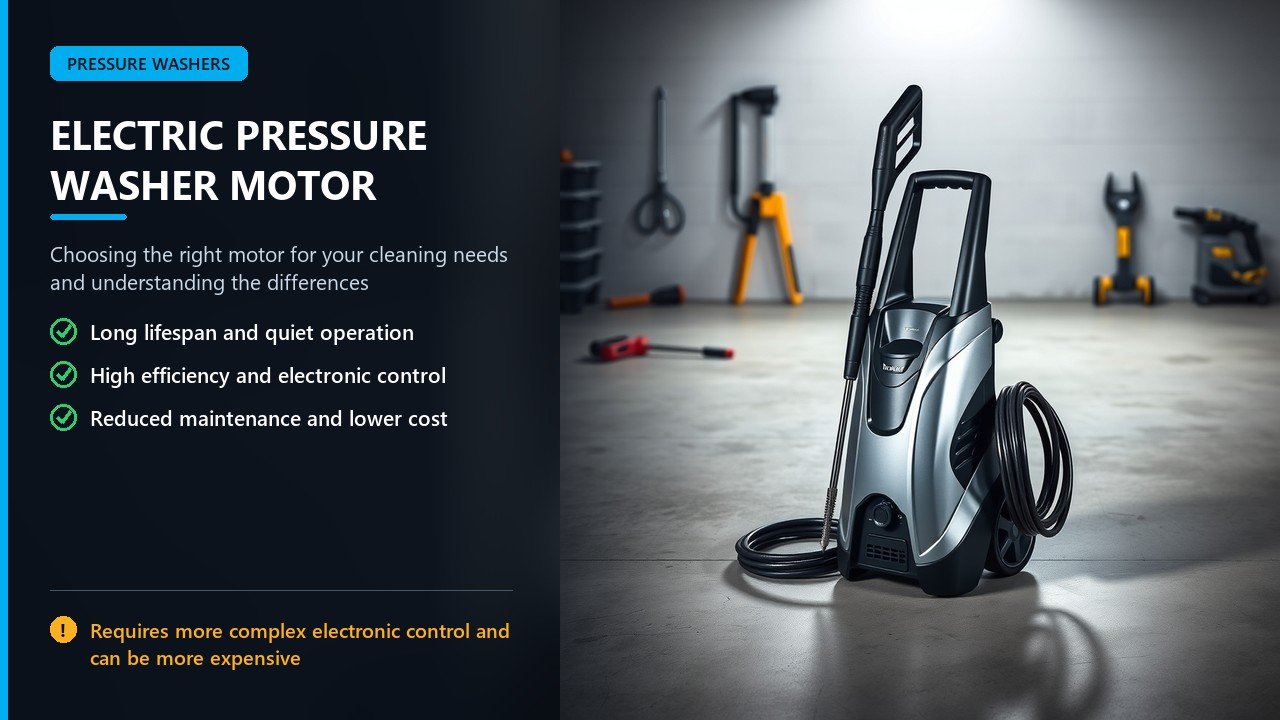
The Three Motor Families
Nearly every electric pressure washer uses one of three motor types: the universal (brushed) motor, the induction motor, and the brushless motor. Each one trades off cost, weight, noise, lifespan, and efficiency differently. Universal motors are cheap and light but loud and short-lived. Induction motors are heavy and expensive but quiet and durable. Brushless motors sit neatly between, offering electronic control and efficiency without brushes to wear out.
Knowing which family a machine uses tells you more about its real quality than its pressure rating. A 2,000 PSI washer with an induction motor will outlast a 3,000 PSI washer with a universal motor in most home settings, because the motor is what fails first. Our guide to motor types, drive, and care expands on this idea.
The Universal Motor
The universal or brushed motor is the workhorse of budget electric washers. It spins very fast, often 10,000 to 20,000 RPM or more, which lets a small, light package produce high pressure. It is inexpensive and easy to make in large volumes, which is why it dominates the sub-$200 market. The catch is that it relies on carbon brushes sliding against a rotating commutator, and those brushes wear down with use.
A universal motor also needs a steady stream of air to cool itself, and it is loud in a way an induction motor never is. Because it breathes air, it is vulnerable to dust and moisture, so it must be positioned away from the spray and never run dry. When a budget washer dies early, it is usually the brushes or the cooling airflow that failed, not the pump itself. Our article on what is really inside an electric washer shows the internals.
The Induction Motor
The induction motor is the premium choice, the same basic design used in industrial equipment for over a century. Instead of brushes, it uses a rotating magnetic field to spin a squirrel cage rotor, so there is nothing to wear out except the bearings and the start or run capacitor. It runs at a fixed speed set by the power line frequency and the number of poles, typically 3,450 RPM for a two-pole motor or 1,725 RPM for a four-pole motor on 60 Hz power.
Induction motors are quiet, smooth, and long-lived, which is why commercial and wall-mount washers favor them. They are also heavier and more expensive, and some need a start capacitor or a run capacitor to spin up. Their steady, lower speed suits the pumps used in better machines and produces far less vibration and noise. The trade-off is upfront cost and weight. Our guide to motor choice and machine lifespan explains why this matters over years.
The Brushless Motor
The brushless motor blends the best of both worlds. Like an induction motor it has no brushes to wear out, but like a universal motor it can be compact and electronically controlled. An electronic controller switches the current to the windings in sequence, using sensors to track rotor position, which means higher efficiency and precise speed control. Brushless motors often carry sealed, water-resistant enclosures rated for wet and dusty conditions.
Brushless motors appear more in battery-powered and premium cordless washers than in corded units, but the technology is spreading. They run cooler and quieter than universal motors and can be throttled electrically for different cleaning modes. The trade-off is a more complex controller that is harder to repair if it fails, though the motor itself tends to outlast a brushed one by a wide margin. Our guide to electric cleaning power touches on where these motors fit.
How the Motor Connects to the Pump
The motor does not drive the pump directly in most cases. Direct-drive electrical machines couple the motor shaft to the pump through a flange, which is compact and efficient but transfers heat from the motor into the pump. Belt drive uses pulleys and a belt to connect them, which isolates heat and vibration and lets the motor and pump each run at their best speed. Better electric washers often prefer belt drive for longevity.
Axial cam pumps are common on budget machines and are usually paired with universal motors, while triplex plunger pumps pair with induction motors on commercial units. The pairing tells a story: if a machine advertises a triplex pump and a quiet motor, it is almost certainly induction-based. Our 3000 PSI electric washer guide covers how motor and pump choices shape performance.
Reading the Motor Nameplate
| Motor | Speed | Lifespan | Best For |
|---|---|---|---|
| Universal (brushed) | 10,000–20,000+ RPM | Short, brush-limited | Light duty, low budget |
| Induction | 1,725 or 3,450 RPM | Very long | Home and commercial use |
| Brushless | Electronically varied | Long, controller-limited | Cordless and premium corded |
The nameplate also lists voltage, full-load amps, horsepower, and the enclosure type. Those details matter as much as the motor family, so take a photo of the plate before you need it for a repair. Our motor troubleshooting and replacement guide shows how to use the plate to source a matching part.
Enclosures and Ingress Protection
How a motor is enclosed decides where it can safely run. An open dripproof (ODP) motor has vents that allow cooling air through, but it is vulnerable to water and dust. A totally enclosed fan-cooled (TEFC) motor has no vents in the housing and uses an external fan to cool the sealed body, so it works in wet and dirty environments. A totally enclosed nonventilated (TENV) motor has no vents and no external fan, relying on the housing to shed heat.
Ingress protection ratings, like IP55 or IP69K, quantify how well a motor resists dust and water. A washdown duty motor takes this further with a 304 stainless housing, oil seals on the shafts, and certification for high-pressure, high-temperature cleaning. Industrial reference materials from suppliers like TECO-Westinghouse and a Baldor TEFC specification lay out the enclosure classes in detail. Our 220V electric washer guide covers the power and enclosure side.
Insulation Class and Service Factor
Two nameplate values tell you how much heat and overload a motor tolerates. The insulation class rates the maximum temperature the winding insulation can withstand: Class B allows up to about 266°F and Class F up to about 311°F, with Class F now common even on fractional-horsepower motors. The service factor, often 1.15, indicates how much a motor can be overloaded continuously without damage. A higher insulation class and service factor mean a motor that survives hot days and tough jobs.
For a pressure washer that runs long sessions, these values matter because heat is the enemy of electric motors. A motor with Class F insulation and a 1.15 service factor has real headroom, while a motor at its thermal limit fails sooner. Reference catalogs from industrial suppliers such as McMaster-Carr list these ratings alongside frame sizes and enclosure types. Our electric versus petrol guide helps you pick the right power source.
Total Stop System and Motor Protection
Better electric washers use a total stop system (TSS) that shuts the motor off when you release the trigger and turns it back on when you pull it. That reduces wear, noise, and power draw during pauses, and it protects the pump from deadheading. On a machine with an induction motor, TSS also avoid the heat that builds when a motor runs continuously against a closed valve.
Look for thermal overload protection, which trips the motor if it gets too hot, and be wary of machines that run the motor constantly even when idle. TSS and thermal protection are simple features that add years to a motor’s life. Our electric cold water guide covers the features worth having. Documented designs from makers such as Mabuchi show how modern brushless motors pair with controllers and sensors for exactly this kind of protection.
Which Motor Should You Choose
For occasional home cleaning, a universal-motor machine is fine if you keep sessions short and never run it dry. For regular use, a machine with an induction motor is worth the extra weight and cost, because it will outlast two or three budget units. For cordless convenience, a brushless machine offers the best blend of efficiency and durability within the limits of battery runtime.
Match the motor to your workload, your budget, and how long you expect the machine to last. If you clean a car and a patio a few times a year, a brushed unit will serve you. If you clean weekly or plan to keep the washer for many seasons, invest in induction. Our motor lifespan guide frames the decision.
Caring for an Electric Motor
Good habits stretch any motor’s life and cost almost nothing. Keep the cooling vents clear on ventilated motors, and never block airflow with a cover or by wedging the machine against a wall. Avoid running the machine in freezing temperatures with a universal motor, since cold stiffens the pump and stresses the windings during startup. Let the motor cool between long sessions, and store the washer under cover so dust and moisture stay out. On induction motors, listen for bearing noise and address it early.
Check the cord and plug for damage, use a GFCI outlet, and never run an extension cord that is too thin for the amperage, because voltage drop under load makes the motor work harder and hotter. Electrical stress kills motors as surely as heat does, and a cheap undersized cord is one of the most common causes of premature failure on electric washers. Our troubleshooting and replacement guide covers the symptoms that point to a failing motor.
Motor Speed and Load Matching
Motor speed and pump design are chosen together by the manufacturer, and changing one affects the other. A universal motor spinning at 18,000 RPM drives a pump with a large gear reduction or a small wobble plate to reach the right pump speed. An induction motor turning at 3,450 RPM couples to a pump built for that speed, sometimes through a belt to slow it further. A mismatched motor and pump either over-speeds the pump and destroys it or under-drives it and loses pressure.
This is why you cannot simply swap in a stronger motor on a whim. The pump’s rated speed, the coupling, and the motor’s torque curve all have to line up. When a motor fails, replacing it with the correct type and rating is essential; a more powerful motor with the wrong speed can damage the pump it drives. Our motor types and drive guide covers the coupling side.
Why Electric Motors Overheat
Heat is the number one killer of electric pressure washer motors, and it usually builds from more than one source. Several things cause it. Running a ventilated motor with blocked vents traps heat inside the housing. Running the machine against a closed trigger without a total stop system leaves the motor churning and the pump deadheading. Low supply voltage forces a motor to draw more current to make the same power, and that extra current becomes heat. Continuous duty under these combined conditions cooks the winding insulation over time.
Cold weather adds a subtler risk. A universal motor needs airflow to cool, and in cold temperatures the pump oil thickens and the load rises, while the motor may be running before it is warm. Letting a machine run dry or at low inlet flow also reduces cooling and can cavitate the pump. The cure is simple: keep vents clear, use TSS or avoid deadheading, and give the motor clean power and a stable water supply. Our troubleshooting guide covers overheating symptoms.
Brushes and Commutator Wear
On a universal motor, the carbon brushes and the copper commutator slowly wear against each other, and this is the part that eventually ends the motor’s life. Brush dust builds up, the commutator surface roughens, and sparking increases until performance drops or the motor fails outright. Some brushes can be replaced, which extends the motor’s life, but many budget washers seal the motor so it is not serviceable.
Signs of brush wear include a motor that struggles to start, runs erratically, or smells of ozone and burning. A machine that has run for hundreds of hours on the original brushes is near the end of its life. Induction and brushless motors avoid this problem entirely, which is why they command a premium. Our inside an electric washer guide shows what brush wear looks like.
Variable Speed and Soft Start
Brushless motors make variable speed practical, letting a washer ramp pressure up and down for different surfaces and soft-start to avoid the current surge that trips breakers. Soft start also reduces mechanical shock on gears and couplings, which extends the life of the whole drivetrain. Some induction-motor machines add soft start through a controller, though it is more common on brushless designs.
For a standard corded washer with a universal or induction motor, speed is usually fixed, and pressure is adjusted with nozzles and an unloader rather than motor speed. That is a design choice, not a flaw: fixed-speed motors are simple, rugged, and reliable. Still, where variable speed and soft start are offered, they can make a machine gentler and easier to control on delicate surfaces. Our motor choice guide weighs the features.
Motors in Wall-Mount and Commercial Machines
Commercial and wall-mount electric washers almost always use induction motors, because they run for hours and demand quiet, dependable power. A wall-mount unit may use a brushless induction motor with a sealed TEFC or washdown enclosure, feed it from a dedicated circuit, and pair it with a triplex pump and a total stop system. The motor is expected to last for years of daily wash-bay use.
These machines often add extra motor protection, including thermal overloads and capacitors sized to the load. When shopping for a commercial electric washer, the motor type and enclosure tell you whether the machine is built for a garage shelf or a busy wash bay. Our electric cold water guide and our 220V guide cover what to expect.
Shock Safety and GFCI
Water and electricity are a dangerous pair, and the motor is where they meet. That is why every electric pressure washer should be plugged into a ground-fault circuit interrupter (GFCI) outlet or use a cord with a built-in GFCI. The GFCI cuts power the instant it senses current leaking to ground, which can prevent a fatal shock. Never defeat or bypass a GFCI to make a washer run.
Inspect the power cord and plug for cracks or damage before every use, and never handle the plug or motor with wet hands. Keep the motor and its electrical parts well away from the spray and from puddles. A grounded, GFCI-protected circuit plus a dry, ventilated motor position is the baseline for safe operation. Our 110V washer guide covers cords and circuits.
Energy Use and Running Cost
Electric motors are efficient, but running cost still depends on horsepower and runtime. A typical home electric washer draws between 10 and 15 amps at 120 volts, which is roughly 1,200 to 1,800 watts. Run for an hour, that is about 1.2 to 1.8 kilowatt-hours of electricity. A commercial 230-volt machine draws more, but it also cleans faster, so cost per job can be lower despite the higher draw.
Total stop systems reduce energy use further by cutting the motor during pauses between passes. Induction motors are generally a little more efficient than small universal motors under load, which slightly offsets their higher purchase price over years of use. For most homeowners, electricity cost is minor compared with the price of the machine and its water and detergent. Our electric versus petrol guide compares total ownership.
Motor Repair or Replace
When a motor fails, you face a choice: repair or replace the machine. On a budget washer with a sealed universal motor, replacement is often the only realistic path, especially if the motor is integral to the pump housing. On a better machine with an induction motor, bearings, capacitors, and sometimes motors themselves can be replaced, making repair worthwhile.
Decide based on the value of the machine and the cost of the part. If the motor is a serviceable component and the pump and frame are sound, a repair is usually cheaper than a brand new washer. If the motor is buried in a molded housing and the machine is inexpensive, replacement is the sane call. Our motor repair and replacement guide walks through the diagnosis.
How Motor Type Shapes Pressure and Flow
Motor type influences what a machine can realistically deliver. A universal motor can reach high pressure in a light, cheap package, which is why budget washers advertise impressive PSI numbers. But that pressure often comes with modest flow, because a small, fast motor and a lightweight pump cannot move a lot of water. The result is a narrow, hard jet that cleans slowly over a large area.
Induction motors, by contrast, are built into machines that balance pressure with flow. Their steady torque suits larger pumps that move more water, so a premium electric washer may clean faster than a cheap one with a higher PSI rating. When you compare electric washers, look at both numbers and consider the motor behind them, because flow is what makes big jobs quick. Our 3000 PSI electric guide shows how the numbers interact.
Buying an Electric Washer: Motor First
When you shop, start with the motor rather than the pressure rating. Ask what type it is, how it is enclosed, and whether it is serviceable. A machine with an induction motor and a TEFC or washdown enclosure signals a builder that expects the washer to last. A machine that only advertises PSI and wattage, with no motor details, is usually hiding a cheap universal motor.
Then match the motor to your routine. Light, occasional use suits a brushed machine. Regular household cleaning rewards an induction machine for its quietness and life. Off-grid or quick jobs suit a brushless cordless unit. Getting the motor right means you will not be replacing the washer every year. Our motor lifespan guide helps you judge value.
Frequently Asked Questions
What type of motor is in most electric pressure washers? Budget units use universal brushed motors, while better and commercial machines use induction motors. Cordless and premium corded models increasingly use brushless motors.
Are induction motors better than universal motors? For pressure washers, yes in most cases. Induction motors are quieter and last far longer because they have no brushes, though they are heavier and cost more.
How do I know if my washer has an induction motor? Induction-motor machines tend to be quieter, heavier, and often paired with triplex pumps. The motor nameplate or manual will state the type and full-load amps.
What does TEFC mean on a motor? Totally Enclosed Fan-Cooled. The housing is sealed with no vents, and an external fan cools it, so it can run in wet and dusty conditions.
Can I replace a brushed motor with an induction motor? Not directly. They need different mounts, controls, and pumps. Motor replacement should match the original type, voltage, and shaft.
How long does an electric pressure washer motor last? A brushed motor may last a few hundred hours, while a well-kept induction motor can last many thousands of hours or a decade of regular home use.
The Bottom Line
The electric pressure washer motor is the true measure of an electric washer’s quality, often more telling than the PSI printed on the box. Universal motors are cheap and light but short-lived; induction motors are heavy and costly but quiet and durable; brushless motors offer efficiency and control. Enclosure type, insulation class, service factor, and total stop protection all refine how well a given motor survives real use.
Read the nameplate, match the motor to your workload, and treat heat and moisture as the two enemies to defeat. Give the motor a stable supply of clean power and water, keep its vents and cooling path clear, and never let it run against a closed valve for long. Do that, and the motor will quietly outlast the pump, the wand, and everything else on the machine, season after season of dependable cleaning.