How to Set Up a Wall Mounted Electric Power Washer Safely
A wall mounted electric power washer keeps the machine off the floor, ready in seconds, and out of the way until you need it. Electric models suit this setup especially well because they make no exhaust, need no fuel, and run quietly, which makes them safe and pleasant indoors. But mounting a powered machine on a wall is not just a matter of screws and a bracket. The electrical supply, the water connection, and the drainage all have to be right.
This guide explains what a wall mounted electric power washer is, why electric suits a wall, and how to set one up safely. It covers the electrical requirements, water and drainage, mounting height, choosing between consumer and commercial units, and the setup, safety, and maintenance details that keep a permanent electric station reliable.
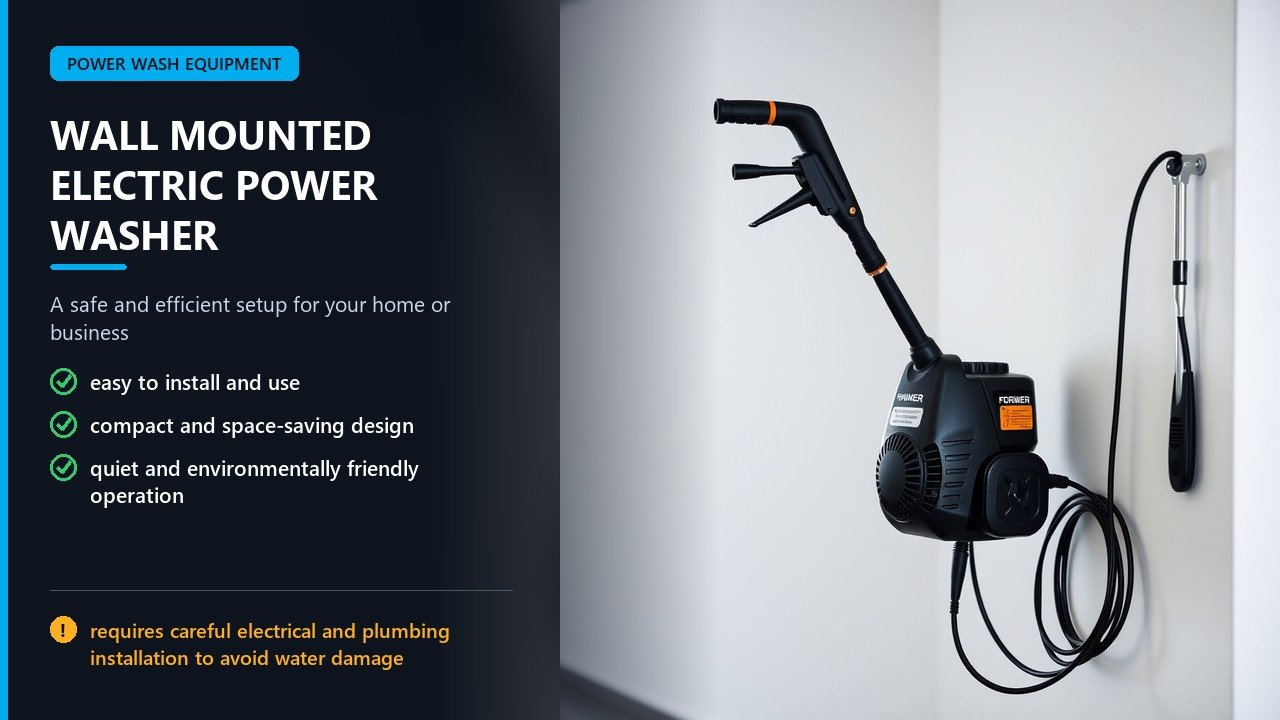
What a Wall Mounted Electric Power Washer Is
It is an electric pressure washer installed on a wall so it stays fixed, powered, and plumbed, ready to clean at a moment’s notice. Some are purpose-built wall units with a remote on/off switch; others are standard portable electric washers hung on a bracket. Either way, the machine leaves the floor and becomes part of a permanent cleaning station.
Electric machines are a natural fit for wall mounting. They have no engine, so no exhaust, no fuel, and no starting; they plug in and run. That makes them quiet, clean, and safe to operate in a garage or shop. The trade-off is that most electric models produce less pressure than gas, which suits car washing, patio cleaning, and light-to-moderate work.
The result is a station where the washer, hose, gun, and nozzles all live together on the wall. For a home garage, that means cleaning is always a few seconds away. For a small shop, it means a tidy, professional setup. Our overview of wall-mounted electric pressure washers covers the category.
Why Electric Works Well on a Wall
The absence of an engine is the main reason. An electric washer has no exhaust to vent, so it can sit on an interior wall without the carbon-monoxide hazard a gas unit would create. It is also much quieter, which matters in a shop or near the house. And it starts instantly with a switch, so there is no pull cord or fuel to manage.
Electric washers are also lighter and more compact, so mounting them is easier and needs less structural support than a heavy gas machine. Their water and power connections are simple, and they are inexpensive to run. For a homeowner who washes cars and patios, an electric wall unit strikes an excellent balance of convenience and capability.
The main limitation is pressure. Most consumer electric washers deliver about 1,300 to 2,300 PSI, enough for vehicles, siding, and furniture but not for heavy stripping. For tougher work, a commercial electric wall unit or a higher-pressure model is the answer. Our guide to choosing a wall-mount electric washer helps you size it.
The Electrical Requirements
Electricity is the part to get right. Most consumer electric washers run on a standard 120V household circuit, but they draw a fair amount of current, so check the machine’s amp rating and make sure the circuit can carry it. A dedicated circuit is ideal, because other loads on the same breaker can trip it mid-job.
Always use a GFCI-protected outlet, especially outdoors or in a garage. Water and electricity are a dangerous mix, and a GFCI cuts power if current leaks to ground. Keep the outlet above the splash zone, and never run the cord through standing water. If the machine is hard to reach, a switched outlet or the unit’s remote switch makes safe control easier.
Larger or commercial electric units may run on 220V or 240V and draw more current. These need a proper circuit and often a qualified electrician, since the wiring and breaker must match. Do not run a high-draw machine on an undersized extension cord, which can overheat. The Grainger wall-mount range shows how voltage and amperage vary across models.
Water Supply and Drainage
Connect the machine’s inlet to a garden hose tap using the adapter for a 3/4” garden hose connector that comes with most models. Keep the supply turned on only when in use, and make sure the inlet screen stays clean. A steady, unrestricted supply protects the pump, which relies on water flow for cooling.
Plan the hose routing so the high-pressure line drops cleanly to the work area without sharp bends. A hose reel on the wall keeps it tidy and prevents kinks. If the machine has a short factory hose, an extension hose reaches the full work area, and the ends must match the machine’s outlet and the gun.
Drainage matters too. Pressure washing produces runoff, so a nearby drain or a sloped surface keeps water from pooling around the machine and the outlet. Never let water sit at the base of a wall-mounted unit, since it stresses the frame and risks the electrical connection. Our guide to the garden hose and quick connect adapters covers the fittings.
Choosing the Mounting Height and Location
Mount the machine so the controls, inlet, and cord are within easy reach, usually around waist to chest height. Leave enough room below for the hose to drop without kinking, and clearance around the machine for airflow and inspection. If you hang the gun and wand nearby, place the holders where you can grab them naturally.
Pick a wall that is structurally solid, near both a power outlet and a water tap, and protected from direct splash where possible. Avoid spots where the machine would sit in runoff or where the cord could trail through water. In a garage, a wall beside the driveway is ideal; in a shop, a wall near a drain suits professional work.
Think through the whole reach envelope before drilling. Height, hose path, and power source all have to work together. A few minutes of planning prevents an awkward station that you dread using. Our guide to pressure washer mounts covers siting in detail.
Consumer vs Commercial Electric Wall Units
Consumer electric washers are affordable, light, and easy to mount, and they suit home cleaning. A model like the Karcher K 5 WCM combines a water-cooled motor, roughly 2,100 PSI, and a compact form that hangs neatly on a wall. It handles cars, paths, and furniture with ease.
Commercial electric wall units are built for daily use. Karcher’s HD Wall Mounted machine, the HD 2.0/14 Ed +, delivers up to 1,400 PSI and 1.8 GPM from a quiet 1,725 RPM motor on 120V, with a steel frame and a remote on/off switch on a 10-foot cord. It is designed for in-shop use and hangs away from backspray. The Karcher HD datasheet lists the specs.
Choose the consumer route for home use and the commercial route for a shop or wash bay. Match PSI, GPM, and electrical requirements to your needs and your building’s power. Our guide to commercial wall-mounted washers helps you decide.
How the Machine Attaches to the Wall
Use a bracket or shelf rated for the machine’s weight, fixed into solid framing, masonry, or proper anchors. Never mount into drywall alone, since the machine is heavy and the hose pulls on it. Some units ship with a dedicated wall bracket; for others, a universal mount or a purpose-built cart-conversion bracket works.
Secure the machine to the mount with all the recommended fasteners, and check the bolts after the first few uses, since vibration loosens them. Leave the water inlet, cord, and switch accessible. If the unit is heavy, get help lifting it into place rather than straining alone.
A wall-mounted electric washer stays put, so the mount must be right the first time. Powder-coated steel brackets with a wide base are best. Our guide to the pressure washer wall mount covers the hardware.
Hose, Gun, and Wand Setup
Set up the hose, gun, and wand to live on the wall. A reel or hook stores the high-pressure hose without kinks, and a holder keeps the gun and wand within reach. Standard 1/4” quick connect nozzles snap on fast, so keep the set in a caddy or rack. If the machine’s outlet differs, an adapter keeps common nozzles usable.
An extension or telescoping wand lets you reach high surfaces without moving the machine, which makes a fixed station nearly as flexible as a portable one. Match the gun and wand ends to the machine so the whole chain connects cleanly and flows freely.
The goal is a station where everything is exactly where you need it, every time. Our guides to the telescoping extension wand and to matching gun and wand help you build it out.
Hot Water and Detergent Options
Most electric wall washers are cold-water only, which suits the majority of home and light commercial work. If you need hot water, choose a unit rated for it and check the temperature limit of the gun, wand, and seals. Hot water improves cleaning on grease and oil but demands heat-rated components throughout.
For detergent, many electric machines draw soap through a suction tube or a foam cannon attached to the gun. A wall station can include a small shelf for detergent and a foam cannon hung nearby. Keep detergent off the machine itself, since spills can damage the housing over time.
Matching the accessories to the machine’s capabilities keeps the station safe and effective. Our guide to the hot-water gun covers the heat-rated choices.
Safety Essentials
Respect the electrical side above all: GFCI outlet, dry connections, no cord in water, and a circuit that can carry the load. Keep the machine out of the splash zone, and never operate it with damaged wiring. Relieve pressure before disconnecting the hose or gun, and lock the trigger when the machine is idle.
Follow the same shutdown routine every session: release and lock the trigger, turn off the water, bleed the line, then switch off the power. Keep hands and feet clear of the spray, wear eye protection, and never point the nozzle at a person. A fixed station is convenient only if it stays safe.
Respect the machine’s pressure and flow ratings, and do not push a light unit beyond its design. Our guide to 220V electric washers covers higher-power setups.
Setup Checklist and Maintenance
Before first use, confirm the bracket is solid, the outlet is GFCI-protected and within cord reach, the water supply is connected and clean, and the hose path is clear. Bleed the air by squeezing the trigger, then run the machine and check every joint for leaks. Lock the trigger when finished and drain the system.
Maintain the station by cleaning the inlet screen, checking O-rings and seals, and inspecting the bracket and fasteners periodically. Protect the machine from freezing by draining it before winter, since trapped water can crack the pump, gun, or hose. Store the hose on the reel and keep the wand and nozzles indoors if the space is unheated.
Follow the manual’s maintenance schedule and the machine will stay ready for years. A wall mounted electric power washer that is set up, powered, and plumbed correctly turns cleaning from a chore into a quick task. Our wall-mounted electric washer guide rounds out the details.
Power Requirements in Plain Terms
Electric washers are rated in volts and amps, and the product is watts, which tells you how much power the machine needs. A typical consumer unit runs on 120V and draws around 13 to 15 amps, near the limit of a standard 15-amp circuit. That is why a dedicated circuit is safer: with nothing else drawing power, the washer gets the current it needs without tripping the breaker.
Commercial electric units may draw 20 amps at 120V or run on 220V or 240V. Higher voltage lets a machine deliver more power on a smaller current, which is why larger electric washers use it. Whichever you choose, the outlet, wiring, and breaker must match the machine. The Grainger pressure washer range lists voltage and amperage across models.
Avoid long, thin extension cords, which add resistance and heat. If the outlet is far from the machine, use a properly rated cord or, better, add an outlet near the station. The cord should stay dry and off the floor, and the outlet should sit above the splash zone. Getting the power right protects both the machine and you.
For homes with limited power, a lower-amperage electric washer is the safer choice, and it still handles car washing and patio cleaning well. Higher amperage and voltage open up more power but demand more from the building. Our guide to 220V electric washers explains what the higher standard buys.
Consumer vs Portable Electric Washers on a Wall
You do not need a purpose-built wall unit to enjoy a wall setup. A standard portable electric washer can hang on a bracket or sit on a wall-mounted shelf, provided the mount holds its weight and the cord and inlet stay reachable. Many owners mount an existing washer this way, pairing it with a hose reel and a gun holder.
A purpose-built wall unit is nicer if you are buying fresh. It is designed to be mounted, often with a remote switch and a compact footprint, so it integrates cleanly. The Karcher HD Wall Mounted machine is the commercial example; consumer Karchers with compact frames are the home example.
The choice comes down to whether you want a machine engineered for the wall or a portable that adapts to one. Both work; the purpose-built unit is simply tidier and, for commercial use, more robust. Our guide to building a clean, ready-to-use wash station shows the payoff.
Getting the Water and Runoff Right
Water supply and drainage make or break a wall station. The inlet should connect to a tap that stays on only during use, with a clean screen to protect the pump. The high-pressure hose should drop cleanly to the work area, and a reel keeps it from kinking or tangling.
Runoff is the other half. Pressure washing floods an area with water, so the station should sit where that water drains away rather than pooling at the machine. A slight slope, a floor drain, or a squeegee routine keeps the base dry. Water sitting against a wall-mounted unit stresses the frame and endangers the outlet.
If your tap is far from the wall, a longer garden hose reaches it without strain on the machine inlet. Protect the hose from being driven over and from freezing. Our adapter guide helps you match the inlet to your tap.
Choosing Power and Pressure Together
Match the machine’s pressure and flow to your work, and its electrical demand to your building. For cars, patios, and furniture, a consumer electric unit around 1,600 to 2,300 PSI is ideal, and it runs on a standard circuit. For a shop that cleans often, a commercial electric wall unit offers the durability and remote control you want.
Higher pressure is not always better. Too much pressure can damage paint, wood, and seals, and a machine that is oversized for the job wastes power and money. The right balance is enough pressure for your worst task without overdriving the surface or the circuit.
Read the machine’s rated pressure, flow, voltage, and amperage together, then compare to your needs and your power. Our guide to wall-mounted electric washers helps you match all four.
Common Setup Mistakes to Avoid
The most dangerous mistake is an inadequate electrical supply: a shared circuit that trips, a non-GFCI outlet, or an undersized extension cord. The second is a mount fixed into drywall or a hollow wall, which can fail under the machine’s weight and the hose pull. The third is mounting so high or low that the controls and hose are awkward.
Other mistakes include leaving the water on when the machine is idle, storing the unit where it can freeze, and routing the hose with sharp bends that restrict flow. Each is easy to avoid with a little planning, and each can shorten the machine’s life or create a hazard.
Plan the power, the mount, the height, the hose path, and the drainage before you drill or plug in. A wall station rewards forethought, and a poorly planned one is frustrating and unsafe. Our mount guide and wall mount guide cover the details.
A Step-by-Step Installation Overview
Installing a wall mounted electric power washer is a straightforward job if you plan the order. First, choose the location and confirm the outlet and tap are within reach. Second, shut off and isolate the power and water before you begin. Third, fix the bracket into solid framing or masonry with the recommended fasteners.
Next, lift the machine onto the bracket with help if it is heavy, and secure it with all the bolts. Connect the water inlet to the tap with the garden hose adapter, and check the inlet screen. Plug the machine into the GFCI outlet, keeping the cord dry and clear of the floor.
Then attach the high-pressure hose, gun, and wand, and mount the reel and holders. Turn on the water and bleed the air by squeezing the trigger before switching on the power. Finally, run the machine and check every joint for leaks, then lock the trigger and switch off. A careful first setup prevents surprises later. Our wall mount guide covers the hardware choices.
Winterizing and Long-Term Care
If the washer lives in an unheated garage or shed, winterizing is essential. Before freezing weather, disconnect the water, drain the hose, gun, and pump, and store the machine where it will not freeze. Trapped water expands when it freezes and can crack the pump, the gun, or the hose, leading to costly repairs.
Follow the manual’s storage steps, which usually include running the machine briefly to expel water and then disconnecting everything. Use the season as a reminder to inspect the bracket, fasteners, O-rings, and hose for wear, and replace anything degraded. Check the cord and outlet for damage as well.
Through the year, keep the inlet screen clean, check seals for leaks, and confirm the mount stays tight. A wall-mounted electric washer that is well cared for stays ready for years, and the small maintenance tasks take only minutes. Our wall-mounted electric washer guide rounds out the routine.
Frequently Asked Questions
What is a wall mounted electric power washer? It is an electric pressure washer fixed to a wall so it stays powered and plumbed, ready to use. It can be a purpose-built wall unit or a portable electric washer hung on a bracket.
Does a wall mounted electric washer need a special outlet? It needs a circuit that can carry its amperage, ideally dedicated and GFCI-protected. Larger 220V or 240V units need proper wiring and often an electrician.
Can I mount any electric pressure washer on a wall? Most can go on a suitable bracket rated for the weight, fixed into solid framing or masonry, as long as the cord and water inlet stay accessible.
Is an electric wall washer as powerful as gas? Usually not. Most consumer electric models deliver about 1,300 to 2,300 PSI, enough for cars, patios, and light cleaning, while gas machines reach higher pressure.
What are the Karcher HD wall-mount specs? The HD 2.0/14 Ed + delivers up to 1,400 PSI and 1.8 GPM from a quiet 1,725 RPM 120V motor, with a steel frame and a remote on/off switch on a 10-foot cord.
Can I use hot water with a wall mounted electric washer? Only if the unit is rated for it. Most electric wall washers are cold-water only; hot-water models need heat-rated seals and plumbing.
How high should I mount an electric power washer? Around waist to chest height so the controls, inlet, and cord stay reachable, with room below for the hose to drop without kinking. Confirm the mount is rated for the machine’s weight.
Do I need a dedicated circuit for a wall mounted electric washer? A dedicated, GFCI-protected circuit is strongly recommended, since these machines draw significant current and a shared circuit can trip mid-job. Larger 220V units require proper wiring and often an electrician.
Final Thoughts
A wall mounted electric power washer is one of the easiest ways to make cleaning convenient, safe, and tidy. Electric suits a wall because it is quiet, exhaust-free, and simple to run, and a permanent station keeps the machine, hose, and tools ready where you work.
Get the electrical supply, the water connection, and the drainage right, mount the unit on a solid bracket at a comfortable height, and set up the hose and wand to live on the wall. Maintain it, protect it from freezing, and respect its ratings, and your wall mounted electric power washer will keep the floor clear and the work moving for years. It is the kind of upgrade that quietly makes every cleaning job quicker and safer.