Hot Water Pressure Washer Gun: Heat-Rated, Insulated, and Safe to Hold
A hot water pressure washer gun is not just any spray gun attached to a heated machine. It is a heat-rated, insulated component designed to handle water at temperatures up to 250 degrees Fahrenheit and pressures up to 5,000 PSI without burning the operator’s hand or failing under thermal stress. Put an ordinary cold-water gun on a hot machine and you invite scalding, weeping seals, and a rupture risk that a machine-rated gun is built to avoid.
This guide explains what makes a hot water gun different, its heat and pressure ratings, how insulation and venting protect you, the materials that survive heat, threads and fit, gun-only versus gun-and-lance combos, safety hardware, matching a gun to your machine, common problems, repair, maintenance, cost, and how to choose one.
Quick Answer: A hot water pressure washer gun is rated for the high temperatures a heated machine produces, typically up to 250 degrees Fahrenheit, and for matching pressure, often 5,000 PSI or more. It uses insulating and vented designs plus heat-resistant materials and O-rings to protect the operator and survive the heat. Never run a gun rated below the machine’s maximum temperature or pressure, or it can scald the user or rupture.
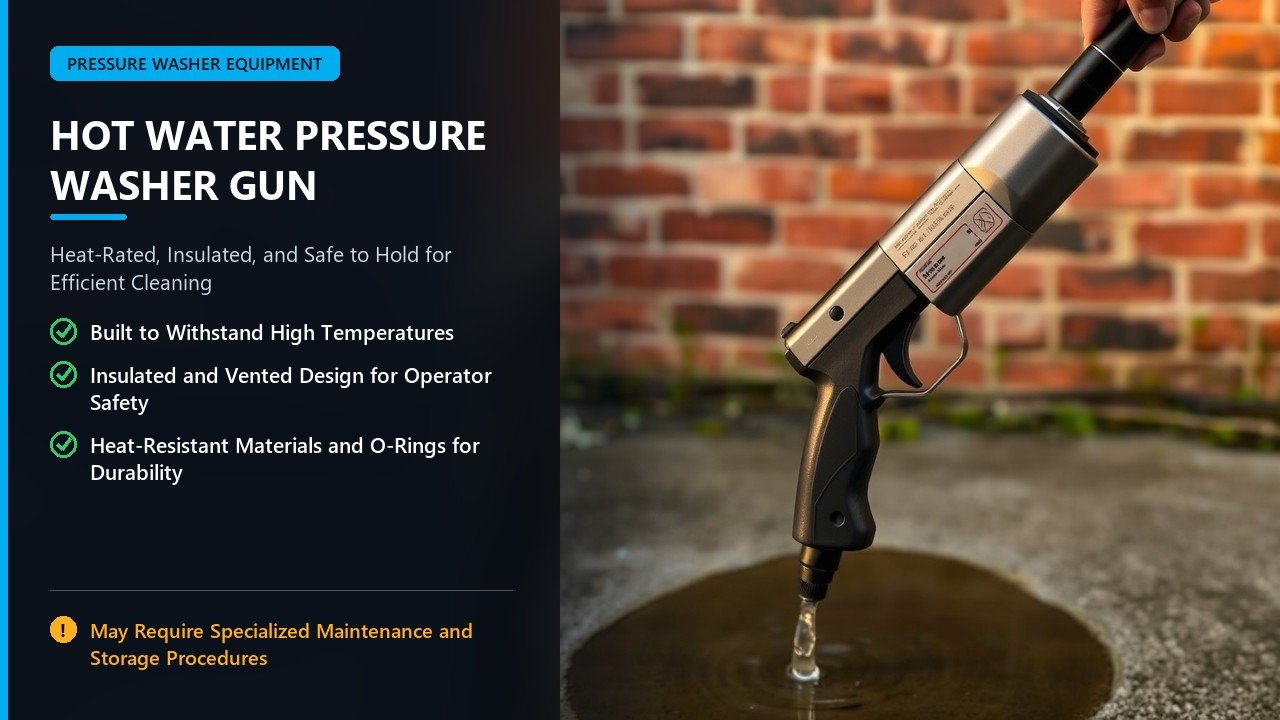
What Makes a Hot Water Gun Different
The defining feature of a hot water gun is that it is built to keep heat out of the operator’s hand and to tolerate it in the flow path. A cold-water gun can carry hot water briefly, but sustained heat attacks ordinary seals and transfers discomfort through the grip. A hot water gun addresses both problems with insulation, a vented body or lance, and heat-resistant sealing materials chosen for the temperature range.
The difference is not cosmetic. Manufacturers warn that no component in the system, including the gun, should be rated below the machine’s maximum pressure and temperature, because a component pushed beyond its rating can burst. On a machine producing 250-degree water, that means a gun explicitly rated to that temperature, not a generic replacement. Our hot water wand guide covers the matching lance side.
Heat Ratings and Pressure Ratings
Every hot water gun carries two critical ratings, and both must meet or exceed your machine’s output. Pressure is measured in PSI with a flow ceiling in GPM; temperature is measured in degrees Fahrenheit. A gun rated higher than the machine is safe; a gun rated lower is a hazard.
| Rating | Typical Hot Water Gun |
|---|---|
| Maximum pressure | 5,000 PSI or more |
| Maximum flow | About 10.5 GPM |
| Maximum temperature | 250 degrees F |
| Inlet | 3/8 inch NPT-F, rear entry |
| Outlet | 1/4 inch NPT-F quick connect |
These are the numbers of units such as the NorthStar hot water trigger gun, rated 5,000 PSI, 10.5 GPM, and 250 degrees F. Higher-rated options exist, including a Simpson hot water gun rated to about 5,075 PSI and 12.0 GPM. The lesson is simple: read both ratings and match them to the machine. Our PSI, GPM, and threads guide explains how the numbers fit together.
Insulation and Venting Explained
Heat protection comes from two design strategies. Insulation places a barrier of low-conductivity material between the hot flow path and your hand, so the grip stays comfortable even when the water inside is near boiling. Venting lets heat escape from the body or lance rather than soaking into the operator, and a vented lance in particular reduces the transfer of heat down the barrel toward the hand.
The combination is what a unit like the NorthStar gun with vented lance describes: a vented design and insulated wand that limit heat transfer to the operator. Without these features, a hot machine makes the gun uncomfortable at best and unsafe at worst. Our comfort and flow guide covers how design affects handling.
Materials That Survive Heat
Hot water guns use materials chosen for thermal and chemical resistance. The housing is often high-impact engineering polymer such as Zytel, which resists heat, chemicals, and jobsite abuse. The sealing O-rings are specifically heat- and chemical-resistant, because ordinary rubber hardens and leaks when repeatedly cycled through hot water. Couplers and internal fittings are stainless steel for corrosion resistance and strength.
These material choices are the quiet reason a hot water gun lasts. A cheap cold-water gun may work for a while on a hot machine, but its seals degrade, it weeps at the swivel, and it fails early. The correct materials are not a luxury on a hot system; they are what make the component reliable. Our ratings and materials guide explores these choices further.
Threads, Couplers, and Fit
Fit is where most replacement frustration lives. Hot water guns commonly use a 3/8 inch NPT-F inlet and a 1/4 inch NPT-F outlet with a quick-connect coupler for the nozzle or lance. The inlet may be rear-entry or bottom-entry, and the choice affects how the hose routes and how the gun balances in your hand. The coupler must be rated for the temperature and pressure, which is why insulated stainless quick-connect couplers appear on hot water guns.
Before buying, confirm the threads on your hose and lance and the entry orientation you want. A gun that does not fit, or that forces an awkward hose routing, is a daily annoyance even if it is rated correctly. Our trigger gun fit and upgrade guide walks through the matching process.
Gun-Only vs Gun-and-Lance Combos
Hot water guns are sold two ways: as a bare gun that accepts your existing lance, or as a gun-and-lance combo with a matching vented, insulated lance. The bare gun is the economical choice if your current lance is already heat-rated and in good condition. The combo is simpler and safer when you are replacing the whole front end, because the lance is guaranteed to match the gun’s rating and to include the venting that reduces heat transfer.
For a machine that runs hot water regularly, the combo is often the better buy, since the vented lance is a genuine safety feature rather than an accessory. If you already own a good insulated lance, a bare gun is enough. Our gun and wand guide helps you decide which pieces to replace.
Safety Hardware and Warnings
Two safety features deserve attention on a hot water gun. The first is the trigger safety latch, which locks the trigger to prevent accidental spray when you set the gun down; on a hot machine, an accidental discharge can scald. The second is the freeze warning: if water freezes inside a gun, it can fail in the open position, and a gun stuck open can whip around dangerously when the machine is started.
Both risks are managed by habits. Use the safety latch every time you set the gun down, and never store a hot water gun with water left inside it in freezing conditions. The NorthStar hot water manual states the freeze-open warning plainly. Our gun problems guide covers what happens when these basics are ignored.
Matching a Gun to Your Machine
| Your Machine | Gun Requirement |
|---|---|
| Cold water only | Standard gun is fine |
| Hot water, 200 degrees F | Heat-rated gun, 250 degrees F or higher |
| Steam-capable machine | Gun rated for the machine’s top temperature |
| 4,000 PSI, 4 GPM | Gun rated well above 4,000 PSI and 4 GPM |
| Frequent heat cycling | Heat- and chemical-resistant O-rings |
The rule is to exceed the machine’s worst case, not merely match its nominal rating. Heat cycling is harder on seals than steady heat, so a margin above the rated temperature pays off. Our heavy duty gun guide covers upgrades for high-pressure machines.
Common Gun Problems With Hot Water
- Weeping or dripping seals. Ordinary O-rings harden and leak under sustained heat; heat-rated seals fix it.
- Hot grip. Without insulation or venting, heat transfers to the hand and makes the gun unsafe.
- Stuck trigger. Heat and scale can bind the trigger mechanism, especially with hard water.
- Failed in the open position. Usually freeze damage; the gun then whips when the machine starts.
- Ruptured body. Caused by using a gun rated below the machine’s pressure or temperature.
- Twisted or kinked hose at the inlet. Wrong entry orientation for the setup strains the connection.
Every one of these traces back to using the wrong gun or neglecting basic care. A correctly rated, insulated gun with heat-resistant seals avoids the majority of them. Our gun parts guide identifies the specific components that wear.
Repair and Replacement
Most hot water gun problems are solved by replacing the offending part rather than the whole gun. Seals, O-rings, and the swivel are common replacements, and trigger and valve assemblies can often be serviced. If the body itself is cracked or the coupler is damaged beyond repair, the gun is replaced. The decision usually comes down to whether the housing and coupler are sound; if they are, a rebuild kit restores the gun for far less than a new one.
When replacing, resist downgrading. A cheaper cold-water gun may save money up front but will fail sooner and carries the safety risk of a rating below your machine’s output. Match the replacement to the original’s ratings, or improve on them. Our replacement gun guide covers the selection.
Maintenance and Storage
Hot water gun care is simple but specific. After each use, flush it, check the swivel and seals for weeping, and store it dry. In freezing weather, drain the gun and lance completely, because trapped water is the leading cause of a gun that fails open. Periodically inspect the O-rings and replace them before they fail rather than after. Keep the trigger and safety latch clean so they operate freely.
These habits keep a hot water gun working through seasons of use. The freeze precaution is the one owners most often skip, and it is the one that causes the most dramatic failure. Our winter storage guide covers the whole machine.
Cost
A hot water gun is an inexpensive component relative to the machine it serves. Bare trigger guns typically cost somewhere in the range of $50 to $100, and gun-and-lance combos a little more, with premium and higher-rated units at the top of that range. Given that the gun is the part you hold and the part that keeps 250-degree water away from your hand, it is a poor place to economize.
A rebuild kit costs less still and restores a sound gun to service. The value question is straightforward: a correctly rated gun protects the operator and lasts, while a cheap substitute risks both safety and early failure. Our spray gun buying guide frames the cost of quality.
Choosing a Hot Water Gun
| Priority | Look For |
|---|---|
| Safety | Temperature rating at or above 250 degrees F |
| Comfort | Insulated grip and vented lance |
| Durability | Heat- and chemical-resistant O-rings, steel coupler |
| Fit | 3/8 inch NPT-F inlet, 1/4 inch outlet, correct entry |
| Convenience | Trigger safety latch, quick-connect coupler |
Match the ratings to your machine, prefer insulation and venting, and confirm the threads and entry orientation before buying. If you are replacing the front end entirely, a gun-and-lance combo removes the guesswork and guarantees the vented lance. Our vented lance guide and hose and gun kit guide finish the picture.
Hot Water Gun vs Standard Gun
Side by side, the differences between a hot water gun and a standard cold-water gun are easy to summarize. The hot water gun costs a bit more and is engineered for heat, while the standard gun is lighter and cheaper but not meant to carry hot water for long.
| Feature | Hot Water Gun | Standard Gun |
|---|---|---|
| Temperature rating | Up to 250 degrees F | Low, cold water only |
| Insulation | Insulated grip and vented body | None |
| Seals | Heat- and chemical-resistant | Standard rubber |
| Housing | Heat-resistant polymer | Standard polymer or metal |
| Cost | Slightly higher | Lower |
The point of the comparison is not that one is universally better, but that they serve different machines. On a cold-water washer, a standard gun is perfectly appropriate. On a hot-water machine, the hot water gun is the correct and safer choice. Our spray gun overview covers the range.
Heat Transfer and Why Ergonomics Matter
Understanding how heat moves explains why hot water guns are shaped the way they are. Heat travels along the metal flow path from the hot water toward anything it touches, including your hand. Insulation blocks that path with a material that conducts poorly, and venting gives the heat somewhere to go instead of soaking into the grip. The shape and position of the grip relative to the inlet also matter, because heat concentrates near the fittings.
Ergonomics and heat protection overlap here. A grip that positions your hand away from the hottest fittings, with an insulating layer and a trigger that is easy to hold, stays comfortable during long hot jobs. A poorly designed gun forces you to grip close to the heat, which becomes a genuine safety concern. Our gun handle and grip guide covers the ergonomic side.
Nozzles and Tips for Hot Water
The nozzle at the end of the gun or lance must also be rated for the heat and pressure, and the tip selection follows the usual logic of matching spray angle to the surface. Hot water adds one consideration: heat plus a concentrated zero-degree stream is unforgiving, so wider angles and restraint are wise on surfaces that heat can damage. Quick-connect stainless tips are the norm on hot water guns.
Because the coupler is part of the hot flow path, it should be an insulated stainless quick-connect rated for the system. Mixing a cold-water coupler or nozzle into a hot system undermines the gun’s protection. Our gun tips guide and nozzle guide cover tip selection.
A Practical Maintenance Checklist
| Check | Frequency |
|---|---|
| Inspect seals and swivel for weeping | After each use |
| Test trigger and safety latch | Before each use |
| Check coupler and nozzle rating | Before each use |
| Replace hardened O-rings | As needed, or annually |
| Drain completely before freezing | Every cold-weather storage |
None of these steps takes long, and together they prevent the most common hot water gun failures. The freeze step is seasonal; the rest are quick checks that fit into the routine of any job. Our gun parts guide details the components behind each check.
Installing and Fitting a Hot Water Gun
Swapping or installing a hot water gun is a straightforward job if you prepare. First, shut down the machine, disconnect the water and power, and relieve any trapped pressure by squeezing the trigger. Then disconnect the old gun from the hose and lance. Before attaching the new gun, check the threads for damage and confirm they match, and wrap Teflon tape or thread sealant on the male threads, keeping the first thread clear so no tape enters the flow path.
Thread the inlet onto the hose by hand first to avoid cross-threading, then tighten. Attach the lance or nozzle and, once everything is connected, run the machine briefly at low pressure to check for leaks before resuming normal work. A leaking swivel or fitting means a loose connection or a damaged O-ring, not a reason to overtighten and crack the body. Our gun and wand guide covers the full process.
Hot Water Gun Upgrades and Accessories
Beyond replacing a worn gun, several upgrades improve hot water work. An insulated or vented lance reduces heat transfer, a swivel reduces hose twist and strain on the inlet, and a longer lance improves reach and keeps you farther from the heat and spray. Quick-connect fittings at both ends speed changes and reduce wear on threads.
For anyone running a hot machine daily, these small improvements add up to real comfort and longer component life. The gun itself is the anchor, but the lance, swivel, and couplers around it shape the daily experience. Upgrade the pieces that most affect heat and handling first. Our gun attachments guide covers the options.
How Gun Design Affects Flow and Pressure
A gun is not a passive handle; it is a valve in the pressure line, and its internal design affects how the machine performs. A restrictive valve or undersized internal passages create pressure drop, so the tip receives less than the pump produces. A well-designed hot water gun keeps the flow path generous and smooth so the rated pressure and flow arrive at the nozzle. This is why a gun rated for high flow, such as 10.5 GPM, matters on a high-output machine: an under-rated gun becomes a bottleneck.
The valve and trigger assembly also determine how the gun feels and how long it lasts. A crisp, low-effort trigger reduces fatigue on long hot jobs, and durable valve components resist the wear that rapid heat cycling accelerates. When choosing a gun, consider not only the ratings but the internal design, because the difference shows up in real cleaning output and in how tiring the work feels. Our comfort and flow guide explores the balance.
Frequently Asked Questions
Can I use a regular pressure washer gun with hot water? Not safely for long. An ordinary gun is not rated for the temperature and will likely have seals that harden and leak, and it may not be insulated against heat transfer. Use a gun rated for the machine’s maximum temperature and pressure.
What temperature are hot water pressure washer guns rated for? Common ratings are up to 250 degrees Fahrenheit, with some higher. The gun should always be rated at or above the machine’s maximum output temperature to avoid scalding and rupture.
Why does my hot water gun get hot to hold? It likely lacks insulation or venting, which are what keep heat from transferring to your hand. A heat-rated gun with an insulated grip and a vented lance solves the problem. Our vented lance guide explains the design.
What threads do hot water guns use? Most use a 3/8 inch NPT-F inlet and a 1/4 inch NPT-F outlet with a quick-connect coupler for the lance. Entry orientation is usually rear or bottom; confirm the fit for your machine.
Why did my hot water gun fail in the open position? Almost always freeze damage. Water left inside the gun expands when it freezes and can jam the valve open, which makes the gun whip dangerously when the machine starts. Always drain the gun before freezing conditions.
Are hot water guns more expensive than cold water guns? Slightly, because of the insulation, vented design, and heat-resistant materials, but they remain inexpensive relative to the machine. The small premium buys safety and longer service life under heat.
Can I convert a standard gun to handle hot water? Generally no. The heat protection comes from the insulation, venting, and heat-resistant seals built into the gun, which a standard gun lacks. Replacing it with a proper hot water gun is simpler and safer than trying to modify a cold-water one.
How do I know if my gun is rated for my machine’s heat? Read the gun’s maximum temperature rating and compare it to your machine’s top output temperature, which is often 200 to 250 degrees Fahrenheit. The gun’s rating must meet or exceed the machine’s maximum, and the same applies to pressure and flow.
Why does my hot water gun leak at the swivel? The most likely cause is a hardened or worn O-ring, which happens faster under heat with standard rubber seals. Replacing the seal with a heat-resistant O-ring usually stops the leak. Loose fittings can also weep and should be tightened by hand first.
Does a hot water gun reduce my machine’s pressure? A restrictive or under-rated gun can create pressure drop and starve the nozzle, so the delivered pressure falls below the pump rating. A gun rated well above your machine’s pressure and flow keeps the internal passages generous and preserves performance at the tip.
How long do hot water guns last? With heat-rated seals and reasonable care, a quality hot water gun lasts for years of regular use. The seals and swivel are the wear items; replacing them periodically restores full service. Running a gun beyond its temperature or pressure rating shortens its life sharply.
Can any pressure washer use a hot water gun? Yes. A hot water gun works fine on a cold-water machine; it simply offers more headroom than needed. The reverse is the problem: a cold-water gun on a hot machine is under-rated and unsafe.
Is a vented lance necessary on a hot water gun? It is not strictly required, but it is strongly recommended and often included with a combo. Venting reduces heat transfer to the operator, making the gun safer and more comfortable during long hot jobs.
Final Thoughts
A hot water pressure washer gun is a small, often overlooked component with an outsized role in safe hot cleaning. It is the part you hold, and it is the part standing between 250-degree water and your hand. Its heat rating, insulation, venting, and heat-resistant seals are not optional extras; they are what make a hot machine safe and comfortable to operate.
Match both ratings to your machine, prefer insulation and a vented lance, use the safety latch, and keep water from freezing inside it. Do that, and the gun quietly does its job for years while the hot water does the hard cleaning work.