Key Start Pressure Washer: Push-Button Electric Start Explained
A key start pressure washer turns the most tiresome part of gas-powered cleaning, the pull cord, into a push of a button. These machines carry a small battery and an electric starter on the engine, so startup comes from turning a key or pressing a button instead of yanking a recoil rope. This guide explains how key start and push-button electric start pressure washers work, which brands offer them, what the batteries and charging involve, and the safety and maintenance details owners need before they buy.
The short version: A key start pressure washer is a gas-powered washer with an electric starter powered by a small onboard battery, usually lithium-ion or AGM, so you start it by key or push button instead of pulling a rope. Generac, Craftsman, and DeWalt all sell models in the 3,000-to-3,400 PSI class. The convenience costs money and adds a battery to maintain, but it removes most of the frustration of cold-starting a gas engine on a winter morning.
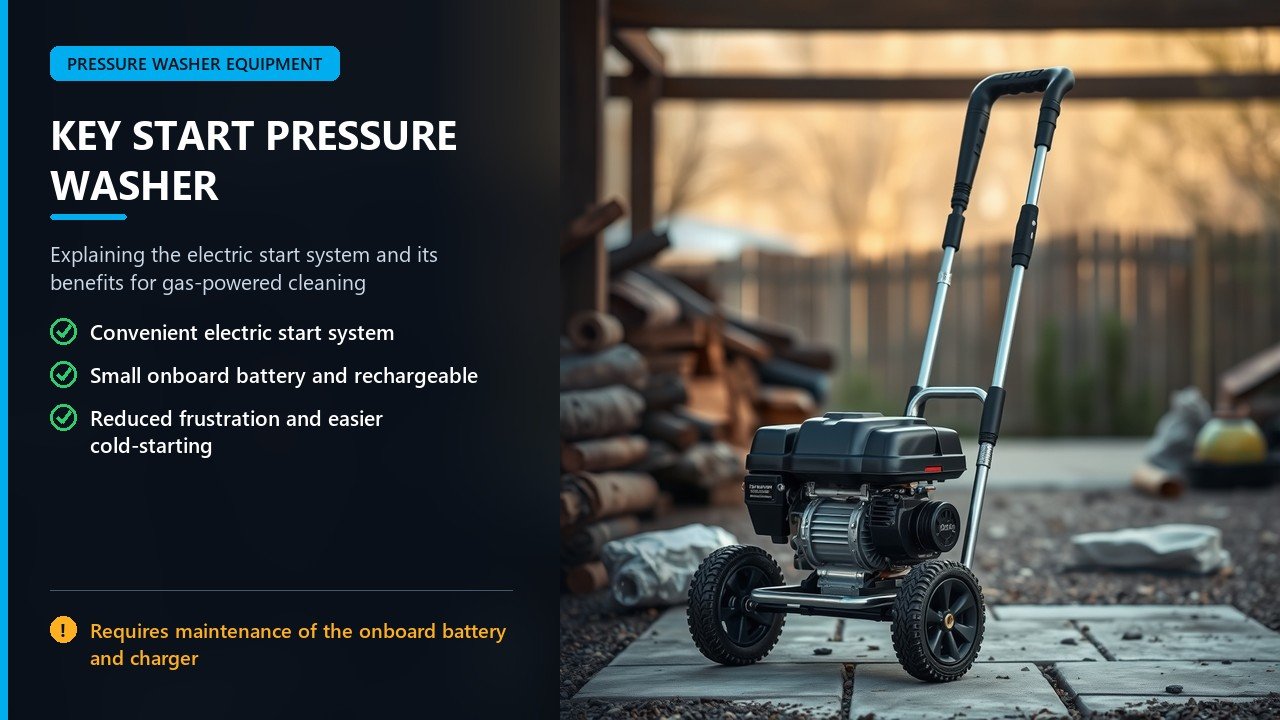
What a Key Start Pressure Washer Is
A key start pressure washer is a petrol pressure washer with an electric starting system added to the engine. Where a standard gas washer starts by pulling a recoil rope, an electric start unit spins the engine with a small starter motor driven by a rechargeable battery, and you trigger it with a key or a push button. Once the engine catches, the battery recharges as the engine runs, ready for the next start.
The appeal is obvious to anyone who has fought a cold gas engine. You skip the choke guessing, the repeated pulls, and the arm-aching starts on a frosty morning. You press a button and the starter cranks the engine for you. That convenience is why the feature is climbing from professional machines into the consumer market, and it is now common on washers in the 3,000 to 3,400 PSI class from brands such as Generac, Craftsman, and DeWalt.
How Electric Start Works
The system sits on top of a standard gas engine. A starter motor engages the flywheel when you turn the key or press the start button, a small battery supplies the cranking power, and the alternator or charging circuit tops the battery back up while the engine runs. Some models also use an automatic choke, which removes the hand-choke step entirely: press the button, and the engine starts, warms up, and runs.
Because the electronics do the choke and crank work, electric start models are easier for a first-time owner. The trade is complexity: a key start washer has more parts than a pull-start model, and the battery is a component you must charge, store, and occasionally replace. For most owners the trade is worthwhile, but it changes how you care for the machine compared with a plain recoil-start engine.
Generac’s Push-Button Electric Start Range
Generac is one of the main names in consumer key start pressure washers. Its 3,100-PSI, 2.5-GPM electric start model uses a one-touch push start, a lithium-ion battery that supports up to 50 starts per charge, and a horizontal-shaft OHV engine that the brand says delivers longer life than typical vertical-shaft engines. It pairs a horizontal axial cam pump with a 25-foot non-marring hose, never-flat wheels, and four quick-change nozzles, and it sells against an MSRP around $500 on the Generac 3100 PSI electric start page.
Generac also sells an upgraded kit version, the G0088950, that adds a PowerDial adjustable gun, a power broom attachment, and a soap blaster to the same electric start platform at a higher price, as detailed on the Generac 3100 PSI electric start kit page. The kit shows how the electric-start convenience is being paired with attachment bundles to compete for homeowners who want one turnkey machine.
Craftsman and Other Push-Button Models
Craftsman brought the same feature to its 3,100-PSI, 2.5-GPM gas washer, pairing a Briggs & Stratton engine with a lithium-ion push-button electric start. The marketing language is consistent across brands: no rope to pull, no choke to fight, just a button for hassle-free starting. At the 3,000-PSI class, electric start is now available from multiple makers, so buyers are not locked into a single brand for the feature.
The spread means you can compare battery type, starts per charge, engine family, pump type, and price across brands before committing. Some models rate the battery in starts, like Generac’s 50 starts, while others simply list the battery chemistry. Whatever the spec, read it before purchase, because battery capacity affects how the machine performs after a long period of sitting between winter uses.
The DeWalt Electric-Start Approach
DeWalt approaches electric start from two angles. Its DXPW3425E is a traditional electric start machine: a 208cc engine with a triplex pump, started by a 12-volt AGM sealed battery with a recoil backup. A water sensor protects the pump by refusing to start the engine if there is no water, and stopping it if the supply fails mid-run. At around $500 with a 2.5-GPM triplex pump, it aims at users who want electric-start convenience with a professional-style pump.
DeWalt’s other approach, the PressuReady system on models like the DXPW3400PR, is a trigger-operated start. The ignition runs on the DeWalt 20V battery system, and the engine fires when you squeeze the wand trigger, then shuts down after a few seconds of inactivity. That hybrid behavior saves fuel and noise between passes, and it is a different philosophy from a key start: the engine runs only while you are actually spraying.
Trigger-Start Systems from Briggs & Stratton
The trigger-start idea is not exclusive to DeWalt. Briggs & Stratton markets Grip & Go, a trigger-activated starting system on its pressure washers: squeeze the gun trigger to start the engine, release it to stop, with no choke or prime step. The engine shuts down when the trigger is released, so the machine is silent and fuel-saving between sprays, as explained on the Briggs & Stratton Grip & Go page.
Trigger-start is worth distinguishing from key start. A key start gives you traditional on-demand engine power with a one-time start; a trigger start couples the engine to the trigger, starting every time you spray. For users who pause frequently, the trigger approach saves gas and cuts noise. For users who want the engine simply to run while they work, a key or push-button start is the more familiar setup, and each type is available now from major brands.
Batteries and Charging
Every key start pressure washer needs a battery, and the chemistry matters. Consumer models tend to use lithium-ion batteries, like Generac’s, which the brand rates for up to 50 starts per charge; DeWalt’s electric start model uses a 12-volt AGM sealed lead-acid battery. Lithium packs are lighter and hold charge longer in storage, while AGM units are cheaper to replace but heavier and more sensitive to deep discharge.
Charging is simple: a cable or charger tops the battery from a wall outlet, and the engine recharges it while running, so in normal use the battery stays topped up. The failure pattern is seasonal. A battery that sits all summer in a shed slowly loses charge, and a deeply drained battery may no longer hold enough power for a cold start in winter. Charge it before storage, or before the first start of the season, and the same fresh-fuel habits that keep any gas pressure washer healthy apply. Our guide to the best gas for pressure washer engines covers the fuel side of reliable starting.
Key Start vs Recoil Start
The honest comparison is cost and complexity versus convenience. A key start washer costs more than a similar pull-start machine, and it carries an additional battery to charge and eventually replace, plus starter components that can fail. A recoil washer is simpler, cheaper, and has nothing to go flat, but it asks your arm to do the work, and cold-start technique matters more to its reliability.
For many buyers the decision comes down to how often the washer is used and who starts it. An older user, or anyone who resents the ritual of choke and cord, is a natural fit for electric start. A buyer who wants the cheapest reliable machine and does not mind a pull start can save money and skip the battery entirely. Neither choice is wrong; the extra cost buys a specific, real convenience.
The 2022 Generac Electric Start Recall
A key start pressure washer is a gas appliance at its core, and one recall shows why the electronics need attention. In April 2022, Generac and DR Power recalled about 53,000 electric start pressure washers because the electronic start/stop button could malfunction and self-start, posing a carbon monoxide risk if the machine ran in an enclosed space. The affected units included models such as the DPW3100DEN and DR Power PRO 3100, and the state notice covering the recall is published by New York State at the Division of Homeland Security and Emergency Services recall page.
The remedy was a free dealer replacement of the start/stop switch, and owners were told they could keep using the machine on pull start with the battery removed while they waited. The lesson for any buyer of a used key start washer is to confirm the model is not on a recall list and that any recall repairs have been done, and for all owners the lesson is simple: never run a gas pressure washer indoors, with electric start or not.
Maintenance and Battery Care
Caring for a key start washer is the care of the gas engine plus the care of the battery. Keep the battery charged, especially between seasons, and replace it when it no longer holds a start. Store the machine with the battery out if the manual says so, charge it before first use, and do not let it sit dead through summer, because deep discharge is what kills starter batteries.
The rest is standard gas-engine maintenance: fresh fuel, clean oil, a clean air filter, and a clear water system. The starter motor solves cold-start effort, but it does not solve stale fuel or a clogged jet, so the habits that keep any pressure washer engine starting are still required. Our guide to gas engine maintenance and safety is directly relevant to a key start machine.
Troubleshooting a Key Start Washer That Won’t Start
When a key start pressure washer refuses to start, check in order: the battery, the fuel, and the choke. If the starter cranks slowly or not at all, the battery is flat or failing, so charge it or jump it to test. If the starter spins but the engine will not fire, the issue is fuel-related, stale gas, a blocked jet, or a fuel valve off, not the starting system.
If the button does nothing at all, check the connections and the safety interlocks, and remember most electric start engines include a recoil backup. If the battery is dead and you need the machine now, the pull cord is still there, exactly as Generac advised during its recall. A key start washer is convenient, but it rarely leaves you stranded, because the manual starter remains as a fallback.
Who Should Buy a Key Start Pressure Washer
A key start washer suits anyone who values easy starting more than the lowest price. It is ideal for owners who use a gas washer occasionally and find the pull-start ritual frustrating, for older users who want less strain, and for anyone who simply wants the machine to start when they press the button, choke managed automatically. It is also a good fit for pro-style users, like those choosing the 5.5-GPM electric start class, who want to begin work without a warm-up chore.
It is less suited to the bargain buyer who will accept a rope pull to save money, or the owner who already handles recoil-style engines without complaint. The premium is real, but so is the feature. Weigh the extra cost against how much you dislike starting a gas engine, and buy the level of convenience you will actually use.
A useful test is to ask who will start the machine on the coldest day of the year. If that person is you, early in the morning, with frost on the handle and a list of chores waiting, the push button will feel like the best money you spent on the washer. If the washer lives beside the tap and starts on the second pull every time, electric start is a luxury you can skip. Match the feature to the reality of how the machine gets used.
Costs of Key Start Models
Electric start adds a meaningful premium to a pressure washer. Generac’s 3,100-PSI electric start model lists around $500, and its kit with attachments around $589, while comparable non-electric 3,000-PSI machines from other brands often sell for appreciably less. DeWalt’s electric start 3,400-PSI model sits near $500 for the machine. The premium goes toward the battery, starter, and automatic choke hardware.
Consider what the extra money buys before you spend it. The difference between a $379 pull-start 3,000-PSI washer and a $500 electric start equivalent is battery and convenience, not cleaning power, since both clean with similar PSI and GPM. If the money would otherwise buy a triplex pump or a longer hose instead of a starter, and you do not mind the cord, the pull-start machine may serve you better. Our guide to push-button, trigger, and recoil start options compares the three starting styles directly.
Safety
The safety rules for a key start washer are the safety rules for any gas pressure washer, with two additions. First, never run the engine in an enclosed or partially enclosed space, even with electric start, because the carbon monoxide risk is exactly what the Generac recall highlighted. Second, be aware that an electric start system can fail in unexpected ways, including self-starting, which is why recalls matter and why the machine should be shut down and stored properly.
Beyond that, respect the spray: keep hands and feet clear of the nozzle, relieve pressure before disconnecting hoses, and never point the gun at a person or pet. Store the washer with fuel stabilized and the battery managed, in a dry, ventilated space. A key start washer is a convenience, but the jets, exhaust, and fuel are still handled with the same respect any gas-powered machine commands.
Key Start vs Electric Start vs Trigger Start
Brands use several names for engine startup, and the terms overlap. Key start usually means a physical key you turn to crank the engine, the classic approach. Push-button or one-touch start replaces the key with a button and is now the most common consumer format, as on Generac’s models. Electric start is the umbrella term for any system that cranks the engine with a battery rather than a rope.
Trigger start is a genuinely different idea: instead of a key or button, squeezing the wand trigger fires the engine, and releasing it stops it, as with DeWalt PressuReady and Briggs & Stratton Grip & Go. Different brands pick different names, so read the description rather than assuming. What matters is whether the engine starts by battery power, and how it is triggered, because that determines cost, battery care, and whether a recoil backup is included.
Engine and Pump Considerations
Electric start adds the starter but does not change the rest of the machine, so engine and pump quality still decide how well a key start washer cleans. Horizontal-shaft engines, which Generac promotes on its electric start models, are the standard for durability in this class, and they are the same engines found in non-electric pressure washers and other equipment. The starter simply bolts to a proven engine design.
Pump choice separates value machines from pro-style ones. Consumer electric start models typically use an axial cam pump, which is affordable and fine for occasional use. DeWalt pairs its electric start with a triplex pump on the DXPW3425E, a step up that is rebuildable and better suited to regular, demanding work. Look at the pump, not just the starting system, and know why a triplex beats an axial cam if you plan to use the washer heavily.
Portability, Tires, and Setup
A key start washer is still a gas machine, and its weight and wheels decide how easy it is to move around the property. Generac fits never-flat wheels that handle rough terrain and stairs, while DeWalt uses 10-inch pneumatic tires on its electric start model for jobsite movement. Battery weight is modest on lithium systems, so the machine’s portability is about the frame, tires, and overall weight rather than the starter.
Setup follows the same pattern as any gas washer: assemble the handle, add engine oil, connect the garden hose and high-pressure hose, and prime before first start. The extra step with electric start is charging the battery before the first use, since a new battery often ships without a full charge. Keep the charger with the machine, charge it the evening before you plan to wash, and the push-button start will work the first time.
Where Electric Start Adds the Most Value
Electric start earns its price differently for different buyers. For occasional users, it removes the single most discouraging part of a gas washer, cold-start effort, which means they actually use the machine instead of dreading it. For professional-style users, it turns a 4,000-PSI push-button class machine into equipment you can start and get to work instantly, which matters when every job begins with the same chore.
The pro end of the market shows the value clearly. The 4000-PSI electric start class exists because professionals want high pressure without a starting ritual, and the same logic runs all the way down to the 3,000-PSI homeowner machines. Whether you clear driveways once a month or wash equipment daily, the button press is the same small luxury; the frequency of use just changes how often you enjoy it.
Frequently Asked Questions
What is a key start pressure washer? A gas pressure washer with an electric starter powered by an onboard battery, so the engine starts by key or push button instead of a pull cord.
Are key start pressure washers worth it? For owners who find pull-starting difficult or frustrating, yes, because they start with a button and often handle the choke automatically. They cost more and carry a battery to maintain, so the value depends on how much the convenience matters to you.
How long does the battery last on an electric start washer? That depends on chemistry and care. Brands rate batteries in starts, such as Generac’s roughly 50 starts per charge, and the charge tops up while the engine runs. A battery left dead through storage will not last long, so keep it charged between uses.
Can I still pull-start a key start pressure washer? Most electric start machines keep a recoil backup, so if the battery fails you can still start the engine by hand. Check the manual for your model to confirm the pull-start is available.
Do I need to do anything special before winter? Keep the battery charged and stored per the manual, use stabilized fuel, and winterize the pump so water does not freeze in it. The battery care is the main thing electric start adds beyond standard gas washer winter storage, as covered in our winter storage guide.
Why is my electric start pressure washer not turning over? A slow or silent crank usually means a flat or failing battery, so charge or jump it to test. If the engine cranks but will not fire, the fault is fuel, not the starter. A dead button with a good battery points to a connection or switch issue, and the recoil backup gets you running meanwhile.
Can I replace the battery with a different type? Use the battery the manufacturer specifies, because the charging circuit is matched to that chemistry. Substituting a different voltage or type can damage the starter or the charging system. When the original wears out, fit the recommended replacement, or an equivalent the maker lists as compatible.
Final Thoughts
A key start pressure washer delivers the one upgrade that changes how a gas machine feels every single time you use it: it starts when you ask it to. The battery, the automatic choke, and the push button replace the cold-morning ritual of pulling a cord, and brands like Generac, Craftsman, and DeWalt have brought the feature to the 3,000-to-3,400 PSI class at consumer prices.
Buy one for the convenience, budget for the battery, and follow the same fuel, storage, and safety discipline as any gas pressure washer. The starter solves the starting problem, but fresh gas, a charged battery, and a ventilated location still decide whether the machine runs well and safely for years. For the right owner, pressing a button and hearing the engine fire is worth every extra dollar, and the machines only get easier to start as the technology spreads.