Electric Start Pressure Washer 4000 PSI: Push-Button Power at the Top End
An electric start pressure washer 4000 PSI is the top of the consumer and light-commercial gas class with one comfort upgrade that changes daily ownership: you start it with a button or a key instead of yanking a recoil cord. At 4,000 PSI the machine is already a serious tool with a big engine and a triplex pump. Electric start makes that tool easier to live with, especially on cold mornings when a pull cord is at its worst.
This guide explains what electric start adds at the 4,000 PSI level, how the system works, the engines and pumps it pairs with, the specs to expect, the cold-weather advantage, battery care, the correct starting procedure, how it compares with recoil-only machines, cost, common mistakes, and how to choose one.
Quick Answer: A 4,000 PSI electric start pressure washer pairs a 338cc to 420cc gas engine with a commercial triplex pump and a battery-driven starter motor. You turn a key or push a button to start it, usually with a recoil cord kept as backup. Expect 3.5 to 4.0 GPM, cleaning units of 14,000 to 16,000, and prices from roughly $1,000 for a cold-water unit to $4,000 or more for hot water.
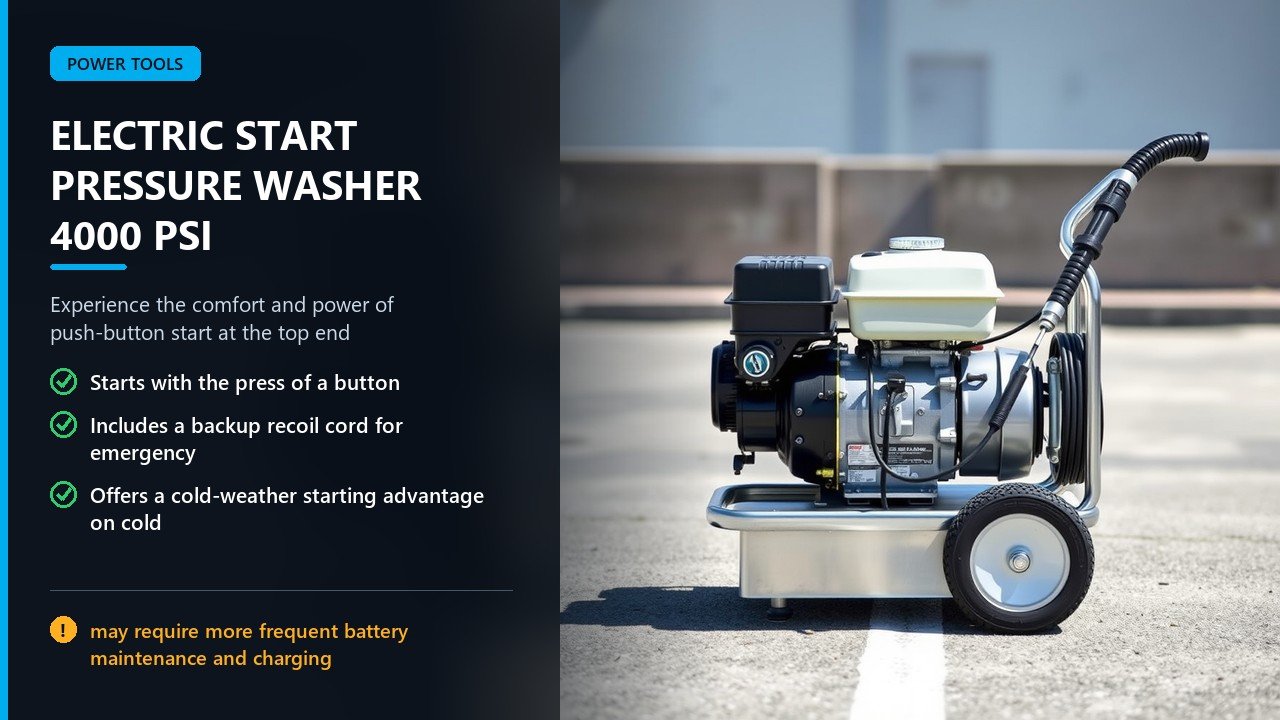
What Electric Start Means at 4000 PSI
Electric start is exactly what it sounds like: a starter motor powered by a small battery cranks the engine for you. Instead of pulling a rope against compression, you flip a switch and press a button or turn a key, and the starter spins the engine until it fires. At 4,000 PSI, the engine is large enough that this matters more than on a small machine, because big single-cylinder engines have more compression and take more effort to pull, particularly when cold.
The upgrade is not about power or cleaning performance; a 4,000 PSI machine cleans the same whether it starts by cord or button. It is about convenience, consistency, and reduced effort. For anyone who has wrestled a stiff recoil cord in freezing weather, that difference is the whole reason the feature exists. Our easy start guide covers the broader family of starting systems.
The 4000 PSI Class in Brief
Before discussing the starter, it helps to know what a 4,000 PSI machine is. This is the top of the portable class and the entry point of professional work. These units pair a large gas engine, typically 338cc to 420cc, with a commercial-grade triplex pump, and they deliver 3.5 to 4.0 gallons per minute at full pressure. The pressure and flow together produce cleaning units (CU) of 14,000 to 16,000, enough for concrete, paint preparation, and heavy commercial grime.
Machines in this class are substantial: 120 to 150 pounds, on large pneumatic tires, with 50-foot steel-braided hoses. They are portable in the sense that one person can move them, not in the sense that they are light. Our 4000 PSI commercial guide covers the class in detail.
What Electric Start Adds
- Effortless cold starts. The biggest win. No fighting a stiff cord on a cold engine.
- Consistency. The starter cranks at a reliable speed every time, which helps engines fire promptly.
- Physical ease. Valuable for older users or anyone who cannot pull hard against compression.
- Speed. Press and go, which matters when you are starting and stopping across a jobsite.
- Backup confidence. Most electric start units keep a recoil cord, so a dead battery never leaves you stuck.
None of these change how the machine cleans, but together they change how pleasant it is to own. At the 4,000 PSI level, where the machine is heavy and the engine is large, the comfort upgrade is proportionate to the effort it saves. Our easy start power washer guide explains why gas engines are the hardest to start.
How the Electric Start System Works
The system has four parts: a battery, a starter motor, an ignition switch, and the wiring that ties them together. The battery is usually a 12-volt sealed lead-acid or AGM unit, sized to crank the engine and often around 55 amp-hours on larger machines. When you turn the key or press the button, current flows to the starter motor, which engages the flywheel and spins the engine. The ignition fires, the engine catches, and you release the switch.
Many machines retain a recoil starter as a manual backup, so if the battery is flat you can still start the engine the old way. That redundancy is a genuine safety net on a jobsite. The Simpson manual for its electric-start units documents the layout plainly: a starter button, an engine starter motor, a battery harness connector, and a recoil alongside, as the Simpson use and care manual shows.
Engines and Pumps That Pair With It
The engines at this level are proven workhorse designs. The Honda GX390, a 389cc overhead-valve engine, is a common choice, and larger 420cc engines from Briggs & Stratton, Powerease, and others fill the same role. These are horizontal-shaft engines built for long service and reliable starting, which is why they dominate professional pressure washers. Our GX390 guide covers the most common of them.
The pump is a commercial triplex, with three ceramic plungers and the durability to sustain high pressure for hours. Brands like AR, Cat, General, and AAA appear across this class. A triplex pump is what separates a 4,000 PSI machine from an axial-cam unit that would not survive the duty; our triplex pump guide explains the difference. Typical pairings include the BE Power HW4015RA, a 4,000 PSI hot-water unit with a Powerease 420cc engine, electric start, and an AR triplex pump, and the Briggs & Stratton Elite 4000, which uses a 420cc engine and a triplex pump.
Specs to Expect
| Spec | Typical Range | Notes |
|---|---|---|
| Pressure | 4,000 PSI | Top of the portable class |
| Flow | 3.5 to 4.0 GPM | More flow, faster cleaning |
| Engine | 338cc to 420cc | Honda GX390, Briggs 420cc, Powerease |
| Pump | Commercial triplex | AR, Cat, General, AAA |
| Starting | Electric start, key or button | Recoil often retained as backup |
| Battery | 12V sealed lead-acid or AGM | Around 55Ah on larger units |
| Weight | 120 to 150 lbs | Plus battery weight |
The numbers confirm the class: the 4,000 PSI and 3.5 to 4.0 GPM figures are what place these machines above homeowner tools, and the large engine is what makes electric start worth having. Our 4000 PSI 4 GPM guide explains how pressure and flow combine into cleaning power.
The Cold-Weather Starting Advantage
The single best argument for electric start is winter. Cold thickens engine oil, stiffens the recoil rope, and makes compression feel heavier, so a pull-start engine is hardest to crank exactly when you most want it running. A starter motor cranks at a consistent speed regardless of temperature, which often starts a cold engine more reliably than a tired human pull.
For anyone who works in cold climates or stores equipment in an unheated shop, this is a real operational benefit, not a gimmick. It also reduces the strain and frustration that make people avoid using a machine. Pair the feature with proper cold-weather fuel and oil practices, and starting is no longer a chore. Our fuel guide covers what keeps engines firing in the cold.
Battery Care and Charging
The battery is the one part of an electric start system that needs periodic attention. Keep it charged, and it will crank the engine for years; neglect it, and you will be pulling the recoil cord after all. The practical rules are simple. Charge the battery before long storage, never store it discharged, and top it up periodically if the machine sits for months. Some units include an onboard charger or maintainer, and small lithium-ion batteries on lighter machines behave similarly.
For machines like the Generac 3100 PSI electric start unit, the manufacturer specifies a lithium-ion battery good for about 50 starts and includes a charger. Larger 4,000 PSI machines use heavier lead-acid or AGM batteries that simply need to be kept charged. Store the battery cool and dry, and recharge before the season begins. Our winter storage guide covers seasonal battery and engine preparation.
Starting Procedure Done Right
An electric start engine still follows the same cold-start ritual as any gas engine, just with a button instead of a cord. The steps are consistent across manufacturers.
- Connect the battery. Confirm the battery harness is plugged into the engine wiring harness.
- Check fluids and fuel. Oil at the right level, fresh fuel in the tank, fuel valve open.
- Set the choke. Move the choke to the cold-start position for a cold engine, or to run for a warm one.
- Press the start button or turn the key. Hold until the engine catches, then release.
- Open the choke as it warms. Move the choke toward run as the engine smooths out.
- Fall back to the recoil if needed. If the battery is flat, use the manual backup.
This is exactly the sequence the Simpson manual describes, with the electric start push button replacing the recoil pull only at the starting step. The habit that matters most is setting the choke correctly for engine temperature, cold or warm. Our GX390 setup and troubleshooting guide walks through the same procedure for the most common engine in this class.
Electric Start vs Recoil Only
The trade-off is straightforward. An electric start machine costs more, adds a battery and starter to maintain, and weighs a little more. In return it starts with a button, saves effort on every start, and shines in the cold; it usually keeps the recoil anyway, so you lose nothing in capability. A recoil-only machine is cheaper, lighter, and simpler, with one less system to maintain, but it demands a real pull every time and is hardest to start when conditions are worst.
For a 4,000 PSI machine, the case for electric start is strong. These engines are big enough that pulling them is work, and the machines are used often enough that starting effort accumulates. If the budget allows and the machine is used regularly, electric start is a comfort worth paying for. Our electric start guide covers the same feature on an even larger machine.
Cost and Value
At the 4,000 PSI level, electric start typically adds a few hundred dollars over a comparable recoil machine, and hot-water electric start units run far higher because the burner and heavier build dominate the price. A cold-water 4,000 PSI electric start unit is often in the $1,000 to $1,700 range, a belt-drive commercial machine higher, and a hot-water unit with a diesel burner from around $4,000 upward.
The value calculation is about use. A machine started once a season does not need electric start; a machine started weekly, in the cold, by someone who values their shoulders, does. The feature pays back in effort and consistency, not in cleaning power, and that is a legitimate reason to buy it. Our shopping guide frames the broader buying decision.
Common Mistakes
- Letting the battery discharge. The most common failure; keep it charged and store it charged.
- Skipping the choke. Cold engines need choke; forgetting it is the top reason a button press does not fire.
- Repeatedly cranking a flooded engine. If it floods, stop, open the choke, and try again.
- Ignoring stale fuel. Old fuel defeats even a perfect starter; use fresh stabilized gas.
- Storing the machine with water in the pump. Freeze damage is not covered and kills pumps.
- Assuming electric start replaces maintenance. It changes how the engine starts, not how it wears.
Every one of these is avoidable with basic habits, and each is a known source of frustration for electric start owners. The battery and the fuel are the two things most often neglected. Our fuel and storage guide covers keeping both in order.
Choosing One
| Priority | Look For |
|---|---|
| Easy cold starts | Electric start with retained recoil backup |
| Proven power | Honda GX390 or 420cc-class engine |
| Durability | Commercial triplex pump (AR, Cat, General, AAA) |
| Convenience | Onboard battery charger, easy-access battery |
| Mobility | Large pneumatic tires, solid frame |
Match the machine to your work. If you clean concrete, prep paint, or take on commercial jobs, a 4,000 PSI, 3.5 to 4.0 GPM electric start machine with a triplex pump is the right target. Confirm the recoil backup, check that the battery is serviceable and chargeable, and buy from a brand with parts and service behind it. Our commercial pressure washer guide details the class this feature belongs to.
Direct Drive vs Belt Drive at This Level
Electric start appears on both drive types, and the choice matters as much as the starter. Direct drive couples the pump to the engine crankshaft, which makes the machine compact and efficient and gives it a slightly lower price. Belt drive runs the pump from a pulley and belt, which isolates the pump from engine heat and vibration, generally extending pump life and allowing higher flow, and often making the machine easier to service. Professional 4,000 PSI machines increasingly favor belt drive for those reasons.
If you see a 4,000 PSI electric start unit advertised as belt drive, that combination signals a serious machine: the starter handles the convenience and the belt drive handles the durability. Direct drive units remain excellent and cost less, but belt drive is what heavy commercial users tend to choose. Our cold or hot, direct or belt guide explains how to weigh the two.
What 4000 PSI Cleans and Where It Is Overkill
A 4,000 PSI electric start machine earns its keep on heavy work. It strips years of grime from concrete driveways and sidewalks, removes paint and prepares surfaces for refinishing, cleans commercial equipment and fleet vehicles, and handles the grease and buildup that lighter machines leave behind. The combination of high pressure and 3.5 to 4.0 GPM means it covers ground quickly, and the triplex pump means it can do so for hours.
It is also overkill for many household jobs. Washing a car, cleaning siding, or rinsing a deck does not need 4,000 PSI, and using too much pressure on soft surfaces can cause damage. The adjustable pressure regulator found on machines like the Briggs Elite 4000 lets you dial from around 300 PSI up to the machine’s rating, which is how professionals match power to the surface. The lesson is to buy the power for your hardest job, then regulate it down for everything else. Our 4000 PSI class guide covers where this power level fits.
Cold Water vs Hot Water Electric Start
Electric start is available in both cold-water and hot-water 4,000 PSI machines, and the difference is significant. A cold-water unit is simpler, lighter, and cheaper, and it handles the majority of exterior cleaning. A hot-water unit adds a burner, usually diesel-fired, and a fuel tank for it, and heats the water to around 200 degrees Fahrenheit. Heat dramatically improves grease and oil removal, which is why hot-water machines dominate heavy commercial and automotive cleaning.
Hot-water electric start units also use the battery for more than starting: they power the 12-volt burner controls. A machine like the BE Power HW4015RA pairs a Powerease 420cc electric start engine with an AR triplex pump, a 55Ah AGM battery, and a Beckett burner, blending electric start convenience with hot-water capability. Our hot water guide explains when heat is worth the cost.
Safety Notes for a 4000 PSI Machine
A 4,000 PSI stream is genuinely dangerous, and electric start changes nothing about that. The pressure can inject water through skin, which is a surgical emergency, so never point the wand at a person or animal and never put a hand in front of the nozzle. Wear eye protection, keep both feet planted on wet, slippery surfaces, and never climb on what you are cleaning. Our safety guide covers the injuries a high-pressure jet can cause.
Gas engines add carbon monoxide to the list. Never run an electric start pressure washer indoors, in a garage with the door closed, or in any enclosed space, even briefly, because the engine produces odorless carbon monoxide. Position the machine outdoors and downwind, and keep the exhaust away from windows and doors. Add the electrical care that comes with the starter battery, no reverse connections, no damaged cables, and the machine is as safe as its power demands. Our gas engine guide covers engine-side safety in full.
Buying Used: Checking the Electric Start
On the used market, the electric start system deserves a specific inspection because it is the part most likely to have been neglected. Bring a charged battery or a jump pack and ask the seller to start the machine cold, not warm, since a cold start is the real test. Listen to the starter: it should crank briskly and evenly, not labor or click without turning. A weak or single-click start usually means a tired battery or a failing starter, both fixable but worth bargaining over.
Then check the rest as you would any 4,000 PSI machine. Confirm the pump makes pressure and holds it, check the oil in both the engine and the pump, look for freeze damage around the pump and inlet, and verify the recoil still works as your backup. A used electric start unit with a healthy engine and a solid battery is a bargain; one with electrical gremlins is a project. Our shopping guide covers the full pre-purchase checklist.
Frequently Asked Questions
What is an electric start pressure washer 4000 PSI? It is a 4,000 PSI gas pressure washer with a 338cc to 420cc engine and a commercial triplex pump that starts via a battery-powered starter motor, using a button or key instead of a recoil cord. A recoil is usually retained as backup.
Does electric start change cleaning performance? No. The starter only affects how the engine starts. Cleaning is set by pressure, flow, and nozzle, so a 4,000 PSI electric start machine cleans exactly like a recoil-only one of the same specs.
Do I still need the recoil cord? You do not need to use it, but having it is valuable. If the battery runs down, the recoil lets you start the engine and keep working instead of being stranded.
How do I maintain the electric start battery? Keep it charged, charge it before storage, never store it discharged, and recharge it periodically during long storage. Store the machine and battery cool and dry, and top up before each season.
Why will my electric start pressure washer not start? Common causes are a discharged battery, the choke set wrong for engine temperature, stale fuel, or a flooded engine. Check the battery and fuel, set the choke correctly, and if flooded, open the choke and retry.
Is electric start worth it on a 4000 PSI machine? For regular use, especially in cold weather, yes. These engines are large enough that pulling them is real work, and a starter makes every start easier and more consistent. For occasional seasonal use, a recoil machine is adequate and cheaper.
Can I add electric start to a recoil-only pressure washer? Not easily or cheaply. Electric start requires a starter motor, a ring gear on the engine, a battery, and wiring, and engines not built for it usually lack the mounting and gear. Buying a machine with electric start from the factory is far simpler than converting one.
Does electric start drain the battery while running? No. Once the engine is running, the engine’s charging system replenishes the battery, which powers only the starter during cranking. The battery drains when the machine sits unused, which is why periodic charging during storage matters.
What engine size comes with a 4000 PSI electric start washer? Most pair a 338cc to 420cc horizontal-shaft engine with a triplex pump. Common engines include the Honda GX390, a 420cc Briggs & Stratton, and the Powerease 420, all chosen for durability and reliable starting at this power level.
Can a 4000 PSI electric start washer run a surface cleaner? Yes, and it is one of its best uses. The high pressure and 3.5 to 4.0 GPM flow drive a surface cleaner attachment efficiently for flatwork, cutting the time to clean drives and lots and delivering more even results than a wand alone.
Final Thoughts
An electric start pressure washer 4000 PSI takes the best of the portable class, a big engine, a triplex pump, and professional-level power, and removes the one part of gas ownership that frustrates people most. Starting becomes a simple button press rather than a fight with a stiff cord, and the machine remains as capable as any recoil model of the same rating. At this power level, where the engine is large and heavy and the work is serious, that convenience is well matched to the tool.
Keep the battery charged, set the choke properly, use fresh fuel, and store it dry indoors, and an electric start 4,000 PSI machine will deliver years of top-tier cleaning with none of the starting grief. It is the same top-tier power, simply without the pull.