The first warm Saturday of spring is the moment of truth for every gas pressure washer owner. You wheel the machine out of the garage, top off the tank, pull the cord, and wait for the familiar roar. Instead you get a sputter, a cough, and then silence. You pull again. Nothing. By the third attempt you are wondering whether the machine is broken, when the real culprit is almost never the engine at all. It is the gas you left sitting in it since last fall.
Fuel is the most neglected input in pressure washing, and it is also one of the most common reasons a perfectly good machine refuses to start. Old fuel varnishes carburetor jets. Ethanol-blended fuel absorbs moisture and separates. The wrong octane causes hard starts and knocking. Getting the fuel right — the best gas for a pressure washer engine, stored and treated correctly — is one of the cheapest and most effective things you can do to keep your machine running for years.
This guide breaks down exactly what fuel a gas pressure washer needs, why ethanol matters so much for small engines, when premium or ethanol-free fuel is actually worth the extra money, how to store gas so it stays fresh, and the mistakes that quietly destroy carburetors. By the end you will know precisely what to pour in your tank and what to keep far away from it.
Quick Note: The best gas for a pressure washer is fresh, clean, unleaded gasoline with a minimum of 87 octane and no more than 10% ethanol. If you can get ethanol-free fuel, that is better still — especially for machines that sit unused between jobs.
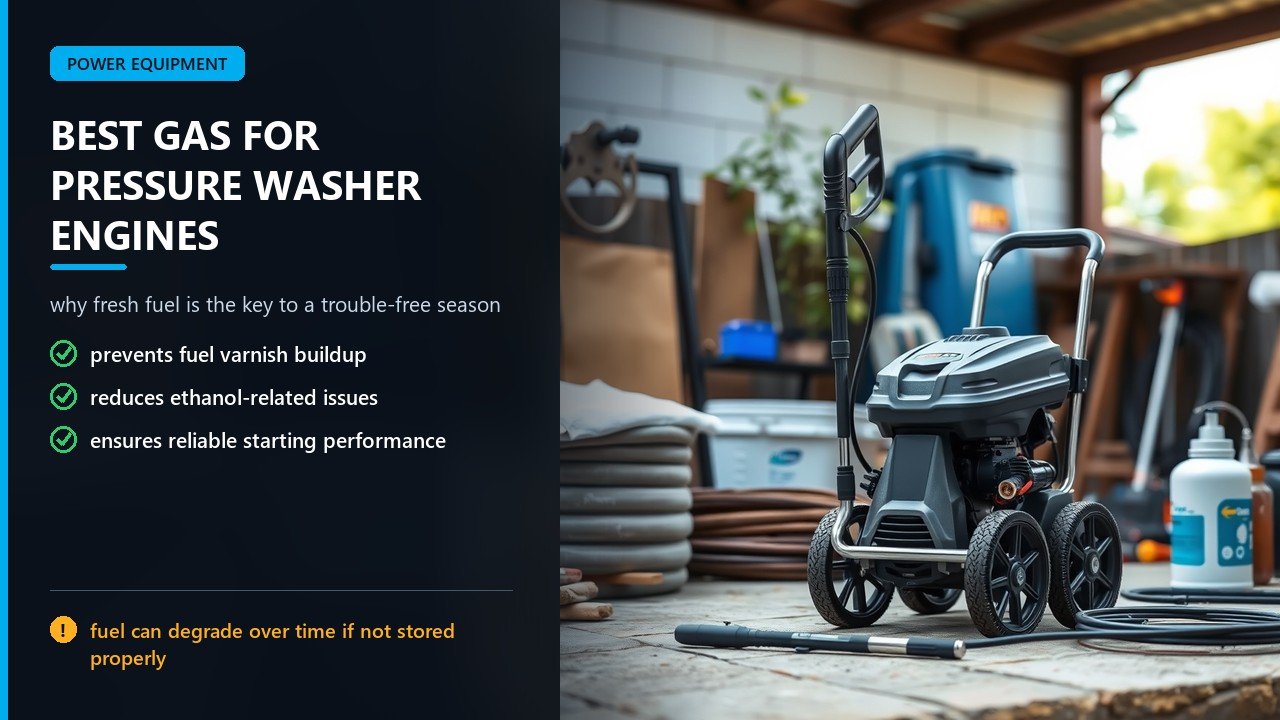
The Short Answer: What Fuel Your Pressure Washer Needs
Most gas pressure washers use a standard four-stroke engine, the same basic design as a lawn mower. Those engines are not fussy about brand, but they are strict about three things: freshness, octane, and ethanol content.
- Fresh, clean unleaded gasoline. Old gas is the number one cause of starting problems. Buy what you will use within a few weeks.
- A minimum of 87 octane. Regular pump gas is fine. Higher octane does not add power and is usually a waste of money unless your manual specifies it.
- No more than 10% ethanol. Gasoline with up to 10% ethanol, often labeled E10, is acceptable. Never use E15 or E85 — they are not approved for small engines and will cause damage.
That guidance comes straight from the engine makers. Briggs & Stratton’s fuel recommendations specify clean, fresh fuel of at least 87 octane, allow up to 10% ethanol, and explicitly rule out E15 and E85. The same rule shows up in pressure washer manuals across every major brand.
Why “Fresh” Matters More Than Anything Else
If you remember only one thing from this article, make it this: gasoline goes bad, and it goes bad faster than most people realize. Engine makers warn that fuel can begin to deteriorate in as little as 30 days. When gasoline sits, its lighter compounds evaporate and it oxidizes, leaving behind a gummy varnish. That varnish is what clogs the tiny passages inside a carburetor and turns a one-pull start into a frustrating ordeal.
The problem is worse in equipment that sits between uses, which describes most pressure washers perfectly. A machine you run every weekend is much more forgiving than one that waits six months between jobs. This is why the single best fuel habit is simple: buy small quantities of fresh gas, and treat or drain what you do not use. Briggs & Stratton’s storage guidance notes that gas can go stale in about 30 days and that the majority of U.S. fuel is an ethanol blend, which begins to break down almost immediately and can cause rust, corrosion, and gummy buildup in the tank. Our guide to easy start power washers explains why fuel and starting ease are so closely linked.
Quick Note: Gasoline can start going stale in about 30 days. If your pressure washer sits unused for longer than that without a fuel stabilizer or ethanol-free fuel, expect hard starts and carburetor trouble. Freshness is not a suggestion — it is the whole game.
Octane: What You Actually Need
Octane is one of the most misunderstood numbers at the pump. It measures a fuel’s resistance to knocking, or premature ignition, under compression. It is not a measure of power, cleaning ability, or quality. A small pressure washer engine designed for 87 octane runs perfectly on 87 octane. Pouring in 93 octane will not make it stronger or cleaner; it will just cost more.
There are only two situations where you might deliberately choose a higher octane. The first is if your owner’s manual explicitly calls for it, which is rare for pressure washers. The second is altitude. At elevations above 5,000 feet, thinner air reduces the engine’s effective compression, and a lower octane is often acceptable — Briggs & Stratton notes that 85 octane is acceptable at high altitude, though the engine may need a high-altitude jet adjustment to run correctly and stay emissions-compliant.
So for the overwhelming majority of owners, regular 87-octane pump gas is the right answer. The label on the pump matters less than how fresh the fuel is and how little ethanol it contains.
Ethanol: The Real Villain for Small Engines
Ethanol is alcohol blended into gasoline, usually at 10% (E10) across most of the United States. It is fine for your car, which burns through fuel quickly and has a sealed, pressurized fuel system. It is less friendly to small engines that sit idle, and understanding why helps you protect your machine.
Ethanol is hygroscopic, meaning it attracts and absorbs water from the air. In a stored small engine, that absorbed moisture can lead to a condition called phase separation, where the ethanol and water drop out of the gasoline and settle at the bottom of the tank. Because most small engines draw fuel from the bottom, the engine then tries to run on that watery, ethanol-rich layer and will not start. Untreated, ethanol fuel also acts as a solvent, loosening old deposits that then flow into the carburetor and cause running problems. State environmental guidance on gasoline handling, such as the Maine Department of Environmental Protection’s homeowner fuel tips, describes this phase separation clearly, and warning notes in manufacturer manuals like the SIMPSON use and care manual explain that alcohol-blended fuels attract moisture that leads to separation and acid formation during storage.
| Fuel Type | Ethanol Content | OK for Pressure Washer? |
|---|---|---|
| Regular E10 (typical pump gas) | Up to 10% | Yes, but stabilize it and keep it fresh |
| Ethanol-free / “pure” gas | 0% | Best choice, especially for storage |
| E15 | 15% | No — not recommended or approved |
| E85 | 51–83% | Never — will damage the engine |
A detail worth noting: some engines tolerate ethanol-blended fuel better than others, and many pressure washers built in recent years are rated for E10. But “tolerates” is not the same as “thrives.” If your machine sits for weeks or months between uses, ethanol-free fuel removes an entire category of problems before they start.
Is Ethanol-Free Gas Worth It?
For many pressure washer owners, ethanol-free fuel is the best single upgrade to their fuel routine. It costs more per gallon and is not available everywhere, but the benefits compound for equipment that sits idle.
- Longer shelf life. Without ethanol’s moisture attraction, the fuel stays stable far longer.
- No phase separation. The most damaging storage problem simply does not occur.
- Cleaner carburetor. Less varnish and gum means fewer hard starts and cleaner jets.
- Peace of mind. You can store the machine for the season with far less worry.
You can find ethanol-free gas at some stations, often labeled as recreational or marine fuel, and many small-engine dealers sell it by the can. If ethanol-free fuel is not practical for everyday use, a common compromise is to run standard E10 during the working season and switch to ethanol-free, treated fuel for the final tank before storage. That way the machine sits through the off-season on the most stable fuel available. When you are ready to put the machine away for good, the same care that protects the engine also protects the pump — a routine covered in our look at when to rebuild, replace, or buy a new pump.
Canned Fuels: The Convenient Option
Pre-mixed and canned small-engine fuels have grown popular for good reason. Products like TruFuel and PowerCare are ethanol-free, high-octane, and blended with stabilizers so they last for years in the can. They are convenient, clean-burning, and eliminate the guesswork of mixing or storing pump gas.
The trade-off is cost. Canned fuel can run several times the price of pump gas per gallon, which adds up if you use your pressure washer often. For occasional users, or for that final tank before storage, canned fuel is a fantastic choice. For frequent commercial use, bulk ethanol-free or treated pump gas is the more economical route. Either way, the key takeaway is the same: ethanol-free fuel with stability built in is exactly what small engines love.
Fuel Stabilizers: Your Storage Insurance
If you cannot get ethanol-free fuel, a fuel stabilizer is the next best defense. Stabilizers slow the oxidation and breakdown that turn gasoline into varnish, and some formulas are specifically designed to combat ethanol-related moisture problems. Add the correct dose when you fill the tank, then run the engine for a couple of minutes so the treated fuel circulates through the carburetor and fuel lines.
Manufacturers recommend stabilizing fuel whenever a machine will sit for more than about 30 days. The exact product matters less than using it consistently. A stabilizer added at the pump, before the fuel has a chance to age, is far more effective than one added to fuel that is already going stale. Think of it as cheap insurance that costs a few dollars and can save a carburetor rebuild.
The 30-Day Rule and Fuel Storage
Good fuel management follows a simple timeline. Buy only as much gas as you will burn in about a month, and store it in a proper, airtight, UL-approved container away from heat, sparks, and living spaces. Never store gas in an unapproved container, and never leave untreated fuel in equipment for the off-season.
For longer storage, you have two solid strategies. The first is to add stabilizer and leave the tank reasonably full, which limits the air space that promotes moisture and oxidation. The second is to drain the tank and run the engine until the carburetor is empty, so no fuel remains to break down. Both work, and both beat leaving stale untreated fuel sitting in the machine. What you should never do is leave untreated E10 fuel in a carburetor for months and hope for the best. Our companion guide on choosing the right power washer water hose covers the pump-side side of storage, and fuel and water protection together keep a machine healthy through the off-season.
Note: Leftover old gas does not have to be wasted. Small amounts of clean, non-gummy old fuel can be diluted into a nearly full tank in your car, following local rules. But fuel that has phase-separated, turned gummy, or contains water must be disposed of properly — never burned in a brush pile or poured down a drain.
Four-Stroke vs. Two-Stroke: Do Not Mix Them Up
Almost all pressure washers use four-stroke engines, which run on straight gasoline with no oil mixed in. If you have ever used a two-stroke trimmer or chainsaw, you know those require oil blended into the fuel at a specific ratio, usually 50:1. Mixing that oil-and-gas blend into a four-stroke pressure washer is a serious mistake: it fouls the spark plug, coats the combustion chamber, and can damage the engine.
The reverse mistake — running a two-stroke engine on straight gas — is even worse and will quickly destroy it. Always confirm which engine you have before fueling. If your pressure washer has a separate oil fill and dipstick, it is a four-stroke and takes straight gas. If it is a two-stroke (rare in pressure washers but common in some specialty and small units), use the correct oil mix ratio from the manual. When in doubt, the manual is the authority.
Common Fuel Mistakes That Kill Pressure Washers
Most fuel-related failures trace back to a handful of avoidable errors. Watch for these and your engine will thank you.
- Using E15 or E85. Never. These fuels exceed what small engines are designed to handle and void many warranties.
- Running stale gas. Fuel older than about 30 days without stabilizer is a starting and carburetor hazard.
- Mixing oil into a four-stroke. It fouls plugs and deposits carbon.
- Skipping the stabilizer before storage. This is the number one cause of spring no-starts.
- Overfilling the tank. Fuel expands and can flood the carbon canister or spill onto hot parts. Fill to the specified level, not the brim.
- Refueling a hot, running engine. A serious fire risk. Let the engine cool first, and never refuel near open flame.
- Leaving the fuel cap loose or missing. Moisture and debris get in, and fuel can spill.
| Situation | Best Fuel Choice |
|---|---|
| Frequent use, burned within days | Fresh 87-octane E10 is fine |
| Occasional use, sits weeks | 87-octane E10 with stabilizer |
| Seasonal storage (months) | Ethanol-free, treated, or canned fuel |
| High altitude (above 5,000 ft) | Down to 85 octane acceptable; adjust jetting |
How Fuel Connects to Starting Problems
When a pressure washer will not start, or runs roughly, fuel is the first thing to check. Troubleshooting references from parts suppliers such as Sears PartsDirect list the usual culprits: stale or low-quality gas, more than 10% ethanol, a dirty or stuck carburetor needle, blocked fuel passages, or a carburetor that needs priming. Equipment manuals such as the Harbor Freight pressure washer manual trace hard-start conditions to the same fuel issues and specifically call out gasoline with more than 10% ethanol as a cause. Each of these has a fuel-management answer. Fresh gas prevents most of them outright; stabilizer prevents the rest during storage.
| Symptom | Fuel-Related Cause | Fix |
|---|---|---|
| Will not start after storage | Stale gas / varnished carburetor | Drain, refill fresh treated gas, clean carb |
| Runs rough, surges | Moisture / phase-separated fuel | Drain tank, switch to ethanol-free fuel |
| Hard or no start in the cold | Low-RVP (summer) fuel in cold weather | Use fresh seasonal fuel; service the carb |
| Knocking, running hot | Octane too low for the engine or altitude | Use the manual’s specified octane |
If a machine has already sat on untreated fuel, a carburetor cleaning may be unavoidable. Simple cures include draining the old fuel, refilling with fresh treated gas, replacing the spark plug, and cleaning or replacing the air filter. If that does not do it, a professional carburetor service is a small price compared to the alternative — especially on a machine that otherwise has plenty of life left. Preventive fuel care is almost always cheaper and easier than repair, which is why experienced owners treat fuel as maintenance rather than an afterthought.
Fuel Safety Around the Home
Gasoline is dangerous, and small-engine fueling deserves respect. Store fuel in approved containers only, away from water heaters, furnaces, and other ignition sources. Keep gas out of living spaces and away from children. Fill the tank outdoors on a cool engine, wipe up any spills immediately, and let fumes dissipate before starting. Never start an engine while the smell of fuel hangs in the air, and keep a fire extinguisher nearby. These habits are simple, but they prevent the kind of accidents that make the news.
Disposal matters too. Old or contaminated fuel should go to a proper hazardous-waste facility, not down a drain or onto the ground, where it can contaminate groundwater. If you are unsure how to dispose of fuel safely, your local environmental or waste authority can point you to the right option.
Fuel Additives: Beyond the Basic Stabilizer
Stabilizer is the essential additive, but a few others are worth understanding. Ethanol treatments are designed specifically to prevent the moisture and corrosion problems that ethanol blends cause; they are not a replacement for fresh fuel, but they help when ethanol-free gas is not available. Carburetor and fuel-system cleaners can dissolve light varnish and keep jets clear, which is useful as preventive maintenance rather than a rescue for a badly clogged carb. And detergent-rich “top tier” gasoline, sold by many major brands, keeps fuel systems cleaner than bargain fuel without costing dramatically more.
Use additives in the doses the label specifies, and avoid stacking multiple products that do the same job. Over-treating fuel can cause its own problems, from rough running to fouled plugs. The goal is not a chemistry experiment; it is fresh, clean, stable fuel that flows freely and burns completely. If you already run ethanol-free fuel and store the machine properly, you often need nothing more than a good stabilizer.
Brand and Engine Notes
The fuel rules in this guide apply across the board, because the engines themselves follow the same general design. Honda GX and GC engines, Briggs & Stratton, Kohler, and Subaru small engines all specify fresh unleaded gasoline of at least 87 octane with no more than 10% ethanol, and all warn against E15 and E85. Some commercial engines built for heavy daily service are more tolerant of regular fuel simply because they burn through it quickly and rarely sit idle, but the underlying rules do not change.
If you run a commercial machine, the stakes are higher because downtime costs money. A commercial-grade engine paired with disciplined fuel management is a combination that runs for thousands of hours. Our look at the Honda industrial pressure washer shows what that class of equipment expects, and fuel quality is part of the equation. For high-demand machines, see our notes on 5 gallon per minute pressure washers to understand why these engines run hard and why clean fuel keeps them reliable.
One practical tip applies to every brand: keep a written fuel log or a simple habit of dating your gas can. Writing the fill date on the can removes all guesswork about whether the fuel inside is fresh. A can that has sat since last season should be diluted into your car’s tank or recycled, not poured into a small engine you need to start on the first pull.
Frequently Asked Questions
What is the best gas for a pressure washer? Fresh, clean, unleaded gasoline with a minimum of 87 octane and no more than 10% ethanol. Ethanol-free fuel is even better, especially for machines that sit unused for weeks or months.
Can I use premium gas in my pressure washer? You can, but it offers no benefit unless your manual requires it. Regular 87-octane gas is what most pressure washer engines are designed for. The exception is high altitude, where a lower octane such as 85 may be acceptable.
Can I use E15 or E85 in a pressure washer? No. E15 and E85 are not approved for small engines and can cause damage and warranty problems. Stick to E10 or lower, and prefer ethanol-free fuel when possible.
Do I need to add oil to the gas in a pressure washer? Not in a four-stroke engine, which is what nearly all pressure washers use. Those engines take straight gas and have a separate oil reservoir. Adding oil fouls the engine. Only two-stroke engines require a fuel-oil mix.
How should I store fuel for my pressure washer? Buy only what you will use in about 30 days. For longer storage, add a fuel stabilizer or switch to ethanol-free fuel, and store gas in an approved container away from heat and ignition sources.
Why does my pressure washer not start after sitting all winter? Almost always stale or ethanol-blended fuel that has varnished the carburetor or absorbed moisture. Draining the old fuel, refilling with fresh treated gas, and replacing the spark plug fixes most cases; stubborn ones need a carburetor cleaning.
Can I use the same gas can for my pressure washer and my car? The fuel itself is the same unleaded gasoline, so there is no harm in sharing a can. The important thing is that the fuel is fresh and properly stored. A can that sits partially full for months will go stale for both uses, so date your cans and rotate them.
How long can gas sit in a pressure washer before it becomes a problem? Treat 30 days as the practical limit for untreated fuel. Beyond that, varnish and moisture begin causing hard starts. If the machine will sit longer, add stabilizer or use ethanol-free fuel before storing it.
Final Thoughts
The best gas for a pressure washer is not the most expensive or the highest octane — it is fresh, clean, properly stored fuel with little or no ethanol. Get those three things right and your engine will start on the first pull, run smoothly, and last for years without a single carburetor rebuild. Ignore them and you will spend more time pulling a starter cord than washing anything.
Fuel is the cheapest maintenance item on the whole machine and one of the most decisive. Buy it fresh, treat it before storage, keep ethanol out when you can, and never let untreated gas sit through the off-season. A pressure washer engine, fed and stored the right way, is one of the most reliable tools in your garage. The fuel you choose is what tips it one way or the other.