Power Washer Rotary Head Types and How to Choose One
A power washer rotary head is any attachment that spins to clean, and it is one of the most useful upgrades you can add to a pressure washer. Rotary heads appear as surface cleaners with spinning bars, turbo nozzles that rotate a jet, and rotating brushes for scrubbing. Each turns a steady stream of water into a faster, more even cleaning action.
This guide explains what a power washer rotary head is, the main types you can buy, how each one actually works, and how to match one to your machine’s flow and pressure. It also covers selection, technique, and maintenance, so you can choose the right rotary attachment and then get the most from it for years.
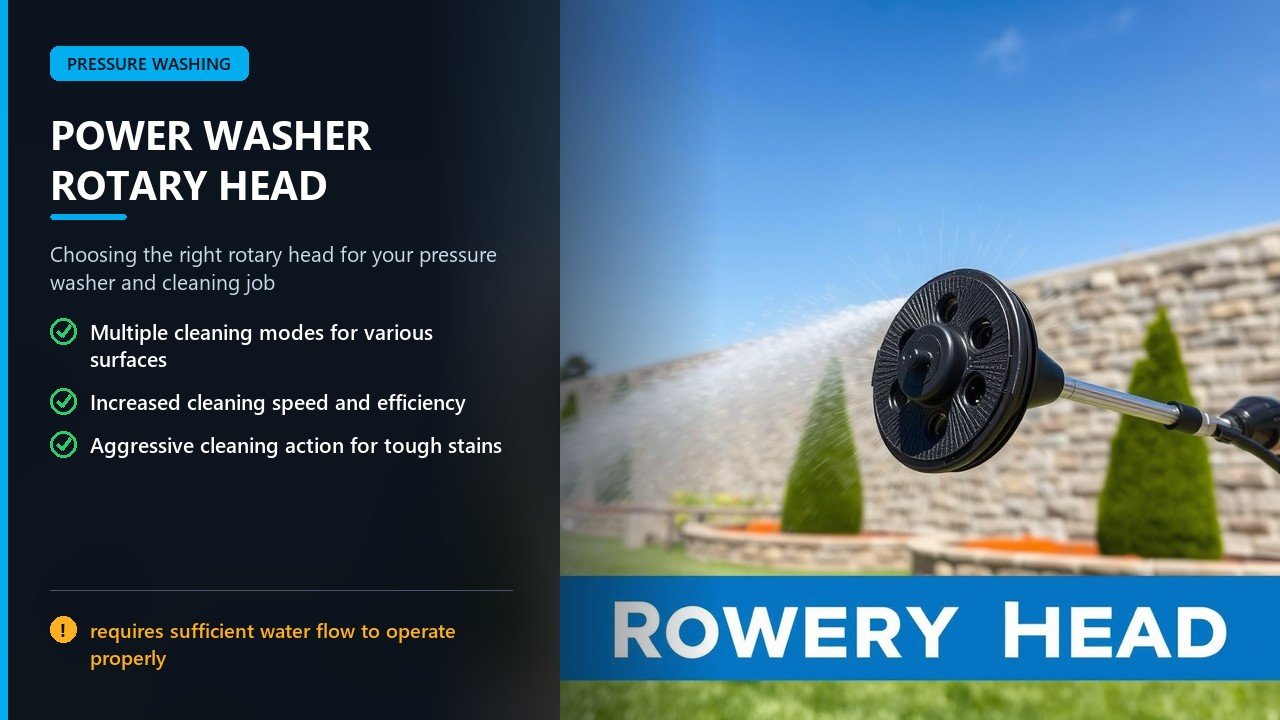
What a Power Washer Rotary Head Is
A rotary head is a cleaning attachment that spins continuously while water flows through it. Instead of holding one fixed jet in a single spot, the head rotates so the water sweeps across an area continuously. The result is faster coverage, far more even cleaning, and often a more aggressive cleaning action than a standard wand can provide.
Rotary heads come in several forms. A rotary surface cleaner uses a spinning bar with opposing jets under a dome. A turbo or rotary nozzle spins a single jet in a tight circle within the spray. A rotating brush uses water power to turn bristles against a surface. All three rely on the same underlying principle of rotation powered by the flow of water.
Note: Rotation is usually powered by the water itself, not by a motor. That means a rotary head needs enough flow, in gallons per minute, to spin properly. If your machine’s GPM is too low, the head will stall or rotate weakly and clean poorly.
Types of Rotary Heads
Each type of rotary head suits different jobs. Surface cleaners dominate flat concrete work, turbo nozzles add punch to a wand, and rotating brushes help with stubborn films and delicate surfaces. Knowing the differences helps you pick the right tool for the task.
| Type | Best For | Action |
|---|---|---|
| Rotary surface cleaner | Driveways, patios, flat concrete | Spinning bar under a dome |
| Turbo / rotary nozzle | Wand cleaning, tough stains | Spinning single jet |
| Rotating brush | Delicate or textured surfaces | Water-powered bristles |
| Rotary drain cleaner | Blocked pipes | Spinning forward jet |
Our guide to how the spinning bar of a rotary surface cleaner works explains the most popular type in detail.
How Rotary Surface Cleaners Work
A rotary surface cleaner sits on a dome or housing with a spinning bar underneath. Two or more nozzles at the ends of the bar point slightly outward and down, so their reaction force spins the bar while the jets clean the surface. The dome contains the spray and keeps water and debris from flying.
Because the jets spin, they clean a circular path and the operator simply guides the cleaner across the surface. The result is even, streak-free cleaning with no zebra stripes, and it is far faster than a wand. The key requirement is enough flow to spin the bar reliably.
The size of the cleaner, measured by its cleaning width, should match the flow of the machine. An under-powered machine cannot spin a large bar, and an oversized cleaner on a small machine cleans poorly. Our guide to choosing a surface cleaner covers sizing in depth.
How Turbo and Rotary Nozzles Work
A turbo nozzle, sometimes called a rotary nozzle, contains a small turbine that spins a single high-pressure jet in a fast circle. This spinning jet covers a wider swath than a fixed tip while keeping the cleaning power concentrated, so it removes stubborn dirt faster than a standard nozzle.
Turbo nozzles fit the wand like any quick-connect tip and are ideal for tough spots, stripping, and concrete edges the surface cleaner cannot reach. They can mark soft surfaces, so use them with care on wood, siding, and vehicles. The spinning action makes them aggressive by design.
Our comparison of turbo, rotary, and fixed nozzles explains when each type is the right choice.
How Rotating Brushes Work
A rotating brush uses water power to spin a set of bristles against the surface. This combines the physical scrubbing of a brush with the rinsing power of water, which helps on textured surfaces, films, and areas where a jet alone struggles. The bristles agitate the dirt while the water carries it away.
Rotating brushes are gentler than a high-pressure jet, making them useful on surfaces that could be damaged by concentrated force. They are a popular choice for cleaning vehicles, boats, and textured materials. Our guide to water-powered spinning brushes explains the design.
| Rotary Head | Flow Needed | Surface Use |
|---|---|---|
| Small surface cleaner | Moderate | Home concrete |
| Large surface cleaner | High | Commercial concrete |
| Turbo nozzle | Any working flow | Tough spots, edges |
| Rotating brush | Moderate | Delicate and textured |
Matching a Rotary Head to Your Machine
The single most important match is flow. Rotary heads are powered by water, so a machine that flows too little will not spin them well. Check the recommended GPM range for any rotary attachment before you buy, and compare it with your machine’s rated flow, not its maximum.
Pressure matters too, but flow drives the rotation. A high-pressure, low-flow machine may not spin a surface cleaner at all, while a moderate-pressure, higher-flow machine will. For turbo nozzles, the flow requirement is lower because only one jet spins, so they work on a wider range of machines.
Note: If a rotary surface cleaner sputters, stalls, or leaves an uneven pattern, insufficient flow is the usual cause. Confirm the machine’s rated GPM meets the cleaner’s minimum before assuming the attachment is faulty.
Choosing by Job and Surface
Match the rotary head to the job and the surface. For large flat concrete, a surface cleaner is the fastest and most even option. For edges, corners, and tough stains, a turbo nozzle adds punch where the cleaner cannot reach. For delicate or textured surfaces, a rotating brush is the safer choice.
| Job | Best Rotary Head |
|---|---|
| Driveway or patio | Rotary surface cleaner |
| Concrete edges and corners | Turbo nozzle |
| Stripping and tough stains | Turbo nozzle |
| Vehicles and boats | Rotating brush |
| Textured or delicate surfaces | Rotating brush |
Many owners keep more than one rotary head, since each covers jobs the others cannot. A surface cleaner and a turbo nozzle together handle the vast majority of flat and edge work. Our guide to rotary pressure washer tools shows how they cut cleaning time.
Rotary vs Fixed Cleaning Action
A fixed nozzle holds one jet in one place, so you must move it back and forth to cover ground. A rotary head moves the jet for you, covering a wider area and cleaning more evenly. The trade-off is that rotation depends on flow and adds a moving part that can wear or clog.
For large, flat surfaces, rotary heads win on speed and evenness. For detailed work and delicate surfaces, a fixed nozzle with the right tip may be the better and safer choice. Many jobs use both: a rotary head for the broad work and a fixed tip for the details. Our comparison of orbital and rotary cleaning action explores the differences further.
Using a Rotary Head Effectively
Technique matters as much as the tool. For a surface cleaner, work in slow, overlapping passes and let the machine do the work rather than pushing down. For a turbo nozzle, keep the tip moving and at a safe distance, since the spinning jet is aggressive. For a brush, let the bristles and water do the scrubbing.
Keep the head level and moving steadily. Pausing in one spot on a surface cleaner can leave a mark, and holding a turbo nozzle too close can damage a surface. A consistent, unhurried pace produces the best and safest results.
Maintenance of Rotary Heads
Rotary heads have moving parts, so they need more care than a simple nozzle. Flush them with clean water after every job to remove grit that wears the bearings and seals. Check the spinning action before use, and clear any debris from the nozzles and passages.
Replace worn parts such as bearings, seals, and nozzles as they fail. A surface cleaner that no longer spins freely usually needs a bearing or a seal, and these parts are often replaceable. Proper care keeps a rotary head spinning for years.
| Part | Care |
|---|---|
| Nozzles | Clear debris, replace if worn |
| Bearings | Keep clean, replace when rough |
| Seals | Inspect for leaks, replace as needed |
| Bar / head | Check spin, keep level and clean |
Sizing a Rotary Surface Cleaner to Your Machine
Surface cleaner size is measured by cleaning width, and it must match your machine’s flow. A cleaner that is too wide for the flow will spin slowly, leave streaks, and clean poorly, while one that is too narrow wastes the machine’s capacity. The manufacturer’s recommended GPM range is the guide to follow.
As a rough rule, a small residential cleaner suits a 2 to 3 GPM machine, a mid-size cleaner suits 3 to 4 GPM, and a large commercial cleaner needs 4 GPM and up. Buying a cleaner below your flow wastes potential, and buying above it defeats the tool. Match the width to the water you actually have.
| Cleaner Size | Recommended Flow | Typical Use |
|---|---|---|
| Compact | 2 – 3 GPM | Home patios and walkways |
| Mid-size | 3 – 4 GPM | Driveways, larger areas |
| Large | 4 GPM and up | Commercial and industrial |
For a deeper look at matching a cleaner to pressure and flow, our guide to flat surface cleaners shows how the right size transforms results.
Choosing a Turbo Nozzle
A turbo nozzle is the easiest rotary head to add, fitting the wand like a standard quick-connect tip. Choose one rated for your machine’s pressure and flow, with the correct connection type. Turbo nozzles clean faster than a fixed tip on tough jobs, so they are worth carrying even if you own a surface cleaner.
Turbo nozzles are aggressive, so they belong on hard surfaces and isolated tough spots rather than delicate materials. Keep them for concrete, brick, and equipment, and switch to a wider fixed tip for wood, siding, and vehicles. The spinning jet concentrates force, which is exactly why it works and why it must be used carefully.
Our review of a turbo nozzle’s pinpoint power explains the action and its best uses.
Choosing a Rotating Brush
A rotating brush suits work that a jet handles poorly: vehicle bodies, textured plastics, and surfaces with a film that needs agitation. Match the brush and its bristle type to the surface, choosing softer bristles for delicate finishes and firmer ones for tougher grime.
Water-powered rotating brushes are convenient because they need no separate motor. Their trade-off is that they need steady flow to spin and are less aggressive than a turbo nozzle. For cleaning and scrubbing in one pass, though, a rotating brush is hard to beat.
Rotary Heads for Drains and Pipes
A rotary drain cleaner, often called a rotating sewer jet, uses forward and rearward jets to propel itself down a pipe while spinning to clear blockages. These are specialized tools for plumbing work, but the principle is the same rotary action applied inside a pipe rather than on a surface.
If you clear drains as part of your work, a rotary jet attachment extends your machine’s usefulness well beyond surface cleaning. Match the nozzle and hose to the pipe size, and always follow safe practice for high-pressure jetting inside confined spaces.
Flow, Pressure, and Spin Speed
Rotation is a mechanical result of flow. Water leaving the jets creates a reaction force, and the arrangement of the jets turns that force into spin. The more water that flows, the stronger the spin. This is why flow is the limiting factor for any rotary head.
Pressure adds cleaning power but does not by itself create strong rotation. A machine with high pressure but low flow may clean well with a fixed tip yet fail to spin a surface cleaner. When choosing rotary heads, always start with flow and then consider pressure.
| Factor | Effect on Rotation |
|---|---|
| Higher GPM | Stronger, more reliable spin |
| Higher PSI | More cleaning force per jet |
| Low flow | Weak or stalled rotation |
| Clogged jets | Uneven or no rotation |
Note: Uneven rotation is often the first sign of a partly blocked jet or worn bearing, not a pressure problem. Check and clean the nozzles before assuming the machine is at fault, because a single clogged jet can throw the spinning bar out of balance.
Rotary Head Maintenance and Storage
Rotary heads have moving parts, so they need more care than a simple nozzle. Flush them with clean water after every job to remove grit that wears the bearings and seals. Check the spinning action before use, and clear any debris from the nozzles and passages.
Replace worn parts such as bearings, seals, and nozzles as they fail. A surface cleaner that no longer spins freely usually needs a bearing or a seal, and these parts are often replaceable. Store the head clean and dry, and proper care keeps a rotary head spinning for years.
| Part | Care |
|---|---|
| Nozzles | Clear debris, replace if worn |
| Bearings | Keep clean, replace when rough |
| Seals | Inspect for leaks, replace as needed |
| Bar / head | Check spin, keep level and clean |
Getting the Best Results From a Rotary Head
Technique matters as much as the tool. For a surface cleaner, work in slow, overlapping passes and let the machine do the work rather than pushing down. For a turbo nozzle, keep the tip moving and at a safe distance, since the spinning jet is aggressive. For a brush, let the bristles and water do the scrubbing.
Keep the head level and moving steadily, and pre-treat tough areas with detergent where needed. Pausing in one spot on a surface cleaner can leave a mark, and holding a turbo nozzle too close can damage a surface. A consistent, unhurried pace produces the best and safest results.
Common Mistakes With Rotary Heads
The most common mistake is buying a rotary head that is too large for the machine’s flow, which leaves it spinning weakly or not at all. Always check the GPM range before buying. Matching the head to the machine is the difference between a fast cleaner and a frustrating one.
Another mistake is skipping maintenance, which lets grit destroy the bearings and seals quickly. People also use turbo nozzles on soft surfaces and damage them, or run a surface cleaner with worn nozzles and blame the machine for uneven results. Match the tool to the surface and keep it in good order.
Rotary Heads for Commercial Work
Commercial cleaners rely on rotary heads because they cut labour time on large surfaces. A surface cleaner covers ground several times faster than a wand, and turbo nozzles handle edges and stains without slowing the job. For a business, the speed a rotary head adds directly increases daily revenue.
In commercial use, durability matters as much as speed. Choose cleaners and nozzles built for constant use, with replaceable parts and robust construction. A rotary head that fails mid-job costs far more than the price difference between a homeowner model and a professional one.
Compatibility and Fittings
Rotary heads connect through standard fittings, so compatibility is usually about the connector type and the flow range. Most surface cleaners use a quick-connect or threaded inlet and connect to the wand or gun. Check that the fittings match your machine before buying, and use quality fittings that will not leak.
Turbo nozzles use the same quick-connect system as standard tips, making them easy to swap. Rotating brushes and drain cleaners may use specific connections. Confirm compatibility, and keep spare O-rings and adapters on hand so a small mismatch never stops a job.
| Item | Compatibility Check |
|---|---|
| Surface cleaner | Inlet fitting and flow range |
| Turbo nozzle | Quick-connect size and rating |
| Rotating brush | Connection type and flow |
| Drain cleaner | Hose and connection type |
Nozzle and Tip Selection for Rotary Tools
Some rotary surface cleaners use replaceable nozzles, and their size and angle affect both spin and cleaning. Worn or wrong nozzles reduce performance and can unbalance the bar. Replace nozzles in matched pairs or sets so the bar stays balanced and spins true.
Turbo nozzles come with a fixed internal jet sized for a flow range, so choose one matched to your machine. A nozzle too large for the flow will underperform, and one too small can over-pressure the system. Match the tip to the flow, just as you would with a fixed nozzle.
Note: When replacing nozzles on a spinning bar, always replace all of them together, even if only one looks worn. Mismatched nozzles unbalance the bar, which causes vibration, uneven cleaning, and faster bearing wear.
Rotary Heads and Detergents
Rotary heads can be used with detergent to improve results, especially on concrete and siding. Applying soap before cleaning with a surface cleaner lets the solution lift dirt, and the spinning jets then rinse it away in fewer passes. Downstream injectors and soap nozzles make this easy.
Match the detergent to the surface and rinse well, since soap left behind can attract dirt or leave a film. On flat concrete a pre-treatment followed by a rotary cleaner is one of the most effective routines in pressure washing, and it is far faster than scrubbing by hand.
Safety With Rotary Heads
Rotary heads concentrate and move a high-pressure jet, so the safety rules are strict. Never point a turbo nozzle or cleaner at a person or animal, and keep hands and feet clear of the spinning parts. Wear eye protection, since the rotating jets can throw debris.
Keep the tip at a safe distance and never test a nozzle against your hand, a common and dangerous mistake. The spinning jet of a turbo nozzle can cause serious injury in an instant. Respect the tool, follow the same care you would with any high-pressure equipment, and never reach into a running attachment.
Cost and Value of Rotary Heads
Rotary heads are among the best-value upgrades in pressure washing. A surface cleaner costs a fraction of a new machine and can double or triple your cleaning speed on flat surfaces. A turbo nozzle is inexpensive and adds cleaning power without changing anything else.
Buy quality where it counts. A cheap surface cleaner with soft bearings wears out quickly and cleans unevenly, while a well-made one lasts for years and keeps spinning true. The value of a rotary head comes from how much time it saves, so reliability matters as much as the initial price.
Frequently Asked Questions
What is a power washer rotary head? It is a cleaning attachment that spins while water flows through it, such as a rotary surface cleaner, a turbo nozzle, or a rotating brush, giving faster and more even cleaning.
How does a rotary surface cleaner work? Two or more angled jets on a spinning bar create rotation while cleaning, and a dome contains the spray. It cleans flat surfaces faster and more evenly than a wand.
What GPM does a rotary head need? It depends on the size. Turbo nozzles need little, while surface cleaners need enough flow to spin their bars. Always check the recommended GPM range before buying.
Is a turbo nozzle the same as a rotary head? A turbo nozzle is a type of rotary head. It spins a single jet in a tight circle, while a surface cleaner spins a bar with multiple jets under a dome.
Can a rotary head damage my surface? Yes, if it is too aggressive for the surface. Turbo nozzles and surface cleaners can mark soft materials, so match the tool to the surface and test in a hidden area.
Why is my rotary surface cleaner not spinning? Usually the machine’s flow is too low to power it, or grit has jammed the bearings or nozzles. Check flow first, then clean and inspect the moving parts.
Final Thoughts
A power washer rotary head turns an ordinary pressure washer into a much faster and more even cleaning machine. Surface cleaners dominate flat concrete, turbo nozzles add pinpoint punch on the wand, and rotating brushes handle the most delicate work. Each type relies on flow to spin properly, so matching the head to the machine is absolutely essential.
Choose the type of rotary head that fits your surfaces, check the flow range before you buy, and keep the moving parts clean. Do that consistently, and a rotary head will save you hours of effort and produce a genuinely professional finish. For most owners, one good surface cleaner and a turbo nozzle together cover nearly every job around the home.
Note: Buy rotary heads rated to match your machine’s flow and pressure, and source them from suppliers that stock replacement nozzles, bearings, and seals. Excellent options include the attachments available at Pressure Wash Supply, the selection at Amazon, and the equipment range at Grainger.