If you have been shopping for a pressure washer lately, you have probably run across a machine with a PowerEase power washer badge or an engine cover stamped “Powerease.” The name turns up on gas washers, electric models, and even hot water units, and it often sits at a price that looks too reasonable to be a serious engine. Shoppers want to know one simple thing: is Powerease a real brand, or a throwaway off-brand built to hit a price point?
The honest answer is that Powerease is a genuine engine and motor brand owned by BE Power Equipment, a Canadian manufacturer that has been building power equipment for decades and supplies dealers across North America. It is not the same pedigree as Honda or Kohler, but it is also not a random no-name. Understanding what Powerease actually is, which machines carry it, how it performs, and how to support it turns a confusing badge into a smart buying decision.
This guide covers the Powerease brand and its parent company, the full engine and motor lineup, the pressure washer models that use it, how it compares with Honda and Kohler, parts and support, how to maintain it, common problems, and whether a Powerease power washer is the right choice for your work.
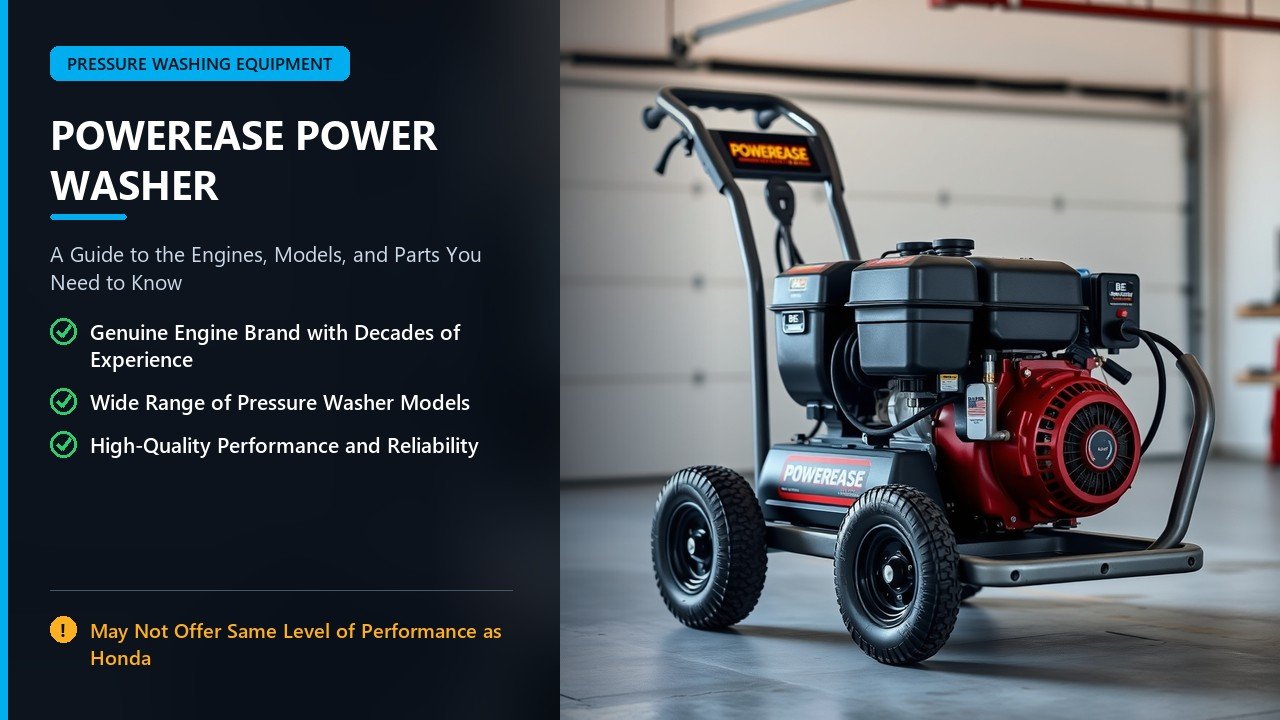
What Powerease Actually Is
Powerease is the house engine and motor brand of BE Power Equipment, a family-owned company based in Abbotsford, British Columbia, that has manufactured pressure washers, generators, water pumps, and related equipment for well over three decades. Rather than relying entirely on third-party engines, BE developed the Powerease line to power its own machines and to serve as a dependable replacement engine option.
That ownership matters for buyers. A house brand backed by an established manufacturer is very different from a mystery engine slapped onto a machine by an overseas trading company with no support structure. BE runs a dealer network, publishes spec sheets and manuals, stocks parts, and offers warranty coverage. Powerease engines have powered BE equipment for well over ten years, which is a meaningful track record in a market full of short-lived brands.
Powerease covers two product families:
- Gasoline engines for pressure washers, generators, and other outdoor power equipment, from small 145cc units up to a 420cc big block.
- Electric motors for electric pressure washers, including wall-mountable commercial models.
So when someone refers to a “PowerEase power washer,” they usually mean a BE pressure washer that carries a Powerease gas engine or Powerease electric motor. The brand is the power source, not the machine itself.
The Powerease Engine Lineup
Understanding the lineup helps you decode what a given machine is really packing. The engines are air-cooled, four-stroke, overhead-valve (OHV) designs, a modern layout that produces more power and runs cleaner than older flathead designs.
| Engine | Displacement | Typical Output | Common Use |
|---|---|---|---|
| Powerease 145 | 145cc | Small gas engine | Inverter generators, light equipment |
| Powerease 212 | 212cc | ~6.5 HP class | Entry gas pressure washers, pumps |
| Powerease 223 | 223cc | ~7 HP class | Mid-size gas pressure washers |
| Powerease 420 | 420cc | 15 HP gross / 12.6 HP net | Large gas and hot water washers |
The flagship is the Powerease 420. Its spec sheet lists 420cc, 15 horsepower gross and 12.6 horsepower net at 3,600 RPM, and 17.8 foot-pounds of torque at 2,500 RPM. It uses a 1-inch straight keyed shaft, a common size that makes it usable as a replacement engine on many machines, not just BE’s own. It features automatic low-oil shutdown, a fuel tank around 6.7 liters, and a splash lubrication system that takes ordinary SAE 10W-30 oil.
That last detail, the net versus gross horsepower figure, is worth pausing on. Gross power is measured without the air filter, muffler, and other accessories installed; net power is the real-world number with everything connected. The 420’s 12.6 net horsepower is the figure that actually drives the pump, and it is honest for its class. More on these engine specs that most owners ignore.
Powerease in BE Pressure Washers
Powerease engines appear across BE’s gas line, from compact homeowner units to commercial machines. Here is how they map onto real models.
| Model | Powerease Engine | Pressure / Flow | Pump |
|---|---|---|---|
| BE327PX | 212cc | 3,200 PSI / 2.5 GPM | CP axial |
| B3475PX | 223cc | 3,400 PSI / 2.5 GPM | CP axial |
| B4415PA | 420cc | 4,400 PSI / 4.2 GPM | CP triplex |
| HW4015RA (hot water) | 420cc | 4,000 PSI / 4.0 GPM | AR triplex |
| B1515EN (electric) | Powerease motor | 1,500 PSI / 1.6 GPM | Triplex |
The pattern is clear. Small Powerease engines drive axial-pump machines aimed at homeowners and light duty. The 420cc big block drives triplex-pump machines aimed at commercial and heavy residential work, including a hot water unit with a diesel burner that reaches around 200 degrees Fahrenheit. The hot water model pairs the 420 with an AR triplex pump and a 12-volt Beckett diesel burner, which is a serious combination for heavy grease and oil. We cover that pump pairing in depth in our article on the PowerEase pressure washer and its AR triplex pump.
Pump type matters as much as the engine badge. An axial-cam pump is fine for occasional use, but a triplex pump with a forged brass manifold, ceramic plungers, and rebuildable internals is what separates a machine that lasts years from one that struggles under regular work. If a Powerease power washer carries a triplex pump, it is built for real cleaning.
Powerease Versus Honda and Kohler
This is the comparison most buyers really care about. Honda and Kohler build premium engines with a legendary reputation for easy starting and long life. Powerease is a value-oriented house brand. The gap is real, but it is narrower than the price difference suggests.
| Factor | Powerease | Honda | Kohler |
|---|---|---|---|
| Price | Lower | Highest | High |
| Brand reputation | Good house brand | Excellent | Excellent |
| Parts availability | Dealer network and BE support | Everywhere | Widely available |
| Service life | Good with maintenance | Very long | Very long |
| Resale value | Moderate | Highest | High |
The practical takeaway: a Powerease engine will serve a homeowner or a light commercial user well for years if maintained, at a noticeably lower purchase price. A Honda or Kohler engine earns its premium through easier cold starts, longer service intervals, higher resale, and near-universal parts availability. A contractor running the machine daily may still prefer the premium engine; a homeowner cleaning a driveway a few times a season gets excellent value from Powerease. If you want to weigh the alternative, our guide to BE 3400 PSI machines and our broader gas engine pressure washer guide both compare the options.
Parts, Support, and Warranty
The main worry with any house-brand engine is parts and support. Here Powerease does better than the typical off-brand.
Best route: a BE dealer. Authorized BE dealers can order Powerease parts, and BE’s parts catalog covers engines, pumps, guns, wands, hoses, nozzles, and fittings. Many common wear items such as o-rings, filter elements, and seal kits are standardized across models.
Common replacement parts. Complete Powerease replacement engines are sold for equipment that accepts a keyed 1-inch horizontal shaft, which covers a huge range of pressure washers and other power equipment. This is a real advantage: instead of scrapping a machine with a seized engine, you can swap in a new Powerease engine and keep the pump, frame, and accessories.
Warranty. BE typically backs its gas pressure washers with a multi-year warranty, and registering the product often extends it. The electric Powerease motors commonly carry a two-year warranty with two-year pump coverage. Registering the machine is the difference between getting a couple of years and getting several.
Documentation. BE publishes manuals and spec sheets for its engines and machines, which sounds minor until you need the oil capacity, valve clearance, or torque spec at 9 p.m. the night before a job.
Maintaining a Powerease Engine
Powerease engines reward basic care. Neglect them and they fail at the same rate as any other engine; keep up the schedule and they run for years.
- Oil: Use the recommended SAE 10W-30, check the level before each use, and change it after the break-in period and then on the interval in the manual. The low-oil sensor protects against disaster, but it is a backup, not a routine.
- Air filter: Clean or replace the dual-element filter regularly, especially in dusty or leaf-covered conditions. A clogged filter richens the mixture and causes hard starting.
- Spark plug: Check the gap and replace annually or when starting becomes difficult.
- Fuel: Use regular unleaded at 86 octane or higher, and prefer ethanol-free fuel where available. Ethanol blends up to 10 percent are acceptable, but ethanol is the leading cause of gummed carburetors in stored machines.
- Fuel storage: For seasonal machines, treat the fuel with stabilizer or run the engine dry before storage. This single habit prevents the most common no-start complaint.
- Valve clearance: Check and adjust per the manual. Valves that are out of spec cause rough running and power loss.
- Winter: Follow a proper winterizing routine so both engine and pump survive the cold.
Common Problems and Fixes
Most Powerease complaints trace back to fuel, not the engine itself.
Won’t start after storage. Nearly always a clogged carburetor from stale ethanol fuel. Drain and clean the carb, replace the plug, and use fresh fuel. Prevention beats repair.
Runs rough then dies. Often a dirty air filter, old fuel, or a fouled plug. Start with the cheap fixes before assuming a mechanical failure.
Surges at idle. Usually a partially blocked jet in the carburetor. A carburetor clean restores smooth running.
Loses power under load. Check the air filter, plug gap, and valve clearance. A worn pump under a healthy engine can also feel like an engine problem, so test pump pressure separately.
Low-oil shutdown lights up. The automatic sensor is doing its job. Top up the oil with the correct grade, and if the shutdown persists with a full crankcase, check the sensor.
Is a PowerEase Power Washer Right for You?
The answer depends on your volume and budget, not on brand snobbery.
Buy Powerease if: you clean your own property several times a year, you want a well-supported machine at a value price, you want a straightforward engine you can maintain yourself, or you want the ability to swap in a replacement engine later instead of replacing the whole machine.
Step up to Honda or Kohler if: you run the machine commercially or daily, you need the easiest possible cold starting, you value maximum resale, or you want parts available at any small-engine shop in town.
For many buyers, a mid-size Powerease power washer with a triplex pump hits the value sweet spot: enough cleaning power for driveways, siding, decks, and vehicles, backed by a real manufacturer with real parts support, at a price that leaves room for accessories.
Frequently Asked Questions
Who makes Powerease engines?
Powerease is the house engine and motor brand of BE Power Equipment, a Canadian manufacturer of pressure washers and power equipment. The engines have powered BE machines for well over a decade.
Is PowerEase the same as Honda?
No. Powerease is a BE house brand positioned below Honda and Kohler. It is a legitimate, supported engine, but it does not carry the premium reputation, resale, or universal parts availability of Honda.
Are Powerease parts easy to find?
Yes, through BE Power Equipment dealers and the BE parts catalog. Complete replacement engines are also sold for equipment with a keyed 1-inch horizontal shaft, along with standardized wear items like o-rings, seal kits, and filters.
What oil does a Powerease engine use?
Common SAE 10W-30 motor oil, with capacity and change intervals listed in the manual. The engines use splash lubrication and include automatic low-oil shutdown.
Can I replace a Powerease engine with a Honda?
Often yes, if the shaft size and bolt pattern match. Both commonly use a 1-inch keyed shaft, but always confirm the specific machine’s mounting and shaft requirements before buying.
How long does a Powerease engine last?
With regular oil changes, clean fuel, and filter maintenance, a Powerease engine typically serves a homeowner for many seasons and can serve light commercial use when cared for properly.
Powerease Electric Motors
Powerease is not only a gas-engine story. BE also builds electric pressure washers around Powerease electric motors, and these models deserve attention because they suit a very different buyer.
The best-known example is a 1,500 PSI, 1.6 GPM electric washer with a 1.5-horsepower Powerease motor and a triplex pump. It runs quietly, can be used indoors, uses a standard 120-volt household plug, and includes a GFCI plug that greatly reduces shock risk around water. The motor is paired with a triplex pump rather than the axial pump many cheap electric units use, which is a meaningful durability advantage.
BE also offers wall-mountable versions of these electric machines. A wall-mountable Powerease electric washer detaches from its frame for portable use, mounts with bolt slots for fixed installation, and includes an automatic shutdown that turns the unit off after a short idle period to protect the pump. That combination, wall-mount flexibility, a slow-turning triplex pump, and automatic shutdown, makes them popular for garages, car washes, and fixed cleaning stations.
The trade-off with electric is flow and pressure ceiling. Most Powerease electric units deliver modest GPM and around 1,500 to 2,000 PSI, which is plenty for cars, siding, patio furniture, and light concrete, but it will not match a 4 GPM gas machine on a large driveway or fresh grease. The electric motor’s advantages are quiet operation, no exhaust, indoor use, and simple maintenance with no fuel system to gum up.
How to Identify Your Powerease Engine
Before ordering parts, you need to know exactly which engine you have. The information lives on a few label plates.
- Model and serial plate. Look on the engine blower housing or the machine frame. It lists the engine model and serial number, which the parts counter needs.
- Displacement casting. Many engines have the displacement number cast or stamped on the engine or flywheel cover, such as 212 or 420.
- Part number. Powerease engines have their own part numbers, for example the 420 is often listed as part 85.570.150. A complete engine is easiest to order by this number.
- Machine model number. On a complete pressure washer, the machine model, such as B3475PX or HW4015RA, decodes both engine and pump specifications.
Photograph every plate before you need them. It takes a minute and saves a frustrating guessing game later when you are trying to match a replacement part or a warranty claim.
Powerease Versus Predator, Ducar, and Other Value Engines
Powerease competes in the value engine space alongside brands like Predator, Ducar, and a crowd of unbranded engines. Understanding where it sits helps you judge a machine.
| Brand | Type | Support | Notes |
|---|---|---|---|
| Powerease | BE house brand | BE dealer network and parts catalog | Used on BE machines; replacement engines available |
| Predator | Retail house brand | Retail store support | Widely sold for DIY replacement use |
| Ducar | Value engine maker | Distributor dependent | Common on budget equipment |
| Unbranded engines | No-name imports | Often none | Avoid; parts and warranty can be impossible |
The key distinction is support. Powerease and Predator have real infrastructure behind them, with parts catalogs, warranty terms, and manuals. Unbranded engines frequently do not. When an unbranded engine fails, the machine is often scrap; when a Powerease engine fails, you can usually repair or replace it and keep the rest of the machine working.
Another advantage of the Powerease 420 is its standard 1-inch keyed horizontal shaft. That common interface means the engine can replace many other brands’ engines and vice versa, so you are never trapped. This interchangeability is a quiet but important long-term benefit that cheap, proprietary engines do not offer.
Buying a Used Powerease Power Washer
Powerease machines turn up regularly on the used market at attractive prices. A quick inspection protects you.
- Check engine hours and evidence of oil changes. Dark, gritty oil or a smoky exhaust signals neglect.
- Test the pump. Confirm it builds and holds pressure, and listen for knocking. The pump is more expensive to replace than the engine.
- Inspect the frame and wheels. Rust, welds, and flattened tires hint at heavy use or poor storage.
- Verify it starts cold. A machine that starts easily cold is far healthier than one that needs many pulls.
- Ask about the carburetor. A recently cleaned or replaced carb is a good sign the machine was maintained rather than abandoned.
- Confirm the model number so you can look up parts and specs before buying.
Because Powerease replacement engines are affordable and available, a used machine with a tired engine but a sound pump and frame can be an excellent bargain. Conversely, avoid a machine with a healthy engine but a seized axial pump, since the machine’s core value is in the pump and frame.
Does a Powerease power washer start easily?
Fresh-gas Powerease engines generally start on the first or second pull from cold, and larger models offer electric start. Hard starting almost always traces to stale fuel, a dirty air filter, or an old spark plug rather than the engine design.
Where can I buy a Powerease power washer?
Through BE Power Equipment dealers, many farm and home retailers, and online sellers that carry BE machines. Buying through a dealer usually means faster warranty and parts support, so it is worth checking your local dealer first.
Is Powerease good quality?
For value-tier equipment, yes. It is an established house brand with real manufacturer backing, published specs, and available parts. It is not a premium engine, but it is a legitimate and supportable one, which is what matters most for occasional and moderate use.
Final Thought
A PowerEase power washer is not a no-name gamble. It is a machine powered by a real brand from a real manufacturer, BE Power Equipment, with dealer support, published specs, available parts, and a warranty worth registering. The brand sits below Honda and Kohler on the prestige scale and below them on price, which is exactly the trade-off most homeowners and light commercial users are happy to make.
Judge the machine by the whole package: engine, pump type, frame, and support. A Powerease engine paired with a triplex pump, backed by a dealer who stocks parts, will clean driveways and siding for years and can be re-engined rather than replaced when the time comes. That is a far better story than a mystery badge with no support behind it. For the next step, read our deeper look at the Powerease engine and motor brand and our guide to why a triplex pump beats an axial cam.