Power Ease Pressure Washer: Inside the Powerease Engine and Motor Brand
If you have been shopping for a gas pressure washer and keep running into the phrase “Powerease engine,” you are not alone. The name turns up on machines sold through home improvement chains and independent dealers, sometimes spelled “Powerease” and sometimes written as two words, “Power Ease.” Either way, it refers to the same thing: the in-house engine and motor brand that BE Power Equipment uses to power a large share of its pressure washers. Understanding what a Power Ease pressure washer actually is, who builds the engines, and where they sit in the market takes the mystery out of the badge on the recoil housing.
The short version: Powerease is not a pressure washer brand. It is the engine and motor brand owned by BE Power Equipment. A “Power Ease pressure washer” is a BE machine fitted with a Powerease engine or electric motor instead of a Honda, Kohler, or Vanguard unit.
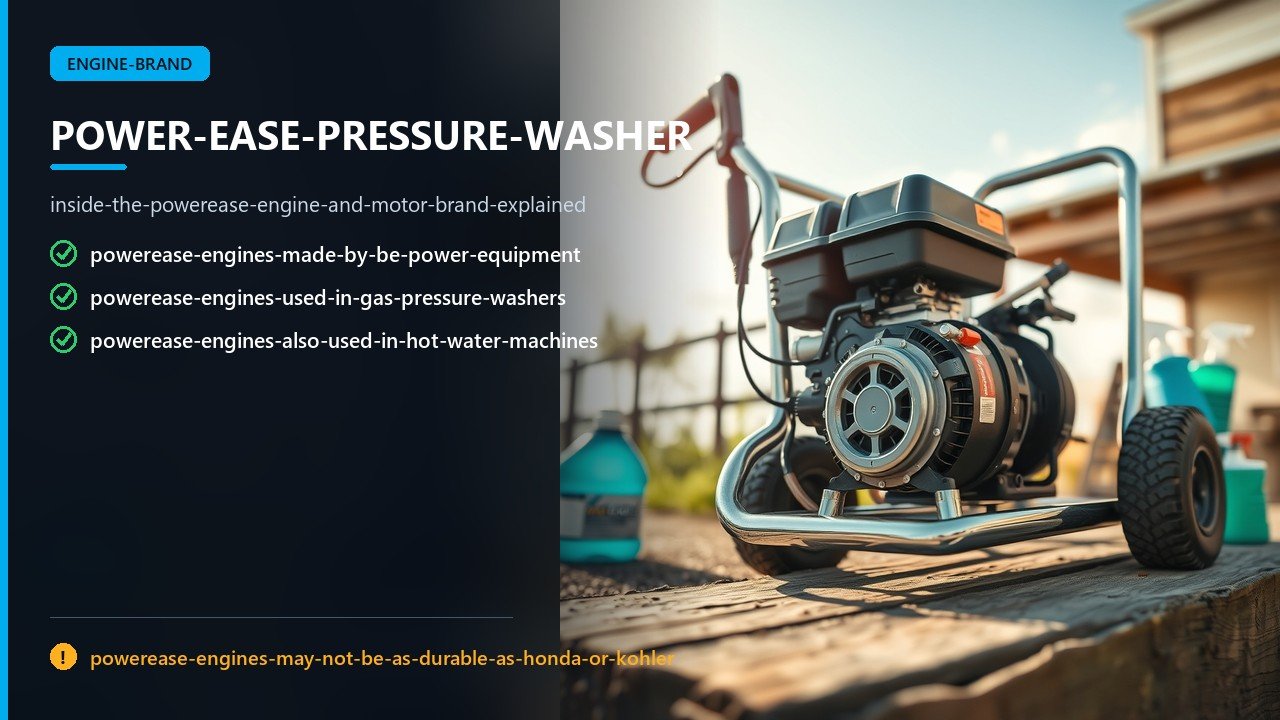
What “Power Ease” Actually Refers To
The spelling varies because the brand is a portmanteau of “power” and “ease,” chosen to suggest an engine that makes hard work easier. In BE’s catalog and on the engine maker’s own site, the trademark is written as one word: Powerease. On retailer listings, it often appears as “PowerEase,” and buyers occasionally type it “Power Ease.” All of these point to the same family of small engines and electric motors.
This matters because the badge on a pressure washer usually tells you who built the engine, not who built the machine. A pressure washer is a sum of parts, and the engine is one of the most important. Knowing that a Powerease engine sits behind the frame tells you where it was made, what it shares with other machines, and how easy it will be to service. Our guide to what is inside a gas engine pressure washer covers how that engine fits into the rest of the machine.
Who Makes Powerease Engines
Powerease is the engine and motor brand of BE Power Equipment, a Canadian company headquartered in Abbotsford, British Columbia, with additional assembly operations in the United States. BE builds pressure washers, generators, water pumps, and related equipment, and rather than relying entirely on outside engine suppliers, it developed its own engine line under the Powerease name. The engines themselves are manufactured in China to BE’s specifications, then fitted to machines assembled and tested closer to market.
The approach is common in outdoor power equipment. A manufacturer controls costs and availability by having a dependable house engine rather than sourcing every unit from Honda. What you give up in brand recognition, you often gain in price. What you need to verify is parts availability and service support, which is why it helps to know that the Powerease name is backed by BE and sold through BE Power Equipment and its dealer network.
The Powerease Engine Lineup
Powerease engines span a wide range of displacements, from small engines for water pumps up to large twin-cylinder units. The engine maker maintains its own site at powereaseengines.com, where the family is laid out. The lineup covers the sizes you will actually see on pressure washers.
| Engine | Role | Notes |
|---|---|---|
| Powerease 212 | Entry gas pressure washers | OHV, air-cooled, recoil start |
| Powerease 223 / R225 | Mid-size gas machines | 223cc, about 6 HP, 3/4 in horizontal shaft |
| Powerease 225 | Bestseller | Backs triplex pump machines near 3,800 PSI |
| Powerease 420 | Large cold and hot water machines | Drives 4,400 PSI / 4.2 GPM units |
| Powerease 420E | Large machines, electric start | 18-amp electric start for easier starting |
| Powerease 550 / V740 | Heavy equipment | Up to twin-cylinder, 30 HP class |
The practical takeaway for a pressure washer buyer is that Powerease covers the full span from a light residential 2,900 PSI unit up to a 4,400 PSI machine with a triplex pump. The same basic engine family shows up across BE’s line, which helps with familiarity and parts.
Powerease Electric Motors
Powerease is not only a gas engine brand. BE also fits Powerease electric motors to its corded electric pressure washers. These are induction motors rated in horsepower rather than cubic centimeters, and they run on standard household current. A Powerease electric motor is typically paired with an axial or triplex pump in a compact, maintenance-light electric machine.
| Motor | Typical output | Pairs with |
|---|---|---|
| Powerease 1.5 HP | 1,500 PSI class | Triplex pump, light residential |
| Powerease 1.6 HP | 2,300–2,500 PSI class | Axial pump, direct drive |
| Powerease 2.0 HP | 2,500 PSI class | Axial pump, workshop series |
These motors are rated at 120 volts, single phase, drawing in the neighborhood of 13 amps, and spinning at about 3,450 rpm. They are not rebuildable in the way a gas engine is, but they are simple, quiet, and require no oil changes or fuel management. For a look at how electric motors differ from gas engines, see our breakdown of what is really inside an electric washer.
Powerease Engines in Gas Pressure Washers
The clearest way to understand a Power Ease pressure washer is to look at actual machines. BE pairs its Powerease engines with pumps from suppliers such as CAT and AR, and the combinations cover residential through commercial work.
| Model | Engine | Output |
|---|---|---|
| BE327PX | Powerease 212cc | 3,200 PSI / 2.5 GPM, axial |
| BE3475PX | Powerease 223cc | 3,400 PSI / 2.5 GPM, axial |
| B3875PA | Powerease 225 | 3,800 PSI / 2.5 GPM, triplex |
| B4415PA | Powerease 420cc | 4,400 PSI / 4.2 GPM, triplex |
| HW4415PA | Powerease 420 | 4,400 PSI / 4.2 GPM, hot water |
The BE327PX is the classic entry example, and the retailer listing for it describes a compact cold water machine built for homeowners who want real cleaning power for weekend projects. It uses a maintenance-free CP axial pump and a recoil-start Powerease 212cc air-cooled OHV engine. At the other end of the range, the Powerease 420 engine drives the 4,400 PSI machines.
Powerease Engines in Hot Water Machines
Hot water pressure washers place extra demands on an engine because they also drive a burner and pump hot water. BE uses the Powerease 420 engine in this role. The Home Depot listing for the HW4015RA, for example, describes a 4,000 PSI / 4.0 GPM hot water gas pressure washer with a Powerease 420 engine and an AR triplex pump on a powder-coated roll cage. That is a serious commercial-grade machine, and the fact that BE trusts its own 420 engine to power it says something about the engine’s capacity.
If you are comparing hot water machines, the choice often comes down to the engine badge. BE sells near-identical hot water units with either a Powerease 420 or a Honda GX390, and the Honda version costs noticeably more. Our guide to the Honda engine that anchors professional machines explains what that premium buys. For many buyers, the Powerease version delivers the same pump and frame for less money.
Powerease Electric Pressure Washers
On the electric side, BE fits Powerease motors to corded machines such as the P2314EN, a 2,300 PSI / 1.7 GPM unit with a Powerease 1.6 HP motor and an axial pump. The P2314EN product page highlights a convertible frame, a maintenance-free direct-drive axial pump, and a built-in GFCI plug for safe outdoor use. These are the electric counterparts to the gas machines, aimed at homeowners, hobbyists, and small shops who want flexible power in a compact footprint.
The motor is the defining component of an electric pressure washer, and a Powerease motor is a standard induction design rather than anything exotic. That is good news for reliability and bad news for repairability if it fails, which is true of nearly all consumer electric washers. The troubleshooting guide covers what to check before replacing a motor. And if you prefer the simplest possible electric setup, a 1,500 PSI machine in the Powerease electric family is a sensible starting point.
What Powerease Shares With Other Engine Brands
One of the quiet advantages of a house-brand engine is that the displacements tend to match industry standards. A Powerease 212cc engine sits in the same size class as the many 208cc and 212cc engines used across the outdoor power equipment world, and a Powerease 223 or 225cc engine is a close cousin to the 224cc engines found on countless machines. That standardization means common maintenance items, spark plugs, and filters follow familiar sizes.
If you have owned a machine with a generic 208cc engine such as the ones behind many pressure washer brands, the Powerease experience will feel familiar: the same basic architecture, the same maintenance rhythm, and the same parts logic. The difference is support. Because Powerease is backed by BE and sold through a dealer network, replacement engines, belts, and pump parts are more traceable than for a no-name import.
Common Powerease Engine Features
Powerease engines carry the features that have become standard expectations on residential and light commercial equipment. Two of them are worth calling out because they protect the machine.
- Automatic low oil shutdown: the engine stops itself if oil runs low, preventing the kind of internal damage that ruins an engine. This is a hallmark of a modern OHV engine.
- Thermal relief valve: on the pump side, this valve dumps built-up hot water if the machine is left running with the trigger released, protecting the pump seals from heat damage.
- Recoil start, with electric start on the 420E: the 420E adds an 18-amp electric start for push-button convenience on larger machines.
These protections are not marketing fluff. Left running unattended, a pressure washer will heat the trapped water in the pump until seals fail; a thermal relief valve prevents that. The best prevention, though, is a good operating habit, which is why we cover caring for a gas pressure washer in detail.
Fuel and Maintenance for Powerease Engines
Powerease engines run on regular unleaded gasoline, and the engine maker specifies 86 octane or higher. They are four-stroke engines, so they take oil in a crankcase rather than a fuel-oil mix, and they need a periodic oil change, an air filter cleaning or replacement, and a spark plug check. None of this is unusual, but it is the difference between an engine that starts on the second pull for a decade and one that is dead by year three.
Fuel is where most small engines meet their end. Ethanol-blended gasoline left in a carburetor over the off-season gums up the jets and turns a good engine into a no-start headache. Use fresh fuel, add a stabilizer for storage, and run the engine dry before putting it away. Our guides to storing fuel correctly and to choosing the best gas for pressure washer engines cover the routine in full.
Powerease vs Honda: Which Should You Choose
This is the real question behind most Power Ease pressure washer searches. BE itself sells the same class of machine with either a Powerease or a Honda engine, so the comparison is unusually direct.
| Factor | Powerease | Honda GX |
|---|---|---|
| Price | Lower | Premium |
| Brand recognition | Lower | Highest |
| Parts availability | Through BE dealers | Widely available |
| Resale value | Moderate | Strong |
| Best for | Value-focused buyers | Commercial, resale-focused buyers |
For a homeowner who runs a pressure washer a few weekends a year, the Powerease version is usually the smarter buy: the same pump and frame, less money, and a warranty that is backed by a real company. For a contractor who runs a machine daily and may sell it later, the Honda premium is easier to justify. Our comparison of the Honda-engine machine lays out when that extra spend makes sense.
Who a Power Ease Pressure Washer Is For
The Powerease badge points to a machine that prioritizes value and serviceability over prestige. That describes a wide range of buyers.
- Homeowners clearing driveways, decks, siding, and vehicles who want gas power without a premium brand price.
- Property managers who need dependable machines they can maintain in-house via a dealer network.
- Small shops and hobbyists who want an electric Powerease motor for quiet, corded cleaning with a GFCI plug.
- Fleet and commercial buyers who want the 420 engine in a hot water machine without paying for a Honda badge.
If any of those describe you, a Power Ease pressure washer is worth a serious look. If you need maximum brand recognition and resale, the Honda-powered version of the same machine is the safer choice. Either way, you are buying the same BE frame and pump; only the engine badge changes.
How to Identify a Power Ease Pressure Washer
Spotting a Powerease machine is straightforward once you know where to look. The engine badge on the recoil housing or the model plate will name Powerease, often alongside the displacement in cubic centimeters. BE model numbers use a pattern of letters and numbers, so a code such as BE327PX or B4415PA tells you the platform and the pump at a glance. Retailer listings usually spell the engine name out in the product title, which is why the phrase “Powerease 212cc” or “Powerease 420 engine” appears so prominently.
If you are looking at a used machine and the sticker has worn off, the displacement and engine layout will still identify the family. A small single-cylinder OHV engine driving an axial pump points to the 212 class; a larger engine on a triplex pump with a roll cage points toward the 420 family. When in doubt, the BE model number on the deck is the fastest route to the specifications, and it is printed somewhere it can survive a decade of weather.
Powerease Beyond Pressure Washers
Because Powerease is a general-purpose engine line, it powers more than pressure washers. BE fits the same engines to water transfer pumps and generators, and the engine maker’s own lineup ranges from a small 79cc unit for light pumps up to the 740cc vertical-shaft twin used on larger equipment. This breadth is a quiet benefit to a pressure washer owner: the engine in your machine is not a one-off, and the same service knowledge applies across a whole family of equipment.
That shared architecture matters when you need help. A dealer who services BE water pumps and generators will recognize the engine in your pressure washer, because it is the same block and the same maintenance logic. A pressure washer is not an island, and a house engine that spans a manufacturer’s catalog is easier to live with than a component nobody else has seen. For an illustration of how a specific engine anchors a whole machine class, see our look at the setup and troubleshooting of a professional engine.
Warranty, Registration, and Support
The warranty behind a Power Ease pressure washer is one of its strongest arguments. Powerease engines carry a 2-year warranty, and BE’s machines carry a 3-year limited warranty that can be extended to 5 years when the product is registered. Registration is free and usually done online, and it is the step most buyers forget. If you skip it, you are leaving two years of coverage on the table for no reason.
Support runs through BE Power Equipment and its dealer network rather than a big-box returns desk. That is typical of commercial-grade equipment and it is not a drawback, but it does mean you should identify a servicing dealer before you need one. A machine with a real parts channel is worth more over its life than a cheaper one with no path to repair, which is exactly the calculation behind buying a branded engine. Our guide to choosing between cold and hot, direct and belt drive walks through the same trade-offs in machine configuration.
A Powerease Engine Won’t Start: What to Check
Small engines fail to start for a short list of predictable reasons, and knowing the order of checks saves time. Work from the simplest causes to the deepest.
- Fuel: stale or ethanol-blended gas is the single most common cause. Drain and replace with fresh fuel, then check that the petcock is open.
- Oil: the low-oil shutdown will prevent starting or stop the engine if the crankcase is low. Check the dipstick before anything else on a machine that has been sitting.
- Spark: pull the plug and check for a healthy spark. A fouled or worn plug is a cheap fix that solves a surprising number of no-starts.
- Air: a clogged air filter chokes the engine. Clean or replace it, especially after dusty summer work.
- Start procedure: confirm the choke and throttle are set correctly, and that the machine is level. On larger models, use the electric start if fitted.
Notice that none of these steps require a mechanic. Most Powerease no-starts are fuel, oil, spark, or air, in that order. Work the list and you will start the engine or confirm that the problem is genuinely deeper.
The Long-Term Ownership Picture
The real test of any house-brand engine is how it holds up over years of ownership, not how it reads on a spec sheet. On that measure, a Power Ease pressure washer is a known quantity: the engine is a standard OHV design, the wear items are common sizes, and the dealer network provides a route to parts. What determines the outcome is what has always determined it, which is whether the owner changes the oil, uses fresh fuel, and stores the machine properly.
Buyers who treat a Powerease machine as disposable and skip maintenance will get the short life they expect, and then blame the badge. Buyers who give it the same care they would give a Honda will find that it starts, runs, and cleans for years. The engine is not the weak point; neglect is. Treat the machine well and the value proposition behind choosing Powerease over a premium brand holds up exactly as intended.
Common Questions Buyers Ask
Are Powerease engines reliable? They are simple, robust OHV engines designed for residential and light commercial duty. Reliability depends far more on fuel and maintenance habits than on the badge, and BE backs them with a 2-year engine warranty and a 3-year machine warranty that extends to 5 years if registered.
Where are Powerease engines made? In China, to BE Power Equipment’s specifications, with machines assembled and tested closer to their markets.
Can I get parts for a Powerease engine? Yes, through BE Power Equipment and its dealer network. Common maintenance items such as plugs, filters, and belts are standard sizes that are easy to source.
Is Powerease the same as Power Ease? Yes. Powerease is the trademarked spelling of the engine and motor brand; “Power Ease” is how many shoppers type or say it. They refer to the same product.
Does the Powerease 420 need electric start? The standard 420 uses recoil start; the 420E adds an 18-amp electric start for larger machines. If pulling a rope on a cold morning is your least favorite part of the job, look for the E.
Frequently Asked Questions
What PSI does a Power Ease pressure washer deliver? Across BE’s full line, Powerease-powered machines range from about 2,900 PSI on the small 212cc units to 4,400 PSI on machines with the 420 engine. Electric Powerease models span roughly 1,500 to 2,500 PSI.
Is a Power Ease pressure washer good for commercial use? The larger Powerease 420 machines, especially the hot water units with triplex pumps, are built for commercial work. The small 212cc machines are residential-duty tools.
How long will a Powerease engine last? With fresh fuel, regular oil changes, and proper storage, a Powerease engine can last many years of seasonal use, and commercial-use machines can rack up hundreds of hours. Neglected fuel is the leading cause of early failure, not the engine itself.
Should I buy the Powerease or Honda version? Buy Powerease for value on part-time use, and Honda for daily commercial use and stronger resale. The pumps and frames are often the same, so the engine badge is the main difference.
Do Powerease electric motors need maintenance? Very little. They need no oil changes and no fuel care, though the axial pump on some models is maintenance-free by design. Keep the machine dry, check the cord and GFCI plug, and store it properly for winter to get the longest possible service life.
Final Thoughts
A Power Ease pressure washer is, at heart, a BE Power Equipment machine with a Powerease engine or motor under the hood. The name is worth understanding because it explains the price you are being offered: a house-brand powerplant that lowers cost while keeping the pump, frame, and warranty that matter most. The engines span a size range from small residential units to the 420 that drives 4,400 PSI hot water machines, and the electric motors cover the corded segment.
If you are shopping, stop treating “Powerease” as a warning sign and start treating it as a value signal. Look at the pump, the frame, and the warranty behind the machine, then decide carefully whether the Honda premium is worth it for your use. For most homeowners and many light commercial buyers, the Power Ease pressure washer is the sensible, serviceable, and affordable choice.