Every pressure washer eventually meets a surface it cannot quite reach. The second-story soffit. The far end of a hundred-foot driveway. The gutter line above the garage. The top of a fence the machine cannot get behind. When that moment comes, owners search for a phrase they half-remember: pressure wash extension. And they land in a confusing aisle, because “extension” can mean several different things, each solving a different reach problem. An extension wand adds length to the tool in your hand. An extension hose adds distance from the machine. A telescoping wand does both in an adjustable tube. Couplers join hoses together. Choosing the wrong kind of extension wastes money, and choosing the right one turns an impossible reach into a routine pass. The trick is knowing which reach problem you actually have, and matching the extension to it.
A pressure wash extension, broadly, is anything that lets the machine reach farther than its stock setup allows, and the category splits into two main approaches: extend the tool (wands) or extend the line (hoses). While overlapping in purpose, they behave very differently, trade off pressure and handling in different ways, and suit different jobs. This guide categorizes the extension options, explains when to extend the wand and when to extend the hose, how each affects pressure and control, the couplers and fittings that join extensions reliably, how to manage the flow losses that come with distance, and the safety habits that keep an extended setup from becoming a hazard.
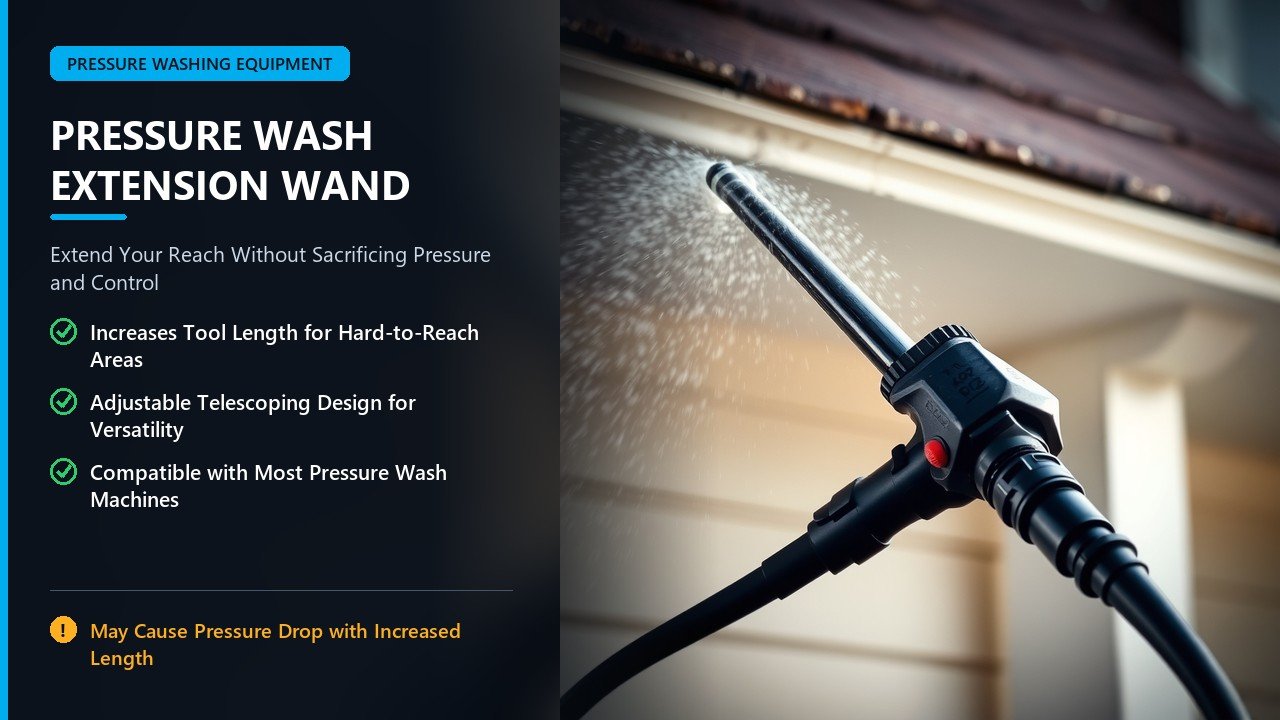
The Two Kinds of Reach
Reach problems come in two flavors, and the fix differs for each.
Vertical reach: getting up to the surface. Gutters, second-story siding, soffits, and roofs are above the operator. The machine can sit at ground level; the challenge is delivering water upward. This is a wand-length problem, and the answer is an extension wand or a telescoping wand that lets the operator aim upward from a safe stance. Our guide to how far a long wand should reach maps the lengths to the heights.
Horizontal reach: getting the machine’s stream to a distant surface. A long driveway, a big parking area, a wall the machine cannot approach, a fence line beyond the hose’s stock length. Here the surface is at operator height but far away, and the fix is more hose, not a longer wand. An extension hose lets the machine stay put while the operator carries the wand to the work. Our guide to how much hose length you need covers the horizontal case.
Why the distinction matters. A longer wand cannot solve a surface that is far away but at ground level, and more hose cannot solve a surface that is directly overhead. Buying the wrong extension leaves the reach problem intact, which is why the first step is always to name whether the unreachable surface is up or out.
The overlap case. Some jobs need both, such as cleaning gutters on a long building where the operator must also cover distance. Those setups combine a telescoping wand with a generous hose, and the pressure math for both extensions then stacks, which is why managing flow loss matters even more on a combined setup.
Extension Wands: Extending the Tool
When the problem is vertical or awkward reach, a wand extension is the tool.
Fixed extension wands. A single tube that threads or quick-connects between the gun and the nozzle, adding a set length of reach. Fixed wands are rigid, balance predictably, and have no joints to leak. They are the simple answer when you need one consistent extra reach, and they are the most durable option for a given length.
Telescoping wands. Adjustable tubes that extend for reach and collapse for storage, covering a range of heights with one tool. They are the practical general-purpose choice, with the catch that the lock and slip joint must be quality, because a cheap lock fails under pressure. Our guide to the telescoping wand covers the top end of the range.
What a wand extension changes. It adds length, and length is a lever: it enlarges the grip force, changes the stream’s angle to the surface, and spreads pressure over distance if the operator holds it wrong. A wand extension does not add pressure; it adds reach, and the operator has to adjust technique to keep the cleaning effective. Our article on wand attachments covers the grips and valves that improve control.
When to choose a wand extension. Gutters, fascia, soffits, second-story siding, roofs, and any surface directly above or beyond arm’s reach. If your unreachable surface is up or over an obstacle, a wand extension is the right category.
Extension Hoses: Extending the Line
When the problem is distance from the machine, more hose is the answer, and the details determine whether the machine still performs.
Longer hoses replace, not just add. The cleanest way to gain horizontal reach is a single longer hose rated for the machine, in the right diameter. Buying one 75-foot hose beats daisy-chaining three 25-foot hoses, because every additional connection is a potential leak and a small flow restriction. Our guides to the 50-foot hose and the 100-foot hose show the length trade.
Joining hoses with couplers. When a longer single hose is impractical or you already own shorter ones, a coupler joins two hoses. Couplers must be rated for the machine’s pressure and matched to the hose fittings, and each added joint increases the chance of a leak and reduces flow slightly. Joining hoses works, but it is the less elegant solution and should be done with quality couplers. Our guide to hose fittings identifies the connectors.
What a hose extension changes. Every foot of hose adds friction, which costs pressure and flow, and the loss grows faster with smaller diameters and higher flow. A long hose on a small machine produces a noticeably softer spray, which is why the diameter matters as much as the length. Upsizing to a larger hose diameter reduces the loss when a long run is unavoidable, and our flow guide explains the math. Our article on how hose diameter affects flow is the reference.
When to choose a hose extension. Long driveways, large flat areas, walls the machine cannot approach, and any surface that is at operator height but beyond the stock hose. If your unreachable surface is out rather than up, extend the line.
Managing Pressure and Flow Loss
Extensions add reach and cost performance, and understanding the trade keeps expectations honest.
Hose length costs the most. The single biggest performance cost of any extension is hose length, because friction grows foot by foot. A wand extension costs almost nothing in pressure, since it does not add hose friction, though it costs control. This is why a wand extension is often the better reach solution when the surface is reachable but high, and why long hose runs should be minimized.
Diameter offsets length. If a long hose is unavoidable, a larger diameter reduces the pressure loss for the same flow. Running a bigger bore on a long run is the standard fix, and it is why commercial long-reach setups use 3/8-inch hose rather than 1/4-inch. Our guide to 3/8 hose construction covers the high-flow side.
Nozzle choice recovers some loss. A slightly tighter nozzle can restore the feel of pressure on a long run, at the cost of flow, which is a usable trade for some jobs and a mistake for others. Tuning the tip to the setup is a legitimate technique, as long as the operator does not over-tighten and overheat the pump. Our guide to nozzle selection explains the trade.
Do not fight physics. A very long hose on a small machine delivers a soft spray no extension choice can fix. When reach demand outruns the machine, the honest options are a bigger machine, a bigger hose diameter, or accepting a slower, softer clean. Extensions help; they do not repeal the relationship between length, diameter, and output. Our guide to restoring lost pressure covers the diagnosis when the drop is more than expected.
| Extension | Solves | Costs |
|---|---|---|
| Fixed wand | Vertical/awkward reach | Control, leverage |
| Telescoping wand | Adjustable height reach | Lock complexity |
| Longer hose | Distance from machine | Pressure and flow |
| Hose coupler | Joining existing hoses | Leak point, small loss |
Choosing the Right Extension for the Job
Match the extension to the reach problem, and the purchase becomes obvious.
Gutters and second story. A telescoping or long fixed wand. This is vertical reach, and it is the most common reason owners buy an extension at all. A wand that reaches from the ground removes the ladder, which is the whole safety win.
Long driveway or parking lot. A longer hose, ideally a single larger-diameter hose rather than a joined stack. This is horizontal reach, and the goal is to keep the machine in one place while covering ground.
Roofline and overhangs. A long wand, used from a safe distance at an angle, for the rinse and pre-treatment stages of soft washing. The reach lets the operator stay on solid ground.
Walls the machine cannot approach. A longer hose, so the machine sits on the accessible side while the wand goes around or through the obstacle. This is distance, not height.
Both distance and height. A combined setup with a telescoping wand and a generous hose, accepting the stacked losses and tuning the tip to compensate. Combined setups work, and they are the most demanding on the machine’s flow.
Buy for the hardest reach on the job list. Then confirm the machine can still deliver at that extension. A wand extension is gentle on the machine; a long hose is not, so a hose extension should be sized to the machine’s flow with margin, and a wand extension should be balanced and lockable. Our guide to how far a wand should reach and the 100-foot hose guide pair to cover both categories.
Safety With Extended Setups
Extensions change the forces in the operator’s hands, so the safety habits change with them.
The ground stays better than the ladder. The primary value of a wand extension is avoiding heights. The OSHA falls guidance confirms falls as a leading cause of serious injury, and an extension wand is a fall-prevention tool. Do not cancel its benefit by climbing anyway for one stubborn spot.
Longer wands transmit more force. A wand extension lengthens the lever, so trigger force and kickback are felt more at the grip. Keep both hands on, plant your stance, and use a ball valve or grip to control the flow rather than fighting the trigger all day.
Longer hoses trip people. An extension hose strung across a driveway or walkway is a trip hazard and an abrasion victim. Route it along edges, keep it off the ground where possible, and reel it when not in use. A hose on the ground gets stepped on and driven over, which shortens its life and risks a fall.
Joined hoses need inspection. Every coupler in an extended line is a potential burst point at pressure. Check couplers before each job, and replace any that weep or show wear. At high pressure a failed joint can whip, so treat each connection as a safety-relevant part. Our guide to preventing hose burst failures covers the checks.
Fittings, Couplers, and O-Rings on Extended Lines
An extended setup lives and dies by its connections, and the hardware at each joint deserves as much attention as the hose or wand itself.
Rated connectors only. Any coupler, adapter, or quick connect used to extend a line must be rated for the machine’s working pressure with margin. A cheap fitting at the joint becomes the system’s weakest point, and at high pressure the failure is dangerous, not merely a drip. Insist on brass or stainless fittings rated above your machine.
Match the thread type. M22 and NPT threads look similar and are not interchangeable, and quick-connect plugs and sockets come in sizes that do not always cross over. Mismatched threads invite cross-threading and leaks, so identify each end before buying. Our fitting guide helps confirm what you have and what you need.
O-rings and seal faces. Quick-connect joints and couplers rely on o-rings to seal, and a worn, grit-scored, or wrong-size o-ring is the most common source of a weeping joint. Keep a small kit of replacement o-rings in the sizes your setup uses, and clean the seal faces before reassembling a joint. A five-cent o-ring is the difference between a dry joint and a constant drip.
Swivels at the wand. On an extended setup, a swivel between the hose and the wand lets the line rotate instead of kinking at the connection, which protects both the hose and the operator’s wrists. A swivel is a small upgrade that pays off every job on a long or wand-extended setup. Our guide to hose swivels covers the fix and the choice.
Test before you commit. After connecting an extended line, pressure-test it briefly before committing to a full job. Check every coupler, adapter, and swivel for drips and confirm that the machine still builds pressure. Five minutes at the start prevents the mid-job failure that wastes a day and soaks a customer’s site.
Building a Complete Extended Setup
Putting the pieces together into one dependable kit turns the extension decision into a working system.
Start with the machine’s real capability. Before buying any extension, know the machine’s PSI and GPM and its pressure loss tolerance. A high-flow machine tolerates a long, larger hose far better than a small electric unit, and the extension kit should respect that ceiling. Our guide to how hose diameter affects flow sets the sizing.
Choose the hose that reaches without waste. Buy the shortest length that covers the farthest horizontal reach on your job list, in the largest diameter the machine’s flow can use without waste. A single longer hose in the right diameter is the cleanest possible extended line. Our guides to the 50-foot and 100-foot hoses help pick the length.
Add the wand for vertical reach. If the job list includes gutters, second stories, or anything overhead, add a telescoping or long fixed wand in a length matched to the highest surface. Include a ball valve or grip for control, and confirm the wand’s fittings match the rest of the setup. Our guide to how far a wand should reach settles the length.
Standardize on quick connect. Build the whole kit around one connector standard so every hose, wand, and accessory joins the same way. Standardizing on quick connect at the working ends slashes the adapter clutter and the leak points, and it makes switching between the extended and stock setups a two-second job. Our fitting guide covers the standard.
Carry a small spares kit. A handful of o-rings, a couple of spare couplers, thread sealant, and clamps turn a mid-job leak into a two-minute repair. On a commercial site, that spares kit is the difference between finishing the job and scheduling a return trip. Extended setups have more joints, and more joints mean the spares kit earns its place.
Store it as a unit. Keep the extended hose, wand, fittings, and spares together on a reel or in a labeled bin so the whole setup deploys consistently. A kit that lives together works together, and the next job starts with everything on hand rather than a hunt through the garage. Our reel guide’s storage section covers the tidy option.
Common Extension Mistakes
Buying a wand to solve a distance problem. A longer wand cannot reach a surface that is far away but at ground level. Extend the hose instead.
Buying hose to solve a height problem. More hose does not reach a surface directly overhead. Extend the wand instead.
Joining many short hoses. Each coupler leaks and restricts flow. Use a single longer hose when possible.
Undersizing a long hose. A small-diameter long hose chokes flow. If the run is long, upsize the diameter.
Cheaping out on a telescoping lock. A weak lock collapses under pressure. Buy quality or use a fixed wand.
Over-tightening the nozzle to recover lost pressure. A tiny tip on a long run overheats the pump. Adjust within reason.
Ignoring extension safety. Longer wands hit harder and longer hoses trip people. Adjust your habits to the setup.
Frequently Asked Questions
What is a pressure wash extension? Any accessory that extends reach, either the tool (a longer or telescoping wand for vertical reach) or the line (a longer hose or coupler for distance).
Do I need an extension wand or an extension hose? A wand for surfaces above or awkward to reach; a hose for surfaces far from the machine at ground level. Name whether the problem is up or out first.
Can I join two pressure washer hoses together? Yes, with a coupler rated for your machine’s pressure and matched to your fittings. Each joint adds a small flow loss and a potential leak, so a single longer hose is cleaner.
Does a longer hose reduce pressure? Yes, through friction, and the loss grows with length and shrinks with a larger diameter. Upsize the hose for long runs to limit the loss.
Does a longer wand reduce pressure? It does not change the machine’s pressure, but it changes the angle and distance to the surface, which affects cleaning if aimed poorly. Technique matters.
What is the best extension for cleaning gutters? A telescoping or long fixed wand, used from the ground, so you avoid ladders entirely. It is the safest and most effective vertical-reach extension.
Final Thoughts on Pressure Wash Extensions
A pressure wash extension is really a decision about which reach problem you have, and the answer splits cleanly: extend the tool to go up, and extend the line to go out. Wands, from fixed tubes to telescoping wands, add vertical and awkward-angle reach and cost mainly control. Hoses, from a single longer hose to at least-reliable couplers, add distance from the machine and cost real pressure and flow, which the diameter can partly recover. Knowing which you need before you buy is the whole game, and it prevents the common mistake of forcing one kind of extension to solve the other kind of problem.
Match the extension to the job, then match it to the machine, confirming that the setup can still deliver at the extra reach and that the wand or hose is rated for the pressure it carries. Keep hose runs as short and as wide as the work allows, keep wand lengths within reason and their locks solid, and inspect every connection on an extended line as the potential weak point it is. Avoid the ladder and plant your feet, because reach that keeps you safe is worth more than reach that wins the last stubborn stain. Do all of that, and the surfaces that used to be out of bounds become routine passes, reached with the same machine that once could not quite get there.