A pressure washer trailer is the difference between owning a cleaning machine and running a cleaning business. The machine itself is only part of the story. What turns a pressure washer into a job-ready rig is the platform under it: a trailer that carries the machine, the water, the hose, the chemicals, and everything else you need to arrive at a site and start working in minutes. Once you understand how these rigs are sized, plumbed, loaded, and towed, the equipment stops being a mystery and starts being a business decision you can make with confidence.
This guide is the broad overview. It explains what a pressure washer trailer actually is, how to size the tank to your pump, the weight math that decides your axles, when to build, buy, or rent, how to lay one out for balance and speed, and the maintenance habits that keep it earning. Where a topic deserves a deeper dive, we point you to our focused guides so you can go straight to the detail you need.
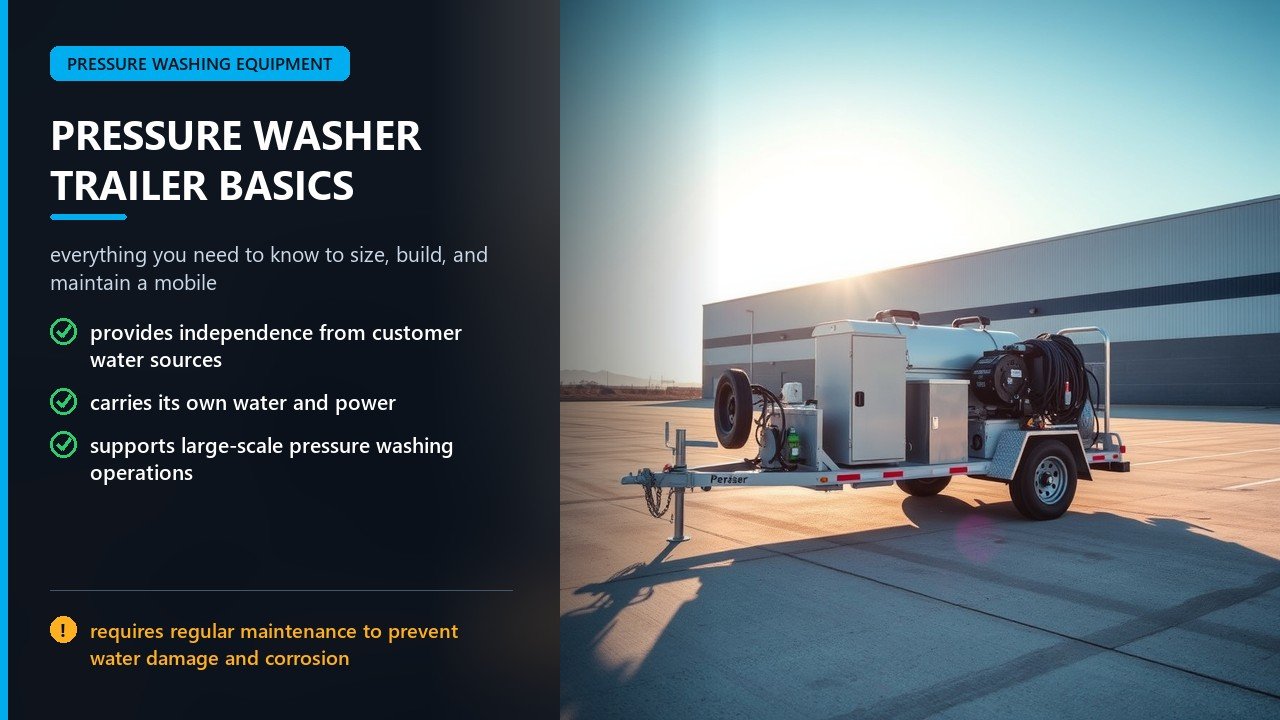
What a Pressure Washer Trailer Actually Is
At its simplest, a mobile pressure washing trailer is a towable steel frame that carries a high-output pressure washer, a water tank, hose reels, and supporting gear. The point is independence. A portable machine tied to a garden hose is limited by the customer’s spigot and by how far you can drag a hose. A trailer rig carries its own water, its own power, and enough hose to reach across a large property without moving the vehicle.
The distinction that matters most is between a trailer rig and a skid. A skid is a self-contained unit that slides into a truck bed or a van. A trailer is a purpose-built platform you tow behind a truck, SUV, or van. Both are legitimate, and the choice usually comes down to water capacity and how you park. A skid is cheaper to start, easier to park on a tight residential street, and easy to hide at night. A trailer carries more water and gear, keeps the truck bed free, and can be unhitched and left on a job site. Most solo operators start with a skid and move to a trailer the moment water capacity, not ambition, becomes the bottleneck.
What separates a professional pressure washing trailer from a box-store machine bolted to a utility trailer is the quality of the frame, the pump, and the plumbing. A powder-coated or galvanized trailer with a proper axle rating, marine-grade wiring, stainless fittings, and a name-brand triplex pump is a tool you can rely on for years. A cheap trailer with a painted frame, household wiring, and a no-name pump is a liability that will strand you on a job site. The photos look similar. The field performance does not.
Cold Water or Hot Water Trailer
The first real decision is water temperature. Cold water handles the majority of residential and light commercial work: driveways, sidewalks, siding, fences, and patios. Hot water is what unlocks grease, oil, animal fats, and heavy industrial grime. The difference in cleaning power is not subtle. Heat cuts through contaminants that cold water only smears around, and it lets you use less chemical to get the same result.
The tradeoff is cost and complexity. A hot water unit adds a burner, a fuel source, and a heating coil, which raises the price and adds a component that can fail. Coils built from cheap pipe are a common warranty headache, which is why experienced buyers pay attention to how the coil is made. If your work routinely involves restaurants, fleet vehicles, kitchen exhaust, or industrial degreasing, hot water is not optional. If your work is residential flatwork and soft washing, a cold water trailer will serve you well and cost far less to run and to repair.
| Feature | Cold Water Trailer | Hot Water Trailer |
|---|---|---|
| Typical PSI and GPM | 3,500 to 4,000 PSI, 4 to 8 GPM | 3,000 to 4,000 PSI, 4 to 5.5 GPM |
| Best for | Driveways, sidewalks, siding, patios, soft washing | Grease, oil, fleet washing, hoods, industrial degreasing |
| Chemical use | More detergent needed on grease | Less chemical, faster dwell and rinse |
| Upfront cost | Lower | Several thousand dollars higher |
| Maintenance | Simple, few moving parts | Adds burner, fuel, and coil service |
| Fuel source | Gas or diesel engine only | Engine fuel plus burner fuel |
Sizing the Tank to Your Pump
This is where most first-time buyers go wrong. They ask how much water a job needs and buy a tank that holds that much. That is the wrong question. With a float valve fitted, the customer’s spigot feeds the tank the entire time you work, so the tank never has to hold the whole job. It only has to cover the difference between what your machine draws and what the spigot delivers, for as long as the trigger stays down.
A residential spigot commonly delivers 4 to 6 GPM, and it drops further through a long or narrow hose. A contractor machine draws 5.5 to 8 GPM. That shortfall is what the buffer tank exists to cover. A 5.5 GPM machine on a 4 GPM spigot runs 1.5 GPM short, so a 45-minute continuous run needs about 68 gallons, not the 248 gallons the job actually consumed. This is why 65- and 100-gallon tanks are the common residential answers, and why operators usually buy one size up so the tank acts as a buffer rather than a countdown.
It also pays to measure the spigot rather than assume it. A five-gallon bucket filled in 60 seconds is 5 GPM. Timing the water at the property, through the hose you actually use, tells you more than any rule of thumb and lets you decide whether to bring water or trust the supply. When there is no water source at all, the tank becomes the whole supply, and you size it to the job: 200 to 325 gallons for a full-time rig, 525 gallons and up for commercial flatwork and fleet washing.
| Tank Size | Typical Use | Water Weight |
|---|---|---|
| 65 to 100 gallons | Residential buffer tank, spigot on site | 542 to 834 lb |
| 200 to 325 gallons | Most full-time rigs, sweet spot | 1,668 to 2,711 lb |
| 525 gallons and up | Commercial flatwork, no water on site | 4,379 lb and up |
The Weight Math That Decides Your Axles
Water is heavy. It weighs about 8.34 pounds per gallon, so a 100-gallon tank is 834 pounds of water alone, and a 225-gallon tank is roughly 1,877 pounds before you bolt down a single pump or reel. Add the machine, reels, hose, surface cleaner, chemicals, and fuel, and a modest rig easily approaches three quarters of a ton. This is the number that decides your trailer’s gross vehicle weight rating and your truck’s tow capacity, and it is the most commonly underestimated figure in a rig build.
Compare your fully loaded total against the trailer’s GVWR, not its empty weight, and against your vehicle’s tow rating including the weight of the trailer itself. A single-axle trailer with a 3,000-pound GVWR suits lighter residential rigs. Once you are carrying 200 gallons or more with a commercial machine and reels, a tandem-axle trailer with a 7,000-pound GVWR is the safer choice. It has the payload, it usually comes with brakes, and it handles a blown tire far better at highway speed. Overloading reduces braking, invites sway, can void insurance, and risks a failure that no schedule can absorb.
Tongue weight is the other half of the equation. Roughly 10 to 15 percent of the loaded weight should sit on the tongue. Put the tank over or slightly ahead of the axles, not behind them. A tail-heavy trailer sways at highway speed, and with a full tank behind the axle that sway can turn into a loss of control. A baffled tank, or one kept either close to full or close to empty while towing, prevents the water from surging under braking and shoving the rig around.
The Anatomy of a Working Rig
Once the platform and tank are decided, the rest is components and plumbing. A solid pressure washer trailer setup generally includes the following.
- Pressure washer. A belt-drive triplex pump machine in the 4 to 8 GPM range. Belt drive runs cooler and lasts longer than direct drive under continuous trailer use, which is why it is the standard for mobile rigs.
- Water tank and float valve. The buffer tank described above, with a float valve fed by the site’s hose so the tank refills while you work.
- Suction plumbing. A short, large-diameter, wire-reinforced suction line from the tank outlet to the pump inlet, with a strainer to catch grit. A garden hose used for suction collapses and starves the pump.
- Hose reels. A high-pressure reel holding 150 to 200 feet of hose so you can reach across a property without repositioning, plus a supply reel and, on soft wash rigs, a chemical reel.
- Surface cleaner. A 20-inch surface cleaner matched to your GPM dramatically speeds up flatwork and improves the finish.
- Chemical injection. A downstream injector after the pump so soap never passes through the pump seals, or a separate 12-volt soft wash pump for bleach-based work.
- 12-volt system. A deep-cycle battery, fuses, and marine-grade wiring for lights, accessory pumps, and, on some rigs, a generator.
Plumbing deserves special attention because pumps rarely fail from use. They fail from starvation: running dry, running against a restriction, or cavitating on air. Keep the tank outlet at least as large as the pump inlet, mount the tank so its outlet sits above the pump inlet and gravity feeds, put a filter before the pump rather than after, and route the unloader bypass back to the tank instead of looping it into the pump inlet. Each rule exists to keep water arriving faster than the pump can ask for it.
Build, Buy, or Rent
There are three legitimate paths to a trailer rig, and the right one depends on your budget, your time, and how certain you are about the work.
Building a rig on a used utility trailer is the cheapest route if you have the skills. You control every component and you can spread the cost over time. The risk is that a first build gets the weight distribution or plumbing wrong, and those mistakes are expensive to undo. A small rig comes together quickly with care, as we cover in our guide to building a 5×8 pressure washing trailer that works.
Buying a turnkey or lightly used rig saves build time and arrives plumbed, wired, and tested. You pay more for that convenience, but you also inherit someone else’s engineering. Because there is so much variation in quality, the buying process rewards patience and inspection, which is exactly what our article on how to choose power wash trailers for sale that last walks through.
Renting is the low-risk starting point. It lets you test a machine before committing, cover a surge of work without capital, or bridge a gap while your own rig is down. For short-term, high-demand jobs, renting a full trailer can be the smartest call, and our guide on a pressure washing trailer for rent covers what rentals include, what they cost, and when renting beats buying.
Layout and Weight Distribution
A rig is built once and worked daily for years, so the layout decisions you make during the build are the ones you live with every job. Good layouts follow a simple order. Put the water tank over or just ahead of the axles because it is the heaviest item and its load changes all day. Place the pressure washer beside the tank with its controls facing the curb side, so you can check oil and start the engine without climbing over hose. Mount hose reels at the rear or curb side so you can pull hose straight off the back toward the property. If you run a soft wash system, put its tank and pump on the opposite side from the engine to balance side-to-side weight and keep chemicals away from engine heat.
Secure everything as if it will be tested in an emergency stop, because eventually it will be. Bolt engines and pumps down with Grade 8 hardware and backing plates, use rubber isolators under the engine mounts to absorb vibration, and strap tanks with heavy ratchet straps or steel bands. A 225-gallon tank that shifts in a hard stop carries the momentum of a small car. Label every valve and switch, keep frequently used nozzles and chemicals within reach, and practice a consistent setup and teardown routine so nothing gets forgotten and nothing slows you down.
Towing Safety and the Legal Side
A loaded pressure washing trailer is a serious vehicle, not an accessory. Before every tow, check the coupler, safety chains, brake connections, tire pressure, and lights. Grease the wheel bearings on schedule and carry a spare tire, a jack, and basic tools so a flat does not end your workday. Confirm that your tow vehicle’s rating covers the trailer plus its load, and remember that a full water tank changes handling, braking distance, and fuel economy.
There is also an environmental responsibility that never goes away. Wash water carrying oil, grease, and detergent should not be dumped into a storm drain, because those drains usually flow untreated to a river or lake. Many commercial jobs require you to contain or recover runoff, and the Environmental Protection Agency publishes stormwater guidance that applies to a wide range of cleaning work. Keeping the rig clean and compliant protects your business as surely as maintaining the pump does.
Maintenance That Keeps the Trailer Earning
A trailer rig earns only when it runs, so maintenance is not a chore, it is the business model. Several habits carry the most weight. Service the pump oil on schedule, because a pump starved of clean oil is the most expensive failure on the rig, and our guide on what type of oil for a pressure washer pump keeps it running explains the specifics. Keep the inlet strainer clean so grit never reaches the pump. Inspect hoses and fittings before each job and replace anything frayed before it bursts under pressure. Check all bolts after the first 20 hours and then monthly, because vibration works hardware loose.
Winter is the season that ends rigs prematurely. Drain the tank, pump, and lines before the first freeze, or run RV antifreeze through the entire system, including the reels and any soft wash lines. A cracked pump manifold costs far more than a jug of antifreeze, and a freeze on an undrained system can take you out of work for weeks. For a complete seasonal routine, see our guide to power washing preventative maintenance for long machine life.
What a Pressure Washer Trailer Lets You Clean
The whole reason to own a trailer rig is the range of work it opens up. With onboard water and enough hose, a single operator can handle driveways, sidewalks, patios, and parking lots using a surface cleaner, wash siding and fences with a downstream injector, and take on commercial projects that a portable machine cannot touch. Add a soft wash system and you can safely clean roofs and delicate siding at low pressure. Add hot water and you can move into grease and fleet work.
That expanded capability changes how you bid. A rig that reaches across a property without repositioning means fewer hours per job. Onboard water means no dependence on a customer’s spigot and no lost time hunting for a working hose bib. Fast setup and teardown means more jobs per day, and more jobs per day is the entire economic argument for the trailer. It is not the machine that makes the money; it is the time the machine saves.
Common Mistakes to Avoid
- Buying the tank before checking payload. Do the 8.34-pounds-per-gallon math against the trailer’s GVWR first.
- Towing a half-full tank without baffles. The water surges forward under braking and pushes the trailer around.
- Loading too much weight behind the axle. It lightens the tongue and causes sway at highway speed.
- Looping the unloader bypass into the pump inlet. Route it back to the tank so it does not overheat the pump.
- Using a garden hose for suction. It collapses and starves the pump, which is the leading cause of cavitation damage.
- Skipping winterization. One hard freeze on an undrained system cracks the pump and splits hoses.
- Neglecting the trailer itself. Bearings, tires, lights, and couplers fail quietly and strand a rig that otherwise runs perfectly.
Answers to the Questions Contractors Ask Most
How big a trailer do I need for a pressure washing rig?
A 5×8 or 6×10 trailer suits a small residential rig with one machine and a modest tank, and it tows behind a half-ton pickup. A 6×12 tandem-axle trailer with a 7,000-pound GVWR is the common choice for a full-time rig because it carries a 200- to 325-gallon tank, a machine, and two or three reels while still handling a blowout safely. Go larger only when the work justifies the harder parking.
What size buffer tank do I need?
Size it from the shortfall. Subtract the site’s spigot flow from your machine’s GPM, then multiply by the minutes the trigger stays down. A 5.5 GPM machine on a 4 GPM spigot runs 1.5 GPM short, so a 45-minute run needs roughly 68 gallons. Buy the next size up so the tank is a buffer rather than a countdown.
Cold water or hot water?
Choose hot water if your work involves grease, oil, fleet washing, kitchen exhaust, or industrial degreasing, because heat cuts those contaminants in a fraction of the time. For residential flatwork and soft washing, a cold water trailer costs less to buy, run, and repair and does the job well.
Is a trailer better than a skid in a truck bed?
A trailer carries more water and gear, keeps the truck bed free, and can be unhitched at a site. A skid is cheaper to start, easier to park on a residential street, and easier to hide at night. Start with a skid and move to a trailer when tank capacity, not ambition, becomes the constraint.
How much does a pressure washer trailer cost?
A basic homemade residential rig on a used trailer might total a few thousand dollars, while a professionally built commercial trailer with a high-flow machine, large baffled tank, hot water, and soft wash can run into the tens of thousands. The trailer and tank are rarely the expensive part; the machine and surface cleaner usually are.
Do I need brakes on a pressure washer trailer?
For a small residential rig under a few thousand pounds, brakes are often optional. Once you carry 200 gallons or more with a commercial machine and reels, a tandem-axle trailer with brakes is the safer choice. Brakes shorten stopping distance, reduce sway, and handle a tire failure far better than an unbraked single axle.
How do I winterize a pressure washer trailer?
Drain the tank, pump, and all lines, then run RV antifreeze through the entire system, including the reels and any soft wash plumbing. Add a low-point drain and a way to introduce antifreeze during the build, because both are difficult to retrofit neatly once the rig is plumbed.
The Bottom Line
A pressure washer trailer is not one piece of equipment. It is a system of decisions that stack: the trailer and its axles, the tank and its placement, the machine and its pump, the plumbing and its suction rules, the reels and the layout, and the maintenance routine that keeps every part running. Get the weight math right, plumb for reliable water without cavitation, lay the rig out for balance and speed, and it will pay for itself in the jobs it lets one person complete. Get those things wrong, and you will spend more time fixing the rig than working from it.
The good news is that the rules are learnable, and none of them are secret. Size the tank to the pump, keep the tongue weight right, feed the pump faster than it draws, secure everything as if the road will test it, and winterize without fail. Do that, and the trailer stops being a source of worry and becomes what it was always meant to be: the reason your cleaning business can grow.