Every time you switch a nozzle, swap to a turbo tip, or clip on a foam cannon, you either uncouple a fitting or fight with threads. Over a cleaning job, those seconds add up, and on a commercial route they add up to real time. A pressure washer wand with quick connect removes that friction. Instead of threading and unthreading, you push, click, and clean. It is a small feature that changes how a job flows.
A quick connect wand is a wand that uses push-to-connect fittings for the nozzle or attachments, so you can change tips and add accessories in a second without tools. It is one of those upgrades that seems minor until you use it, after which going back to threaded connections feels like a step backward. Pretty much every modern commercial wand uses quick connect, and for good reason.
This guide explains what a quick connect wand is, how quick connect works on a wand, the different types of wands that feature it, how to convert a fixed wand to quick connect, how to match fittings and sizes, what to look for when buying, how to maintain it, and the mistakes to avoid. If you want to speed up every job, this is where to start.
What a Quick Connect Wand Is
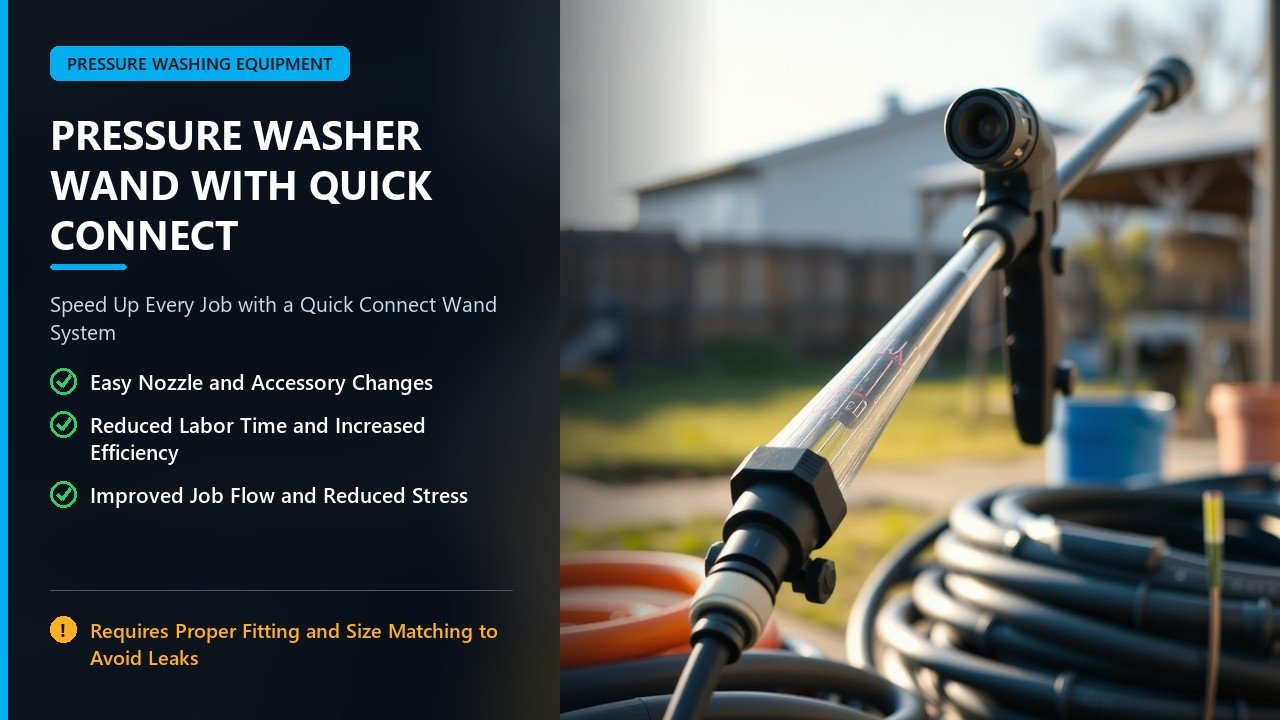
A quick connect wand, sometimes called a QC wand or plug-in wand, is a pressure washer wand that terminates, at the tip, in a quick connect coupler rather than a threaded end. Instead of screwing a nozzle onto the end, you push the nozzle’s plug into the wand’s coupler and it locks in place. To change nozzles, you pull back the collar and swap them.
Many QC wands also use quick connect at the inlet, so the wand clips onto the gun or an extension rather than threading on. The result is a wand that interacts with the rest of your setup instantly, with no tools and no thread tape. This is the standard on professional equipment because it saves time on every single nozzle change.
The practical benefit is simple: on a job where you might change nozzles half a dozen times, a QC wand saves several minutes and a lot of annoyance. Over a season, that is meaningful. It also reduces wear, because you are not repeatedly tightening and loosening threads that can strip or cross-thread.
How Quick Connect Works
Quick connect fittings work with a plug and a coupler, held together by spring-loaded balls and a sliding collar.
The coupler is the female side. It has a sleeve that, when pulled back, releases the locking balls that grip the plug. Inside the coupler is an O-ring that seals against the plug to prevent leaks.
The plug is the male side, with a groove that the locking balls grip. When you push the plug into the coupler, the balls snap into the groove and lock it in place. Pull the collar back and the plug releases.
The seal is the O-ring inside the coupler, which creates a watertight connection. When a QC fitting drips, the O-ring is usually the culprit, and replacing it is the fix.
This design is why quick connect works without tools and why it holds firmly under pressure. It is used across pressure washer guns, wands, nozzles, surface cleaners, and hoses precisely because it is fast and reliable. Our guide to the pressure washer gun quick connect explains the same system as it applies to guns.
Types of Wands That Offer Quick Connect
Quick connect appears on several kinds of wands, each suited to different work.
Standard QC wands. The common straight wand that clips onto a gun or extension, with a QC tip for nozzles. This is the everyday wand on most setups.
QC extension wands. Longer wands that extend reach for siding, roofs, and high surfaces, with a QC connection at the tip so nozzles still swap instantly. Our guide to pressure washing wands covers choosing the right extension length and nozzle.
Insulated wands. Wands with a grip designed for cold or hot water, used on hot water machines. They must be rated for the temperature to survive.
Angled and telescoping wands. Angled wands reach under vehicles and into gutters, and telescoping wands extend to clean high surfaces. Both commonly use QC fittings so tools swap quickly.
Snub nose wands and guns. Short wands used for vehicle detailing and close work, often with QC for fast nozzle changes. Our article on snub nose pressure washer guns covers the short-barrel options.
Regardless of the type, the QC feature is what makes each of them fast to use, because it turns nozzle changes from a chore into a click.
| Wand Type | Best For | QC Benefit |
|---|---|---|
| Standard QC wand | Everyday cleaning | Instant nozzle changes |
| Extension wand | Siding, roofs, high spots | Swap nozzles while extended |
| Insulated wand | Hot water machines | Fast swaps on hot water jobs |
| Angled wand | Under vehicles, gutters | Add a nozzle without tools |
| Telescoping wand | High reach | Quick tip changes at height |
| Snub nose | Vehicle detailing | Rapid switching for car work |
Converting a Fixed Wand to Quick Connect
If your wand has a threaded tip and you want the speed of quick connect, you do not need a new wand. You need a quick connect adapter.
The adapter. A QC wand adapter is a threaded fitting on one end and a QC coupler on the other. You thread the adapter onto your wand’s threaded tip, and now your wand accepts QC nozzles and attachments. This is the simplest upgrade, and it is inexpensive.
Match the threads. The threaded end must match your wand’s thread, which is usually M22 but can vary. Confirm the thread size and type before buying, and use thread tape or a sealing washer if needed to prevent leaks.
Match the QC size. The coupler end should match the size of your nozzles and plugs, which is commonly one-quarter inch. Buying the wrong size defeats the purpose.
Or replace the wand. If your wand is worn or old, buying a new QC wand outright is often simpler than adapting a tired one. A quality QC wand with a comfortable grip and a robust coupler will outlast a cheap adapter on a worn wand.
Either way, the goal is the same: get to the point where changing a nozzle takes a second, so you spend your time cleaning rather than fiddling. Our guide to quick connects for pressure washers covers matching the whole system so everything fits together.
Matching Fittings and Sizes
Quick connect is only fast if everything fits. Getting the sizes right is the key to a working system.
Threaded connections on pressure washers are most commonly M22, appearing on pumps, guns, hoses, and some wands. M22 has a male and female version, and both must match. Our guide to pressure wash hose connector types explains threaded connections and adapters.
Quick connect plugs and couplers come in quarter-inch and three-eighths inch for accessory connections. These are the fast connections for guns, wands, surface cleaners, and hoses.
Nozzle QC uses a smaller, nozzle-specific plug that fits the end of a wand or gun. Most pressure washer nozzles use this standard size, so replacement nozzles fit a QC wand directly.
The most common compatibility problem is mixing these categories, threading a nozzle onto a QC tip, or buying a three-eighths plug for a quarter-inch coupler. The fix is adapters, but buying the right size in the first place is simpler. Our guide to the 3 8 pressure washer quick connect explains the sizes in detail.
What to Look For When Buying a QC Wand
Not all quick connect wands are built the same. These features separate a good one from a frustrating one.
A quality coupler. The coupler takes the most abuse, so it should be metal, smooth to operate, and lock firmly. A cheap coupler leaks and releases prematurely.
A comfortable grip. You hold the wand for hours, so a grip that is easy on the hand matters. Rubberized or insulated grips are a plus, especially for hot water.
Stainless steel tube. A stainless tube resists corrosion and lasts far longer than painted steel, which rusts and flakes.
The right length and angle. Match the wand to your work. A standard straight wand for general use, an angled wand for under vehicles and gutters, an extension for reach.
Correct QC size. Confirm the wand’s QC size matches your nozzles and plugs, whether quarter-inch or three-eighths.
Temperature rating. If you use hot water, the wand and its grip must be rated for the temperature, or the grip and seals degrade quickly.
| Feature | Why It Matters | Look For |
|---|---|---|
| Coupler quality | Most abused part, holds connection | Metal, smooth, locks firmly |
| Grip | Comfort over long jobs | Rubberized or insulated |
| Tube material | Corrosion and durability | Stainless steel |
| Length and angle | Match to the job | Standard, angled, extension |
| QC size | Compatibility with nozzles | 1/4 or 3/8, matched to your kit |
| Temperature rating | Hot water compatibility | Rated for your machine’s heat |
Maintaining a Quick Connect Wand
Quick connect parts need a little care to keep working smoothly.
Keep fittings clean. Grit and debris in a coupler cause leaks and rough operation. Rinse and wipe fittings, and keep them out of the dirt when not in use.
Replace O-rings. A dripping QC connection is almost always a worn O-ring. Keep spares on hand, because replacing one takes seconds and restores a leak-free seal. Our guide to pressure washer O rings covers the full system.
Lubricate sparingly. A small amount of suitable lubricant, such as a silicone or O-ring-safe grease, keeps couplers operating smoothly. Do not use petroleum products that can degrade rubber seals.
Do not force fittings. If a plug will not lock, something is wrong, wrong size, debris, or a worn coupler. Forcing it damages the fitting.
Check for wear. Over time, coupler locking balls and springs wear, and the connection becomes loose or releases too easily. Replace worn couplers rather than risking a failure under pressure.
Store clean and dry. Store wands and nozzles clean and dry, protected from dirt and moisture, so they are ready to work.
Common Mistakes to Avoid
These mistakes cause leaks, poor performance, and safety risks.
Mixing QC sizes. Quarter-inch and three-eighths do not interchange. Confirm sizes before buying, or you will have parts that will not connect.
Using a worn coupler. A loose coupler leaks and can release a nozzle under pressure. Replace it.
Skipping the O-ring. A missing or worn O-ring guarantees a leak. Always confirm the O-ring is present and in good condition.
Over-tightening threaded adapters. Threads seal with a washer or tape, not brute force. Over-tightening strips threads and causes leaks.
Converting only part of the setup. A QC wand with threaded connections elsewhere still costs you time. Standardize for the full benefit.
Ignoring temperature limits. Using a cold-water wand or grip on a hot water machine degrades the parts quickly and can make the handle unsafe to hold.
Why Professionals Standardize on Quick Connect
Walk up to any professional pressure washing rig and you will see quick connect everywhere: on the gun, the wand, the surface cleaner, the hoses, the nozzles. This is not a fashion. It is a direct response to how the work is done.
Speed on every job. A cleaner changes nozzles constantly, switching to a wide nozzle for rinsing, a narrow nozzle for tough spots, a soap nozzle for detergent, and a turbo nozzle for flatwork. With quick connect, each change takes a second. With threads, each change is a small project. Over a day, the difference is substantial.
Fewer stripped threads. Threads wear out. Repeatedly tightening and loosening a nozzle or wand damages the threads, leading to cross-threading and leaks. Quick connect avoids that by design, because the connection is not threaded.
Faster setup and teardown. Assembling and disassembling a rig at the start and end of a job is faster when every connection clips together instead of threading on. On a busy route, saved minutes are saved money.
Easier swaps for surface cleaners and accessories. Going from the wand to a surface cleaner, or adding a foam cannon, is instant with quick connect. This makes a single machine far more versatile, because you can move between tools without breaking your rhythm.
Standard parts, easy replacement. Because quick connect is a shared standard, a worn coupler or a lost nozzle is easy to replace. You are not locked into a proprietary system.
For a homeowner who cleans a few times a year, these benefits are convenient. For someone cleaning daily, they are the difference between an efficient operation and a slow one, which is why quick connect has become the default on serious equipment.
Nozzles and Attachments for a Quick Connect Setup
The value of a QC wand multiplies with the nozzles and attachments it can accept. Building a good kit makes the machine far more capable.
The nozzle set. The standard color-coded nozzles, zero, 15, 25, and 40 degrees, cover the range from aggressive to gentle. With quick connect, switching between them is instant, so you naturally use the right nozzle for each surface. Our guide to the pressure washer spray tip for every surface explains which angle suits which job.
A turbo or rotating nozzle. A turbo nozzle concentrates the stream in a spinning pattern, boosting cleaning power on flat surfaces. It is one of the most useful quick connect additions. Our guide to a rotary nozzle for a pressure washer covers how they work.
A soap nozzle. A low-pressure soap nozzle applies detergent evenly, and with quick connect you can swap to it and back in seconds. Our guide on how to use pressure washer soap explains the soap-and-rinse sequence.
A foam cannon. For vehicle washing, a foam cannon clips onto a QC connection and applies thick foam for a pre-wash. It is a favorite upgrade for anyone cleaning cars.
A surface cleaner. A rotary surface cleaner connects with quick connect and transforms flatwork cleaning, making a QC wand part of a faster, more even system on pavement and concrete.
An angled or extension wand. For under vehicles, gutters, and high surfaces, angled and extension wands with QC keep the fast-swap benefit while adding reach.
With a full QC kit, a single machine can swing between gentle car washing, tough concrete cleaning, and detergent application without ever slowing down, which is exactly why quick connect is worth adopting.
Setting Up and Using a Quick Connect System
A well-organized QC system is simple to use once it is set up correctly.
Decide on a standard size. Choose quarter-inch or three-eighths accessory quick connect for your main connections and stick with it. Standardizing avoids mismatches.
Convert connections one by one. Add QC adapters at the pump outlet, the hose ends, the gun, and the wand tip, so the entire path is quick connect. This is the full conversion.
Confirm each connection. After converting, check every connection seals and locks properly before running the machine at full pressure. A loose fitting under pressure is a hazard.
Test the locks. Push and pull each connection to confirm it locks firmly and does not release. A connection that releases too easily needs attention.
Purge air before running. As always, connect water, open the trigger, and let water flow before starting the machine. This purges air and protects the pump.
Organize nozzles for reach. Keep nozzles in a holder within easy reach, so swapping is truly instant. Part of the quick connect benefit is not having to hunt for a tip.
Label your fittings. If you run multiple sizes, label or color-code them so you do not grab the wrong plug mid-job.
Troubleshooting Quick Connect Problems
When a quick connect system misbehaves, the cause is usually one of a few familiar issues.
Connection leaks. A worn or missing O-ring inside the coupler is the most common cause. Replace the O-ring. If it still leaks, the coupler itself may be worn and should be replaced.
Connection will not lock. A wrong-size plug, debris in the coupler, or a worn coupler causes this. Confirm the sizes match, clean the fitting, and replace a worn coupler rather than forcing it.
Connection releases under pressure. This is a safety concern. Worn locking balls or a weak spring in the coupler allow the plug to release. Replace the coupler immediately and do not use the fitting until it locks properly.
Hard to operate collar. Dirt or corrosion makes the collar stiff. Clean and lightly lubricate with an O-ring-safe product. If it remains stiff, the coupler is worn.
Reduced flow through the wand. A partially clogged nozzle or a mismatched fitting with a small bore restricts flow. Clean the nozzle and confirm your fittings are full-flow enough for your machine.
Nozzle will not stay on the wand. A worn coupler or a damaged nozzle plug is the likely cause. Replace the worn part.
Frequently Asked Questions
What is a quick connect wand?
It is a pressure washer wand that uses push-to-connect fittings for the nozzle and often the inlet, so you can change tips and attachments in a second without tools.
Can I add quick connect to my existing wand?
Yes. A QC wand adapter threads onto a threaded wand tip and converts it to accept quick connect nozzles and attachments. Alternatively, buy a new QC wand.
What size quick connect do pressure washer wands use?
Accessory quick connect is commonly one-quarter inch or three-eighths inch, and nozzles use a smaller standard nozzle plug. Confirm the size your nozzle and gun use before buying parts.
Why does my quick connect wand leak?
A leaking QC connection is almost always a worn or missing O-ring inside the coupler. Replace the O-ring, and if it still leaks, the coupler may be worn and need replacing.
Is quick connect better than threaded connections?
For speed and convenience, yes. Quick connect lets you change nozzles and attachments instantly without tools, which is why professional equipment uses it. Threaded connections are still common where a permanent connection is fine.
Can I use a quick connect wand with hot water?
Only if the wand, grip, and seals are rated for the temperature. Cold-water wands and grips degrade quickly on hot water machines, so choose hot-water-rated components for hot water use.
Do all pressure washer nozzles fit a quick connect wand?
Most pressure washer nozzles use a standard quick connect nozzle plug, so they fit a QC wand directly. Confirm the size, since accessories can vary.
Final Thoughts
A pressure washer wand with quick connect is one of the simplest upgrades that makes every job faster. By turning nozzle and attachment changes into a one-second click, it removes the constant threading that slows down cleaning, and it is the reason professional setups rely on quick connect throughout. Once you use one, going back to threaded connections is hard to accept.
Buy a wand with a quality coupler and a comfortable grip, match the QC size to your nozzles and plugs, convert the whole path to quick connect for the full benefit, keep the O-rings fresh, and replace worn couplers before they fail. Do that, and your wand will be a quiet productivity upgrade on every job. For related reading, our guides to the gun quick connect and pressure washing wands will help you build a fast, reliable setup.