Marcus had cleaned the vinyl siding on his two-story house the same way for six years. He would drag the stepladder to the wall, climb up with a pressure washer wand gripped in one hand and the trigger in the other, lean out past the top rail, and hope the foot of the ladder stayed planted. One Saturday the ladder shifted on a patch of wet grass. He caught the gutter with his elbow and kept his balance, but the near-miss rattled him enough that he started looking at the equipment instead of his technique. What he found was an adjustable wand for pressure washer work that let him stand flat on the ground and still reach the second-story trim, the soffit, and the gutters. The ladder went back to the garage, and his shoulders stopped aching after every wash.
That story repeats in thousands of driveways, and it is the reason the adjustable wand has quietly become one of the most useful accessories a pressure washer owner can buy. It is not a gimmick and it is not just a long stick. When it is chosen well, it changes the geometry of a cleaning job, keeps your feet on solid ground, and turns a two-person chore into something one person can finish alone. When it is chosen poorly, it wobbles, leaks, and drops pressure until the machine feels weak. This guide walks through what an adjustable wand actually is, how to match it to your machine, which lengths suit which jobs, and the mistakes that make people throw theirs in a corner.
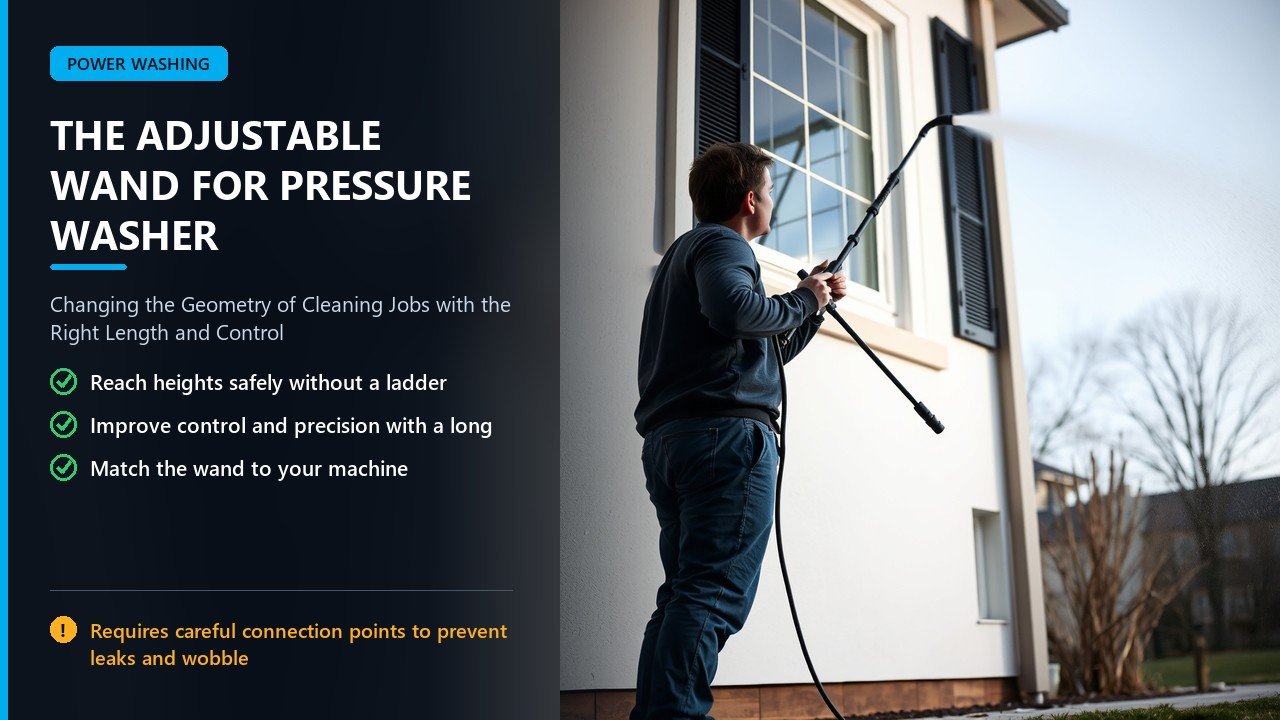
What an Adjustable Wand for Pressure Washer Work Actually Is
An adjustable wand is a multi-section lance that telescopes in and out, then locks at the length you need. Most versions have two or three sliding sections made from anodized aluminum, fiberglass, or a composite. A locking collar or a cam lever holds each section in place once you extend it. The top of the wand carries a standard connection for a quick-connect nozzle, and the bottom connects to your pressure washer gun or hose with the same fitting the rest of your equipment uses.
The difference between length and angle. A spray-angle tip decides how wide the water fans out. An adjustable wand decides how far away from the work you can stand. They solve different problems, and the best setups use both. If your real frustration is a spray that is too narrow or too soft, you want a different nozzle, not a longer wand. If your frustration is that you cannot reach the peak of the roof without a ladder, the wand is the answer.
How the sections lock. The lock is the part that separates a wand you trust from one you do not. A good collar tightens evenly around the tube with a positive click or a firm twist, so the section cannot creep back in while you are pushing against a wall. A weak lock lets the wand collapse under pressure, which is dangerous at height because the sudden give throws your balance off. When you shop, extend the wand fully in the aisle if you can and press down hard on the top section. If it slides, keep looking.
Materials and weight. Fiberglass and composite wands weigh less than aluminum and do not conduct electricity, which matters when you are working near a house. Aluminum is strong and stiff but heavier and, at the top of a twenty-foot reach, that weight becomes leverage against your wrists. The most comfortable wands balance stiffness with a foam or rubber grip placed low, near the gun, and a second support grip partway up the tube. Our overview of pressure washing wand types, lengths, and how to choose one goes deeper into materials, while this article focuses on the adjustable, telescoping kind.
Why Reach Changes Everything on a Cleaning Job
Reach is not a luxury. It is the variable that decides whether a job is safe, fast, and thorough. When you can stand on the ground and point the wand up at the work, three things improve at once: safety, consistency, and speed.
Safety comes first. Falls from ladders and roofs are among the leading causes of serious injuries on home and job-site projects, and the U.S. Bureau of Labor Statistics has long tracked falls as a top cause of workplace fatalities. The Occupational Safety and Health Administration treats fall prevention as a core safety priority for exactly this reason. A pressure washer makes a ladder worse, not better: the hose tugs, the wand recoil pushes you back, and one hand is always busy with the trigger. An adjustable wand removes the ladder from the equation for most single- and two-story work.
Consistency improves. When you are balanced on a ladder, your stance is cramped and your passes are short and choppy. The result is a patchy wash with streaks where the wand paused. Standing on the ground with an adjustable wand, you can sweep in long, even strokes and keep the tip at a steady distance, which is what produces a uniform finish on siding and trim.
Speed goes up. No ladder to move, no climbing down to reposition, no waiting for a helper to spot you. You walk the perimeter and clean. For a two-story house, the time saved over a ladder-based method is often measured in hours, not minutes. That is the practical value of an adjustable pressure washer wand, and it shows up on every job once you get used to the balance.
| Wand Type | Typical Reach | Best For | Main Trade-Off |
|---|---|---|---|
| Standard fixed wand | 3 to 4 feet | Ground-level work, cars, patios | No height reach without a ladder |
| Single extension wand | 6 to 8 feet | Walls, fences, lower gutters | Fixed length, less versatile |
| Adjustable telescoping wand | 18 to 24 feet | Two-story siding, roofs, high trim | Heavier, more pressure loss |
| Telescoping wand with support grip | 18 to 24 feet | Long sessions, high commercial walls | Costs more, needs care to store |
Adjustable Versus Fixed Wands: The Real Trade-Offs
A fixed extension wand is simpler and lighter, but it does one thing at one length. An adjustable wand folds down for storage and stretches out when you need it, which is why it suits owners who clean several different surfaces. The trade-offs are worth understanding before you buy.
Pressure loss grows with length. Every foot of hose and wand adds friction, and friction costs you pressure at the tip. A long wand does not reduce the pump’s output, but it does reduce what arrives at the nozzle. That is why a wand that feels strong at eight feet feels softer at eighteen. The fix is not a bigger pump; it is choosing the correct nozzle orifice for the extra length and accepting that the top of the wand delivers slightly less bite than the gun alone. Our guide to flow rate and why it matters as much as pressure explains why more flow helps carry cleaning power through a longer reach.
Weight and leverage increase. At full extension, the wand acts like a lever, and every pound at the top multiplies the load on your wrists. A lighter fiberglass or composite wand reduces that load, and a support grip partway up lets your lower hand carry some of the weight instead of your trigger hand.
Control becomes a skill. A long wand magnifies small movements. A steady two-handed grip, a wide enough nozzle, and a rhythm of overlapping passes keep the spray where you want it. Short, jabbing motions at high reach produce streaks and knock your aim off target.
Matching the Wand to Your Machine
A wand that does not match your machine’s fittings will not connect, and one that does not match its flow will feel weak or erratic. Two numbers matter most: the connection type and the machine’s flow and pressure rating.
Get the connection right. Residential and light commercial pressure washers use a few common fittings. The two you will meet most are the M22 threaded connection and the 1/4-inch quick connect. Many guns use a 1/4-inch quick-connect plug at the wand socket, so most adjustable wands sold for homeowners simply push in and lock. Others use M22 male or female threads and need an adapter. Before ordering, look at the very end of your current wand or gun and identify the fitting. Our breakdown of pressure washer hose fitting types and threads shows photos of each style so you can match them at a glance.
Match the nozzle to the extra length. When you add length, the effective pressure at the tip drops, so a nozzle that was perfect on the short wand may now feel soft. Stepping down one size in orifice can restore the bite, but only within the range your pump can feed. A 25-degree tip is a safe all-around choice for a telescoping wand because its wider fan is easier to control at distance. Our article on how the right pressure washer angle tip decides cleaning power explains how to pick the angle for high work.
Respect the machine’s limits. A small electric washer with modest flow will not push water to the top of a twenty-foot wand with much authority. Adjustable wands reward machines with more flow, which is why gas units and higher-flow electric models feel dramatically better through a long lance. If your machine is entry level, choose a shorter adjustable wand, around ten to fifteen feet, rather than the longest one on the shelf.
Picking the Right Length for the Job
Length is the one decision that makes or breaks the purchase. Too short and you still need a ladder. Too long and you fight weight and pressure loss you did not need.
For a typical single-story home, a wand that reaches about twelve to fifteen feet covers the walls and the gutters from the ground. For a two-story house, eighteen feet is the common sweet spot because it reaches the second-story siding and the roof edge while staying manageable. Beyond about twenty-four feet, weight and sway climb quickly and the wand becomes a two-person tool. Commercial operators sometimes run those lengths on high-flow machines, but homeowners rarely need to go that far.
| Job | Recommended Wand Length | Notes |
|---|---|---|
| Single-story walls and fences | 12 to 15 feet | Light, easy to control |
| Two-story siding and trim | 18 feet | The all-around homeowner choice |
| Roof edges and tall soffits | 18 to 24 feet | Use a wide nozzle and brace well |
| Commercial walls and signage | 24 feet and up | Needs high flow and two hands |
The Connection Points That Decide Whether It Works
Most adjustable wands fail at the joints, not the body. The connections at both ends and the seals between sections are where leaks and wobble live.
The gun connection. This is where the wand meets the trigger gun. A loose or mismatched fitting here leaks, sprays your legs, and drops pressure. Use the correct adapter, wrap threaded joints with thread sealant or PTFE tape where appropriate, and hand-tighten firmly without overtightening, which distorts seals.
The nozzle connection. The very top of the wand usually carries a 1/4-inch quick-connect socket. Nozzles push in and lock. If your nozzle dribbles or pops out, the o-ring inside the socket is worn or missing. A fresh o-ring is a two-dollar fix that restores a solid seal. Our guide to what a quick-connect pressure washer wand changes for you covers these push-fit joints in detail.
The telescoping seals. Between each sliding section sits an o-ring or seal that keeps water from weeping out. These seals wear with use, and grit is their enemy. Rinse and wipe the sliding sections after every job, keep the wand closed when you store it, and replace seals when you notice water beading at a joint.
Nozzles, Grip, and Control at the Top of a Long Wand
The longer the wand, the more the nozzle and grip matter, because you are now steering a lever instead of a stick.
Choose a wider angle up high. At distance, a narrow 0-degree tip is nearly impossible to keep on a target and it concentrates force in one spot, which risks etching siding. A 25-degree or 40-degree tip spreads the water into a controllable fan and cleans by flow rather than brute concentration, which is safer on cladding and trim. The color system for tips is universal, and our guide to pressure washer nozzle colors breaks down which tip to grab for each surface. The SIMPSON pressure washer FAQ makes the same point, steering owners toward wider nozzles for siding and delicate materials.
Add a swivel or support grip. A swivel between the gun and wand lets the wand rotate without twisting the hose, which reduces wrist strain across a long job. A foam support grip partway up the tube gives your leading hand a place to hold and carry weight. Together they turn a tiring tool into one you can run for an hour.
Brace, do not stab. When the wand is long, brace the lower section against your hip or forearm and move from your core, not your wrists. Long, smooth passes beat short jabs every time, both for your body and for the finish.
Common Mistakes People Make With Extendable Wands
Most disappointment with an adjustable wand comes from a small set of avoidable errors.
Overextending on a weak machine. Owners buy the longest wand they can find and then wonder why the spray trickles. The wand is not at fault; the flow behind it is. Match the length to the machine and step the nozzle orifice up, not down, if the stream stalls.
Running a narrow tip at full extension. A 0-degree tip on an eighteen-foot wand is a recipe for etched siding and wasted effort because you cannot hold it steady. Use a wide angle at height and save the tight tips for ground-level concrete.
Ignoring pressure drop. Adding length always costs a little pressure. If the job suddenly feels weak, increase flow or move closer rather than blaming the wand.
Buying by price alone. A cheap wand with a flimsy locking collar will collapse under load, leak at the joints, and flex until your aim wanders. The lock and the seals are where the money goes, and a sturdy wand outlasts two bargain ones.
Skipping the seals on maintenance. Grit chews through o-rings fast. Rinse the wand, dry it, and store it retracted. A little care doubles its life.
Maintenance and Storage That Keep a Wand Working
An adjustable wand has more moving parts than a fixed one, so it rewards basic care. After each use, run clean water through it, wipe the sliding sections dry, and check the o-rings at the top socket and between sections. Store the wand retracted and horizontal, or hang it by its base, so the tubes do not sit bent under their own weight. Never leave water sitting in the sections through a freeze, because ice expands and can crack a tube or distort a seal. If you store equipment in an unheated garage, blow the wand out and bring it indoors, the same way you would protect the pump from winter damage.
Safety Around Heights, Electricity, and Water
A long wand keeps you off a ladder, but it also points high-pressure water at places you may not be looking. Safety deserves the same attention you gave the ladder.
Watch the electrical path. Never spray toward overhead power lines, meter boxes, light fixtures, or exterior outlets. Water and electricity are a lethal pair, and a wand lets you aim higher than you might expect. Keep a clear margin around anything electrical and work from the ground so you can see what you are aiming at.
Respect injection hazard. High-pressure water can pierce skin and inject fluid into tissue, a serious injury that can require surgery. The National Institute for Occupational Safety and Health documents high-pressure injection injuries, and the rule is simple: never point the wand at a person or animal, and never use your hand to test whether the spray is on.
Protect eyes and skin. At height, the spray rebounds off hard surfaces and carries grit and debris back toward you. Safety glasses and gloves are the minimum, and a wide nozzle reduces the back-splash that a narrow one throws.
Mind the recoil and the hose. A long wand amplifies recoil and hose drag. Keep your stance wide, and route the hose so it does not snag on a corner and yank the wand out of your grip.
When an Adjustable Wand Is the Wrong Tool
The adjustable wand is a reach specialist, and it is not right for every job. On a car, the extra length puts you too far from the surface to control the spray, and the long arc makes it easy to catch a panel edge with a tight stream. For auto detailing, a short stubbier wand gives far better control. Our look at the short wand that reaches every tight spot explains why precision work wants less length, not more.
On delicate surfaces such as soft wood, painted trim, or window screens, the pressure at the end of a long wand can still do damage if you use a tight tip, even though the overall pressure has dropped. Use a wide nozzle, keep your distance, and test on a hidden spot. And on flatwork such as driveways, an adjustable wand is simply the wrong shape: a surface cleaner attachment does that job faster and more evenly than any lance. Reach tools and flatwork tools are built for different geometries, and using each in its lane produces the best results.
Frequently Asked Questions
What is the best length for an adjustable wand for pressure washer use at home? For a two-story house, eighteen feet is the practical sweet spot. It reaches second-story siding and roof edges while staying light enough for one person to control. For a single story, twelve to fifteen feet is plenty.
Will a longer wand reduce my pressure? It reduces the pressure that arrives at the tip because of friction inside the tube, but it does not change what the pump produces. Matching the nozzle to the extra length keeps the spray feeling strong.
Can I use an adjustable wand with any pressure washer? As long as the fittings match, yes. The bigger question is flow. Machines with more gallons per minute push water through a long wand with far more authority than small entry-level units.
Do I need an adapter to connect a telescoping wand? Sometimes. If your gun uses a 1/4-inch quick connect, most homeowner wands plug straight in. If your gun uses M22 threads, you will need an M22-to-quick-connect adapter. Check your current wand’s end before ordering.
How do I keep the wand from collapsing while I work? Extend each section fully and tighten the locking collar until it grips firmly, then test by pressing down on the top section. If it creeps, the lock is worn or you have not tightened it enough. A worn cam or collar is usually replaceable.
Final Thoughts on the Adjustable Wand for Pressure Washer Jobs
The adjustable wand is one of those upgrades that seems small until you use it, and then you cannot imagine going back. It replaces a ladder with solid ground, replaces choppy passes with smooth ones, and turns a two-story wash from a risky scramble into a controlled walk around the house. The key is to choose for the tallest thing you clean, match the fittings and nozzle to your machine, and treat the locks and seals with the same respect you give the pump.
Start by measuring your high reach, then buy a wand that covers it with a little margin. Pick a model with a firm locking collar, a comfortable support grip, and non-conductive tubes if you work near the house. Pair it with a wide nozzle for safe, controllable coverage up high, and keep the tight tips for ground-level concrete. Rinse and store it properly, and it will serve you for years.
Do that, and the ladder stays in the garage where it belongs. You stay on the ground, the wand does the reaching, and the job gets done faster, safer, and cleaner, one smooth pass at a time.