Diane has a long driveway, a detached garage, and a back patio that sits almost a hundred feet from the outdoor spigot. Her pressure washer came with a 25-foot hose, which meant she spent more time dragging the machine around the property than she spent cleaning. Every time she reached the end of the hose she had to shut the machine down, unplug it, move it ten feet, and start over. Then a neighbor showed her a simple fix: an extension pressure washer hose and a pair of couplers. She connected her original hose to a 50-foot extension, and suddenly the washer stayed parked while the hose did the traveling. Her whole routine changed, because the machine finally reached where she needed it to be.
An extension pressure washer hose is one of the least expensive upgrades you can make, and one of the most misunderstood. Add length and you gain reach, but you also lose a little pressure, add another joint that can leak, and introduce a new place for the pump to feel strain. Done well, an extension frees you from moving the machine every few minutes. Done carelessly, it turns a strong spray into a dribble and leaves you chasing leaks. This guide explains how extension hoses work, how to match them to your machine, how to couple them so they never leak, and how to tell when a longer hose is the right answer instead of simply moving the washer.
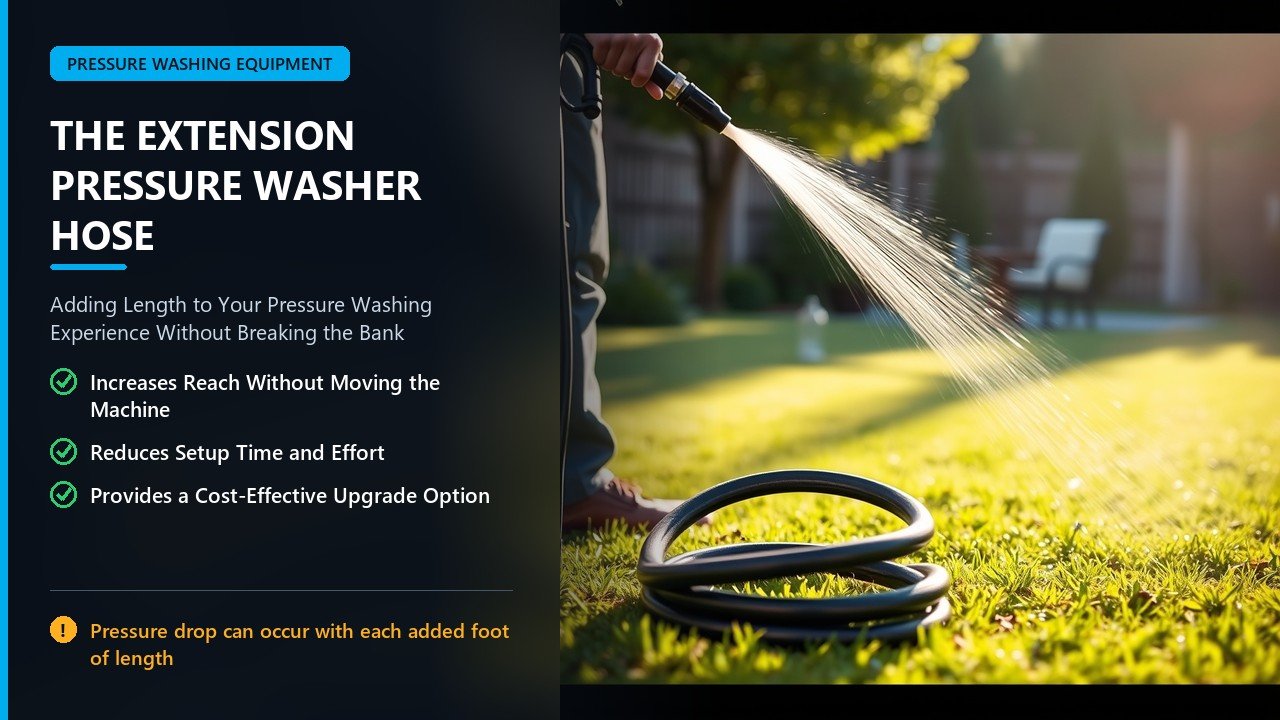
What an Extension Pressure Washer Hose Actually Does
An extension pressure washer hose is simply a second length of high-pressure hose that couples onto the end of your existing hose to make the total run longer. It is not the same as a supply hose, which feeds water into the machine at low pressure, and it is not a jumper hose, which is the short line that connects the pump to a reel. The extension hose carries full working pressure from the gun end of your setup all the way to the nozzle.
Why length helps. Reach is the whole point. A longer hose lets you circle a house, cross a large driveway, or wash a second vehicle without moving the machine. It also lets you leave the washer near the water supply and power outlet, which is often exactly where you want it to stay. Fewer machine moves mean less setup, less risk of tipping the unit, and a faster job start to finish.
How it connects. The extension joins your existing hose through a coupler or an adapter. Most pressure washers use either M22 threaded fittings or 1/4-inch quick connects, and some use 3/8-inch quick connects on higher-flow machines. The coupler has to match both ends. If the ends do not match, an adapter bridges them. Getting these joints right is the difference between a dry, reliable setup and one that sprays your legs every time you pull the trigger.
What it is not. An extension hose is not a way to increase pressure. It cannot make the machine stronger. It only moves the nozzle farther from the pump. If your spray feels weak after adding length, that is expected physics, not a defective hose.
The One Trade-Off That Matters: Pressure Drop
Every pressure washer setup loses a little pressure as water travels through the hose. The longer the hose, the more friction, and the more pressure disappears before the water reaches the tip. This is why a machine feels stronger on a short hose than on a long one, even though the pump is doing identical work.
Friction is the thief. Water rubbing against the inside wall of the hose resists flow, and resistance costs pressure. A 100-foot run loses more than a 50-foot run on the same machine. Adding an extension simply adds to that run, so some pressure loss is unavoidable. The goal is to keep the loss small enough that the machine still cleans the way you need.
Diameter fights back. The bigger the inside diameter of the hose, the less friction water meets, and the less pressure it loses over distance. That is why high-flow machines use 3/8-inch hoses rather than 1/4-inch. If you are adding significant length, matching the extension’s diameter to your original hose, or even going slightly larger, keeps the flow moving. Mismatching a narrow extension to a wide hose creates a bottleneck that costs pressure for no gain.
Nozzle sizing can compensate. If the extended run softens the spray, stepping down one orifice size can restore the bite at the tip, provided your pump can still feed it. A 25-degree tip is a safe all-around choice for longer runs because its wider fan is easy to control and less likely to etch a surface. Our guide to choosing the right pressure washer angle tip explains how the nozzle and the hose work together.
| Total Hose Length | Relative Pressure at Tip | Best Use |
|---|---|---|
| 25 feet | Highest, minimal loss | Cars, small patios, tight work |
| 50 feet | Slight loss, still strong | Most residential jobs |
| 75 feet | Noticeable loss | Large driveways, long properties |
| 100 feet and up | Significant loss | Wide runs, add a wider nozzle or more flow |
Choosing the Right Extension Hose
A good extension hose must survive the same pressure as the rest of your setup. Treat it as a high-pressure component, not a garden accessory.
Match the pressure rating. The extension must be rated above your machine’s maximum output, with a margin to spare. A hose rated below your pump’s pressure is a burst waiting to happen. Check both working pressure and burst pressure, and never use a cold-water hose on a hot water machine. Our guide to high-pressure water hose buying covers the ratings in detail.
Match the diameter. Match the extension’s inside diameter to your original hose so the flow stays smooth. A narrower extension creates a bottleneck; a wider one keeps flow strong over the extra distance. For most residential machines, 1/4 inch is standard; for gas and high-flow units, 3/8 inch is the norm. Our look at how a 4000 PSI hose handles the load shows where the heavy-duty sizes matter.
Choose a flexible, kink-resistant construction. An extension that kinks defeats its own purpose, because a kink stops flow and strains the pump. Rubber and hybrid constructions resist kinks far better than stiff PVC. If you clean in cool weather, avoid cheap PVC entirely. A kink in a long run is frustrating enough that many owners trade a little money for a hose that refuses to fold.
Match the fittings. Confirm the ends before you order. M22 threaded, 1/4-inch quick connect, and 3/8-inch quick connect are the common standards, and adapters exist for everything else. Our guide to matching hose connectors before you buy shows how to identify each end at a glance.
Couplers and Fittings That Never Leak
The weakest point of any extended setup is the joint where the two hoses meet. A little attention there keeps the whole run dry.
Use a proper high-pressure coupler. A dedicated hose coupler is built to join two pressure hoses and hold full pressure. Do not try to improvise with a garden-hose repair fitting, which will fail under load. Our overview of a pressure washer coupler explains how the correct part seals.
Seal threaded joints, respect quick connects. Threaded connections seal on a washer, so snug is enough and over-tightening crushes the seal. Quick connects rely on an o-ring, so keep spare o-rings on hand and never use tape on them. A missing o-ring is the most common cause of a drip at a quick-connect joint. Our breakdown of hose fitting types and threads walks through each style.
Add a swivel if you fight the twist. Coupling two hoses can introduce twist that tangles the run and stresses the joints. A swivel fitting lets the hose rotate without binding, which keeps the connection relaxed and the hose easier to manage. Our article on joining hoses and killing the twist covers this useful upgrade.
One Long Hose or Two Coupled Hoses?
When you need more reach, you can buy one longer hose or add an extension to the one you have. Each approach has strengths.
A single long hose has fewer joints and therefore fewer places to leak. It is the cleaner solution if you know you need the length permanently. The downside is cost, weight, and the fact that you cart a long hose around even for small jobs.
An extension hose lets you keep your short hose for quick jobs and add length only when you need it. It is flexible and less expensive than replacing your whole hose. The trade-off is that extra joint, which demands a good coupler and a little care.
Which wins? If you almost always need the extra reach, buy one longer hose and skip the joint. If your needs vary, keep a short hose for everyday work and couple on an extension for the big jobs. Our discussion of choosing and caring for pressure washer hoses helps weigh the options. Either way, never chain together more joints than necessary, because each connection is a potential weak link.
How Long Hose Runs Affect the Pump
Owners often ask whether a long hose can damage the pump, and the honest answer is that length itself is not the danger. Restriction is. A hose that is properly sized for the machine’s flow lets the pump work within its design, while a hose that is too narrow, kinked, or otherwise restricted makes the pump push against resistance it was never meant to fight.
Watch for a starved or surging feel. If the spray pulses, weakens, or surges when you pull the trigger, the pump is likely struggling against restriction. That can happen with a hose that is too narrow for the flow, with a partly closed supply, or with an extension that matches poorly. Restoring flow by matching diameters and clearing kinks protects the pump and keeps the spray steady.
Keep the supply ahead of the demand. A long output hose is only half the equation. If the machine cannot pull enough water from the spigot to keep up, it will cavitate and run hot, which is far harder on the pump than any amount of hose length. The water supply must be able to exceed the machine’s flow with margin to spare. Our article on the right water supply for your pump explains how to keep the machine fed.
Keep runs sensible. Modest extensions, correctly sized, are easy on the pump. Extremely long runs of narrow hose are not. That is another reason to buy the shortest extension that solves your reach problem, and to move the machine closer when you can.
Matching the Extension to Your Setup
The right extension depends on your machine and the space you clean. Use the size of the job to guide the length, and match the hose spec to the machine.
| Scenario | Suggested Total Length | Hose Diameter |
|---|---|---|
| Small car and patio | 25 feet | 1/4 inch |
| Typical home and single driveway | 50 feet | 1/4 or 5/16 inch |
| Large property, two-car driveway | 75 feet | 3/8 inch |
| Wide commercial runs | 100 feet or more | 3/8 inch |
If you regularly need more than 100 feet, the better answer is often to move the machine closer to the work rather than to keep adding hose. Friction compounds with every foot, and beyond a point the pressure loss outweighs the convenience. Our guide to the 100-ft power washer hose shows how to keep performance up at long distances. For most homeowners, a 50-foot setup hits the sweet spot between reach and pressure, which our article on the 50-foot residential hose explores.
How to Add an Extension the Right Way, Step by Step
Adding an extension is a five-minute job, but the order of steps keeps it leak-free and safe. Follow this sequence and you avoid the mistakes that lead to drips and pressure loss.
Step one: identify both ends. Look at the end of your existing hose that connects to the gun, and at the two ends of the extension hose. Determine whether each is M22 threaded, 1/4-inch quick connect, or 3/8-inch quick connect. Write it down so you buy the right coupler, not the wrong one.
Step two: gather the right parts. You need a high-pressure coupler or an adapter that joins the two hose ends, plus spare o-rings or washers. If the ends do not match, you may need a male-to-male adapter or a threaded-to-quick-connect adapter. Buying the parts in advance avoids a second trip and a stalled job.
Step three: inspect before you connect. Check the o-rings inside quick connects and the washers on threaded fittings. A cracked or missing o-ring guarantees a leak. Replace them while the joint is open, because doing it later means draining and reconnecting everything.
Step four: connect and hand-tighten. Thread fittings snug by hand, using a wrench only to gently seat a stubborn metal joint. Over-tightening crushes seals and causes the leak you were trying to prevent. For quick connects, push until you hear or feel a positive click, then tug lightly to confirm the lock.
Step five: pressure-test before the real job. Run the machine with a nozzle attached and point the wand at a safe patch of ground or gravel. Watch every joint for a few moments. A drip means an o-ring, a washer, or a loose connection. Fix it now, not halfway through a driveway.
Step six: manage the run. Lay the hose in loose loops and keep it out of walkways. A long run that tangles will kink, and a kink stops flow and strains the pump. Take a second to arrange the hose before you start, and the rest of the job goes smoothly.
Extension Hose or Hose Reel? Choosing the Better Upgrade
Two upgrades often solve the same reach problem, and owners sometimes buy the wrong one. An extension hose adds length to your existing hose. A hose reel stores hose neatly, protects it, and makes uncoiling fast. They are not competitors; they often work best together.
Choose an extension hose when your only problem is reach. It is cheap, simple, and adds length exactly where you need it. If your current hose is short and you keep moving the machine, an extension is the direct fix.
Choose a hose reel when your problem is tangling, storage, or setup time. A reel keeps the hose protected and lets you pull out just the length you need, which reduces kinks and speeds up every job. Many reels accept a hose that is already the right length, eliminating the need for an extension entirely. Our guide to the types of pressure washer hose reels and how to choose one explains the options.
Use both when it makes sense. A common commercial setup is a long hose on a reel, with the ability to add an extension for extra-long runs. If you go that route, keep the total length reasonable and use a swivel at the reel so the hose does not twist. The article on a matched reel and hose shows why buying the pair together usually beats mixing parts. The best choice is whichever one removes the most friction from your workday, and often that is a reel for daily convenience with an extension kept on the shelf for the occasional big job.
Common Mistakes With Extension Hoses
Buying a hose rated too low. An extension is a high-pressure part. A hose rated below your machine’s output will burst. Always exceed the machine’s rating.
Mismatching diameter. A narrow extension on a wide hose chokes the flow. Match the diameter to keep the pressure strong.
Cheaping out on the coupler. A weak coupler is the first thing to leak. A proper high-pressure coupler costs little and saves a lot of frustration.
Adding too much length. More hose means more pressure loss. Buy for your real reach, not the longest run imaginable.
Ignoring kinks. A kinked extension stops flow and strains the pump. Choose a flexible, kink-resistant hose and keep loops loose.
Leaving joints hand-loose. A joint that is not fully seated sprays at the connection. Check every connection before you pull the trigger.
Care, Storage, and Safety
An extension hose lasts years with basic care. Rinse it after each use to clear grit from the fittings, wipe it dry, and coil it in loose loops rather than tight circles. Store it out of direct sunlight and above freezing, because trapped water can freeze and split the tube. Inspect the coupler and the crimped ends for bulges or weeping, and replace the hose at the first sign of trouble. A damaged high-pressure hose is a genuine safety risk, because the escaping water can cut or inject beneath the skin. The Occupational Safety and Health Administration treats high-pressure systems with respect for exactly this reason, and the same caution belongs in a driveway as in an industrial bay.
Standards for hose construction and pressure ratings come from bodies such as SAE International, and a hose’s stated rating is an engineering limit, not a suggestion. Keep your total length sensible, keep every joint tight, and keep spare o-rings handy, and your extension setup will serve you like part of the machine rather than an afterthought.
Frequently Asked Questions
Can I connect two pressure washer hoses together? Yes, with a proper high-pressure coupler or adapter that matches both ends. The joint must be rated for full pressure, and you should expect a slight pressure loss because of the added length.
Does an extension hose reduce pressure? It reduces the pressure that reaches the nozzle because of friction inside the longer run, but it does not change the pump’s output. Matching the hose diameter and nozzle keeps the loss manageable.
What is the maximum length I should use? For most residential machines, 50 feet is a comfortable limit and 100 feet is the practical maximum. Beyond that, pressure loss becomes significant and you are better off moving the machine closer.
What diameter extension hose should I buy? Match your existing hose. Use 1/4 inch for small electric washers, 5/16 inch for mid-range, and 3/8 inch for gas and high-flow machines.
Why is my extension hose leaking at the connection? The most common causes are a missing or worn o-ring, a loose connection, or a coupler not rated for the pressure. Check the o-ring first, then the tightness, then the coupler.
Can I use a garden hose as an extension? No. A garden hose cannot hold pressure washer pressure and will burst. Garden hoses are for feeding water into the machine, never for carrying high-pressure output.
Final Thoughts on the Extension Pressure Washer Hose
An extension pressure washer hose solves a problem nearly every owner runs into: the machine cannot reach where the work is. Add the right length and your washer stays by the spigot and outlet while the hose does the traveling, which saves setup time on every job. The catch is that length costs pressure and adds a joint, so the key is to buy deliberately instead of grabbing the longest hose on the shelf.
Match the extension’s pressure rating and diameter to your machine, choose a flexible, kink-resistant hose so it will not fold underfoot, and use a proper high-pressure coupler with spare o-rings on hand. Keep the total length as short as your reach allows, move the machine closer when you can, and step the nozzle down slightly if the extended spray softens. Rinse, dry, and store the hose properly, and inspect the joints for wear.
Do those things and the extension becomes invisible, doing exactly what it should: putting the cleaning power within reach of the whole property while the machine stays exactly where you left it. That small change, made well, is often the difference between a job that drags on all afternoon and one that finishes before lunch.