Two contractors pulled into the same commercial job: a warehouse floor coated in a slurry of grease and dust. One brought a 4,000 PSI machine running 4 GPM. The other brought a lower-pressure unit pushing 8 GPM. Most people would bet on the higher-pressure machine, but the high-flow rig finished the floor first. The reason comes down to one number that rarely gets printed in big type on the box: GPM. If you are hunting for the highest GPM pressure washer, you are really shopping for speed, and speed is what wins on large areas.
This guide explains what GPM is, why flow rate often matters more than pressure on big jobs, how high GPM ratings actually get across electric, gas, and industrial machines, what the highest GPM pressure washer needs in pump and water supply, and how to decide whether a high-flow machine is right for your work.
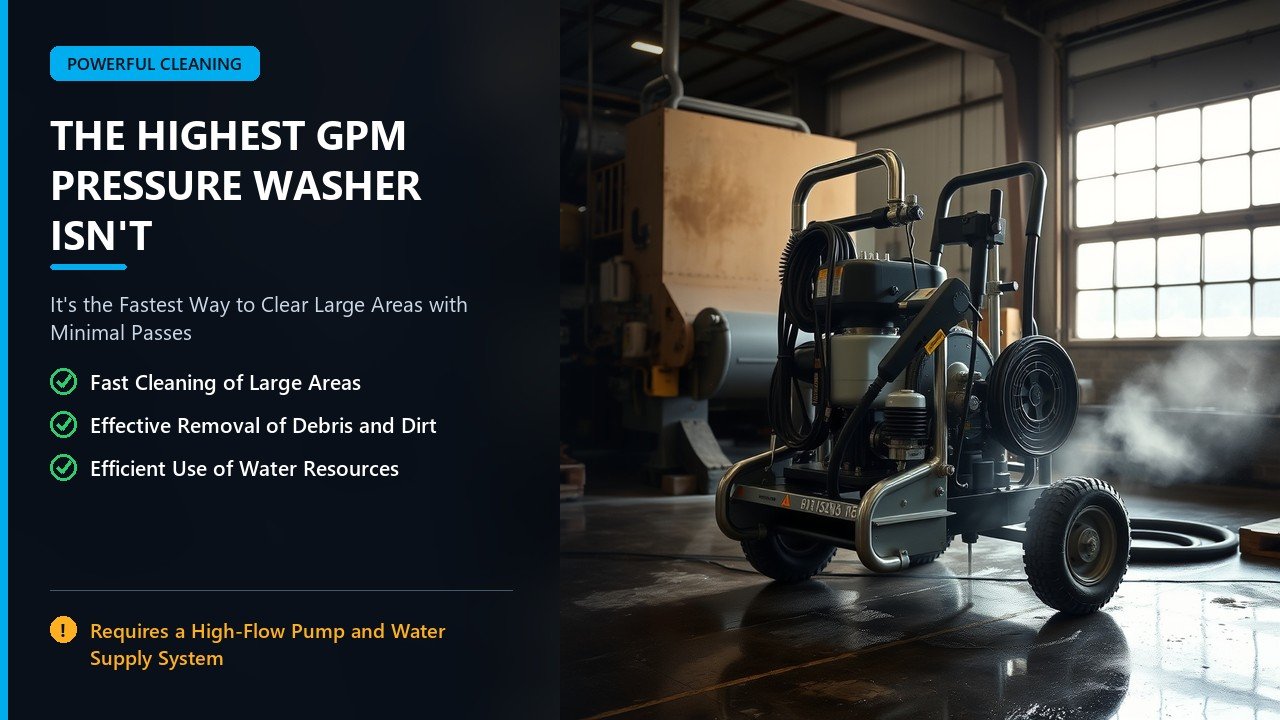
What GPM Means and Why It Decides Speed
GPM stands for gallons per minute, and it measures how much water a pressure washer pushes through the nozzle every minute. If PSI is the force that lifts dirt off a surface, GPM is the volume that carries that dirt away and covers ground. Think of PSI as intensity and GPM as speed.
A narrow, high-pressure jet with low flow strips one stripe clean and then leaves the loosened debris sitting right where it fell. A machine with more flow rinses that debris away and sweeps a wider path in the same pass. That is why a 3,000 PSI machine at 1.1 GPM can feel far slower on a driveway than a 2,300 PSI machine at 2.3 GPM. The lower-pressure machine moves twice the water, and moving water is what actually clears a surface.
For anyone searching for the highest GPM pressure washer, the takeaway is simple: when two machines produce equal pressure, the one with higher flow finishes the same job in less time. On large flatwork, fleet washing, and industrial cleanup, flow rate is the productivity spec.
PSI vs GPM: Cleaning Units Explained
The industry combines the two numbers into a single shorthand called Cleaning Units, calculated by multiplying PSI by GPM. It is a rough index, but it is far more informative than pressure alone, and it exposes listings that lean on one impressive figure while hiding a weak one.
What Cleaning Units also reveal is that two machines with identical totals can behave very differently. One may lean toward pressure for stripping, the other toward flow for rinsing. For a deeper look at that idea, our guide to why flow rate decides how fast you clean walks through the same logic.
| Machine | PSI | GPM | Cleaning Units |
|---|---|---|---|
| Machine A (higher pressure) | 4,000 | 4.0 | 16,000 |
| Machine B (higher flow) | 2,000 | 8.0 | 16,000 |
| Machine C (balanced) | 3,000 | 5.0 | 15,000 |
Quick Note: Cleaning Units compare broad output, but they are not a surface-safety rating. A high-flow machine can still damage a surface, and a high-pressure machine can still be slow on a huge area if its flow is low.
How High Does GPM Actually Get?
The highest GPM pressure washer ratings vary enormously by class. A corded electric machine is capped by its household circuit, so it rarely exceeds about 2.3 GPM, which is the practical ceiling for a 15-amp outlet. Gas machines break free of that limit and commonly run 2.5 to 4.0 GPM, which is the main reason they finish large flat areas faster than electric units even when their PSI looks similar.
Above the portable gas range sit commercial and industrial high-flow machines. Contractor-grade belt-drive gas rigs reach 5 to 12 GPM, often driven by big engines like a Honda V-twin. Industrial electric skids pushed by high-horsepower motors go higher still, with units running 12, 16, and 20 GPM or more, and some manufacturers custom-build machines up to around 25 GPM. At the very top, these are not handheld tools; they are trailer- or skid-mounted systems weighing hundreds of pounds and drawing heavy power or large engines.
| Flow Class | Typical GPM | Best For |
|---|---|---|
| Home electric | 1.1–2.3 | Cars, patios, light concrete |
| Portable gas | 2.5–4.0 | Driveways, decks, general pro work |
| Commercial contractor | 5.0–8.0 | Fleet washing, large flatwork, multi-gun |
| Industrial high-flow | 10–25+ | Warehouse floors, plants, municipal, agriculture |
Retailers group these top-machines together: the Power Wash Store high GPM category lists commercial machines from 6 to 10 GPM and higher, and an industry pump manufacturer notes that custom high-pressure designs can reach roughly 25 GPM for the most demanding work.
The Jobs That Demand the Highest GPM
High flow earns its price on jobs where the work is measured in area, not in scale thickness. Fleet and truck washing needs huge rinse volume to clear soap and road film quickly across many vehicles. Warehouse and factory floors need a broad, stable sweep that carries loosened slurry toward drains instead of just redistributing it. Municipal and agricultural cleaning, from street washing to livestock facilities, relies on flow to flush debris away fast. Multi-gun rigs, where several washers share one machine, also demand high flow so every operator keeps full pressure.
In all of these cases, the goal is throughput: more surface cleaned per shift, fewer passes, less rework. That is the point of chasing the highest GPM pressure washer. If your work is small and occasional, none of this applies, and a modest machine will save you money.
Water Supply Is the Real Limit
Here is the trap almost every first-time high-flow buyer falls into: the machine can only deliver its rated flow if the supply can feed it. A 12 GPM washer needs 12 gallons every minute coming in, and a typical household spigot on a short hose may not supply that. Starve a high-flow pump and it cavitates, drawing air instead of water, which erodes seals and valves and can destroy the pump quickly.
Before buying, confirm your water source. That may mean a larger feed line, a buffer tank, or a dedicated high-volume connection. For the biggest machines, a float tank that lets the pump draw from a reservoir while the supply refills it is standard practice. The rule is blunt: match the supply to the demand, or the highest GPM pressure washer becomes an expensive way to destroy pumps.
Pump, Engine, and Drive for High Flow
High flow puts real strain on every component, so the hardware has to be built for it. The pump should be a triplex plunger design, not an axial cam, because triplex pumps handle continuous high-volume output and can be rebuilt. Look for a brass or stainless manifold and ceramic plungers. Our explainer on why a triplex pump beats an axial cam covers the durability difference.
Drive matters too. At high flow, belt-drive and gearbox-reduction setups are preferred because they let the pump turn slower than the engine or motor, cutting heat, vibration, and wear. Direct drive is simpler and cheaper but runs the pump at full speed, which shortens its life under constant heavy use. Power source sets the ceiling as well: gas engines roam free of circuit limits, while large electric machines need heavy voltage or three-phase power, plus variable frequency drives on the biggest units to control flow precisely and soften the startup surge.
To see how these pieces scale up, our articles on the 6 GPM class, the 12 GPM machine, and 24 GPM ultra-high-flow systems trace the ladder from serious to extreme.
Accessories Must Match the Flow
A high-flow machine fails if its accessories choke it. Small hoses and fittings create friction that wastes the flow you paid for. High-GPM rigs use larger-diameter, high-pressure hose, commonly 3/8 inch and up, to move volume without losing pressure. Our guide to the 3/8 inch hose explains why that diameter is the standard for high-flow work.
Surface cleaners, guns, wands, and nozzles all need to be rated for both the pressure and the flow, and their orifice sizes must suit the machine. Multi-gun setups need a manifold that splits flow evenly. Get these wrong and the highest GPM pressure washer underperforms while you blame the machine.
When the Highest GPM Is Overkill
Not everyone needs extreme flow. For occasional car washing, patio cleaning, and light concrete work around a home, a machine in the 1.5 to 2.5 GPM range is plenty, easier to handle, and far cheaper to run. The 5 GPM tier is already a serious step up for dedicated professionals and sits near the top of what a normal water supply can feed without support.
Chasing the highest GPM pressure washer only makes sense when your jobs are large, frequent, and measured in throughput. Buy flow you cannot feed, or cannot justify, and you pay more for a machine that underperforms and drinks more water than you can supply. A mainstream buying guide makes the same point: match the machine to the job rather than to the biggest headline number.
Maintaining a High-Flow Machine
High flow means more work for every part, so maintenance matters more, not less. Change the pump oil on schedule and never let it run low. Keep the inlet filter and feed line clear, and size the supply so the pump never starves. On gas machines, service the engine and check the unloader; on industrial electric units, keep the motor’s cooling path clean, especially on enclosed TEFC frames, and respect the duty cycle. Protect the pump from freezing, and rebuild it with a seal and valve kit when performance drops rather than running it to failure. High-flow pumps move more water and generate more heat than small machines, so oil condition and clean filtration are not optional details; they are what keep the highest GPM pressure washer running shift after shift instead of sitting in a repair shop. Keep a spare inlet filter and spare O-rings on hand, since a few dollars of maintenance protects a pump that costs many times more.
Frequently Asked Questions
What is the highest GPM pressure washer? Industrial high-flow machines reach 12, 16, and 20 GPM or more, with some manufacturers building custom units up to about 25 GPM. Consumer electric washers top out near 2.3 GPM, and portable gas machines run roughly 2.5 to 4.0 GPM.
Is higher GPM better than higher PSI? It depends on the job. Higher PSI strips stubborn material, while higher GPM rinses faster and covers more area. On large flatwork and fleet washing, flow usually drives productivity, so higher GPM wins.
Can a normal hose feed a high GPM washer? Often not. A high-flow machine needs a water supply that matches its rated flow. Many setups require a larger feed line or a buffer tank, or the pump will cavitate and suffer damage.
How many GPM do I need for concrete cleaning? For driveways and most flatwork, a gas machine with about 2.5 to 4.0 GPM and 3,000 to 4,000 PSI handles the job well. Higher flow helps mainly on very large areas or with surface cleaners.
Do I need a belt-drive pump for high GPM? For continuous heavy use, yes. Belt drive and gearbox reduction turn the pump slower, reducing heat and wear, which is why they are standard on commercial high-flow machines.
Why does my high GPM washer not reach its rated flow? The usual causes are an undersized water supply, a kinked or too-small feed hose, a clogged inlet filter, or an accessory restricting flow. Check the supply and inlet path first.
Final Thoughts
The highest GPM pressure washer is not necessarily the most powerful one, but it is almost always the fastest on large areas. Flow rate decides how quickly you rinse, sweep, and finish, which is why commercial and industrial buyers prioritize GPM once pressure is adequate for the surface.
Just remember the balance. Choose flow that matches your jobs and, above all, your water supply, pair it with a triplex pump and the right drive, and use large-diameter hose and matched accessories so the volume reaches the surface. A high-flow machine set up correctly becomes a productivity engine; set up badly, it becomes an expensive liability. Match the machine to the work, and the highest GPM pressure washer will pay for itself in time saved.