The first time Tanya priced a powered hose reel for her detailing van, she closed the browser tab and laughed out loud. The motorized unit cost more than her backup pressure washer. She ran a tight operation cleaning driveways and a few commercial lots on weekends, and the numbers simply did not work. What she bought instead was a manual pressure washer hose reel, a hand-crank steel drum that bolted to the back of the van for a fraction of the price. Three seasons later it had never once failed to wind, never once needed a replacement spring, and had earned back its cost dozens of times over in the hours she was not spending untangling hose. The simple tool, it turned out, was the right tool.
That story captures why manual reels remain the backbone of hose management even in an era of automatic and powered options. A manual reel has no motor to burn out, no spring to snap, and no electronics to corrode in a wet wash bay. It does one job, and it does it with the kind of reliability that only comes from having almost nothing to break. But “simple” does not mean “buy the first one you see.” The manual reel category spans flimsy stamped-metal units that wobble after a month and industrial-grade steel drums that outlive the machine they serve. This guide explains what makes a manual pressure washer hose reel worth owning, how it differs from the alternatives, how to size and mount one, and the specific details that separate a keeper from a landfill donation.
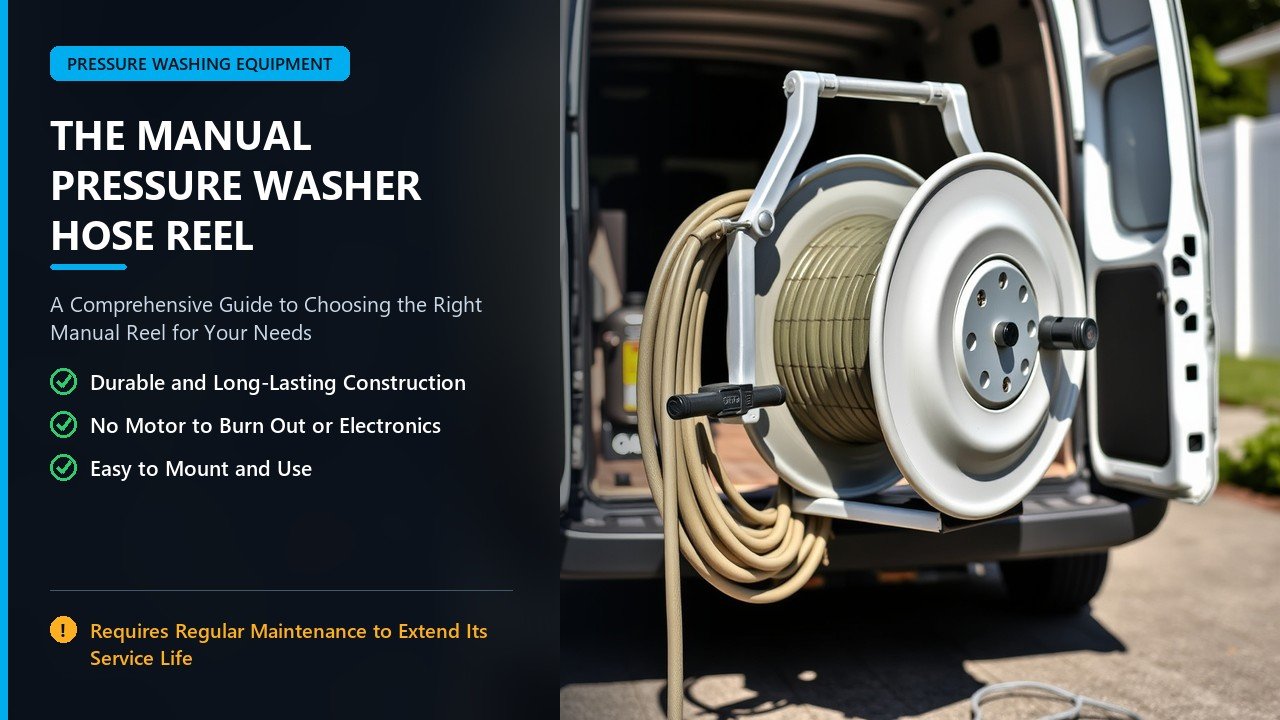
What “Manual” Really Means in a Hose Reel
A manual hose reel stores high-pressure hose on a drum that you turn by hand. You pull the hose out to work, then wind it back with a crank handle on the side of the drum. A lock, either a ratchet latch or a pin, holds the drum in position so the hose does not creep out on its own. That is the entire mechanism. No electricity, no spring, no remote.
The parts that matter. The drum holds the hose. The swivel at the center lets water pass through the rotating connection without leaking and is the single most important component for performance. The frame supports the drum and the load of hose under pressure. The crank, lock, and guide arm are the interface you touch every time you work. Every one of these shows up in the price, and every one is a place where a cheap reel cuts corners.
Why it never gets fancy. A manual reel is essentially a bearing on an axle. There is almost nothing to fail, which is precisely the appeal. In a wet, dirty, chemical-heavy environment, fewer parts means fewer failure points, and that is why so many professional rigs still run manual reels alongside or instead of powered ones. If you want the full landscape of reel options before committing, our overview of choosing a power washer hose reel helps you compare manual reels to the rest.
Manual vs Retractable vs Powered: The Honest Comparison
The manual-versus-automatic decision comes down to a trade between money, effort, and failure risk. None of the three options is universally better; each fits a different working style.
Manual reels win on cost and ruggedness. They cost the least, have the fewest failure points, need the least maintenance, and shrug off weather and chemicals. You supply the winding effort, and for hoses up to about a hundred feet that effort is minor.
Retractable reels win on speed. A spring-rewind reel winds itself with a tug, which is satisfying and fast. The price is a spring that wears, tension that drifts and needs adjusting, and a mechanism sensitive to grit. Our guide to how spring-rewind reels work explains when that trade pays off.
Powered reels win on volume. Motorized reels shine in high-volume commercial settings where hoses are long and handled constantly. They are the most expensive and add electrical components to maintain, so they only make sense when the time saved clearly beats the added cost and complexity.
| Feature | Manual Reel | Retractable Reel | Powered Reel |
|---|---|---|---|
| Upfront cost | Lowest | Medium | Highest |
| Winding effort | You crank by hand | Spring does it | Motor does it |
| Failure points | Fewest | Spring and mechanism | Motor and wiring |
| Maintenance | Minimal | Spring tension, cleaning | Electrical and mechanical |
| Best for | Home, light and mid pro | Frequent moderate use | High-volume commercial |
Where a Manual Reel Makes the Most Sense
A manual reel is the smart default for three kinds of owners.
The homeowner with a mid-length hose. If you run a fifty-foot hose around the house and coil it by hand today, a manual wall-mounted reel cleans up the garage, protects the hose, and costs very little. You give up almost nothing, because a fifty-foot hose is easy to crank.
The light professional on a budget. A mobile detailer, a handyman, or a weekend cleaning operator gets the full benefit of tidy hose handling without the cost or failure risk of a powered unit. Winding effort is a few seconds per job when the hose is managed well.
The AG or pest-control operator using chemicals. These operations often use aggressive chemicals where stainless steel and simple mechanics matter more than convenience. A manual reel in stainless is easy to rinse and hard to ruin.
Where a manual reel loses. If you routinely run two or three hundred feet of heavy 3/8-inch hose all day, hand-winding becomes genuine labor, and that is when a spring or powered reel starts to earn its price. If you clean one small driveway twice a year, even a manual reel may be more than you need, and a simple wall hook will do.
Sizing a Manual Reel to Your Hose
Sizing determines whether the reel feels effortless or constantly jams. Three numbers decide it: hose inner diameter, hose length, and the reel’s pressure rating.
Inner diameter. Pressure washer hose is sized by inner diameter, most often 1/4 inch or 3/8 inch. A 3/8-inch hose moves more water and is standard on higher-flow machines, but it is thicker and takes more drum space. A reel rated for a hundred feet of 3/8-inch hose holds more length if you use thinner 1/4-inch hose. Know exactly what you have before you order, and if fittings confuse you, our guide to pressure washer hose fitting types will help you match the ends.
Length with margin. Buy a reel that fits your hose with room to spare. A reel stuffed to its maximum capacity winds unevenly and jams. The extra capacity costs little and prevents the single most common manual-reel frustration.
Pressure and temperature rating. A reel must be rated for at least your machine’s working pressure. Many quality manual reels are rated to 4,000 PSI, covering most gas machines, with hot-water reels rated to higher temperatures. Never run a hot-water machine through a cold-only reel, and never run bleach through mild steel when stainless is available.
| Hose Size | Typical Manual Reel Capacity | Pressure Rating to Look For | Fits |
|---|---|---|---|
| 1/4 inch | About 100 to 130 ft | 2,000 to 4,000 PSI | Compact and mid machines |
| 3/8 inch | About 50 to 100 ft | 4,000 PSI and up | Higher-flow gas machines |
The Construction Details That Separate Good From Cheap
Two manual reels can look the same online and behave nothing alike after a season. These are the details that decide which is which.
A full-flow swivel. Look for a solid brass or stainless swivel with ball bearings and a grease fitting. This is the part that carries water into the spinning drum, and a weak swivel leaks, drops pressure, and seizes. A serviceable swivel with a grease port is worth more than a decorative frame. Our comparison of matching a hose and reel as a combo shows how the swivel ties into the whole flow path.
A rigid frame. Powder-coated steel is the standard, and stainless steel is the upgrade for chemical work. Test for flex: a frame that twists under hand pressure will twist worse under a pressurized hose. Look for gussets, welded corners, and a base wide enough to resist the pull.
A real guide arm. A roller guide or a multi-roller arm feeds the hose on evenly and lets it come off at a natural angle. A fixed metal slot drags the hose and wears it. Even winding is what keeps a manual reel from jamming on the next pull.
A positive lock. A ratchet with several positions or a spring-loaded pin lock keeps the drum from unwinding while idle. A weak lock lets the hose creep out and tangle.
A comfortable crank. The handle should be large enough to grip with a gloved hand and positioned so you can turn the drum without scraping your knuckles. Small details, but they decide whether the reel is pleasant six months in.
Mounting a Manual Reel for Real-World Use
The mounting can make or break a good reel. A reel under tension pulls hard, and it needs a solid anchor.
Wall mount. The most common setup. Bolt the reel to a stud, masonry, or steel frame at a comfortable working height, and use every mounting hole. Drywall anchors alone will fail. A wall-mounted setup done properly turns a messy corner into a clean station.
Trailer and van mount. Mobile rigs mount the reel to the trailer frame or van wall with reinforced brackets. The reel feeds the hose out the back so you can clean without dragging the whole length through the vehicle. Our article on adding a hose reel to your machine covers mounting choices in detail.
Floor and pedestal mount. A low pedestal works in an open bay where work spreads in all directions. Make sure the base is heavy or anchored so it does not tip when you pull.
The inlet whip. A short jumper hose connects your machine to the reel’s inlet. Use a proper high-pressure hose for this, not a garden hose, and route it so it does not kink. Our explanation of the jumper hose between pump and reel covers why this little line deserves real attention.
Using a Manual Reel Like a Pro
A few habits keep a manual reel smooth and safe.
Pull, do not wrench. Pull the hose from the reel with steady tension, never in sharp yanks. Sudden loads stress the swivel and the lock.
Wind with light tension. When rewinding, guide the hose and let it lay in even layers. Bunching causes jams and pinches the hose.
Lock it every time. Engage the lock when the machine is idle so the hose stays put.
Mind the bend at the outlet. Keep a gentle angle from the guide to your work. A sharp turn at the outlet is where kinks and wear start.
Never pull past the end. The last few feet should stay on the drum under light tension. Pulling tight against the end strains the swivel and the fittings.
Maintenance That Doubles a Manual Reel’s Life
A manual reel is low-maintenance, not no-maintenance. The routine is short.
Grease the swivel. Use the grease fitting on schedule. A greased swivel turns freely and seals better.
Watch for drips. A drip usually means a worn seal or o-ring at the swivel or fittings. Rebuild parts are cheap and common, so fix leaks early instead of losing pressure and blaming the pump. Fresh fittings and quick-connect o-rings solve most small leaks at the hose ends.
Rinse and dry. After a job, rinse the reel and let the hose dry. Grit in the guide arm grinds the hose, and moisture rusts steel.
Drain before frost. Water trapped in the hose or swivel freezes and cracks metal. Drain and store the reel where it will not freeze, the same care you give the pump and any water tank on the rig.
Check the frame bolts. Reels vibrate loose over time. A quick tighten every few months keeps the drum spinning true.
Common Manual Reel Mistakes to Avoid
Buying a garden hose reel. The single worst mistake. A garden reel cannot handle pressure washer hose or pressure, and it will leak or break. Only buy a pressure-rated reel.
Choosing by price alone. The cheapest manual reels use weak swivels and thin frames that flex and fail. The lock and swivel are where the money goes; spend there.
Oversizing the hose on an undersized reel. If the reel barely fits the hose, it will jam. Buy capacity to spare.
Mounting to weak surfaces. Drywall and thin siding fail under load. Hit real structure or add a backing plate.
Winding wet, gritty hose. Grit wears the swivel and guide, and moisture rusts the frame. Rinse and dry.
Ignoring hot water and chemical ratings. A cold-water mild-steel reel will fail fast with a hot machine or bleach. Match the rating to your worst job, and if you clean with heat, understand how a hot water high pressure washer stresses the whole setup, reel included.
How Much Hose Do You Really Need?
One of the quiet causes of manual-reel frustration is buying more hose than the job requires. A long hose is heavier to wind, loses more pressure to friction, and takes longer to manage. More is not automatically better; the right length is the shortest hose that reaches your work without dragging.
Measure your reach. Walk the farthest cleaning point from where the machine sits and add a few feet of slack. For a typical driveway and front walk, fifty feet usually covers it. For a two-story home where you move around the perimeter, seventy-five to a hundred feet gives comfortable room. Beyond that, weigh the benefit of reach against the effort of winding.
Pressure loss grows with length. Every added foot of hose costs a little pressure at the tip because of internal friction. A very long hose can make a strong machine feel soft, and that is usually a length problem, not a pump problem. Match the length to the job and keep the working hose no longer than it needs to be.
| Cleaning Scenario | Recommended Hose Length | Why |
|---|---|---|
| Small driveway and walkway | 25 to 50 ft | Short, light, easy to wind |
| Single-family home exterior | 50 ft | The residential sweet spot |
| Two-story home, full perimeter | 75 to 100 ft | Reach without repositioning |
| Commercial lot and fleet | 100 ft and up | Consider a powered reel at this length |
Manual Reels, Hot Water, and Chemicals
The manual reel’s simplicity serves it especially well in the two harshest applications: hot water and chemical cleaning.
Hot water. Heat stresses seals, hoses, and metal. A manual reel rated for the temperature avoids the spring and motor components that heat can shorten. If you run a hot machine, choose a reel explicitly rated for hot water, often around 200 to 250 degrees Fahrenheit, and keep the swivel greased.
Chemicals. Bleach, in particular, destroys mild steel. A soft-wash or roof-cleaning operator should choose a stainless steel reel so bleach does not rust the frame and swivel. Stainless costs more up front and lasts dramatically longer in chemical service, which makes it the cheaper choice over time.
Rinsing matters more with heat and chemicals. After any hot or chemical job, flush the hose and rinse the reel thoroughly, then let it dry. Residue left in a swivel or guide arm accelerates wear and corrosion, and a little discipline after each job protects the whole assembly.
Building a Manual Reel Into a Complete Setup
A reel works best when it is part of a system rather than a standalone add-on. Three companions turn a manual reel into something close to automatic in daily use.
A jumper hose at the inlet. This short line connects the machine to the reel. Use a proper high-pressure hose with the correct fittings so the connection does not become the weak link. Read our breakdown of the jumper hose that joins pump to reel so the small parts match the big ones.
Quick-connect fittings at the working end. Quick connects let you swap the wand, a surface cleaner, or a foam cannon without a wrench or a trip to the truck. A set of quality quick-connect fittings makes the reel feel truly modular.
A matched hose. The reel is only as good as the hose it stores. A kink-resistant commercial hose winds evenly and survives the repeated bending that a reel naturally imposes. Our guide to choosing a commercial pressure washer hose that lasts explains the construction details that matter.
An organized machine area. With the reel, the machine, and the soap and nozzles all in fixed places, setup shrinks to a couple of minutes. That organization is the quiet productivity gain that a reel delivers, and it compounds with every job.
Frequently Asked Questions
Is a manual hose reel good enough for professional use? For many professionals, yes. Manual reels are rugged, cheap, and nearly failure-proof, which is why they remain common on real working rigs. If you handle very long, heavy hose all day, a powered reel may eventually save you labor.
What is the difference between a manual and a retractable hose reel? A manual reel winds by hand with a crank and lock. A retractable reel uses a spring to pull the hose back automatically. Manual reels cost less and have fewer failure points; retractable reels are faster and more convenient.
How much hose can a manual reel hold? It depends on the reel and the hose diameter. Common manual reels hold about 100 to 130 feet of 1/4-inch hose or about 50 to 100 feet of 3/8-inch hose. Always leave a little spare capacity.
What pressure should a manual reel handle? At least your machine’s working pressure, ideally more. Many quality reels are rated to 4,000 PSI, which covers most gas pressure washers, with hot-water models rated for higher temperatures.
Can I mount a manual reel on a trailer? Yes, and it is one of the most common uses. Use reinforced brackets and mount to the trailer frame so the pull of the hose does not flex the wall.
Why does my manual reel leak at the swivel? Usually a worn seal or o-ring, or a dry swivel. Grease it and replace the seal or o-ring. A serviceable swivel is designed for exactly this kind of maintenance.
Final Thoughts on the Manual Pressure Washer Hose Reel
The manual pressure washer hose reel is proof that the simplest solution is often the most durable. It asks for a fraction of what a powered reel costs, offers almost nothing that can break, and turns a loose pile of high-pressure hose into a controlled, protected system. For homeowners and for a large share of working professionals, it is not the budget compromise. It is the better engineering choice.
Buy by matching the reel to your hose’s diameter, length, pressure, and temperature. Prioritize a serviceable full-flow swivel, a rigid frame, and a lock you can trust. Mount it to solid structure, wind it evenly, and give it the small maintenance it asks for. Then stop thinking about the hose altogether. The reel handles it, quietly, season after season, which is the highest praise any tool can earn.