A detailer named Luis had a full-size pressure washer gun that cleaned hoods and roofs beautifully but made wheel work miserable. When he crouched to clean a wheel arch, the long gun put his hand far from the spray, and the wand kept catching on the fender. He fought the geometry more than he fought the dirt. Then he swapped to a pressure washer stubby gun, a compact handle barely longer than his hand. Suddenly he could aim into the tightest corner of a wheel well without contorting his wrist, and his arm stopped barking after a full day of cars. The stubby gun did not add power. It added control, and for detail work, control is everything.
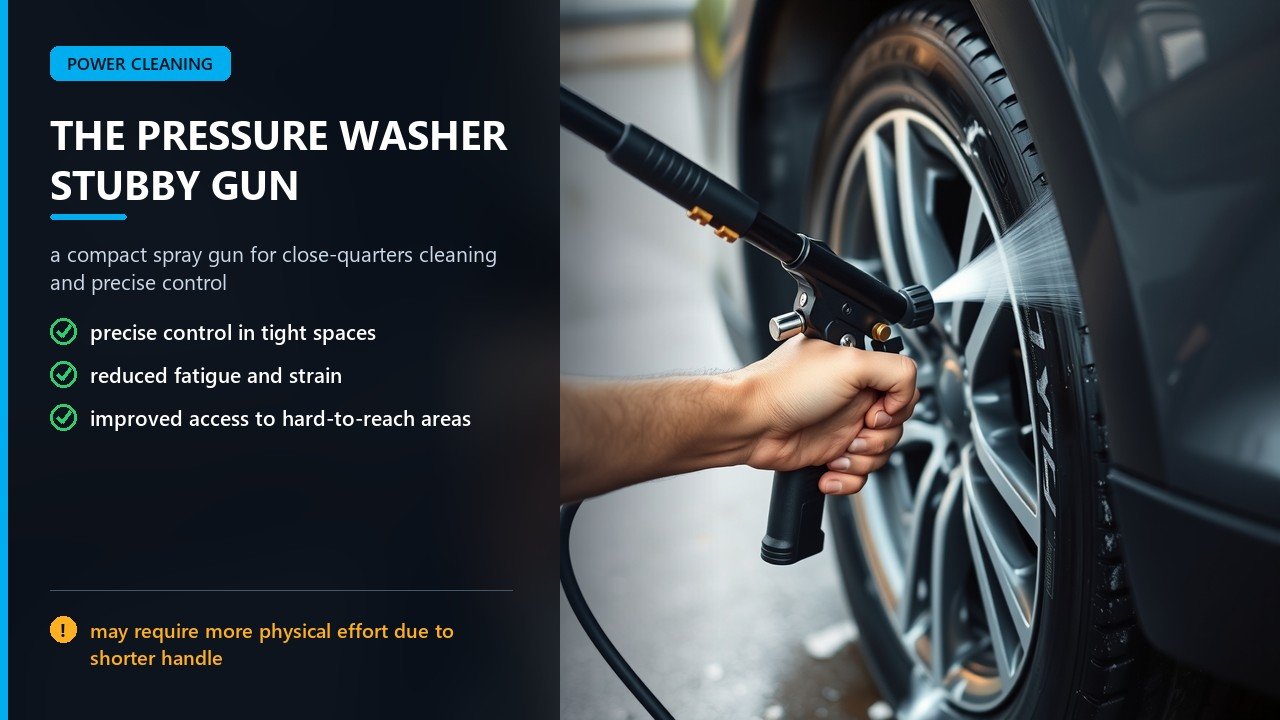
A pressure washer stubby gun is a short, compact spray gun designed for close-quarters cleaning and precise control. It trades the long body of a traditional gun for a stubby profile that sits low and close to your hand, which lets you aim into tight spaces and keep the nozzle near the work. Detailers love them, but they are useful for far more than auto detailing. This guide explains what a stubby gun is, why the shorter shape changes how you clean, where they shine and where they fall short, how to match one to your machine, and how to care for it so it stays crisp and leak-free.
What a Pressure Washer Stubby Gun Actually Is
A stubby gun is a high-pressure spray gun with a very short body. Where a standard gun has a long barrel between the hose connection and the wand socket, a stubby gun compresses that length into a compact handle. The result is a gun that feels closer to an extension of your hand than a tool you hold at arm’s length.
Short body, same function. Inside, a stubby gun works exactly like a full-size gun. It has a trigger, a valve that opens and closes under pressure, and connections for the hose and the nozzle or wand. It holds back the same pressure and flows the same water. The only real difference is the shape, and that shape changes everything about how it handles.
Short wand or no wand. Many stubby guns attach almost directly to the nozzle or accept a short wand, and some include a built-in swivel. This puts the spray tip very close to your hand, which is exactly what you want for precision work. Our guide to a short wand that reaches every tight spot explains why less length helps in detail work.
Built for close-quarters cleaning. A stubby gun is not a replacement for a long extension wand when you need reach. It is the opposite tool for the opposite problem. Where an extension wand takes the spray far from you to reach high or across a distance, a stubby gun brings the spray close so you can work with precision. The two solve different jobs, and many serious operators keep both.
Why Shorter Means More Control
The advantage of a stubby gun comes down to physics and ergonomics. A shorter gun changes the balance, the leverage, and the feedback you feel through your hand.
Less leverage against your wrist. A long gun or wand acts like a lever. When water pushes back through the nozzle, and when you move the gun against pressure, that leverage loads your wrist. A stubby gun removes most of that lever, so your hand absorbs far less strain. Over a full day of cars or equipment, that difference decides whether your arm is sore at the end.
Closer aim. With the nozzle near your hand, you can see exactly where the spray is going and place it precisely. That is invaluable when you are cleaning around lug nuts, emblems, mirrors, and tight trim, where a long gun’s tip is far from your eyes and hard to position.
Better access to tight spaces. Wheel wells, engine bays, undercarriages, and the gaps between parts are all easier to reach when the gun is short. A compact gun lets you angle into places a long wand cannot go without catching on something.
Quicker, more fluid movement. A short gun lets you rotate, dip, and change angles quickly. For detail work, where the wand is constantly moving around curves and corners, that agility makes the work smoother and faster.
Where Stubby Guns Shine
Stubby guns suit any job that rewards closeness and precision. They are not a one-trick tool, even though detailing is where they became popular.
Wheels, tires, and wheel wells. The classic use. A stubby gun reaches into the wheel arch, around the spokes, and behind the tire far more easily than a long gun. It is the tool detailers reach for first on every car.
Foam cannons and soap application. Many stubby guns accept a foam cannon, and the short body makes it easy to coat a vehicle evenly. Applying foam close to the surface with a compact gun is quicker and more controlled than doing it at arm’s length. Our guide to a hose attachment with a soap dispenser covers the soap side of detailing.
Undercarriage and engine bays. Cleaning the underside of a vehicle or the tight spaces of an engine bay is far easier with a short gun, where you can angle the spray into narrow gaps without a long wand banging into components.
Equipment and machinery. Any job involving tight access around parts benefits from a stubby gun. Cleaning farm equipment, machinery, and small components is easier when the spray tip is close to your hand.
Interior and gutter detail. Some operators use a stubby gun with a suitable nozzle to flush gutters and reach into tight architectural details, where the compact shape is easier to control than a long wand.
| Feature | Stubby Gun | Full-Size Gun and Wand |
|---|---|---|
| Control at close range | Excellent | Limited |
| Reach and height | Poor | Good with a wand or extension |
| Wrist strain over a long day | Low | Higher |
| Access to tight spaces | Excellent | Difficult |
| Best use | Detailing, wheels, precision | Walls, driveways, open areas |
Where Stubby Guns Fall Short
A stubby gun is not the right tool for every job, and being honest about its limits keeps it in the role where it excels.
Reach is minimal. You cannot clean a two-story wall or a tall fence with a stubby gun. It keeps the spray close by design, which is the opposite of what you need for height or distance. For high work, an extension wand is the right answer, and our guide to how wand extensions add reach without a ladder covers those tools.
Not ideal for large flatwork. Cleaning a long driveway with a stubby gun means a lot of bending and close passes. A surface cleaner or a full-size gun with a wide tip covers large areas faster.
Demands more care on delicate surfaces. Because the nozzle sits close to your hand and the target, it is easy to bring a tight tip too close to paint or trim. The short gun gives you control, but it also gives you the power to damage quickly if you are careless. Always match the tip to the surface.
Can be harder to brace at high pressure. At very high pressure, a short gun with a tight nozzle produces strong recoil close to your body. A wide tip reduces that recoil, and a firm two-handed grip helps. On a 4,000 PSI machine, a stubby gun with a 0-degree tip is a handful, so keep the nozzle moderate for close work.
Matching a Stubby Gun to Your Machine
Like any high-pressure part, a stubby gun must match your machine’s specs and fittings. Get these right and it will serve you for years.
Pressure rating. The gun must be rated above your machine’s maximum pressure. A gun rated below the pump’s output is unsafe. Choose one with margin, especially for close-quarters work where a failure would happen near your hand and face.
Flow rating. The gun’s internal passages must handle your machine’s gallons per minute. A gun that restricts flow weakens the spray and strains the pump.
Fittings. Confirm the hose-side and nozzle-side connections. Common standards are M22 threaded and 1/4-inch quick connect, with 3/8-inch quick connect on larger machines. A stubby gun with a 1/4-inch quick-connect socket is the most flexible, because it accepts standard nozzles and wand tips. Our guide to picking a gun that fits shows how to identify connections.
Swivel option. A stubby gun with a swivel lets the hose rotate without twisting your wrist, which is even more valuable on a short gun used for constant movement. Our guide to a professional pressure washer gun explains the benefit.
Temperature rating. For hot water use, choose a heat-rated gun. Standard seals fail under heat. Our guide to a heat-rated hot water pressure washer gun covers what to look for.
| Spec to Check | Match To | Why It Matters |
|---|---|---|
| Pressure rating | Machine’s max PSI | Prevents failure near your hand |
| Flow rating | Machine’s GPM | Prevents flow restriction |
| Hose-side fitting | Your hose connection | Determines compatibility |
| Nozzle-side fitting | Your nozzles and wands | Lets you use standard tips |
| Temperature rating | Cold or hot water | Cold seals fail under heat |
| Swivel | Your work style | Reduces wrist strain |
Stubby Guns for Detailing Versus Pressure Washing
The right stubby gun depends on whether you clean cars, equipment, or both. The priorities shift with the work.
For auto detailing, prioritize control and gentleness. A stubby gun with a swivel, a comfortable short body, and the ability to mount a foam cannon is ideal. Pair it with wide nozzles to protect paint, and keep the pressure moderate. The goal is a spotless finish without swirls or damage, and control is the detailer’s most valuable asset. Our guide to automotive washers done right covers the broader kit.
For pressure washing equipment and hard surfaces, prioritize durability. If you use a stubby gun on machinery and tough surfaces, choose a heavier-duty model rated for your machine and built for frequent use. A sturdier gun handles the higher pressures and rougher conditions of non-automotive work.
For both, keep two tips handy. A 40-degree tip for delicate surfaces and a 25-degree tip for tougher grime covers most close-quarters work. Our guide to pressure washer nozzle colors shows which tip suits which surface.
Getting the Most From a Stubby Gun
A stubby gun rewards good technique, and a few habits make it far more effective.
Use a wide tip by default. Because the nozzle is close to the work, a narrow tip concentrates force in a small area and risks damage. Start wide and step down only for stubborn spots, and never use a 0-degree tip near paint.
Keep the gun moving. Close-range work makes it tempting to hold still on a stubborn spot, but that is how damage happens. Smooth, moving passes clean evenly and safely.
Control the distance with your arm, not the nozzle. You have fine control over distance with a stubby gun, so use it. Backing off slightly softens the impact without changing tips, which is a fast way to protect a surface.
Grip firmly and brace when needed. At high pressure, brace the gun with both hands or against your body for stability. A short gun with strong recoil can wander off target if your grip is loose.
Stubby Gun vs Stubby Wand vs Turbo Nozzle
Close-quarters cleaning involves a few different tools that are easy to confuse. Each solves a slightly different problem, and knowing which is which helps you buy the right one.
A stubby gun is a short spray gun. It is the handle and valve, and it changes how you hold and aim the spray. It does not change the spray pattern by itself; the nozzle you attach does that.
A stubby wand is a very short wand or lance that connects to a gun. It moves the nozzle a little farther from your hand than a bare gun while staying compact, which some operators prefer for a bit more clearance around wheels and trim. It is a length choice, like the gun itself.
A turbo nozzle is a nozzle that spins a jet in a tight circle, combining cutting power with wider coverage. It is a nozzle choice, not a gun or wand choice, and it is powerful enough to damage paint and trim. Turbo nozzles belong on concrete and tough surfaces, never on car paint. Our guide to the best power washer turbo nozzle explains where they are safe.
How they combine. A detailer might use a stubby gun with a fixed wide nozzle for paint and a short wand with a slightly tighter tip for wheels. The gun sets the control, the wand sets the distance, and the nozzle sets the pattern. Choosing each part deliberately gives you a kit that handles every corner of a job.
Choosing Your First Stubby Gun
A buying checklist keeps you from a purchase you will regret. Run through these points before you order.
Confirm the pressure and flow ratings. The gun must exceed your machine’s maximum pressure and handle its flow. This is a safety matter, not just a performance one, because the gun sits close to your hands and face.
Match the fittings. Identify the hose-side and nozzle-side connections on your current gun and choose a stubby gun that matches, or plan for the adapters you will need. A 1/4-inch quick-connect nozzle side keeps you flexible with nozzles and accessories.
Decide on a swivel. If you will use the gun on cars and equipment with constant movement, a swivel is worth the small extra cost. It keeps the hose from fighting you and reduces wrist strain.
Check the temperature rating. For a hot water machine, insist on a heat-rated gun. For cold water, a standard rating is fine.
Look for a rebuildable valve. A gun you can rebuild with a seal kit lasts far longer than a disposable one. Professional-grade guns are designed to be serviced, which lowers the long-term cost.
| Buying Factor | What to Look For | Priority |
|---|---|---|
| Pressure rating | Above your machine’s max PSI | Essential |
| Flow rating | Matches your machine’s GPM | Essential |
| Fittings | M22 or quick connect, matching yours | Essential |
| Swivel | Turns freely without leaking | High for detailing |
| Temperature rating | Heat-rated for hot water | Essential for hot water |
| Rebuildable valve | Replaceable seals and kit | High for frequent use |
Common Mistakes With Stubby Guns
Using too tight a tip up close. The most common error. A narrow tip on a short gun, held near a surface, is the fast track to damaged paint and trim. Use a wide tip and let chemistry help.
Expecting reach. A stubby gun cannot clean high walls. Buy it for precision and keep an extension wand for height.
Underrating the pressure. A cheap stubby gun rated below your machine is dangerous, especially so close to your hand. Always exceed your machine’s maximum.
Ignoring the flow rating. A restricting gun weakens the spray and strains the pump, even if the pressure rating looks fine.
Skipping the swivel. On a gun used for constant movement, no swivel means the hose fights you and your wrist pays the price. A swivel is a small upgrade with a big payoff.
Neglecting maintenance. Grit and worn seals cause leaks and stiff triggers. Rinse the gun, check the inlet for debris, and rebuild the valve when it starts to drip.
Maintenance and Safety
A stubby gun needs the same care as any high-pressure gun. After each use, rinse it and wipe it dry, and check the inlet filter for debris that could clog the valve. Store it indoors and above freezing, and winterize the system so water does not freeze inside the gun and crack it. Rebuild the valve when it leaks or stiffens, and keep spare o-rings on hand. Our guide to a gun that leaks, sticks, or will not build pressure covers the common fixes.
Safety comes first with a compact gun. Because the nozzle sits close to your hand and body, high-pressure water is nearer to you than with a long gun. High-pressure water can pierce skin and inject fluid into tissue, a serious injury, which is why the Occupational Safety and Health Administration treats high-pressure cleaning as a genuine hazard and the National Institute for Occupational Safety and Health warns that these injection injuries are surgical emergencies. Never point the gun at a person or animal, never test the spray with your hand, and wear eye and skin protection. Keep the tip wide enough that recoil stays manageable, and always engage a trigger lock when you set the gun down.
Frequently Asked Questions
What is a pressure washer stubby gun used for? It is a compact spray gun for close-quarters cleaning and precise control, ideal for wheels, wheel wells, engine bays, undercarriages, detailing, and any tight-access work where a long wand is awkward.
Does a stubby gun reduce pressure? No. It delivers the same water your machine produces. The shorter shape gives you more control, but it does not change the pressure or flow of the machine.
Can I use a stubby gun on a car? Yes, and it is one of the best tools for it. Use wide nozzles and moderate pressure, and keep the tip moving to protect the paint. Avoid 0-degree tips on painted surfaces.
What fittings should a stubby gun have? A 1/4-inch quick-connect socket on the nozzle side and either M22 or a quick connect on the hose side, matching your machine. A swivel option is a helpful extra.
Can a stubby gun handle hot water? Only if it is rated for heat. Standard guns fail at the seals on a hot water machine. Use a heat-rated gun for heated systems.
Do I still need a full-size gun? Yes, if you clean large areas or high surfaces. Keep both and swap with a quick connect. The stubby gun handles precision and access; the full-size gun handles reach and coverage.
Final Thoughts on the Pressure Washer Stubby Gun
A pressure washer stubby gun is a specialist tool for a common problem: cleaning where a long wand is awkward and precision matters. It brings the spray close to your hand, cuts the leverage that tires your wrist, and opens up wheels, engine bays, and tight spaces that a full-size gun struggles to reach. It does not add power, and it cannot reach height, but within its role it is one of the most useful additions a detailer or equipment cleaner can make.
Match the gun’s pressure and flow ratings to your machine with margin, confirm the fittings, and choose a swivel model if you work with constant movement. Use wide tips by default, keep the gun moving, and control impact with distance rather than a tighter nozzle. Maintain the valve, keep spare o-rings, protect it from freezing, and treat the safety rules with the same respect you would give any high-pressure tool.
Do those things and the stubby gun becomes the tool you reach for first on every detailed job. It puts you in control of the spray instead of fighting the geometry, and it turns the tightest, most annoying corners of a job into just another quick, clean pass.