How a Power Washer Hose Attachment With Soap Dispenser Makes Cleaning Easier
A power washer hose attachment with a soap dispenser is one of the simplest and cheapest ways to add real cleaning power to a basic pressure washer you already own. Instead of buying a new machine with a built-in tank, you fit a small accessory that draws soap into the stream so the water can lift grease and grime instead of just blasting it from one spot to another. It is a cheap upgrade that changes how well the washer cleans, and it usually takes only a few minutes to fit and test.
This guide explains what these attachments are, the types you can buy, how each one works, and how to match a dispenser to your machine before you spend. It covers compatibility, setup, mixing, troubleshooting, and care, so you can pick the right soap dispenser attachment, fit it correctly the first time, and get years of use from a small investment.
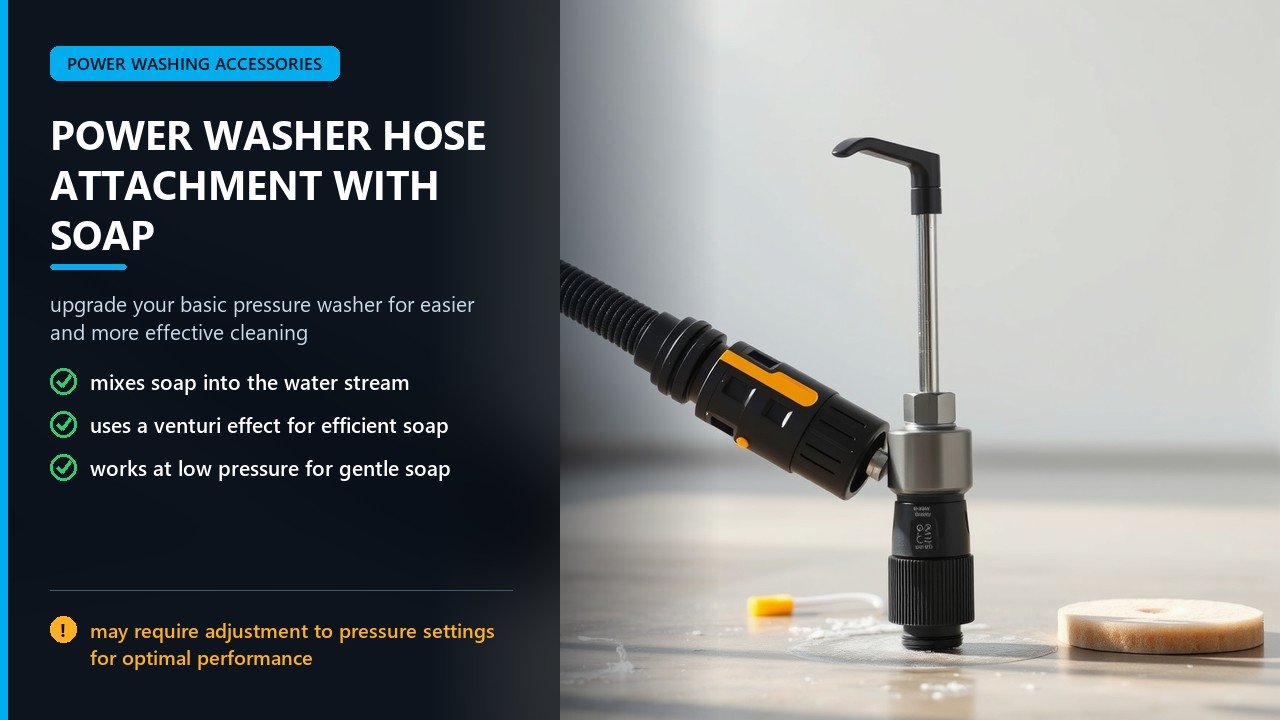
What a Soap Dispenser Attachment Does
A soap dispenser attachment mixes soap into the water on the way to the nozzle, turning plain water into an active cleaning solution that lifts dirt instead of only moving it. Most use a venturi effect, where the flow of water creates suction that pulls soap up a siphon tube from a bottle or container. The soap enters after the pump, so it never passes through the machine valves or seals.
These attachments work only at low pressure, so you fit a soap nozzle or turn the pressure down for the soap pass, then switch to a high-pressure nozzle to blast the loosened dirt away in a clean, even rinse. That low-pressure soap stage is what lets the chemical dwell on the surface and do its work instead of being blasted off the moment it lands.
The result is a washer that soaps as well as it rinses, which is exactly the point of the upgrade for most owners. Our guide to how to add soap to a pressure washer covers the methods, and this article focuses on the hose-mounted attachment itself.
Types of Soap Dispenser Attachments
Several attachment styles can add soap to a pressure washer hose, and they range from tiny inline valves to bulky foam cannons. An inline downstream injector sits in the hose line and draws soap from a bottle. A soap nozzle with a siphon tube is the simplest form. A foam cannon attaches at the gun and makes thick foam. And a hose-end dispenser bottle clips to the hose or gun.
Each type suits a different job, container size, and budget. Inline injectors work well for driveways and siding. Foam cannons are best for cars. Bottle-style dispensers suit light jobs. Choosing by task rather than by the loudest marketing claim gets you the right tool for your work.
| Attachment | Where It Fits | Best For | Foam |
|---|---|---|---|
| Inline downstream injector | In the hose line | Driveways, siding, fleets | Moderate |
| Soap nozzle with siphon | At the wand | Light jobs, spot cleaning | Thin |
| Foam cannon | At the gun | Cars, detailing | Thick |
| Bottle-style dispenser | Clips to hose or gun | Small washes | Light |
Match the attachment to the surface and the machine. Our guide to the best pressure washer attachments and to soap bottles and detergent covers the options.
How a Downstream Soap Dispenser Works
A downstream dispenser relies on a venturi, a narrow passage that speeds up water and drops its pressure, creating suction. That suction pulls soap up the siphon tube and into the stream. The faster the water moves through that narrow passage, the stronger the suction and the soap draw.
The key rule is that the dispenser only draws at low pressure. At high pressure, the venturi stops pulling, which is exactly what you want: soap during the low-pressure pass, clean water during the high-pressure rinse. This is why a low-pressure soap nozzle is always part of a working dispenser setup.
Siphon tube length and seal matter. A tube that is too long may not draw, and one drawing air will sputter. Keep the tube end submerged and screened, and keep it airtight where it meets the dispenser. Our guide to the soap hose and siphon setup explains the details.
Foam Cannon vs Soap Dispenser Attachment
A foam cannon and a plain soap dispenser attachment do the same core job but differ in foam. A foam cannon mixes air with the water and soap to make thick foam that clings to vertical surfaces, which is ideal for cars. A basic dispenser attachment produces a thinner soap spray, which still suits flatwork, siding, and general rinsing jobs very well.
Foam cannons need enough flow from the machine to work well, since foam depends on volume. A low-GPM electric washer may struggle to make thick foam even with a good cannon. A simple soap nozzle or bottle dispenser needs far less flow and still adds genuinely useful cleaning power to a modest electric machine.
Choose based on the surface and the machine. For a car with a decent machine, a foam cannon is worth the money; for a small electric washer or a driveway, a basic dispenser attachment is usually the smarter buy. Our guides to foam applications and to detergent tanks help you decide.
Compatibility: Fittings, Flow, and Pressure
Before buying, match the attachment to your machine’s fittings. The connection may be a screw thread such as M22, a quick-connect, or a barb for a siphon. The wrong fitting will not seal, and every adapter you add is another joint that can leak under pressure.
Check the pressure and flow the attachment can handle. An accessory rated below your machine pressure can fail, leak, or blow apart, so the rating is a safety matter, not a detail. For high-flow machines, choose a dispenser with a wide internal passage so it does not choke the flow and rob the nozzle of the pressure it needs.
| Check | What to Match | Why It Matters |
|---|---|---|
| Connection type | M22, quick-connect, or siphon barb | The wrong fitting will not seal |
| Pressure rating | At or above your machine’s PSI | Prevents leaks and failure |
| Flow capacity | Suits your machine’s GPM | Avoids choking the flow |
| Soap nozzle | Low-pressure tip included or available | Dispensers only draw at low pressure |
Get those four things right and the attachment drops straight in without a stack of adapters. Our guide to matching a gun kit to your machine uses the same logic.
Note: A soap dispenser attachment only works at low pressure, so you must have a low-pressure soap nozzle or a way to reduce pressure. If your kit has no soap tip, buy one that fits, or the dispenser will never draw soap no matter how it is fitted.
Choosing the Right Attachment
Decide the surface first. For cars, choose a foam cannon or a quality dispenser that makes clingy foam and is gentle on the paint and trim. For driveways and siding, choose an inline injector or a robust bottle dispenser that covers large areas fast and survives hard, repeated use. For occasional light jobs, a simple soap nozzle with a short siphon is plenty and costs almost nothing to add.
Then match the fittings, rating, and flow, and buy a product with good seals and a replaceable siphon. A dispenser built from tough materials with a metal connection and replaceable seals lasts far longer than a flimsy plastic one. Read reviews for how well the dispenser draws and seals, since those two things are what most often disappoint owners after a few weeks.
Buying headroom in pressure and flow keeps the attachment from becoming a bottleneck. A supplier such as Pressure Wash Supply lists dispensers and injectors by fitting and rating, and a mainstream category such as the Grainger pressure washer category shows how attachments sit beside the machines.
Setting Up and Using the Attachment
Fit the attachment at the correct point in the line, connect the siphon tube to your soap container, and fit the low-pressure soap nozzle so the venturi can actually do its job. Drop the siphon end into the soap mix, keeping it just off the bottom, then run the machine at low pressure to check that the draw is smooth. You should see soap pulled up the tube and mixed into the spray, and the draw should be steady rather than sputtering as the venturi pulls it through.
Once soap is flowing, apply it from the bottom up, let it dwell for a few minutes so it can lift the dirt, then switch to a high-pressure nozzle and rinse from the top down. Keep the nozzle moving, work in manageable sections, and stay ahead of the sun so the soap never dries on the surface before you can rinse it away.
After the job, switch back to plain water and flush the attachment, siphon, and nozzle until no trace of soap remains anywhere in the line. Soap left in the line can gum up the dispenser, the siphon, and the nozzle, so flushing is not optional. Our soap guide covers the rinsing and flushing method in full.
Note: Never let undiluted soap sit in the dispenser or siphon between jobs. Thick concentrate can clog the venturi and dry into a stubborn residue, so rinse everything with clean water before you store it, and check the tiny venturi passage for blockages.
Mixing Soap for the Dispenser
The right mix depends on the attachment, the soap, and the surface, so a little thought before you pour pays off. A downstream injector draws a concentrate that it dilutes in the stream, while a foam cannon uses a ready mix of roughly one part soap to five or ten parts water depending on hardness. A simple siphon nozzle draws whatever is in the bottle, so mix it to a sensible strength.
Start with the manufacturer recommendation and adjust to your water and the level of dirt. Too strong a mix leaves residue and streaks; too weak does little. Hard water reduces foaming, so a hard-water area may need slightly more soap to reach the same effect, and it can also leave mineral spots if the rinse is rushed.
| Attachment | Typical Mix | Adjust For |
|---|---|---|
| Inline injector | Concentrate | Injector draw ratio |
| Foam cannon | 1:5 to 1:10 | Foam thickness, hardness |
| Siphon soap nozzle | Ready mix | Soil level, surface |
| Bottle dispenser | Follow bottle guide | Small capacity |
Mix in a clean container, label it clearly, and never store mixed soap for more than a day or two. Our soap and detergent guide covers choosing the right product for each surface and attachment.
Troubleshooting the Dispenser
If no soap is drawn, first check that you have the low-pressure soap nozzle fitted, since dispensers only draw at low pressure. Then check the siphon tube for air leaks or clogs, make sure the end is fully submerged, and confirm the soap is thin enough to flow. Thick, undiluted soap can also stop the draw by blocking the tiny venturi passage.
Weak or uneven soap usually means an air leak in the siphon, a partially clogged venturi, or soap that is too thick to flow freely. Clean the passage, reseat the tube, and thin the mix. If soap keeps flowing once you switch to high pressure, the dispenser is faulty or the wrong nozzle is fitted, because a working venturi should stop drawing at high pressure.
A dispenser that leaks under the machine often has a worn seal, a cracked body, or a mismatched fitting. Reseal or reseat it, and check the rating against your machine. Our guide to the soap hose and siphon covers these fixes in detail.
Caring for the Attachment
Good care keeps a dispenser drawing for years, and it starts with the thirty-second flush you do in the last minute of every job. Flush it with clean water after every soap job, store the siphon dry, and inspect the seals and the venturi for wear or clogs. Keep the small nozzle and the venturi passage clear, since they are the parts most likely to block and the hardest to notice until the soap stops.
In winter, drain the attachment and siphon completely so trapped water cannot freeze and split the plastic body or the tube in a cold garage. Store the unit with the hose and gun so the parts stay together, loop the siphon loosely to avoid kinks, and keep the soap nozzle handy for the next job.
Treat the dispenser as a wear part and keep a spare siphon or seal on hand. Our guides to soap tanks, soap hoses, and pressure washer attachments cover the related gear and its care.
Hose-Mounted vs Gun-Mounted Dispensers
Soap dispensers mount either in the hose line or at the gun, and the choice depends on the job and your machine. A hose-mounted inline injector sits between the pump and the hose, drawing soap from a bottle it carries or from a bucket. A gun-mounted dispenser fits at the gun or wand, close to the nozzle.
The inline type is out of the way, works with a long siphon from a large container, and keeps the soap supply off your hand, which suits long jobs where you refill rarely and want both hands free. The gun-mounted type is compact and travels with you as you walk around a car, which suits detailing, tight spaces, and quick touch-ups. Both rely on low pressure to create the suction that draws soap, so both need a low-pressure tip.
| Feature | Hose-Mounted Inline | Gun-Mounted |
|---|---|---|
| Location | Between pump and hose | At the gun or wand |
| Soap source | Bottle or bucket via siphon | Small on-board bottle |
| Best for | Big flatwork, fleets | Cars, detailing |
| Capacity | Large | Small |
| Portability | Fixed to the line | Moves with the gun |
Choose by job size and how you move around. For a whole driveway, an inline injector feeding from a bucket keeps you working; for a car, a gun-mounted bottle is handier.
Pairing Soap With a Surface Cleaner
On flat concrete, a surface cleaner plus soap is a powerful combination. A surface cleaner spins high-pressure jets under a hood to clean evenly, and some setups add soap upstream so the cleaner lays down a cleaning solution as it works. Together they cut cleaning time and reduce streaks and swirl marks on large flat surfaces like driveways and patios.
If you clean driveways or large patios often, an inline soap dispenser feeding a surface cleaner lets you pre-treat and rinse in fewer passes with a more even result. Let the soap dwell for a few minutes, then clean with the surface cleaner and rinse, working in overlapping passes for an even finish. This is far faster and more even than soap and a wand alone on a big slab.
Match the dispenser and the surface cleaner to the machine’s flow, since both need volume. A low-GPM machine limits both foam and cleaning width. Our guide to choosing a surface cleaner shows how to size it.
Soap Dispensers for Commercial Use
In commercial washing, soap delivery is a designed part of the system rather than a last-minute add-on. Wash bays feed soap through injectors or injector pumps tied into the machine, and hot-water units clean faster and cut grease better than cold. The dispenser is sized to the machine flow so the soap mix stays consistent across long shifts and huge volumes of water, and it is built to be serviced rather than replaced.
For professional duty, the whole package of machine, dispenser, and nozzles is chosen for continuous use, easy service, and parts that are always available. A machine such as a Hotsy hot-water pressure washer pairs hot water, high flow, and soap injection to clean fleets and equipment quickly. The home logic still applies, just at a larger scale, with heavier parts and a fixed soap supply.
If you run a small business, a robust inline injector on a hot-water machine is a smarter buy than a string of small bottle dispensers that need constant refilling. Our guides to soap tanks and to commercial attachments cover the heavier gear.
Maintenance and Winter Care
Like any pressure washer accessory, a soap dispenser lasts far longer with a little care. After every soap job, switch to plain water and run the dispenser for thirty seconds so clean water flushes the venturi, the siphon, and the nozzle. Soap left to dry is the fastest way to clog a dispenser.
Once a month, pull the siphon tube off and rinse it, then poke any debris out of the venturi with a soft pick. Check the O-rings and seals for cracks and replace them if they look worn. A spare set of seals costs very little and saves a whole unit later.
In winter, drain the attachment and the siphon completely so trapped water cannot freeze and split the plastic body or the tube in a cold garage. Store the unit with the hose and gun so the parts stay together, loop the siphon loosely to avoid kinks, and keep the soap nozzle handy for the next job.
Common Mistakes to Avoid
The most common mistake is expecting soap at high pressure, because people fit the dispenser and then never think to switch to the black soap tip. Dispenser attachments only draw at low pressure, so if you keep a high-pressure tip fitted, no soap will come out. Fit the soap nozzle first, and the problem usually disappears.
Another is putting soap through the pump. Additives belong after the pump, drawn in by the dispenser, never poured into the machine’s inlet or water supply. Soap inside a pump can strip its lubrication, cause foaming, and shorten its life, so the dispenser is the only correct way to put soap into the stream.
People also skip the flush, letting soap dry in the dispenser and nozzle until they clog, and they reach for the wrong cleaner, leaving sticky residue or harming the surface they meant to help. Use a cleaner made for pressure washers, match it to the surface, and rinse the whole system after every job.
Note: Buying the biggest dispenser or the thickest soap is not the goal. Match the attachment and the mix to the surface and the machine, because a modest dispenser matched correctly cleans better than an oversized one that chokes a small washer or leaves residue on every surface.
Frequently Asked Questions
What is a power washer hose attachment with a soap dispenser? It is an accessory that fits in the hose line or at the gun, draws soap into the water at low pressure using suction, and lets the washer clean with soap as well as plain water.
How does a soap dispenser attachment work? Most use a venturi that creates suction as water flows, pulling soap up a siphon tube and mixing it into the stream, and they only draw when the pressure drops at the tip of the wand.
Why is my soap dispenser not drawing soap? Usually the wrong nozzle, an air leak or clog in the siphon, undiluted soap, or low water flow. Fit the soap nozzle and check the siphon first.
Can I use a soap dispenser on any pressure washer? Mostly yes, provided the fittings match and the attachment is rated for your pressure and flow, so check the connection type, thread, and rating before you buy.
Do I need a foam cannon instead? Only if you want thick foam, mainly for cars. A basic dispenser or soap nozzle adds cleaning power with less flow and cost.
How do I clean a soap dispenser attachment? Flush it with clean water after each soap job, clear the venturi passage with a soft brush or pick, and store the siphon dry so residue cannot harden inside it.
Can I put soap in the pressure washer tank instead? Only if your machine has a dedicated soap tank. Never pour soap into the pump inlet or the water supply, because it can damage the pump and its seals.
Why does soap only come out at low pressure? Soap dispensers work on a venturi, which only creates suction when the water pressure drops. Switch to the soap nozzle for the soap pass, then back to a high-pressure tip to rinse.
Will a soap dispenser fit my pressure washer? It will if the connection matches your hose, gun, or wand and the attachment is rated for your machine’s pressure and flow. Check those three before buying.
Can I use the dispenser with hot water? Only if the attachment is rated for that temperature. Many are designed for cold water, and hot water can soften or damage them.
How often should I clean the dispenser? After every soap job. Flushing with clean water takes a minute and prevents the venturi and nozzle from clogging with dried residue.
Is a dispenser attachment worth it? Yes, for most owners. It is cheap, easy to fit, and adds real cleaning power without buying a new machine or a built-in tank.
Final Thoughts
A power washer hose attachment with a soap dispenser is a small, inexpensive part that can transform how well a basic washer cleans. Match the attachment to your surface, fittings, pressure, and flow, fit the right soap nozzle, mix sensibly, and flush it after use.
Choose a foam cannon for cars, an inline injector for big flatwork, and a simple siphon nozzle for light jobs, and your washer becomes a genuine cleaning system instead of an expensive hose that only wets the dirt.