The first time a buddy handed me the wand of his water cannon 4000 psi pressure washer and told me to “just start on the driveway,” I laughed at how seriously he said it. Then the trigger came down, the machine loaded up, and a strip of old, black, seemingly permanent grime peeled off the concrete in one pass like it was never there. I had spent years scrubbing that kind of buildup with a 2,000 PSI unit, holding the wand in one spot until the concrete gave up. This thing did not negotiate. It cleaned.
That moment is why 4,000 PSI machines have such a devoted following, and it is also why they scare first-time buyers. The power is real, and so are the risks. If you understand what a water cannon 4000 psi pressure washer can actually do, what it cannot, and how to run it without damaging surfaces or hurting yourself, it becomes one of the most capable tools a homeowner or contractor can own. This guide covers all of it with practical, real-world detail.
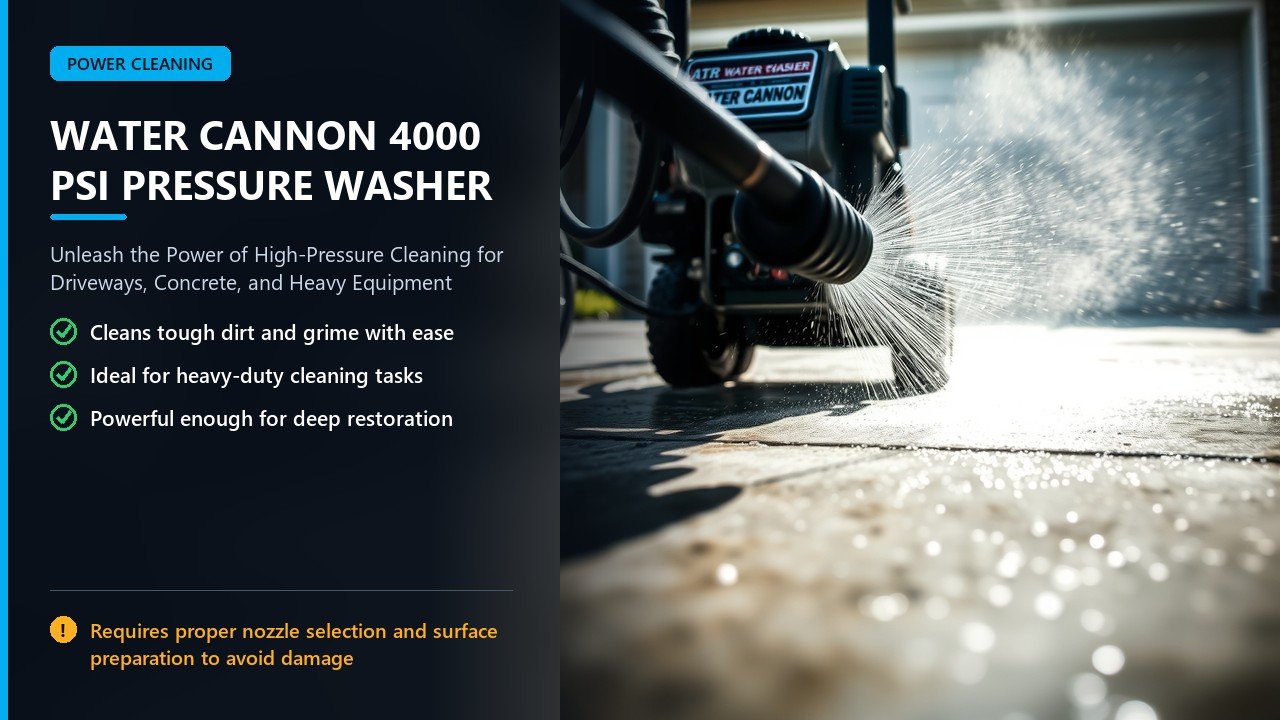
What Is a Water Cannon 4000 PSI Pressure Washer
The name “water cannon” gets used two ways. It refers to a category of high-pressure cleaning machine, and it is also the brand name of a well-known commercial pressure washing supplier. In everyday conversation, a water cannon 4000 psi pressure washer means a machine rated at 4,000 pounds per square inch of output, powerful enough to strip heavy buildup from hard surfaces without the operator leaning on the wand for minutes at a time.
At this pressure class, you are generally looking at gas-powered machines with triplex pumps and healthy flow rates, typically in the 3 to 4 GPM range. That combination is what lets the machine clean quickly and evenly. Pressure alone would just blast a narrow line of clean into a field of dirt. Flow is what carries the grime away and lets you cover ground fast.
If you have been comparing a 3,000 PSI unit to a 4,000 PSI unit, the jump sounds small but feels large. Let us look at why.
Why 4,000 PSI Is a Genuine Sweet Spot
There is a reason 4,000 PSI shows up on so many professional and prosumer machines. It sits at the point where you have enough force to handle nearly any residential or light commercial hard-surface job, without jumping into the industrial class that brings heavier maintenance, bigger water demands, and a much higher price. For the vast majority of concrete, driveway, fleet, and equipment cleaning, 4,000 PSI is more than enough muscle and a very sensible ceiling.
A machine at 7,000 PSI exists for a different world, the industrial one where two-part surface preparation and heavy paint removal are routine. Most buyers never need that, and the extra pressure increases the risk of surface damage and the cost of everything downstream, from hoses to pumps. So 4,000 PSI is the class where capability and practicality meet.
| Pressure Class | Best Use | Risk Level |
|---|---|---|
| 1,500 to 2,000 PSI | Cars, furniture, light siding, windows | Low |
| 2,500 to 3,000 PSI | Patios, fences, general home cleaning | Moderate |
| 3,000 to 4,000 PSI | Driveways, concrete, fleets, equipment | Moderate to high |
| 4,000 to 5,000+ PSI | Heavy commercial, paint prep, industrial | High |
What a 4,000 PSI Water Cannon Actually Cleans
This is where the machine earns its keep. At 4,000 PSI with proper flow, backed by a triplex pump, you can tackle jobs that make weaker machines quit.
Driveways and concrete. Years of embedded dirt, tire marks, and organic staining come up far faster. Pair the machine with a surface cleaner and you get an even, streak-free finish instead of zebra stripes. The surface cleaner also uses the pressure more efficiently, covering a wide path with consistent results.
Heavy equipment and vehicles. Tractors, trailers, mowers, and work trucks caked in mud and oil-based grime respond well to this class of machine, especially when you pre-treat with detergent and let it dwell before rinsing.
Brick, stone, and pavers. These surfaces tolerate higher pressure better than wood or painted surfaces, though you still want to keep the nozzle moving and avoid directing the stream into mortar joints at close range.
Paint and coating removal. At 4,000 PSI, a machine can strip loose paint and failing coatings, which makes it useful for prepping surfaces before refinishing. This is aggressive work, so mask off areas you do not want to damage.
Fences and outbuildings. With a wider, softer nozzle and the right distance, high pressure restores weathered fences and siding surprisingly well, though delicate or old wood deserves caution.
| Surface | Recommended Tip | Nozzle Distance | Technique |
|---|---|---|---|
| Concrete driveway | Surface cleaner or 25-degree green | 1 to 3 inches with cleaner | Steady walking pace, overlap passes |
| Brick and pavers | 25-degree green | 6 to 12 inches | Keep moving, avoid mortar at close range |
| Wood deck | 40-degree white | 12 inches or more | With the grain, low pressure only |
| Car paint | 40-degree white | 18 inches and up | Low pressure, avoid seals and edges |
| Heavy equipment | 15-degree yellow | 6 to 10 inches | Pre-treat, then steady passes |
What a 4,000 PSI Machine Should Never Touch
Power is only useful when it is aimed correctly. Point a 4,000 PSI stream at the wrong target and you cause damage that is expensive to fix.
Car paint and clear coat. A focused high-pressure stream at close range can cut through clear coat and paint. If you wash a car with a 4,000 PSI machine, use a wide nozzle, keep your distance, and never aim at seals, badges, or trim edges head-on.
Wood decks and fences (at close range). High pressure furs and gouges wood, opening the grain and shortening its life. Turn the pressure down, use a fan tip, and keep the nozzle well back.
Roof shingles. Pressure washing a roof destroys the granules and voids warranties. Use a soft wash approach instead, and check our guidance before you ever point a wand upward.
Windows and screens at close range. Direct pressure can force water past seals and crack glass. For window work, use a low-pressure setting or a dedicated soft attachment.
Paint, stucco, and mortar at close range. These softer surfaces erode under concentrated high pressure. Keep your distance and keep moving.
Your own skin. This is not a joke. High-pressure streams can inject water and bacteria deep into tissue and cause serious injury. Never point the wand at a person, and never try to “rinse off” a cut or injury with a pressure washer.
Gas vs Electric at This Pressure Class
At 4,000 PSI, the overwhelming majority of machines are gas powered, and for good reason. Producing that much pressure and flow requires an engine capable of sustained output, and gas engines deliver it in a package that runs anywhere, unplugged.
Electric machines can reach impressive pressures, but they usually top out well below 4,000 PSI at serious flow rates, and the ones that get close need heavy-duty power, often 230V, and are more stationary by nature. If portability plus maximum cleaning force is the goal, gas is the standard answer at 4,000 PSI. If quiet, indoor-safe operation matters more, you may prefer a lower-pressure electric machine, but understand you are trading away the very power that makes a water cannon 4000 psi pressure washer attractive.
At this class, engine quality matters enormously. Look for machines powered by proven engines, whether a Honda or equivalent, because they are what keep a high-output washer running reliably season after season.
Hoses, Fittings, and the Parts That Survive 4,000 PSI
Here is a truth that surprises new owners. The moment you buy a high-pressure machine, everything connected to it becomes a wear item, because standard hoses and cheap fittings that survive 2,500 PSI often fail at 4,000 PSI.
You want a hose rated comfortably above your machine’s output, ideally a heavy-duty pressure washer hose with a proper burst rating and steel-braided reinforcement. A hose rated to 4,000 PSI working pressure with a much higher burst rating is the safe choice. Anything thinner risks a violent failure at exactly the wrong moment.
Fittings matter just as much. Quick connects and couplers must be rated for the pressure and made of durable material. Cheap brass or plastic fittings blow out, strip, and leak under high pressure. Spend a little more on quality quick connect fittings and you will save yourself endless leaks and frustrating mid-job repairs.
A wall-mounted or cart-mounted reel also becomes more valuable at this pressure because coiling a stiff, high-pressure hose by hand is unpleasant. A good reel protects the hose, speeds setup, and keeps the driveway looking professional.
Water Supply: The Hidden Requirement of High Pressure
A 4,000 PSI machine with a 4 GPM pump needs roughly 4 gallons per minute of supply, plus a margin. If your faucet or well cannot deliver that, the pump starves, cavitates, and loses performance, and sustained starvation damages the pump. This is one of the most common reasons a powerful machine underperforms for its owner.
Before buying, measure your available flow. A simple test is to time how long it takes to fill a known-size bucket from the exact faucet you plan to use. If you fall short, consider a buffer tank. A dedicated water tank and pressure washer setup lets the pump draw from a reservoir that refills continuously, smoothing out any supply shortfall and letting you work without starving the machine.
Also protect the inlet. Sediment, sand, and rust flakes chew up pump valves and seals fast, so fit an inline filter and keep it clean. On a high-output machine, clean inlet water is not a luxury, it is the difference between years of service and a premature pump replacement.
Nozzles and Tips for a 4,000 PSI Machine
Nozzle choice is the difference between a beautiful result and a costly mistake. Color-coded tips are standardized, and at this pressure the wrong color can etch concrete or shred wood.
A red 0-degree tip concentrates the stream into a pencil-thin jet. It is the most aggressive and the most dangerous. Use it sparingly, for stripping and for blasting out tight crevices, never on delicate surfaces and never held still.
Yellow (15 degree) and green (25 degree) tips are the workhorses for general cleaning, offering a balance of force and coverage. A 40-degree white tip is for delicate surfaces and final rinsing. A soap tip draws detergent at low pressure for pre-treatment.
A turbo nozzle spins a zero-degree jet in a tight circle, combining the power of a pinpoint stream with the coverage of a fan, which makes it excellent for concrete but still aggressive enough to demand care. Keep a nozzle chart handy so you never grab the wrong tip by accident.
Pump Quality: The Part That Decides Longevity
A 4,000 PSI machine lives or dies by its pump. Look for a triplex plunger pump with an oil bath. Triplex pumps handle high pressure and sustained use far better than axial cam pumps, and they can be rebuilt with a seal kit rather than thrown away.
Check and change the pump oil according to the manual, using the exact type specified. The wrong oil or neglected oil is a fast track to pump failure. If you want a deeper explanation of what belongs inside, our guide to the right pressure washer pump oil explains why the exact spec matters. Protect the pump from freezing, from running dry, and from dirty water, and it will reward you for many seasons.
How to Buy the Right 4,000 PSI Machine
When you shop, ignore the biggest number on the box and read the whole spec sheet.
Compare cleaning units. Multiply PSI by GPM. A machine rated 4,000 PSI at 3.5 GPM is far more capable than one rated 4,000 PSI at 2.5 GPM. Flow determines how fast and evenly you clean.
Check the engine. A proven engine means easier service and parts availability. This matters a lot in a machine you will run hard.
Confirm the pump. Triplex with oil bath, and ideally rebuildable.
Look at the frame and wheels. A heavy machine on small wheels is miserable to move. Large pneumatic wheels roll over curbs and gravel.
Verify the hose and fittings rating. Everything attached should be rated above your machine’s output, or you will be replacing parts immediately.
Plan your water supply. If you cannot feed 4 GPM, budget for a tank.
Consider the accessories you will actually use. A surface cleaner, a good wand, and a quality reel turn a capable machine into a complete system.
Common Mistakes With High-Pressure Machines
Holding the wand still. A stationary 4,000 PSI stream etches concrete and burns wood. Keep it moving.
Using a zero-degree tip on the wrong surface. The red tip is for extreme jobs only, never for routine cleaning.
Starving the pump. Undersized supply lines, kinked hoses, or low water flow kill pumps. Always confirm adequate supply.
Running dirty water. Skipping the inlet filter invites pump damage.
Ignoring the pump oil. Check it, change it, use the right spec.
Buying the cheapest hose and fittings. They fail under high pressure and can injure you. Buy rated components.
Letting it freeze. Water left in the pump and lines over winter cracks components. Winterize properly.
Maintenance That Keeps It Running Strong
Build a simple routine and a 4,000 PSI machine will outlast its warranty several times over. Flush the system after detergent use. Check and change pump oil on schedule. Clean the inlet filter. Inspect hoses and o-rings for wear and replace them before they fail. Keep the unloader tuned. Store the machine out of the weather and winterize before the first freeze by running a pump protector through it. Change engine oil and service the air filter and spark plug on a gas machine. Finally, never leave the machine running unattended or with the trigger locked, and always relieve pressure before disconnecting fittings.
Detergents and Chemicals That Pair With High Pressure
A 4,000 PSI machine does its best work when pressure and chemistry team up. Plain water removes a lot, but the stubborn stuff, oil, grease, mold, and oxidized film, gives up far faster when you pre-treat with the right detergent and let it dwell for a few minutes before you rinse.
For general hard-surface cleaning, an alkaline detergent cuts through organic grime and grease. For mold, mildew, and organic growth on siding and patios, a dedicated cleaner with a mild bleach base works well, but always test on a hidden patch first because some cleaners can lighten colored pavers or stain metal. For vehicles, use a car-specific soap rather than dish soap, since dish soap strips wax and can dull finishes over time.
Note: Always follow the dwell time on the label and never let detergent dry on a surface in the sun. A dried-on chemical is harder to rinse and can leave streaks or etch glass. Rinse from the bottom up on vertical surfaces and top-down on horizontal ones, and keep the machine’s soap nozzle or downstream injector clean so it draws evenly.
One practical reality with high-pressure machines: many use a downstream injector that sips detergent after the pump, which limits how strong the mix can be but protects the pump from chemical damage. If you need heavy chemical concentration, apply detergent with a separate pump sprayer and rinse with the pressure washer. That approach gives you full strength without exposing the pump to harsh chemicals.
Real-World Job Scenarios and What to Expect
Let us ground this in actual jobs, because that is where the value shows up.
A two-car concrete driveway with years of buildup. Pre-treat the surface with detergent, give it dwell time, then run a surface cleaner across the whole slab at a steady walking pace. Expect one pass to remove most of the grime. A second pass on the worst areas handles tire marks and oil shadows. Total time for an average two-car driveway is often under an hour once you are organized.
A work truck caked in mud and road film. Rinse the loose mud first at low pressure so you are not sandblasting grit into the paint, then apply car soap, then rinse with a wide nozzle at moderate distance. Keep the wand off seals and never blast decals or badges head-on.
A weathered wood deck. This is where you should drop the pressure and change technique. Use a 25 or 40-degree tip, keep the nozzle a foot or more away, and work with the grain. Better yet, use a dedicated deck cleaner and a gentle rinse. High pressure is the wrong tool for deep cleaning wood, no matter how satisfying the results look in a video.
A farm tractor covered in grease and caked soil. This is the job that justifies the machine. Pre-treat the greasy areas with a degreaser, let it soak, then hit everything with a 15-degree tip and sustained flow. The combination of 4,000 PSI and high GPM makes short work of what would otherwise be an afternoon of scraping.
A commercial building’s loading dock and dumpster pad. This is heavy-duty work that benefits from a surface cleaner, a degreaser, and a machine that can run for a long stretch. Make sure your supply can keep up through the whole job, or stage a buffer tank nearby.
How It Compares to Lower and Higher Pressure Machines
Understanding where 4,000 PSI sits relative to the rest of the market helps you avoid overspending or underbuying.
Compared to a 2,000 PSI homeowner machine, the 4,000 PSI unit cleans roughly twice as fast on concrete and handles grime the smaller machine simply cannot. The tradeoff is weight, cost, water demand, and the risk of surface damage if used carelessly. If you clean hard surfaces regularly, the higher class pays for itself in time saved. If you clean occasionally, the smaller machine may be all you need.
Compared to a 5,000 PSI or higher industrial machine, the 4,000 PSI class asks for less water, uses more common hoses and fittings, costs less to buy and maintain, and is far easier to handle for one person. The extra pressure above 4,000 PSI mainly benefits specialty work like coating removal and industrial surface prep. For almost everyone else, 4,000 is the practical ceiling.
If you are weighing electric units in the same conversation, remember they solve a different problem. A quiet electric machine is wonderful for cars and light jobs, but it will not match the sustained output of a gas 4,000 PSI unit on a long concrete job. Choose based on the hardest task you actually face, not on the biggest number you can find.
Water Cannon 4000 PSI Pressure Washer: Frequently Asked Questions
Is a 4,000 PSI pressure washer too powerful for home use? It is more than most homes need, but it is ideal if you have concrete driveways, heavy equipment, or a lot of hard-surface cleaning. For cars and decks alone, a lower-pressure machine is safer and cheaper.
Can I wash my car with 4,000 PSI? You can, carefully. Use a wide nozzle, keep distance, and never aim at seals or paint edges head-on. Many owners keep a smaller machine and nozzle set for cars.
What size hose do I need for 4,000 PSI? Choose a hose rated at or above your machine’s working pressure with a much higher burst rating. Never use a standard garden hose for the high-pressure side.
Does 4,000 PSI damage concrete? Only if you hold the nozzle still or use a concentrated tip. With a surface cleaner or a fan tip kept in motion, it cleans concrete beautifully without etching.
Gas or electric at 4,000 PSI? Gas dominates this class for portability and output. Electric options exist but are typically heavier, need more power, and are less portable.
How much water does it use? A 4,000 PSI machine with a 4 GPM pump uses roughly 4 gallons per minute while the trigger is held. Confirm your supply can keep up.
Final Verdict on the Water Cannon 4000 PSI Pressure Washer
A water cannon 4000 psi pressure washer is a machine for people who are done messing around with stubborn grime. It turns multi-hour cleaning chores into efficient, satisfying work, and with a surface cleaner and the right tips, it delivers professional-looking results on concrete, brick, and equipment. The key is respecting the power. Match the nozzle to the surface, keep the wand moving, feed the pump clean water at the right flow, and maintain the machine like the serious tool it is.
If your cleaning involves driveways, fleets, farm equipment, or heavy restoration, 4,000 PSI is a sweet spot worth owning. If your list is limited to cars and a few patio chairs, save your money and your paint by choosing a gentler machine. Buy for the hardest job you actually do, run it wisely, and this class of pressure washer will deliver serious results for years.