Marcus had been pressure washing driveways for eleven years, and he could still feel the ache in his shoulders from the early days. Back then, every job ended the same way: wrestling 150 feet of stiff, heavy hose into a messy coil on the bed of his pickup, then spending the first ten minutes of the next job untangling kinks under the hot sun while the customer watched. He lost time, he lost patience, and twice he lost a hose entirely to a permanent kink that killed the flow. The day he bolted a water pressure hose reel onto his trailer, everything changed. Setup dropped to under two minutes, the hose stopped kinking, and his hoses started lasting years instead of months.
That story is not unusual. A water pressure hose reel is one of the most overlooked upgrades in pressure washing, yet it quietly fixes the three problems that plague nearly every operator: tangled hoses, damaged hoses, and wasted time. Whether you clean a single driveway on the weekend or run a full commercial rig, the right reel turns a frustrating chore into a smooth, repeatable routine. This guide breaks down exactly how pressure washer hose reels work, how to size one, how to mount and plumb it, and how to avoid the costly mistakes that trip up both homeowners and professionals.
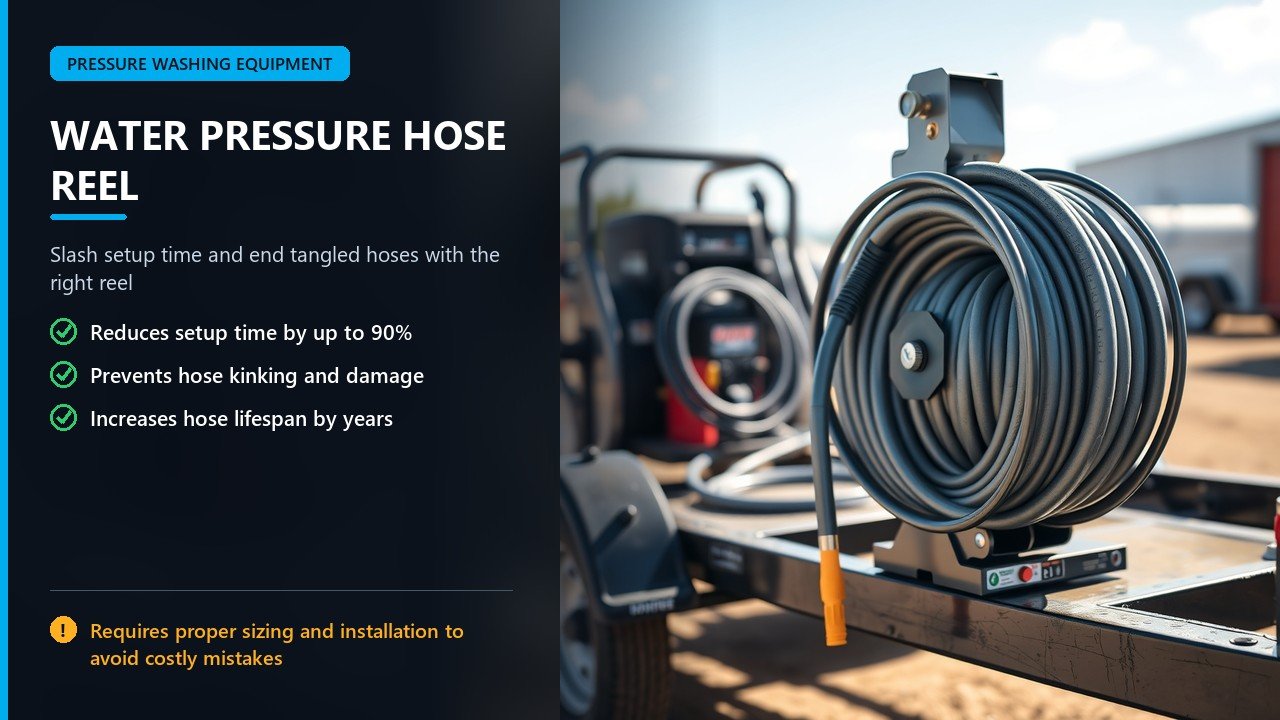
What Is a Water Pressure Hose Reel and Why It Matters
A water pressure hose reel is a mechanical spool designed to store, protect, and deploy a pressure washer hose. It has a drum that the hose winds around, a crank or motor to turn that drum, and a mounting bracket to attach it to a wall, a trailer, a truck bed, or a cart. On a live reel, water flows through a rotating swivel fitting at the center of the drum, which lets the hose stay connected and pressurized while you reel it in or pull it out.
The core value is simple: organization and protection. A pressure washer hose is the single most abused component in a cleaning system. It gets dragged across asphalt, run over by tires, kinked around corners, and baked in the sun. Every one of those events shortens its life. A reel keeps the hose off the ground, stores it in wide, even loops instead of tight coils, and dramatically reduces the kinks that choke water flow and eventually split the inner tube.
Think about what a kink actually does. When a high-pressure hose folds sharply, water flow stops or slows at that point. The pump keeps building pressure against a restriction, which stresses seals and the pump itself. At the same time, the reinforced layers of the hose are bent beyond their design radius, weakening the wall. Do that a few hundred times and the hose fails. A reel prevents the fold in the first place, so the hose keeps its shape and the pump keeps an even load.
Beyond the equipment, there is the human factor. An organized hose reduces tripping hazards on a job site, keeps your workspace looking professional, and lets you move from the machine to the farthest point of the job without stopping to untangle. On a commercial job, that saved time compounds across dozens of accounts. This is why seasoned operators treat the reel as core equipment, not an afterthought.
If you are building out a mobile setup, our guide to a pressure washer on a trailer shows how the reel fits into the bigger picture alongside tanks, pumps, and burners.
How a Pressure Washer Hose Reel Actually Works
Understanding the internals helps you buy the right reel and diagnose problems later. Every pressure washer hose reel revolves around a few key parts, and the fluid path is the part most buyers misunderstand.
The drum and the hose load
The drum, or spool, is the cylinder the hose wraps around. Its diameter and width determine how much hose it can hold. A larger drum holds more hose and lets the hose bend more gently, which is easier on the material. The drum is usually supported by two side plates or discs that keep the hose contained, plus a frame that carries the bearings and the mounting points.
The swivel is the heart of a live reel
The swivel is a rotating joint that lets the drum spin while water stays sealed inside. It is the hardest-working part of a live reel. Every time you pull hose out or crank it back, the swivel rotates under full system pressure. Inside, seals and bearings manage that rotation. A quality swivel uses stainless steel or brass construction with replaceable seals; a cheap one leaks within weeks under commercial use. When operators say a reel “went bad,” nine times out of ten they mean the swivel started dripping or seized.
The swivel also determines the pressure and temperature ceiling of the whole reel. A 5,000 PSI reel does not make your 4,000 PSI hose stronger, and a 4,000 PSI swivel does not magically handle a 5,000 PSI machine. The complete high-pressure path is only as strong as its weakest link, and the swivel is often that link on an inexpensive reel.
Live reel versus storage-only reel
This distinction matters more than almost any spec. On a live reel, the hose stays connected to the pump through the swivel, so pressurized water travels through the reel at all times. You can spray while the hose is on the drum. On a storage-only reel, the hose is disconnected from the water path and simply wrapped for storage; you must pull the hose completely off, or connect it separately, before you spray. Many homeowner reels are storage-only, and many commercial reels are live. If a product page does not clearly state that the swivel is pressure-rated and part of the fluid path, assume it is storage-only.
Types of Water Pressure Hose Reels
The market splits into three broad categories, each suited to a different user and budget. Choosing the wrong type is the most common first mistake.
Manual reels
A manual reel is turned by hand with a crank handle. It is the simplest, most durable, and most cost-effective option. Fewer moving parts mean fewer failures, and a well-built manual reel can last a decade or more with basic care. The trade-off is physical effort and speed. Winding 200 feet of 3/8-inch hose by hand takes a minute or two and can tire you out after a long day. For homeowners and part-time operators, that is a fine trade.
Retractable and spring-return reels
Spring-return reels use an internal spring to automatically wind the hose when you release a latch. They are popular for residential use because they are fast and tidy. The catch is that the spring mechanism is a wear item, and it is the part most likely to draw complaints in reviews. If the spring fails, the reel often becomes unusable. Read recent buyer feedback before choosing a spring-driven model.
Motorized and electric reels
Electric reels use a 12-volt DC motor (common on trucks and trailers) or a 120-volt AC motor (common in fixed wash bays) to rewind the hose at the push of a button. For a full-time professional running several jobs a day, an electric reel pays for itself through time savings and reduced fatigue. For an occasional user, it is overkill and adds cost and complexity, because you now have wiring, a switch, and a solenoid to maintain.
| Reel Type | Best For | Typical Cost | Main Drawback |
|---|---|---|---|
| Manual hand-crank | Homeowners, part-time operators | $80 to $400 | Physical effort, slower winding |
| Spring retractable | Residential convenience | $150 to $350 | Spring is a wear item |
| Electric 12V / 120V | Daily commercial use | $300 to $800+ | Cost, wiring, more parts to fail |
The table above shows why most commercial operators still favor manual reels: they are simple, rebuildable, and nearly indestructible. Electric reels win when speed and reduced fatigue directly translate to more jobs per day.
Capacity, PSI, and Temperature: The Three Ratings That Matter
Every reel listing shouts a headline number, usually the hose capacity. But a “100-foot reel” is meaningless without the hose diameter, and capacity tells you nothing about whether the reel can survive your machine. There are three ratings you must check together.
1. Hose capacity (with diameter)
Manufacturers publish capacity by hose inside diameter (ID) because the outside diameter and bend radius determine how much hose fits on a drum. A reel rated for 200 feet of 3/8-inch hose will hold far less 1/2-inch hose, because the larger diameter takes up more room. The same reel might hold more 1/4-inch hose. Always match the reel’s published capacity to the exact hose you own, and when in doubt, buy slightly oversized. Real 3/8-inch hose varies in wall thickness, and a thick-walled hose eats capacity.
2. Pressure rating
The reel’s swivel, seals, and plumbing must be rated for the pressure your machine produces, with a safety margin. Most professional pressure washer reels are rated 4,000 to 5,000 PSI, which covers nearly all gas and commercial electric machines. A reel rated below your machine’s output is a safety hazard, not just a reliability problem, because a failed swivel can release a jet of high-pressure water.
3. Temperature rating
If you run a hot-water machine, temperature becomes critical. Hot water puts far more stress on seals than cold water. Many reels are rated for 200 to 250 degrees Fahrenheit, while some handle up to 300 degrees. A cold-water reel used on a hot-water machine will fail quickly. If your pressure washer includes a burner, confirm the reel is rated for hot water before you buy.
| Rating | What It Tells You | What to Check Before Buying |
|---|---|---|
| Hose capacity | How much hose fits on the drum | Match to hose ID and length; buy slightly oversized |
| Working pressure | The highest PSI the swivel and plumbing handle | Must exceed your machine’s output with margin |
| Temperature | The hottest water the seals tolerate | Must match cold or hot-water machine use |
Choosing the Right Water Pressure Hose Reel for Your Setup
With the ratings understood, selection comes down to matching the reel to your actual workflow. Answer a few questions and the right reel practically chooses itself.
Match hose diameter and length
Start by measuring the hose you own or the hose you plan to buy. Hose ID and length determine required capacity. If you currently run 100 feet and might expand, buy a 200-foot reel now so you do not rebuy later. Our guide to what size pressure washer hose to choose for PSI and GPM explains how diameter and length affect flow and reach, which directly informs reel sizing.
Match fittings and connections
Reels connect through the inlet (from the pump or unloader) and the outlet (to your working hose). Professional reels often use NPT threads, while many homeowner hoses use M22 or quick-connect fittings. You may need an adapter or a short jumper hose to bridge the reel inlet to your machine. Check the thread size and gender before ordering, and avoid stacking several adapters, because every extra joint is another pressure-rated connection that can leak. Our guides to M22 adapters and quick-connect hose fittings cover the most common configurations.
Choose a mounting location that fits your work
Reels mount on walls, trailers, trucks, carts, and skids. The best location is wherever the hose feeds out smoothly without rubbing other equipment, with room for the crank to turn a full circle. On a trailer, the rear or side rail is popular because the hose deploys straight toward the job. In a garage, mounting at eye level keeps the hose off the floor and easy to reach.
If your hose has ever frustrated you, our article on a pressure wash hose reel to end the tangled hose struggle covers the everyday pain points a good reel solves.
Mounting and Plumbing Your Reel the Right Way
A reel that is poorly mounted or plumbed will vibrate loose, leak, or fail early. Follow this sequence for a clean, durable installation.
Step 1: Pick a sturdy, vibration-friendly surface
A loaded reel is heavy. A 200-foot 3/8-inch hose plus the reel can top 100 pounds. Mount to steel framing, a stud, or a reinforced plate, never to thin trailer decking or drywall alone. On trucks and trailers, use vibration-dampening washers and mount to the frame rather than just the floor, because constant road vibration destroys weak mounts.
Step 2: Check crank clearance and hose path
Before drilling, set the reel in place and simulate pulling the hose out and winding it back. Confirm the crank handle clears everything through a full rotation and that the hose feeds without catching on sharp edges. Repositioning a reel after it is bolted and plumbed is a genuine headache.
Step 3: Connect the inlet to the high-pressure side
Run a properly rated jumper hose or fitting from your pump or unloader to the reel inlet. Seal threaded connections with thread tape or high-pressure thread sealant, and route the line so it is clamped and clear of sharp edges. A loose, chafing line is a leak waiting to happen.
Step 4: Connect the working hose to the reel outlet
Attach your pressure washer hose to the drum outlet. On a live reel, water now travels through the swivel as the drum turns. Pull the hose off, pressurize the system, and inspect every joint for weeping before you use it in the field.
Step 5: Test under pressure
With the machine running and the gun triggered, watch the swivel and all fittings for leaks. A small drip at the swivel is the classic first sign of a failing seal. Fix it before it becomes a burst.
Common Mistakes That Shorten Reel and Hose Life
Most reel failures trace back to a handful of avoidable mistakes. Watch for these.
- Undersizing the reel. Forcing a thick hose onto a small drum creates tight bends and tangles. Buy capacity for the hose plus some margin.
- Ignoring the pressure rating. Running an underrated reel on a high-PSI machine invites swivel failure and safety risk.
- Cranking the hose on without guiding it. If you do not guide the hose evenly across the drum with your free hand, it piles up on one side and kinks.
- Mounting to a weak surface. Vibration and load will rip bolts out of thin decking and drywall.
- Using a garden hose reel. A garden reel is not built for high-pressure water or large-diameter hose. Its swivel and seals are not rated for the job and can burst.
- Skipping winterization. Trapped water can freeze and crack a swivel or split a hose. Our guide to how to winterize a power washer pump applies to the whole high-pressure path, reel included.
Maintenance and Troubleshooting
A quality reel is a long-term investment, and a little care keeps it running for years.
Leaking swivel
The number-one reel problem. Swivel seals wear from constant rotation under pressure. Fix it by replacing the seals, or the whole swivel assembly if the housing is worn. Keep a spare swivel on the rig if you rely on the reel daily, because a leaking swivel takes you offline.
Hard to crank
If the drum fights you, check for hose tangles, a binding swivel, or over-tensioned hose. Inspect and lubricate the bearings or bushings per the manufacturer’s instructions.
Hose kinking on the drum
Usually a loading error. Guide the hose back and forth evenly, laying it in flat rows rather than letting it bunch. An overfilled reel also kinks, so stay within capacity.
Hose wearing through
If the outer jacket is rubbing against the frame or sharp edges as it feeds, relocate the reel or add a guide. Even small abrasion points eventually cut into the reinforcement.
Residential Versus Commercial: Which Reel Do You Actually Need?
The right reel depends on how often you use it and how much hose you run.
For a homeowner washing a driveway, siding, and a car a few times a year, a manual wall-mounted reel with 50 to 100 feet of capacity is ideal. It is affordable, simple, and dramatically better than coiling hose on the ground. Pair it with stainless steel quick-connect fittings for fast hookups.
For a part-time operator running a handful of jobs a week, a heavier manual or mid-range spring reel with 100 to 200 feet of capacity fits well. Prioritize all-metal construction and rebuildable swivels over convenience features.
For a full-time commercial operator running multiple accounts a day, a live reel rated 4,000 to 5,000 PSI with 200 to 300 feet of capacity is the standard. Electric rewind becomes worth the cost once you are doing four or more jobs daily. Fleet and truck-bed setups are covered in our guides to 100 ft pressure washer hose reel capacity and 4000 PSI hose reel buying.
What a Water Pressure Hose Reel Setup Actually Costs
Budgets vary widely based on type and capacity. Use this as a rough planning guide for a U.S. buyer.
| Setup Level | Reel | Hose | Mounting and Fittings | Approx. Total |
|---|---|---|---|---|
| Homeowner manual | $80 to $150 | $40 to $90 | $20 to $50 | $140 to $290 |
| Part-time manual/spring | $150 to $350 | $90 to $180 | $40 to $90 | $280 to $620 |
| Commercial electric | $400 to $800 | $150 to $250 | $80 to $230 | $630 to $1,280 |
The commercial figures assume wiring or a switch and a long 3/8-inch hose. For professionals, the time saved on setup and breakdown often repays the reel within a couple of months, which is why the upgrade feels obvious once it is installed.
Frequently Asked Questions
Can I use any hose reel for a pressure washer? No. A pressure washer reel must be built for high-pressure water with a swivel, seals, and plumbing rated for your machine’s PSI and temperature. A garden hose or air hose reel can look similar but is not rated for the pressure and can burst.
What is the difference between a live reel and a storage reel? A live reel routes pressurized water through a rated swivel while the hose stays connected, so you can spray with the hose on the drum. A storage-only reel just holds the hose and is not part of the pressurized path.
How much hose can a reel hold? It depends on reel size and hose diameter. A reel rated for 200 feet of 3/8-inch hose holds less 1/2-inch hose and more 1/4-inch hose. Always check the manufacturer’s capacity table for your exact hose ID.
Do I need a hot-water reel for a hot-water machine? Yes. Hot water stresses seals far more than cold water. Choose a reel rated for the water temperature your machine produces, commonly 200 to 300 degrees Fahrenheit.
Should I buy manual or electric? Manual reels suit homeowners and part-time operators because they are simple, durable, and affordable. Electric reels suit full-time professionals who run several jobs a day and value speed and reduced fatigue.
Why is my hose reel leaking? The most common cause is worn swivel seals from constant rotation under pressure. Replace the seals or the swivel assembly, and check all threaded fittings for proper sealing.
Can I mount a reel on a trailer? Yes, and trailers are one of the most common applications. Mount to the frame or a reinforced plate with vibration-dampening hardware, allow crank clearance, and route the hose so it feeds out cleanly.
Final Thoughts on Choosing a Water Pressure Hose Reel
A water pressure hose reel is the kind of upgrade that feels minor until you use one, then feels essential forever. It protects your hose, steadies your pump’s load, cuts setup time, and makes any cleaning job look and run more professionally. The key is to look past the headline capacity number and confirm the three ratings that actually matter: capacity at your hose diameter, working pressure above your machine’s output, and temperature suited to cold or hot water.
Match the reel to your workflow. Homeowners do well with a simple manual wall reel. Part-time operators should invest in an all-metal, rebuildable mid-range unit. Professionals should standardize on a live, high-pressure reel with enough capacity to grow. Mount it to something solid, plumb it cleanly, guide the hose as you wind, and inspect the swivel regularly. Do that, and a good reel will outlast several hoses and pay you back in saved time on every single job.
Sources and Further Reading
- Coxreels, manufacturer specifications for high-pressure hose reels: coxreels.com
- Reelcraft, pressure washer and high-pressure reel product data: reelcraft.com
- U.S. Occupational Safety and Health Administration (OSHA), hand and power tool safety guidance: osha.gov
- U.S. Environmental Protection Agency (EPA), on managing wash water responsibly: epa.gov