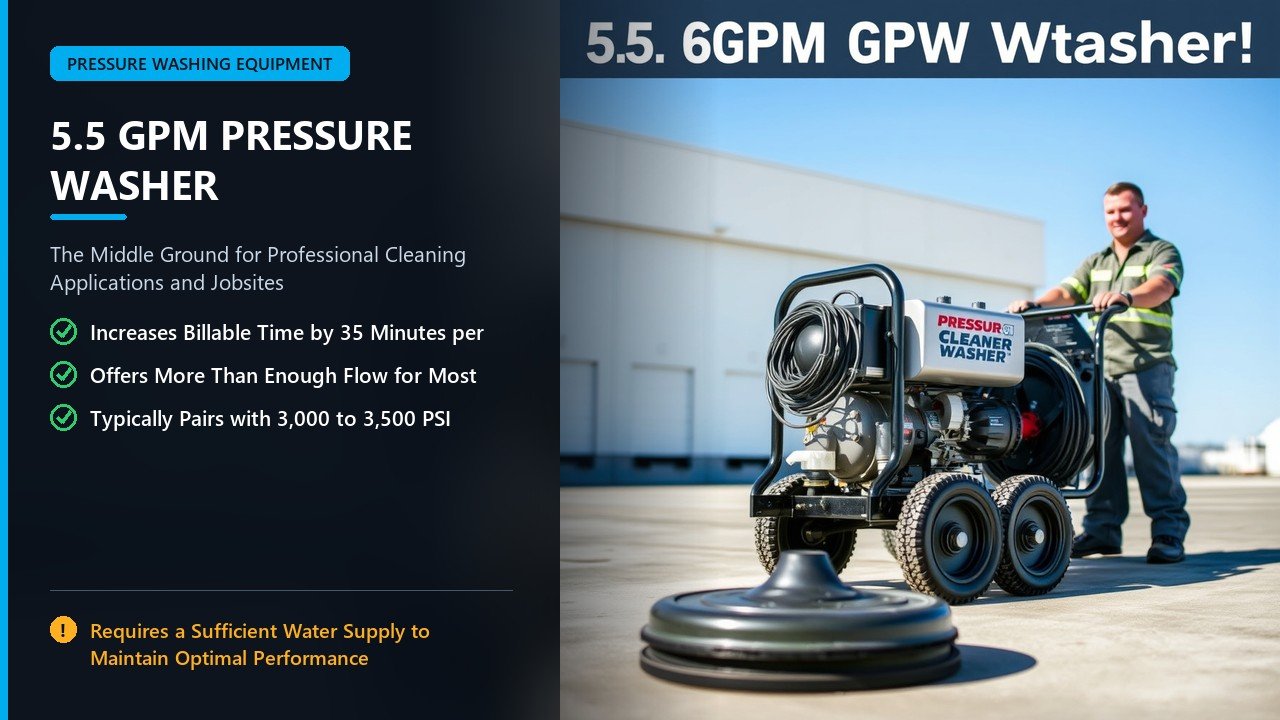
Two crews, same company, same city, same Saturday. One truck carried a 4,000 PSI machine pushing 4.0 gallons per minute. The other had been upgraded to a 3,500 PSI machine pushing 5.5 gallons per minute. Both crews washed a thirty-by-sixty concrete pad with a surface cleaner, and both pads came out the same shade of clean. The difference was on the invoice: the 4.0 GPM truck took two hours and ten minutes, the 5.5 GPM truck took one hour and thirty-five minutes. Same labor rate, same fuel, thirty-five minutes of billable time that only one crew captured.
That is the quiet argument behind the 5.5 GPM pressure washer. It is not the biggest machine on a job site and it is not the one that shows off the highest pressure number on the spec sheet, which is exactly why it keeps getting overlooked by buyers who have been trained to shop for PSI first. In practice it occupies the most useful middle ground in the professional range: enough flow to change how fast real work gets done, without the water demand, weight, and fuel appetite of a full-size 8 GPM rig.
This guide walks through the whole decision. You will see what a 5.5 GPM machine actually is, how flow translates into hours saved, which accessories it can properly drive, what your water supply has to be able to feed it, how the pump and drive choices differ at this size, and the mistakes that make people regret the purchase in month three.
Where the 5.5 GPM Class Sits
The professional pressure washer market sorts into rough flow classes, and each one solves a different problem.
- 2.0 to 3.0 GPM. Entry-level gas and strong electric units. Fine for homeowners and light residential work, slow on large flatwork.
- 4.0 GPM. The widely accepted professional floor. Enough to run a 16-inch surface cleaner and work productively on residential jobs.
- 5.5 GPM. The step-up class. Meaningfully faster than 4.0, still compact enough for a standard truck or small trailer.
- 8.0 GPM and up. True production rigs. Twice the water demand, bigger everything, usually trailer-mounted with a buffer tank.
What makes a 5.5 GPM pressure washer worth discussing is that the jump from 4.0 to 5.5 GPM is a thirty-seven percent increase in water volume, while the jump from 5.5 to 8.0 GPM is a much larger commitment in supply, fuel, and cost. For a great many contractors, the first jump pays for itself and the second one creates logistical problems they did not sign up for.
If you have been comparing flow classes, our breakdown of what GPM is good for a pressure washer explains the reasoning behind the numbers in more detail.
Why Flow Beats Pressure on Real Jobs
Pressure and flow do different work, and mixing them up is the most common mistake in machine selection.
PSI breaks the bond. It is the force that separates dirt, grime, and coatings from the surface. Above a certain threshold, more pressure adds very little. Concrete does not need 4,500 PSI to clean; it needs enough pressure to break the soil loose and not so much that you etch the paste.
GPM clears the surface. Volume carries the loosened material away, rinses detergent, and determines how wide a path you can sweep per pass. Flow is what makes the difference between stopping every few feet to chase slurry and walking at a steady pace across the whole slab.
Time on the trigger is the single largest variable in a washing crew’s labor cost. Anything that reduces minutes per square foot compounds across every job for the life of the machine. That is why experienced operators tend to talk about flow first and pressure second.
A second, less obvious advantage is that flow drives chemical delivery. Downstream injectors meter detergent based on flow and pressure differential, so a machine with more volume pulls chemical more reliably and rinses it away faster. If you soft wash or pre-treat surfaces regularly, the extra gallon per minute is not only speed.
Our 4 GPM flow versus pressure guide covers the same principle from the other side of the decision.
4 GPM Versus 5.5 GPM Versus 8 GPM
Here is how the three professional classes compare when you look past the marketing and at daily operation.
| Factor | 4.0 GPM Class | 5.5 GPM Class | 8.0 GPM Class |
|---|---|---|---|
| Typical pressure | 3,500 to 4,000 PSI | 3,000 to 3,500 PSI | 3,000 to 4,000 PSI |
| Surface cleaner it drives well | 16 inch | 20 inch | 24 inch and up |
| Relative flatwork speed | Baseline | Roughly a third faster | Roughly double the 4.0 baseline |
| Water supply demand | Modest, most spigots cope | Notices a weak supply | Usually needs a tank or strong feed |
| Typical engine | GX390 class single cylinder | Large single or small V-twin | V-twin, often 20+ HP |
| Drive type common at this size | Direct or belt | Gear or belt preferred | Gear or belt |
| Transport | Truck bed or small cart | Truck bed, skid, or compact trailer | Trailer or large skid |
| Best fit | Solo operators starting out | Full-time residential and light commercial | High-volume commercial and fleet work |
Notice that pressure actually trends downward as flow climbs in this table. That is deliberate, not a compromise. Manufacturers pair high flow with moderate pressure because the combination is more useful, easier on surfaces, and gentler on the pump. A 3,500 PSI machine at 5.5 GPM produces roughly 19,250 cleaning units, compared with 16,000 for a 4,000 PSI machine at 4.0 GPM, and it delivers them in a form that rinses faster.
For a deeper look at the high end of the range, see our guide to 8 GPM Honda pressure washers.
What a 5.5 GPM Machine Can Actually Power
Flow is what determines which attachments run correctly, and this is where the class earns its price.
- 20-inch surface cleaners. The standard pairing. A 20-inch bar needs real volume to spin properly and rinse clean; underfeed it and you get stripes and a slow operator chasing slurry.
- Downstream chemical injection. Reliable soap pull and faster rinsing, which matters on house washing and pre-treatment work.
- Long hose runs. Extra volume tolerates the friction loss of a hundred feet of hose far better than a marginal machine does.
- Soft wash rigs. Adequate flow to run a proportioner or injector system without starving the pump.
- Larger orifice nozzles. Wider tips at higher flow clean more area per pass while staying inside the pump’s comfort zone.
- Seasonal demand spikes. Spring and fall rushes are when the extra capacity turns into completed jobs rather than overtime.
What it will not do is drive a 24-inch surface cleaner or support two guns at once. Those belong to the 8 GPM class. Sizing accessories to flow rather than to whatever fits your budget is the rule that keeps a machine productive, and our surface cleaner guide shows the matching logic.
The Water Supply Question Nobody Asks First
This is where a 5.5 GPM pressure washer surprises people. The machine is only half of the system; the supply has to feed it.
A pump running at 5.5 gallons per minute draws more water than a typical residential spigot can reliably deliver, especially in older homes, rural properties, or anywhere the municipal main is small. When supply falls short of demand, the pump cavitates, pressure pulses, seals wear prematurely, and the machine loses performance long before it shows any visible damage.
There are three workable approaches.
- Verify the source. A good outdoor faucet with a short, full-diameter garden hose can often manage the flow, but a long or restricted hose cannot. Measure before you commit.
- Use a buffer tank. A tank between 100 and 325 gallons fed by the spigot lets the pump draw freely from a reservoir that refills slowly. This is the standard professional answer and it works on nearly any site.
- Improve the plumbing. Larger diameter feed hose, a clean inline filter, and a fully open valve all add usable supply with almost no cost.
Buffer tanks deserve particular attention because they separate the machines that last from the machines that get new pumps every season. If you regularly work on properties with poor supply, a tank is not an accessory, it is part of the machine. Our 5 GPM class overview covers the same supply math.
Matching Accessories to 5.5 Gallons Per Minute
Everything downstream of the pump has to be rated for both the pressure and the volume. The table below is a practical starting point.
| Accessory | Correct Match for 5.5 GPM | Common Mistake |
|---|---|---|
| Surface cleaner | 20 inch deck, matched to 3,000 to 3,500 PSI | Running a 16 inch deck and leaving speed on the table |
| High pressure hose | 3/8 inch, rated at or above machine pressure | Using a 1/4 inch hose that restricts flow |
| Nozzle orifice | Sized to the machine’s PSI and GPM chart | Reusing a tip sized for the old 4 GPM machine |
| Trigger gun and lance | Full-flow gun rated for the volume | A narrow-bore gun that becomes the bottleneck |
| Wand length and style | Matched to surface and operator height | Too short, forcing back strain all day |
| Detergent system | Downstream injector rated for the flow range | An injector calibrated for lower flow that pulls too much soap |
| Hose length | 50 to 100 feet of properly sized hose | Chaining multiple short hoses with restrictive couplers |
The pattern is consistent: the machine’s extra capacity only helps if the rest of the chain can carry it. A 5.5 GPM pump pushed through a restrictive hose and a small-orifice tip behaves like a smaller machine while wearing out faster.
Fittings and connections are worth checking too, since a partial restriction at any joint shows up as lost performance. Our guide to pressure washer carts and frames also covers how to package a machine of this size so it stays movable.
Pump, Drive, and Engine Choices at This Size
Specifications on paper matter less than how the machine is put together, and the 5.5 GPM class has some clear conventions.
Pump
A triplex plunger pump is the standard, with brands such as AR, General Pump, Comet, and CAT all common in this range. Look for a pump that is rebuildable rather than sealed, with parts you can actually source locally. A quality triplex pump will run for thousands of hours with proper oil changes; a bargain axial unit is not built for daily commercial duty at any flow.
Drive type
Direct drive is compact and cheap but spins the pump at engine speed and transfers heat and vibration straight into it. Belt or gear drive reduces pump RPM, runs cooler, and lasts noticeably longer under sustained use. At 5.5 GPM, where machines tend to work long hours, a gear or belt drive is the configuration most professionals prefer.
Engine
You will find large single-cylinder engines in this class as well as small V-twins. What matters is reliable starting, parts availability, and enough torque to hold speed under load. Electric start moves from a luxury to a near-necessity once the engine gets big enough to pull-start comfortably on a cold morning.
Our 5.5 GPM versus PSI explainer digs further into why this pairing works.
Mistakes That Ruin the 5.5 GPM Experience
- Buying on pressure alone. If the spec sheet leads with 4,500 PSI and buries the flow figure, keep reading. Pressure without volume is slow on flatwork.
- Ignoring water supply. The most common source of buyer’s remorse. Test your supply or plan for a buffer tank before the machine arrives.
- Keeping the old accessories. Nozzles, hoses, and injectors sized for a smaller machine throttle the new one. Budget for matching attachments.
- Skipping the tank on poor-supply sites. Starving the pump is how a good machine develops a bad reputation.
- Oversizing for occasional work. If you wash a few driveways a month, a 4.0 GPM machine will serve you better and cost less to run.
- Underestimating transport. These machines are heavy. Confirm your truck bed, skid, or trailer can carry it safely with room for the hose reel and tank.
- Neglecting pump oil. Higher flow means longer duty cycles, which means oil changes matter more, not less.
Reading Cleaning Units and Sizing Nozzles
The industry compares machines by cleaning units, which is simply pressure multiplied by flow. It is not a safety rating and it does not tell you whether a machine suits your surfaces, but it is the fairest single number for judging raw cleaning capability across spec sheets.
| Machine | PSI | GPM | Cleaning Units | What the Number Tells You |
|---|---|---|---|---|
| Entry gas machine | 2,700 | 2.5 | 6,750 | Light residential only |
| Strong residential gas | 3,100 | 3.0 | 9,300 | Occasional driveway work |
| Professional floor | 4,000 | 4.0 | 16,000 | Full-time solo work begins here |
| This class | 3,500 | 5.5 | 19,250 | Faster rinse, larger accessories |
| Production rig | 3,000 | 8.0 | 24,000 | High-volume commercial flatwork |
Two lessons fall out of that table. First, the 5.5 GPM machine at moderate pressure outranks a 4,000 PSI machine at 4.0 GPM. Second, the 8 GPM machine does not win by a landslide on raw units, but it wins decisively on rinse speed and the size of cleaner it can drive. Cleaning units start the comparison; flow and nozzle sizing finish it.
Nozzle orifice matters as much as the machine. A turbo or fan tip that is too small restricts flow, spikes pressure, cycles the unloader, and converts your 5.5 GPM machine into a hard-working 4 GPM machine that runs hot. A tip that is too large drops pressure below the usable range and leaves the pump under-loaded. Size the orifice to your PSI and GPM together, using the manufacturer’s chart, and replace worn tips before they quietly enlarge and cost you performance.
This is the same principle that makes hose diameter and gun bore important. Every restriction downstream of the pump changes the job the pump was built to do, and at high flow those small bottlenecks compound faster than they do on a homeowner machine.
A Productive Day Starts With Setup
Owning the right machine is only half of it. The crews that get the most out of a 5.5 GPM pressure washer follow a routine that protects the pump and keeps the day moving.
- Check the water supply first. Open the source fully, confirm the buffer tank is filling through its float valve, and clear the inline filter before starting anything.
- Check oil on both engine and pump. Higher flow means longer duty cycles, and pump oil is the cheapest insurance in the kit.
- Purge air before you clean. Run the gun with the trigger held until the stream is steady and free of sputter, then set your working pressure.
- Match the accessory to the job. Drop the 20-inch surface cleaner on open flatwork, switch to a wand and the correct tip for edges, steps, and vertical surfaces.
- Pre-treat rather than over-pressurize. On heavy soil, apply detergent, let it dwell, then rinse with flow. Chemical and flow beat raw pressure every time on organic and greasy grime.
- Keep the pass steady. Consistent walking pace with about fifty percent overlap gives an even finish and avoids the stripe pattern that signals an inconsistent operator.
- Mind the temperature on hot days. Long trigger-held runs on a hot machine need clean oil and a working thermal relief valve to prevent seal damage.
- Shut down in order. Release the trigger, stop the engine, close the water, then bleed pressure at the gun before disconnecting anything.
- Flush and store properly. Run clean water through the detergent line, drain the tank and pump, and store the machine out of freezing temperatures.
- Log the hours. Track engine hours and pump hours so maintenance happens on schedule rather than after a failure.
This is the unglamorous part of the job, and it is exactly where the difference between a machine that lasts three seasons and one that lasts ten is decided.
What the Upgrade Costs and Returns
Expect to pay meaningfully more than a 4.0 GPM machine, with the gap depending on engine, drive type, and pump brand. Against that sits a straightforward productivity calculation.
If the extra flow saves you thirty minutes on a typical flatwork job and you run four such jobs a week, you recover two hours every week. At a modest hourly labor rate, the machine pays for the difference within a season, and every hour after that is margin.
There are real operating costs to acknowledge. Fuel consumption rises with a larger engine. Water consumption rises with flow, which matters where rates are metered. Hose and nozzle wear increase slightly with volume. And a buffer tank, if you need one, is a separate line item.
The businesses that get the best return are those with steady volume, real flatwork in the schedule, and enough jobs per week to keep the machine earning. For them the 5.5 GPM pressure washer is not an indulgence; it is the tool that makes the workload fit inside a normal day.
If you are still weighing this against other classes, our business machine matching guide frames the decision around the work you actually sell.
Frequently Asked Questions
Is 5.5 GPM enough for commercial pressure washing? Yes. It is a genuine professional class that handles residential flatwork, light commercial cleaning, fleet work, and soft washing comfortably, and it runs a 20-inch surface cleaner correctly.
Is 5.5 GPM better than 4 GPM? For regular flatwork and busy schedules, yes, because roughly thirty-seven percent more water rinses faster and drives larger accessories. For occasional residential work, 4.0 GPM is cheaper to buy and easier to feed.
How much pressure does a 5.5 GPM machine have? Usually 3,000 to 3,500 PSI. That combination produces more cleaning units than many higher-pressure, lower-flow machines and rinses better.
Can it run a 24-inch surface cleaner? Not correctly. That deck wants 8 GPM or more. A 5.5 GPM machine is properly matched to a 20-inch cleaner.
Do I need a water tank? Not always, but if your spigot cannot deliver the full flow, a buffer tank is the fix. Starving the pump causes more problems than any other single mistake in this class.
What hose diameter should I use? 3/8 inch. A 1/4 inch hose restricts the volume the machine is built to deliver and wastes the reason you bought it.
Direct drive or gear drive? For sustained commercial use, gear or belt drive. It runs the pump slower and cooler and extends service life substantially.
What surface cleaner matches 5.5 GPM? A 20-inch deck sized to the machine’s pressure range. Always match deck width to flow rather than choosing the largest one that fits your budget.
Final Thoughts on the 5.5 GPM Pressure Washer
The 5.5 GPM class solves a problem that neither extreme addresses well. It gives working contractors real production speed without dragging them into the water supply, transport, and fuel commitments of an 8 GPM rig, and it outpaces the 4.0 GPM floor that so many operators outgrow within a season.
The right buyer is someone washing full time, with flatwork regularly on the schedule and enough jobs each week to reward the extra capacity. That person will feel the difference on the very first driveway and see it reflected in completed jobs per week.
Buy it with the whole system in mind. Confirm your water supply, match the surface cleaner, hose, and nozzles to the flow, choose a rebuildable triplex pump on a gear or belt drive, and budget for a buffer tank if your sites are not reliable. Done properly, this is the machine a growing business keeps for years and measures every other purchase against.
Sources and Further Reading
- PowerWash.com, is 5.5 GPM enough for commercial pressure washing jobs: powerwash.com
- Freedom Wash Supply, choosing between 4, 5.5, and 8 GPM machines: freedomwashsupply.com
- JR Racenstein, commercial pressure washer buying guide: jracenstein.com
- PressureWashMatch, commercial pressure washer flow, pumps, and heat: pressurewashermatch.com
- U.S. Occupational Safety and Health Administration, safety in pressure washing operations: osha.gov