A friend of mine started his pressure washing side business with almost nothing. He had an old utility trailer, a used 4 gallon per minute gas machine, and a stubborn belief that he did not need to spend thousands on equipment before he earned a single dollar. His first water supply was a garden hose tapped off the customer’s spigot, and it worked until the day a homeowner’s well could not keep up with his pump. The machine starved, cavitated, and lost pressure mid job. On the drive home he passed a hardware store, bought a heavy duty trash can, and by the next weekend he had bolted it to the trailer, drilled a hole in the side, and plumbed it to his pump. That trash can pressure washer trailer setup carried him through his first two seasons and taught him a lesson a lot of newcomers learn the hard way: sometimes the simplest solution is the one that gets you working.
The phrase trash can pressure washer trailer can mean two related things, and both are worth understanding. It can describe using a trash can as a water tank on a mobile pressure washer rig, a genuinely smart budget build. It can also describe a trailer rig built specifically to clean trash cans and wheelie bins as a business. This guide covers both, along with the plumbing, math, safety, and legal details that decide whether a build like this makes money or becomes an expensive lesson.
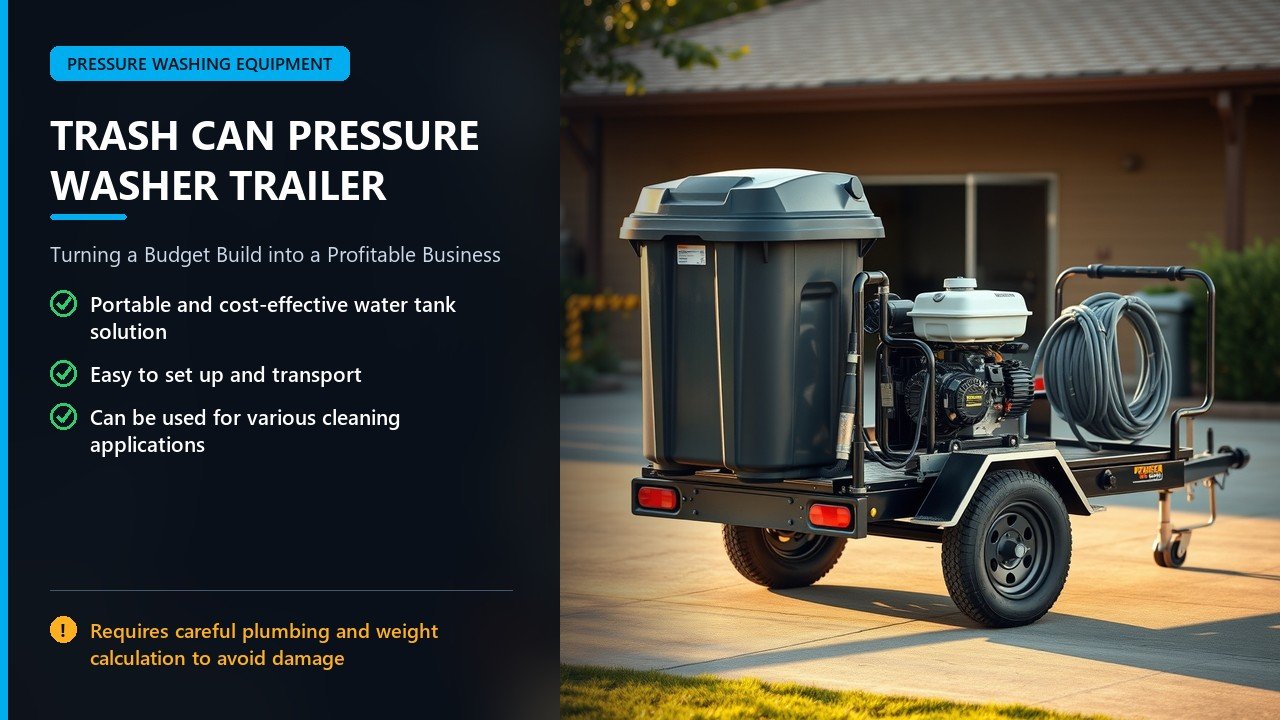
What a Trash Can Pressure Washer Trailer Actually Is
At its core, this is a mobile pressure washing setup where a trash can serves as the water reservoir, mounted on a trailer alongside the pressure washer, a hose reel, and often a battery to power a transfer pump. The point of any water tank on a pressure washer trailer is to break the link between your machine and the customer’s water supply. A pressure washer pulls water fast, and most garden spigots cannot keep up with a serious pump. Without a reservoir, the pump pulls harder than the supply can deliver, and that is the fast track to cavitation, which quietly destroys pumps over weeks.
A trash can solves that problem on a shoestring. It holds enough water to buffer the difference between what the spigot delivers and what the pump demands, and it lets you work in places with no readily accessible water at all. Fill it at one location, tow it to the next, and clean without hunting for a tap.
The second meaning is a business model. A trash can cleaning trailer is a rig purpose built to lift, wash, and sanitize residential wheelie bins on a route. These rigs combine a water supply, a pressure washer, a lifting mechanism, and a wash chamber, all on a trailer. Homeowners pay a recurring monthly fee for clean, sanitized bins, and operators build routes that become predictable income. Both meanings share the same bones: a trailer, a water tank, a pump, and the plumbing that connects them.
Why a Trash Can Works as a Water Tank
A purpose built water tank is the professional answer, but a heavy duty trash can is a legitimate budget one, and it is not as crude as it sounds. Trash cans are made from tough, impact resistant plastic, they are available in sizes that suit small rigs, and they cost a tiny fraction of a molded tank. The trade offs are real, so know them before you commit.
| Factor | Heavy Duty Trash Can | Purpose Built Water Tank |
|---|---|---|
| Cost | Very low | Moderate to high |
| Shape and mounting | Round, needs custom brackets | Flat, often molded feet or leg tanks |
| Center of gravity | Higher, can slosh | Lower, often baffled |
| Lid security | Needs a strap or clamp | Sealed with a proper lid |
| Fitting support | Thin walls need care | Designed for bulkheads and outlets |
| Durability | Can crack if UV or cold stressed | Built for years of service |
| Best for | Budget DIY and side hustle rigs | Full time commercial operations |
If you go the trash can route, choose a heavy duty, rigid can with thick walls rather than a flimsy household model. A food grade or chemical resistant high density polyethylene can is ideal, because it resists cracking and does not leach. Avoid thin, flexible cans that flex when full, since flexing stresses the plastic around any fitting you install and eventually causes leaks. A wheeled trash can with a sturdy body is a common favorite, though you will usually remove the wheels and mount the body securely to the trailer so it cannot tip.
The Weight Math You Cannot Ignore
Water is heavy, and this is where many DIY builds get into trouble. A gallon of water weighs about 8.34 pounds, so the tank, the full water load, the pressure washer, the hose, and the trailer itself all add up fast against the weight your trailer and towing vehicle can legally and safely handle.
| Water Volume | Approximate Water Weight | Typical Use |
|---|---|---|
| 32 gallons | About 267 lb | Small buffer, short jobs |
| 50 gallons | About 417 lb | Light residential work |
| 100 gallons | About 834 lb | Serious DIY buffer tank |
| 200 gallons | About 1,668 lb | Tandem axle territory |
| 380 gallons | About 3,170 lb | Commercial rig, heavy duty tow vehicle |
Add the machine, which can weigh well over a hundred pounds, plus the trailer, hose, battery, and chemicals, and it is easy to see why a modest single axle trailer fills up quickly. The tank must sit over or near the axles, never hanging off the back, because an unbalanced load causes trailer sway at highway speed and shifts your tongue weight dangerously. Balance side to side as well, especially if the engine or battery sits on one side. Before you build, check your trailer’s gross vehicle weight rating and the towing capacity of your vehicle, and remember that a full tank of water dwarfs almost everything else you will carry. Our article on building a 5×8 pressure washing trailer that works walks through the layout decisions in more detail.
Plumbing a Trash Can Tank the Right Way
The plumbing is where budget builds succeed or fail, and a trash can is no different. The good news is that the principles are simple, and there are well established practices from the professional pressure washing world you can copy. The basic flow is tank to strainer to pump to unloader to hose reel. Every piece needs to be sized so it does not strangle the flow.
- Bulkhead fitting. This is the fitting that lets you pull water from the side of the can without leaks. It is a threaded tube with a flange and a seal that clamps through the wall. Size the hole carefully with the correct hole saw, keep the hole high enough above the bottom that the nut can turn freely inside, and seal the threads properly. Thin trash can walls demand a careful, snug fit rather than muscle, or you will crack the plastic. There are detailed walkthroughs of bulkhead installation from trusted suppliers like the Expert Power Wash guide.
- One 90 degree elbow, not two. A single 90 off the strainer is fine. Stacking two 90s restricts flow enough to matter and defeats the purpose of the tank.
- Crush-proof suction hose. This is the most important part and the most common mistake. The hose from the tank to the pump must be wire reinforced so it does not collapse under suction. A collapsing hose starves the pump, and starvation causes cavitation that destroys the pump from the inside. Never use a garden hose for the suction line.
- Inlet strainer. A Y or tee strainer between the tank and the pump catches grit before it reaches the valves and seals. This single inexpensive part prevents a large share of pump repairs.
- Float valve. A float valve at the tank inlet lets a garden hose fill the tank all day without you babysitting it. It fills, shuts off at the preset level, and refills as the pump draws water down.
- Unloader bypass return. The unloader sends water somewhere when you release the trigger. Route that bypass line back to the tank so the recirculated water has somewhere to cool, rather than sitting trapped and heating in the pump head.
The Trash Can Cleaning Business Trailer
The second meaning of the phrase, a trailer built to clean other people’s trash cans, is a genuine small business model. The idea is simple. A route operator tows a trailer through a neighborhood on trash pickup day, lifts each wheelie bin into a wash chamber, blasts it inside and out with a rotating spray head, sanitizes it, and returns it to the curb. Customers pay a recurring fee, often monthly, and the operator builds a route that becomes reliable income with low overhead.
A professional trash can cleaning trailer typically includes a fresh water tank, a wastewater recovery tank, a pressure washer, a rotating spray head inside a wash chamber or hopper, a lifting mechanism to raise the bin, and a hose reel for the exterior and any pressure washing add ons. The wash chamber matters for two reasons. It contains the spray so dirty water does not blast the customer’s driveway, and it collects the wastewater so it can be disposed of properly instead of running into the street.
Many operators start lean. A homemade rig might use a simple trailer, a tank for fresh water, a container to catch runoff, and a hand sprayed or wand based wash instead of a polished automated system. As the route grows, they upgrade to purpose built equipment with assisted lifts and rotating heads that clean a bin in about a minute. The economics depend entirely on route density, water capacity, and how many stops a tank of water supports, which is why measuring real consumption is far more useful than guessing from tank size alone.
The Legal and Environmental Side Nobody Warns You About
Washing anything outdoors creates wastewater, and wastewater carries legal weight. Grime, detergent, and especially the bacteria and residue washed out of a garbage bin are not something you can let run freely into a storm drain. In many places, storm drains lead directly to waterways without treatment, so discharging wash water into them can violate environmental regulations. A collection tank does not by itself grant you permission to dump anywhere, and the rules vary by city, county, and state.
Before you turn a wash water hose or a bin cleaning rig loose on a route, find out what your local authority requires. Many jurisdictions expect you to collect runoff and dispose of it through an approved method, whether that is a sanitary sewer connection where permitted, a treatment arrangement, or a designated disposal site. Some areas have specific rules about surfactants and cleaning chemicals. This is not legal advice, and you should confirm the requirements for your own area, but general guidance on stormwater and wastewater from bodies such as the U.S. Environmental Protection Agency is a reasonable starting point. Getting this right protects your customers, your community, and your business from fines that could wipe out your profits.
What It Costs to Build Versus Buy
A trash can based DIY rig can be assembled for very little if you already own a trailer and a pressure washer. The extra cost is a heavy duty can, a bulkhead fitting, a crush-proof suction hose, a strainer, a float valve, and some clamps and sealant. It is one of the cheapest ways to get a mobile machine off the ground, and it is a fine way to test whether a pressure washing side business suits you before investing more.
A purpose built commercial trash can cleaning trailer is a different order of magnitude, often running thousands of dollars for a basic unit and far more for a full hot water system with an automated lift. There are also DIY kits that supply the lifter, hopper, and rotating head for people who already own a trailer and a machine, letting an operator build in stages. The right choice depends on whether you are testing an idea or running a business. Start cheap if you are experimenting, and invest in real equipment once the demand proves itself. For a broader look at the trailer side of a cleaning business, our articles on how a pressure washer trailer turns cleaning into a business and how to choose power wash trailers that last are useful next reads.
Safety and Practical Lessons for a First Build
- Secure the tank. A full trash can that shifts in transit can turn a small trailer into a hazard. Strap it, bracket it, or bolt it so it cannot move, and keep the load centered over the axles.
- Never exceed weight ratings. Full water is heavy. Check your trailer’s gross vehicle weight rating and your vehicle’s towing limits, and leave margin for tools and chemicals.
- Protect the suction line. Crush-proof hose, one 90, and a strainer are non negotiable. This is the difference between a rig that lasts and one that kills pumps.
- Watch for cavitation. A pump that sounds like it is rattling or losing pressure may be starved for water. Stop and fix the supply before damage compounds.
- Keep chemicals separate. Screw on sodium hypochlorite for a soft wash belongs in its own dedicated tank, never in a tank feeding a high pressure pump. Bleach corrodes pumps fast.
- Winterize everything. Drain the tank, lines, pump, and gun completely before freezing weather. Frozen water splits manifolds and housings, and the damage is easy to avoid.
If you clean bins or soft wash at low pressure, note that a standard high pressure pump is not the ideal tool for the job, and the low pressure side of the system deserves its own attention. Our explainer on what a pressure washer plate does on your cleaning setup touches on how low pressure application fits into a professional kit.
Maintenance That Keeps a Homebuilt Rig Working
A homemade rig rewards the same care a commercial one does. Rinse and drain the tank regularly so sediment and biofilm do not build up, especially if you use it for anything organic. Check the strainer and clean it often, because a clogged strainer starves the pump just as surely as a collapsed hose. Inspect the bulkhead and all low pressure joints for slow weeps, and re seal them at the first sign of a drip rather than waiting for a mid job failure. Change the pump oil on schedule, keep the machine free of grit, and store the whole rig under cover if you can. Our guide on power washing preventative maintenance lays out a routine that fits a trailer rig well, and you can browse more ideas in our Pressure Washer category.
Buffer Tank or No Tank: A Simple Way to Decide
The first question on any mobile build is whether you need a tank at all. There is a reliable way to answer it. Find out how much water your pump demands per minute, which is the machine’s GPM rating, and then find out how much water your water source can actually deliver per minute. If the source can supply more than the pump demands, you can often run straight off the tap without a tank. If the pump pulls more than the source delivers, which is the case for almost every machine above about four gallons per minute, you need a buffer tank or the pump will cavitate.
A simple test makes this concrete. Fill a five gallon bucket from the tap and time how long it takes. If a five gallon bucket fills in a minute, the source delivers about five gallons per minute. If your pump wants six, you are short and a tank is mandatory. If your pump wants three, you have headroom and may not need one. Doing this test once saves a lot of guessing and prevents the pump damage that comes from assuming a garden spigot can keep up with a serious machine.
A transfer pump is the other piece worth understanding on a trailer rig. Many builds use a small 12 volt pump to move water from the trash can tank into the pressure washer’s inlet, or to refill the tank from a larger source. The transfer pump does not create the cleaning pressure, the pressure washer does, so it does not need to be powerful in the same way. It just needs to move enough volume to keep the buffer tank topped up and the high pressure pump fed. Match the transfer pump’s flow to the pressure washer’s demand, run it from a charged battery, and keep the suction side of both pumps supplied so neither starves.
Answers to the Questions Buyers Ask Most
Can I really use a trash can as a water tank on a pressure washer trailer?
Yes, and many people do, especially for budget and starter rigs. Choose a heavy duty, thick walled can, mount it securely over the axles, and plumb it with a proper bulkhead, crush-proof suction hose, and strainer. It is not as durable or as low in center of gravity as a purpose built tank, but it works.
Why does a pressure washer need a tank at all?
Most garden spigots deliver less flow than a serious pressure washer pump demands. Without a buffer tank, the pump pulls harder than the supply can provide, which causes cavitation and damages the pump. A tank guarantees the pump always has enough water.
How big a water tank do I need?
Size it around your jobs and your pump’s flow. A small buffer of 30 to 50 gallons suits light work, while a full mobile setup may carry 100 to 380 gallons. Remember that every gallon adds about 8.34 pounds, so check your trailer and vehicle weight ratings before filling.
What is the most common DIY plumbing mistake?
Using a flexible garden hose as the suction line. It collapses under the pump’s suction, starves the machine, and causes cavitation that destroys the pump. Always use a wire reinforced, non collapsible suction hose.
How does a trash can cleaning trailer make money?
Operators charge homeowners a recurring fee to wash and sanitize wheelie bins on a route, timed around trash pickup day. Route density, water capacity, and low per stop time determine profitability, and many operators add pressure washing services on the same stops.
Do I need a permit to wash trash cans or pressure wash for customers?
Requirements vary by location, but you should always address wastewater. Many areas restrict discharging wash water into storm drains and expect it to be collected and disposed of properly. Check with your local environmental or public works authority before starting a route.
Can I use bleach in my pressure washer tank for bin cleaning?
Not through a high pressure pump. Sodium hypochlorite corrodes pumps and seals. Soft wash chemicals belong in their own dedicated tank and low pressure system, kept entirely separate from the high pressure water supply.
The Bottom Line on a Trash Can Pressure Washer Trailer
A trash can pressure washer trailer is a perfect example of practical problem solving. Whether you use the can as a buffer tank to feed a starter rig or build a trailer around the business of cleaning bins, the principle is the same: get the water supply right, plumb it so the pump never starves, keep the load safe and legal, and collect and dispose of wastewater responsibly. A purpose built tank is more durable and better balanced, but a well chosen heavy duty trash can will get you working for a fraction of the cost while you learn the ropes. Build it carefully, respect the weight and the wastewater rules, maintain it like the tool it is, and a simple trailer with a humble water tank can carry a real business down the road.