Mark bought his first gas power washer at a spring garage sale, a solid machine with a pull cord that fired on the second try. He used it all season without thinking much about maintenance. Then, on the first job of the next summer, the engine started knocking, the oil looked like black coffee, and a thin trail of smoke drifted out of the exhaust. A small engine shop told him what he already suspected. He had poured car oil into the crankcase, ignored the pump, and never once checked the dipstick. The repair cost more than the washer had cost him.
That story plays out in driveways across the country every year, and it always starts with the same unanswered question: what oil for power washer equipment actually needs. The honest answer is that a power washer is not one machine with one oil. It is an engine plus a high-pressure pump, sometimes with a belt or gearbox between them, and each of those parts has its own opinion about what should be inside it. Get the engine right and the pump wrong, or the other way around, and the machine will still let you down.
This guide answers the question completely, by machine type and by component, then walks through capacities, change intervals, the mistakes that destroy pumps, and how to dispose of used oil the right way. By the end, you will know exactly what oil for power washer work belongs in your specific machine, and why the two bottles on the shelf that look interchangeable are not.
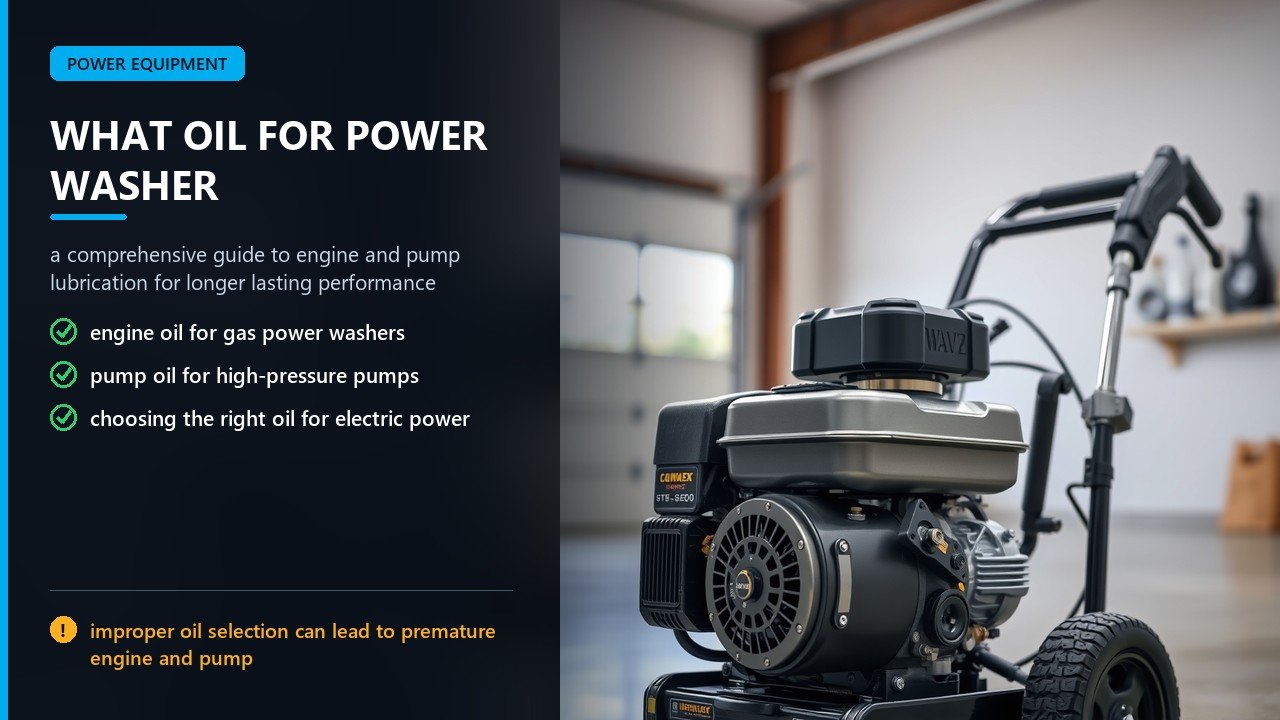
Why One Power Washer Can Need Two Different Oils
Pressure washers are assembled from components made by different companies. A single consumer machine might carry a Honda or Briggs & Stratton engine, an Annovi Reverberi or Cat pump, and a frame built by a third brand. Each of those manufacturers publishes its own lubrication specification, and they do not always agree.
The engine is a four-stroke gasoline engine, very similar to what runs a lawn mower or a generator. It wants engine oil, with detergent additives that hold contaminants in suspension so the filter and drain can remove them. The pump is a different animal. It is a precision assembly of plungers, check valves, and seals operating under extreme pressure, and detergent additives can actually work against it by foaming or by attacking seals. Most pumps therefore call for non-detergent oil, or a dedicated hydraulic-style pump oil formulated for the job.
So when someone asks what type of oil for power washer equipment, the real reply is a question back: which part are you filling? The engine and the pump are separate systems with separate needs, and confusing them is the single most common cause of preventable failure. Our breakdown of pressure washer components from pump to nozzle shows how the two systems sit next to each other on the frame but share nothing else.
Engine Oil for Gas Power Washers
The engine is where most owners spend their attention, and for good reason. A seized engine ends the machine. The good news is that engine oil selection is straightforward, because the engine maker has already done the engineering for you.
Almost every pressure washer engine falls into one of two camps. Small air-cooled engines from Honda, Briggs & Stratton, Kohler, and similar manufacturers generally specify SAE 30 for warm-weather use, with 10W-30 or 5W-30 approved as multi-grade alternatives. Larger commercial engines, including the Honda GX390 found on many 4,000 PSI units, follow the same pattern with slightly higher oil capacity.
What oil does a power washer take in practice? Here is how the common grades line up against the conditions you are likely to work in.
| Engine Oil Grade | Best Temperature Range | Where It Fits Best | Notes |
|---|---|---|---|
| SAE 30 | 50°F and above | Summer use, break-in period | Classic choice for air-cooled engines. Hard to start below 50°F. |
| 10W-30 | -30°F to 100°F | Year-round general use | Easier cold starts, wide availability. |
| 5W-30 | -22°F to 104°F | Cold mornings, mixed climates | Widest range. Preferred after break-in by several manufacturers. |
| 15W-40 | 10°F to 100°F+ | Heavy commercial use, hot weather | Diesel-grade protection, holds up under long duty cycles. |
| 20W-50 | Above 40°F | Hot climates, older engines | Thick film strength for worn or hard-worked engines. |
Two details matter more than the brand on the bottle. First, use a high-detergent oil rated for small engines. Automotive oil is detergent oil, so it is compatible, but avoid oils labeled as racing oil, motorcycle oil, or anything carrying friction modifiers not intended for stationary air-cooled engines. Second, respect the break-in window. Most manufacturers, including Generac, ship units with SAE 30 and recommend holding off on synthetic until the first five hours of operation are complete, so the piston rings seat properly against the cylinder wall.
After break-in, synthetic 5W-30 or 10W-30 is a genuine upgrade. It resists thermal breakdown better, which matters because air-cooled engines run considerably hotter than car engines, and it maintains viscosity longer between changes. The American Petroleum Institute motor oil licensing program is the easiest way to confirm a bottle meets recognized performance standards, and the API “starburst” or “donut” symbol on the back of the container tells you it has.
Pump Oil, the Part Most Owners Forget
Here is where the question of what oil for power washer pumps gets specific, and where a lot of machines get ruined. The pump sits on the back of the frame, often with its own dipstick or sight glass, and it holds far less oil than the engine, sometimes only four to eight ounces. That small volume is doing enormous work.
Pump manufacturers publish their own tables, and they are not interchangeable. The chart below covers the brands most commonly found on American pressure washers.
| Pump Brand | Typical Pump Oil | Common Capacity | Change Interval |
|---|---|---|---|
| CAT | SAE 30 non-detergent or CAT-branded oil | Fill to midpoint of sight glass | First 10 hours, then every 50 hours |
| Annovi Reverberi (AR) | 10W-30 synthetic or 20W-40 synthetic | About 5 to 18 oz by model | Many are lifetime-fill; check the label |
| General Pump | SAE 30 non-detergent | 4 oz typical | First 10 hours, then every 50 hours |
| Comet | Universal tractor transmission oil or 15W-50 synthetic | 4 to 5 oz on common models | First 10 hours, then every 50 hours |
| Karcher | 15W-40 non-detergent | 4 oz typical | Varies; many are sealed or lifetime fill |
What kind of oil goes in a pressure washer pump, then, if you cannot find the brand? The safe fallback recommended across the industry is SAE 30 non-detergent oil, filled to the middle of the sight glass. But the better move is to read the sticker on the pump itself. Nearly every manufacturer stamps or labels the required oil right on the housing, and our guide to non-detergent oil for pressure washer pumps explains why the detergent question matters so much in this particular component.
The reason pump oil differs from engine oil comes down to chemistry. Engine oil needs detergents to keep combustion byproducts from forming sludge. Pump oil has no combustion byproducts, and detergents in that environment can promote foaming. Foamed oil cannot maintain a stable film, and a pump running on foamed oil wears at an accelerated rate. That is why what type of oil does a pressure washer pump use is always answered with a non-detergent or purpose-formulated lubricant rather than whatever is cheapest on the shelf.
Electric Power Washers and the Oil Question
Electric pressure washers complicate the picture in a helpful way, because they remove one whole variable. There is no gasoline engine, so there is no engine oil to check, and the electric motor itself is typically a sealed, maintenance-free unit that needs nothing.
The pump on an electric unit is where the remaining question lives. The vast majority of consumer electric pressure washers use wobble-plate or axial pumps with permanently sealed crankcases. These are oil-filled at the factory for the life of the pump. There is no dipstick, no drain plug, and no refill schedule. If someone tells you that an electric pressure washer needs an oil change, they are describing a pump design that most residential machines do not have.
A smaller number of commercial electric units, including wall-mounted professional models, do carry serviceable pumps with real oil capacities. In those cases, the pump oil requirements follow the same brand-specific logic described above. The rule stays simple: if there is a way to add oil, there is a specification for what to add, and the pump label will say which.
What oil for power washer equipment on the electric side, then? For most homeowners, the answer is none, which is one reason electric machines are popular as low-maintenance entry points. The maintenance that does matter on an electric unit is water supply filtering, nozzle care, and cord inspection. For a deeper look at that side of ownership, our guide to electric pressure washer setups covers the surrounding hardware.
How Much Oil Goes In and When to Change It
Capacity and interval are the two numbers people write down and then forget. Both vary by machine, so treat the figures below as the common range rather than a substitute for your manual.
| Component | Typical Oil Capacity | First Change | Regular Interval |
|---|---|---|---|
| Gas engine, small (5 to 7 HP) | 20 to 30 fl oz (0.6 to 0.9 L) | After first 5 hours | Every 20 to 50 hours or once per season |
| Gas engine, large (13 HP GX390 class) | 32 to 44 fl oz (0.9 to 1.3 L) | After first 5 hours | Every 20 to 50 hours or once per season |
| Serviceable pressure washer pump | 4 to 18 fl oz (120 to 530 mL) | After first 10 hours | Every 50 hours, or per pump label |
| Sealed pump, electric or gas | Factory fill, not serviceable | Not applicable | None, replace pump when it fails |
How often to change pressure washer oil in the engine comes down to usage hours more than calendar time. A machine washed twice a month for a home driveway accumulates maybe ten to twenty hours a year, so one change per season is realistic. A contractor running eight hours a week will hit the fifty-hour mark in under two months and needs to be on an hours-based schedule.
Oil tells you things if you look at it. Fresh engine oil is amber and translucent. Dark but still fluid is normal for a used oil. Gritty, milky, or smelling of gasoline means something has gone wrong. Milky usually points to water in the crankcase, often from a machine stored outdoors or washed while hot and then left damp. A gasoline smell means fuel has leaked past the rings into the oil, which thins it and strips away lubrication. Any of those signs call for an immediate change regardless of hours.
Step by Step, Changing the Oil the Right Way
The process is the same idea on almost every machine: warm it, drain it, refill it, verify it. Here is the sequence that works.
Warm the engine. Run the power washer for three to five minutes. Warm oil flows and carries more contaminants out with it. Then shut it down and let it sit long enough that you will not burn yourself, usually five to ten minutes.
Position the drain. Place a drain pan under the oil fill side, since most small engines drain from a plug or tube on the opposite side of the dipstick. Some units use a hose-and-cap drain that threads onto the filler neck, which makes the job much cleaner.
Drain fully. Remove the fill cap or dipstick and the drain plug, and let gravity finish. Give it several minutes. Tipping the machine slightly toward the drain side helps clear the last ounce.
Refill carefully. Replace the drain plug first, then add roughly eighty percent of the rated capacity. Check the dipstick, top up to the middle of the crosshatch or between the marks, and never pour past the full line. Overfilling a small engine can cause pressure buildup and seal damage.
Run and recheck. Start the engine, let it idle a minute, shut it off, wait, and check the level again. Oil that immediately drops to the low mark means you underfilled. Look under the machine for drips before you call the job done.
The pump follows a similar pattern on serviceable models, except you fill to the sight glass rather than a dipstick, and you use the pump-specific oil. Our step-by-step walkthrough of changing oil in a pressure washer pump covers the sight glass method in detail, and the Generac owner knowledge base publishes the temperature-based engine oil chart their own units ship with.
Five Mistakes That Cost More Than the Oil Ever Did
Putting detergent pump oil in the pump. Engine oil in the pump is the classic error. It foams, it breaks down under pressure, and it eats seals. If you have already done this, drain it completely, flush with the correct oil if the pump maker recommends it, and watch for pressure loss afterward.
Filling to the top. Both the engine and the pump have a maximum level for a reason. Overfilled crankcases cause aeration and foaming, and an overfilled pump can blow its seals as the oil expands with heat. Fill to the mark, not to the brim.
Skipping the first change. Break-in produces fine metal particles. Leaving them circulating for a full season is the fastest route to premature wear. The first five to ten hours matter more than the next five hundred.
Ignoring the machine all winter. Water in the oil, cold-thickened oil, and corroded internals all follow a machine stored full and unprotected. Winterizing means changing the oil, running the machine dry, and stabilizing the fuel. Our winterizing checklist and our notes on using antifreeze in the pump both walk through the sequence.
Buying on price alone. The difference between a quart of quality oil and the bargain bottle is a few dollars. A pump replacement runs into the hundreds, and an engine replacement costs more than the washer itself. This is not the place to economize.
Synthetic, Conventional, and What the Labels Really Mean
Oil labels carry a confusing amount of shorthand, so it helps to translate the important parts.
SAE 30 is a single-grade oil with one viscosity rating measured at operating temperature. Simple, stable, and exactly what air-cooled engines were designed around for decades.
10W-30 or 5W-30 are multi-grade oils. The W stands for winter, and the number before it describes how the oil behaves when cold. Multi-grade oil flows better at startup while protecting at temperature, which is why modern manuals list it as an acceptable alternative.
Synthetic refers to a base stock engineered for uniformity rather than refined from crude in the conventional way. It resists breakdown longer and holds viscosity across a wider range. The trade-off is cost, and the benefit is real, particularly in air-cooled engines that run hot.
Non-detergent means the additive package that holds contaminants in suspension has been left out. That is deliberate for pumps, where suspended grit would do more harm than good. It is the wrong choice for an engine, which relies on detergents to keep sludge from forming.
For specific grade recommendations tied to a particular engine family, the Briggs & Stratton support center and Stihl’s product documentation both publish maintenance schedules for their power equipment, and Cat Pumps publishes pump-side specifications directly for its own units. Those are primary sources, and they beat any generic list when your machine matches one of them.
What to Buy, and How to Read the Bottle
Shopping for power washer oil gets simple once you know what you are looking for. For the engine, choose a name-brand small-engine or automotive oil meeting the API service category the manual requests, in the grade that matches your climate. For the pump, buy either the pump maker’s branded oil or the specific non-detergent grade the housing calls for, in the smallest container you will realistically use before it sits too long.
Look for four things on the label:
- The API symbol. It confirms the oil meets recognized performance standards rather than a vague marketing claim.
- The viscosity grade. It should match either the manual’s primary recommendation or an approved alternative for your temperature range.
- The words “non-detergent” for pump oil. If that phrase is missing from a bottle you intend for the pump, put it back.
- The container seal. Oil that has been sitting on a shelf in a hot warehouse is not what you want in a precision pump.
Buy in a size you will finish. Oil that opens and then sits for two years in a humid garage absorbs moisture and loses its additive package. For a homeowner doing two oil changes a year, quart bottles make more sense than bulk quarts.
Disposing of Used Oil the Right Way
Used oil from a power washer is used motor oil, and it carries the same environmental weight. The EPA notes that oil from a single change can contaminate one million gallons of fresh water, enough to supply fifty people for a year, which is a startling number for something that looks harmless in a drain pan. The same agency points out that one gallon of used oil provides the same 2.5 quarts of lubricating oil as 42 gallons of crude, which is why recycling it is genuinely worthwhile.
Handle it simply. Drain it into a clean, leak-proof container with a secure lid, never a container that once held food, chemicals, or antifreeze. Do not mix it with anything. Do not pour it down a storm drain, into soil, or into household trash. Take it to an auto parts store, a service station, or a municipal collection center that accepts used oil, and drop the filter off alongside it if the location takes filters. The EPA’s page on managing, reusing, and recycling used oil lists the handling rules and points to collection options.
Quick Answers to the Questions Owners Actually Ask
Can I use car oil in my power washer engine? Yes, a quality conventional or synthetic automotive oil with the correct viscosity works well in the engine, provided it is not a specialty formula with friction modifiers. It does not belong in the pump.
What happens if I put the wrong oil in the pump? Short term, nothing visible. Long term, foaming and accelerated seal wear lead to pressure loss and eventually a pump rebuild or replacement. If you catch it early, drain and refill before the next serious use.
Do I need to change oil if I only use the washer a few times a year? Yes, once per season at minimum. Oil degrades from moisture and time even when the machine sits idle.
Is there one oil for both engine and pump? No. Some all-in-one claims circulate, but no single oil is optimal for both a detergent-requiring engine and a non-detergent-requiring pump. Keep them separate.
My pump has no dipstick. Is it bad? Not at all. It means the pump is sealed and factory-filled, which is the design used on most consumer machines. Nothing to check and nothing to add.
How do I know if my pump is serviceable? Look for an oil fill cap, dipstick, or sight glass on the pump body. Any one of those means it takes oil. None of them means it does not.
What about oil for a Honda pressure washer pump specifically? Honda pairs its engines with several pump suppliers, so the pump brand matters more than the engine brand. Read the pump label. Our dedicated look at oil for Honda pressure washer pumps breaks down the common pairings.
Keeping the Machine Alive Comes Down to Two Bottles
The whole question of what oil for power washer maintenance really comes down to identifying two components and respecting two specifications. The engine gets detergent engine oil in a grade that suits your weather, changed on an hours-based schedule with attention to the break-in period. The pump gets non-detergent or brand-specific pump oil, filled to the sight glass, changed on the interval stamped on its label. Everything else is checking levels, reading labels, and not letting a full winter of storage undo a season of good habits.
Do those things consistently and the machine rewards you with years of service for a trivial annual cost. Skip them, as Mark did, and the repair bill teaches the same lesson in a much more expensive way. The dipstick takes ten seconds to read. That is a very cheap form of insurance.
If you are still sorting out which components your specific unit has, start with our guide to what type of oil a power washer engine and pump each need, then check oil for gas pressure washers for the capacity and interval tables specific to common gas machines. Both sit alongside dozens of other maintenance guides that keep washers running season after season.