Grant had cleaned the same concrete patio for years with a green 25-degree tip, and it always took a slow, methodical series of overlapping passes. One afternoon a friend handed him a turbo nozzle to try. The same patio, with the same machine and the same pressure, came clean in a fraction of the time. Nothing about the washer had changed; the turbo simply took the pinpoint force of a zero-degree jet and spun it across a wider path. Once you understand what a pressure washer turbo attachment does, you wonder how you cleaned without one.
The word turbo gets attached to several pressure washer accessories, but the most important one is the turbo, or rotary, nozzle. This guide explains what turbo means, how the nozzle works, how it compares with standard tips and surface cleaners, how to size it correctly so you get power instead of pump damage, which surfaces love it, which surfaces hate it, and how to use it safely.
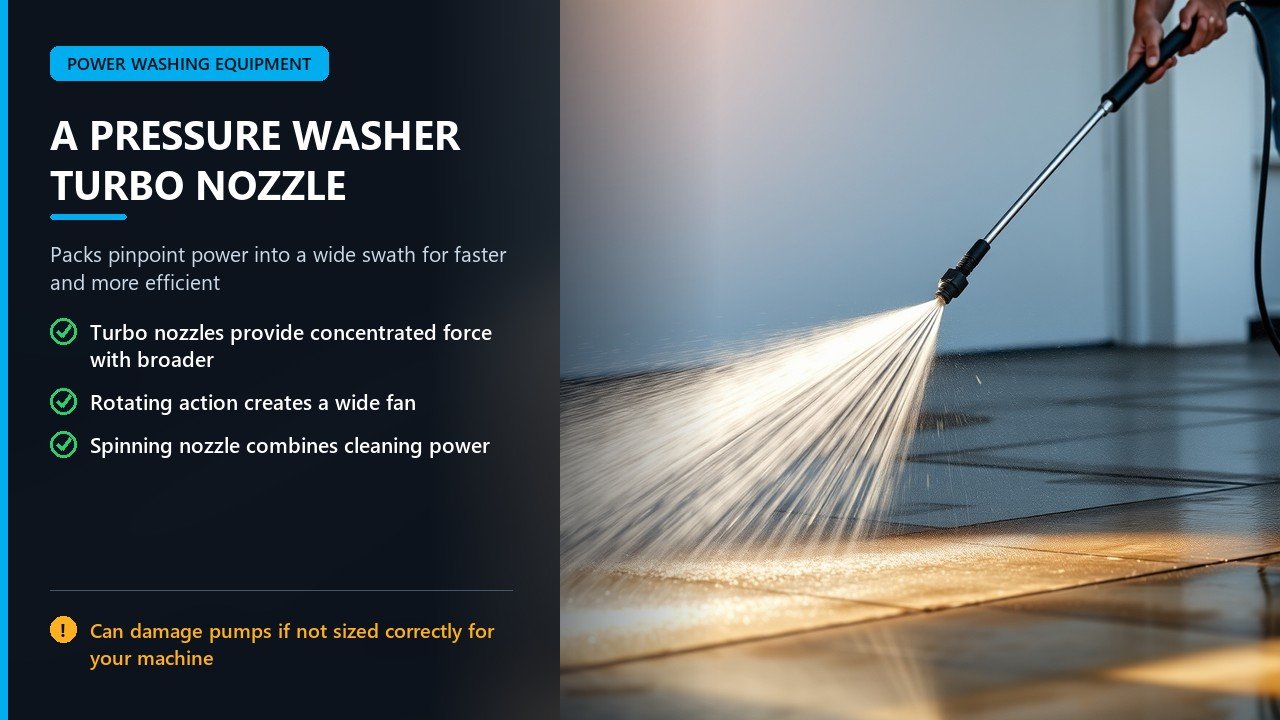
What “Turbo” Means on a Pressure Washer
On a pressure washer, turbo almost always refers to a rotating nozzle, also called a rotary or turbo nozzle. Rather than spraying a fixed fan like a standard tip, it spins a highly concentrated jet in a tight circle. The result is the cleaning power of a 0-degree pencil jet combined with the coverage of a much wider fan.
You may occasionally see turbo used for other accessories, such as turbo surface cleaners or rotating brushes, but the core idea is the same: a spinning action that combines concentrated force with broader coverage. When people talk about turbo cleaning with a pressure washer, they almost always mean that rotating nozzle.
It is worth separating the turbo nozzle from the machine itself. A pressure washer turbo attachment is a tool you add to an existing washer, not a separate category of machine. That means you can upgrade almost any washer, gas or electric, by fitting the right turbo nozzle. It also means the turbo nozzle is only as good as the pump feeding it, which is why sizing and compatibility matter so much later in this guide.
How a Turbo Nozzle Works
Inside a turbo nozzle, a small ceramic tip or ball rotates at high speed, commonly around 2,000 to 3,000 revolutions per minute, driven entirely by the water flow. As the jet exits, the rotation sweeps it around a cone or circle, typically covering a path roughly 4 to 8 inches wide. Instead of striking the surface at a single stationary point, the jet hits from constantly changing angles, which breaks up caked-on grime quickly while reducing the risk of a stationary 0-degree jet etching one spot.
An important truth about turbo nozzles is that they do not increase your machine’s pressure or flow. They rearrange the energy your pump already produces, concentrating it at a moving point rather than spreading it across a fan. A turbo nozzle makes available power attack deposits more effectively, but it cannot rescue a machine that lacks the pressure or flow for the job. You can still see this physics at work in our guide to how the nozzle shapes your cleaning.
Turbo vs Standard Nozzles
The trade-off between turbo and fixed tips comes down to bite versus control. A red 0-degree tip delivers the hardest single-point impact but covers almost no area, so cleaning a whole driveway with it is painfully slow. A wider 25 or 40-degree tip covers more ground gently but lacks the concentrated force for stubborn grime. A turbo nozzle sits in between: near zero-degree impact with a compact circular cleaning path.
The catch is consistency and control. Because the jet spins, an uneven pace can leave faint circles or stripes, and the concentrated impact is unforgiving on soft or delicate surfaces. Fixed tips produce predictable, easy-to-overlap patterns and gentler fans for delicate work. Our guide to the rotating versus fixed nozzle choice explores that balance in more detail.
| Nozzle | Action | Best Use |
|---|---|---|
| Turbo / rotary | Spinning near-zero jet | Stubborn grime on hard, unpainted surfaces |
| Red 0° | Stationary pinpoint jet | Cracks, joints, rust, raw concrete |
| Yellow 15° | Narrow fan | Paint stripping, tough stains on hard surfaces |
| Green 25° | Medium fan | General cleaning, concrete, siding at distance |
| White 40° | Wide gentle fan | Painted and delicate surfaces, rinsing |
Turbo Nozzle vs Surface Cleaner
For large flat slabs, a surface cleaner usually beats a turbo nozzle, because it covers a wide, even swath in one pass and leaves a uniform finish. But a surface cleaner is clumsy around edges, steps, corners, and tight spaces, and it does not reach vertical surfaces. That is where turbo shines.
Many professionals use both: the surface cleaner for the open slab and the turbo nozzle for edges, steps, curbs, corners, and isolated heavy deposits. If your priority is a large, streak-free driveway, reach for a surface cleaner. If your problem is a stubborn patch, a stained step, or masonry that is hard to cover, the turbo nozzle wins. Our guide to the surface cleaner covers the other half of that pairing.
| Job | Better Tool |
|---|---|
| Large driveway or patio slab | Surface cleaner |
| Steps, curbs, corners, edges | Turbo nozzle |
| Vertical brick or masonry walls | Turbo nozzle |
| Isolated heavy stains or mud | Turbo nozzle |
| Uniform finish on big concrete | Surface cleaner |
Sizing a Turbo Nozzle to Your Machine
This is the step that separates a great turbo experience from a broken pump. A turbo nozzle must be sized to your machine’s pressure and flow by its orifice number. A nozzle that is too large lets water pass too freely, so you never reach working pressure and the rotor spins weakly. A nozzle that is too small restricts flow, drives pressure too high, cycles the unloader, strains the engine or motor, and heats the pump.
The correct approach is to find your machine’s PSI and GPM, then use a nozzle chart to pick the matching orifice, just as you would for a standard tip. A low-pressure machine with modest flow needs a larger orifice number, while a high-pressure machine needs a smaller one. You must also match the nozzle’s pressure rating to your machine, since the internal ceramic parts can shatter under pressure beyond their rating. A $15 nozzle that fits your wand can still be hydraulically wrong; the quick-connect only proves it attaches. Our article on what turbo nozzle listings get wrong and the flow guide explaining why flow rate matters both reinforce how sizing protects the machine.
Attachment Types and Compatibility
Before you buy, confirm how the nozzle attaches to your equipment. Most turbo nozzles use a standard quick-connect plug, often 1/4-inch, that snaps straight onto the wand. Others thread on, and a few are sold as complete turbo wands with the gun and lance built in. If your machine uses a proprietary connector, you will need an adapter, so check your wand’s fitting first.
Also confirm the nozzle is designed for cold, warm, or hot water. Many turbo nozzles are rated for cold water only, and using one on a hot-water machine beyond its rating can damage the internal seals and bearings. Match the nozzle to both your connector and your water temperature. A rotary turbo buyer’s guide is a useful reference for pairing a turbo nozzle with the right machine and fitting before you invest.
Best Surfaces for Turbo Cleaning
Turbo nozzles earn their keep on sound, hard, unpainted surfaces with stubborn contamination. Excellent candidates include concrete driveways and sidewalks, patios, curbs and steps, brick and block paving, unpainted masonry and stone facades, and mud-caked heavy equipment. They also reach vertical walls and awkward crevices where a surface cleaner cannot go, and they strip moss, algae, and weathered grime far faster than a fixed tip. In short, if a surface can survive a zero-degree jet, it can benefit from a turbo nozzle.
Surfaces to Avoid
Because a turbo nozzle hits like a zero-degree jet, it is destructive to anything soft or finished. Never use one on wood decking, which splinters and gouges, or on vehicles, where it lifts paint and clear coat and damages seals. Keep it away from vinyl and painted siding, painted or sealed concrete, decorative or newly poured concrete, mortar joints and paver joint sand, and anything already cracked, aged, or repaired. On these surfaces, use a gentler fixed fan, and test any questionable area first.
Using a Turbo Nozzle Safely
Technique matters with this much concentrated power. Start farther from the surface than feels natural and move closer only as needed, keeping the nozzle moving at a steady, even pace to avoid circles and stripes. Point the wand at the ground before pulling the trigger so the internal ceramic tip seats properly, which also prevents damage at startup. Wear eye protection and sturdy boots, since the rotating jet throws debris and, at close range, can injure through footwear. Test on a hidden spot, and never direct the stream at people or animals. If the surface etches, sheds material, or a coating lifts, stop immediately rather than pushing harder. A contractor-focused guide sums up the essentials: wear protective gear, test first, keep moving, and avoid delicate surfaces.
Maintenance and Longevity
A turbo nozzle has moving internal parts, so it needs a little more care than a fixed tip. The rotor can clog, wear, or seize if debris reaches it, which is why many quality turbo nozzles include an inline filter like the one on this rotary turbo nozzle. Add a high-pressure inlet filter and keep your water supply clean. Flush the nozzle after use, and if the rotation stalls or the pattern weakens, clean the orifice with a proper nozzle needle or replace the nozzle. A turbo nozzle that stops spinning still sprays water, but it loses the coverage advantage, so do not ignore a lazy rotor.
Frequently Asked Questions
What is a pressure washer turbo nozzle? It is a rotating nozzle that spins a near-zero-degree, pencil-thin jet in a tight circle, combining the cutting power of a 0-degree tip with the coverage of a much wider fan, which cleans hard surfaces faster.
Does a turbo nozzle increase pressure? No. It does not add PSI or GPM; it rearranges the energy your pump already produces, concentrating it at a moving point so it cleans more aggressively.
Is a turbo nozzle better than a surface cleaner? It depends on the job. A surface cleaner is faster and more even on large flat slabs, while a turbo nozzle wins on edges, steps, corners, vertical walls, and isolated heavy stains. Many users own both.
Can I use a turbo nozzle on wood or a car? No. It hits like a 0-degree jet and will gouge wood, strip paint, and damage vehicle finishes and seals. Reserve it for hard, unpainted surfaces.
How do I size a turbo nozzle? Match the orifice number to your machine’s PSI and GPM using a nozzle chart, and confirm the nozzle’s pressure rating equals or exceeds your machine. An incorrectly sized turbo nozzle can overload or underperform the pump.
Why did my turbo nozzle stop spinning? The rotor is likely clogged, worn, or seized by debris. Clean or replace the nozzle and fit an inlet filter to keep debris out, since a stationary turbo nozzle loses its main advantage.
Final Thoughts
A pressure washer turbo nozzle is one of the best value upgrades you can make, turning a slow pinpoint jet into a fast, wide cleaning action that strips grime from hard surfaces in far less time. It does this without adding pressure, simply by redistributing the power you already have.
Buy one sized correctly to your machine, keep an eye on its rotor and water supply, and use it only where concentrated, moving impact belongs: sound, hard, unpainted surfaces. Pair it with a surface cleaner for large slabs, and step back to a gentle fixed tip for anything delicate. Choose the right pressure washer turbo nozzle, use it with respect, and it becomes a genuine time machine on every tough cleaning job.