The way you mount a pressure washer shapes how you work. A pressure washer mount is not just a bracket or a frame — it is the decision that determines whether your machine rolls to the job, rides in your truck, or lives permanently on a wash-bay wall. Get the mount right and every job starts faster, your gear stays protected, and your setup scales with your business. Get it wrong and you spend your days loading, unloading, and untangling.
Consider two contractors with nearly identical equipment. The first bought a portable cart and drags it up and down driveways all day. The second mounted a complete skid in the bed of a work truck, with a water tank, hose reel, and chemical system locked into place. Same pump, same engine, same cleaning power — but the second finishes twice the work because everything is always ready and never has to be set up. The mount, not the motor, made the difference.
This guide explains the main ways to mount a pressure washer: skid mounts, trailer mounts, truck mounts, wall mounts, and carts. It covers how to choose between them, how to secure a machine safely, how tank size follows your flow rate, and how to maintain a mounted setup through the seasons.
Quick Note: The five common ways to mount a pressure washer are skid mount, trailer mount, truck mount, wall mount, and portable cart. Skids transfer between vehicles, trailers travel behind any tow vehicle, wall mounts save floor space in a wash bay, and carts suit occasional work. Choose by mobility, water capacity, and cost.
The Main Types of Pressure Washer Mount
Each mounting style answers a different question about how and where you clean. Understanding what each is built for is the fastest route to the right choice.
| Mount Type | Best For | Key Trait |
|---|---|---|
| Skid mount | Mobile crews using a truck bed | Transfers between vehicles |
| Trailer mount | Self-contained mobile operation | Tows behind any rated vehicle |
| Truck mount | Dedicated work truck | Permanently bolted in |
| Wall mount | Fixed wash bays and equipment rooms | Frees floor space |
| Portable cart | Occasional home and light commercial use | Rolls to the work |
These are not competing products so much as different answers to the same need. As Power Wash’s truck skid guide puts it, a skid consolidates pumps, tanks, reels, and accessories on a single, liftable base so crews can roll out faster, keep gear protected, and simplify service. The same logic drives every other mount: put the right equipment on the right platform for how you actually work.
Skid Mount vs. Trailer Mount
For mobile professionals, the central decision is skid versus trailer. Both carry a complete system — pump, engine, water tank, hose reel, and often a chemical or soft wash setup — but they differ in how they move and how much they hold.
A skid-mounted pressure washer is a self-contained unit built on a steel or aluminum frame that sits in the bed of a truck, van, or flatbed. The skid does not roll; it bolts or straps down and rides with the vehicle. Its defining feature is transferability: you can pull it from one truck and drop it in another. Most commercial skids run a gas or diesel engine in the 4 to 8 GPM range with a 50- to 200-gallon water tank, a hose reel, and optional chemical injection. Forklift pockets make loading and unloading practical.
A trailer-mounted pressure washer puts the same system on a dedicated trailer with its own wheels, hitch, and frame. It tows behind any properly rated vehicle, carries far more water, and can be left loaded and ready between jobs. Trailers typically run 200- to 525-gallon tanks, with 200-foot high-pressure reels standard on many units, and hot-water burner options for grease and fleet work.
| Factor | Skid Mount | Trailer Mount |
|---|---|---|
| Vehicle needed | Truck bed or flatbed | Any rated tow vehicle |
| Water capacity | 50–200 gal | 200–525 gal |
| Portability | Moves between vehicles | Dedicated to tow vehicle |
| Job site access | Better in tight urban spaces | Standard trailer footprint |
| Entry cost | Lower upfront | Higher upfront |
The trade-off, as Power Line Industries explains, is transferability versus capacity. If you run multiple trucks and want to shift equipment as demand changes, a skid wins. If you want a dedicated, ready-to-roll rig with a full day of water onboard, a trailer wins. Many growing businesses eventually own both.
Wall-Mounted Systems for Fixed Wash Bays
Not every machine needs to travel. For detailers, fleet yards, and facilities with a permanent cleaning bay, a wall-mounted pressure washer is often the most efficient choice. Mounting the machine on the wall frees valuable floor space, keeps the equipment out of the way of vehicles and foot traffic, and puts the controls at a convenient height.
A representative wall-mount package, such as the Tomahawk wall-mount system, uses a custom aluminum bracket to hold an electric motor and pump against the wall, often paired with a ceiling-mounted 360° swivel boom so operators can reach both sides of a vehicle without dragging hose across the floor. These systems typically run an energy-efficient electric motor with a General pump, feeding a high-pressure gun through a boom and a short hose.
Wall mounting has real advantages: a dedicated circuit powers a machine that never needs fuel, there is no engine noise or exhaust indoors, and the setup is permanent and instantly ready. The catch is that it is fixed — you clean where the machine is, so it suits a defined wash bay rather than a mobile operation. For the right setting, it is the cleanest, most space-efficient mounting solution available.
Truck-Mounted and Cart Solutions
Between the full skid and the portable cart sit truck-mounted and cart-based options, each suited to a different scale of work.
Truck mounts are permanent installations bolted into a dedicated work truck. As Simpson’s truck mount lineup shows, these units are built for industrial duty, often pairing high-flow pumps with Honda engines to deliver, for example, 3,000 PSI at 8 GPM or 2,800 PSI at 10 GPM. That kind of flow supports multiple guns, large surface cleaners, and serious production. A truck mount turns the vehicle itself into the cleaning rig.
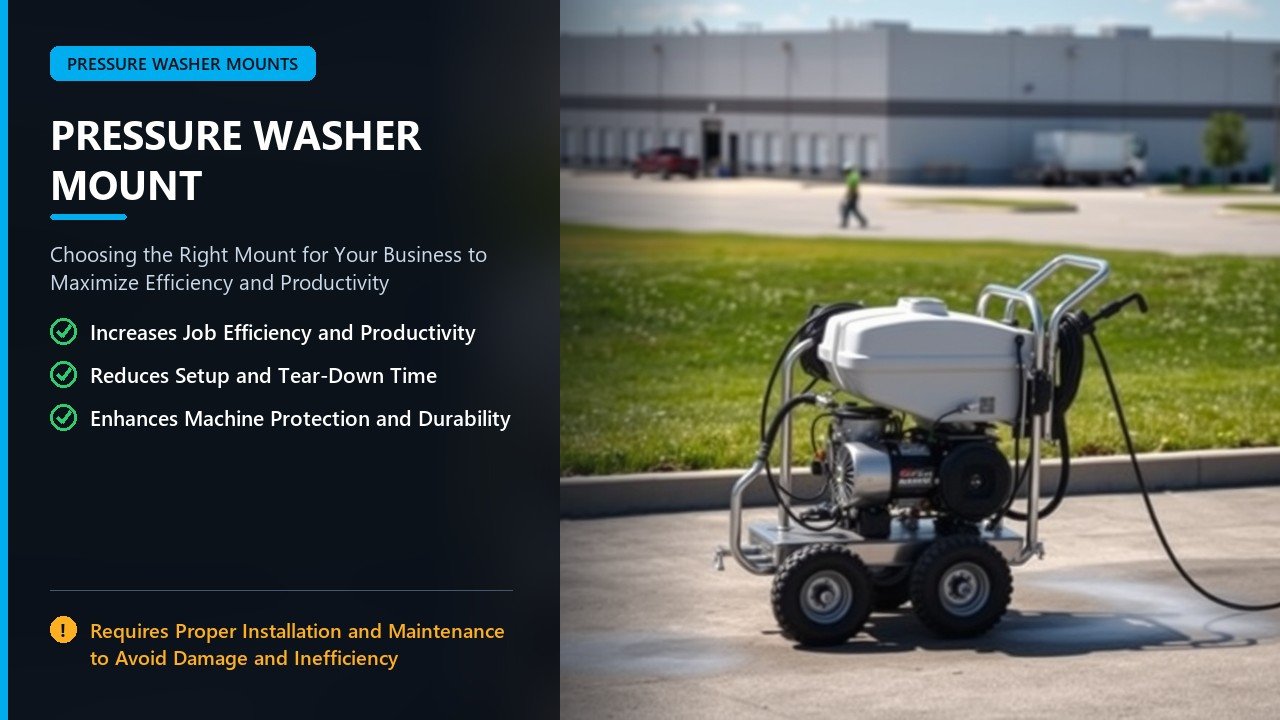
A portable cart, by contrast, is what most homeowners and light-commercial users buy. The machine, pump, and engine sit on a wheeled frame with a handle, and you roll it to the work. Carts are inexpensive, easy to store, and adequate for driveways, decks, and vehicles. Their limits are modest water and fuel capacity and the fact that you must drag them, plus a hose, to every job. For occasional use they are ideal; for daily commercial work they quickly become a bottleneck.
If you are deciding on a machine to mount, our guides to the 5 gallon per minute pressure washer, the 6 GPM sweet spot, and the 4,000 PSI pressure washer help you match output to the platform you choose.
How to Choose the Right Mount
Work through these questions in order, and the right mount usually reveals itself.
- Do you travel to jobs, or do jobs come to you? Mobile work points to a skid, trailer, or truck mount; a fixed location points to a wall mount.
- How much water do you need on board? Long jobs with no spigot access favor a large trailer tank; short jobs may need only a small skid tank.
- How many vehicles and crews? Multiple trucks favor transferable skids; a single dedicated crew may prefer a trailer that is always ready.
- What is your site access like? Tight urban spaces favor a truck skid over a trailer.
- Indoors or outdoors? Indoor bays favor electric wall mounts to avoid exhaust and noise.
- What is your budget and growth plan? Start with what pays for itself, and choose a platform that can scale.
There is no single best mount — only the best mount for your work. A detailer in a fixed bay, a fleet operator with several trucks, and a homeowner with a long driveway will each choose differently, and each will be right.
Securing a Mount Safely
However you mount a machine, securing it correctly protects your equipment, your vehicle, and everyone on the road. A pressure washer on a skid can weigh several hundred pounds fully loaded with water, and a loose unit becomes a dangerous projectile in a sudden stop.
- Use rated hardware and backing plates. Bolts should spread load across the bed or subframe rather than pull through thin sheet metal.
- Bolt down where possible. A skid or truck mount should be mechanically fastened, not merely set in place.
- Strap and tension correctly. If you must strap, use rated straps and check tension before every trip.
- Balance the load. Center heavy tanks over the axle and keep the footprint stable to preserve vehicle handling.
- Secure everything. Reels, wands, guns, and chemical containers should all have a home so nothing shifts or falls.
- Check after rough roads. Vibration loosens fasteners; inspect mounts regularly.
Note: A filled water tank makes a pressure washer very heavy and raises the vehicle’s center of gravity. Always mount low and centered, use rated hardware with backing plates, and verify tie-downs before driving. An unsecured skid is a serious safety hazard.
Matching Tank Size to Flow Rate
On skid, trailer, and truck mounts, the water tank is part of the mount decision, and its size should follow your machine’s flow rate and the length of your typical job. A tank that empties in ten minutes is as limiting as one that is too heavy to move. The working rule is to size for continuous spray time between refills.
| Machine Flow | 100-gal Tank | 200-gal Tank | 300-gal Tank |
|---|---|---|---|
| 3 GPM | ~33 min | ~66 min | ~100 min |
| 4 GPM | ~25 min | ~50 min | ~75 min |
| 5 GPM | ~20 min | ~40 min | ~60 min |
| 8 GPM | ~12 min | ~25 min | ~37 min |
These figures assume the tank supplies the machine alone. Some rigs draw from a tank refilled by a spigot or transfer pump, which extends run time indefinitely so long as the refill rate keeps up with the flow. This is the buffer-tank principle: the tank guarantees adequate supply even when the tap is marginal, protecting the pump from starvation. Our articles on the portable water tank pressure washer and the pressure washer tank setup explain how to build and feed one.
Maintaining a Mounted Setup
Mounted machines live in vehicles and bays, exposed to vibration, temperature swings, and the elements. A little care keeps them ready.
- Inspect fasteners monthly. Vibration loosens bolts; check mounts, reel brackets, and tank straps.
- Keep tanks clean. Flush tanks periodically and use a feed filter to protect the pump from debris.
- Winterize thoroughly. Drain the pump, coil, hoses, and gun, and use a pump saver before storage. Our pump saver guide covers the routine; mounted rigs with hot-water coils need extra attention.
- Protect from freezing in transit. A trailer parked overnight in freezing weather can crack a pump or coil.
- Secure between jobs. Coil hoses onto the reel and stow guns and wands so nothing is damaged in transport.
- Service the engine and pump on schedule, and keep fuel treated with stabilizer.
Because a mounted system is more expensive and harder to move than a cart, protecting it with consistent maintenance is well worth the small effort. A hose reel pays for itself in tidiness and reduced wear, and our guide to the pressure washer reel explains why it belongs on almost every mount.
Small-Machine Mounts: Brackets, Kits, and Carts
Not every mounting decision involves a full commercial rig. For smaller electric and gas machines, a range of brackets and kits turn an ordinary pressure washer into a tidier, more permanent setup.
A wall bracket lets you hang a compact electric washer on a garage or wash-bay wall, off the floor and out of the way. Dual-purpose kits go further. The bigboi 2-in-1 mount, for example, can be used either as a wall mount for a fixed garage setup or as a wheelbase stand for a mobile one, and it adds a hose reel, quick connection, and holders for the nozzle and trigger gun. For a detailer or enthusiast, that kind of mount converts a loose machine into a purpose-built station.
Cart mounts, the most common of all, keep a machine portable while giving it a stable home. When evaluating a cart, look at the wheel size and material, the handle height, and whether it has onboard storage for nozzles, hose, and gun. Small carts with tiny wheels and no storage frustrate as often as they help. Larger wheels roll over curbs and rough pavement, and integrated storage saves trips back to the truck.
Whatever the size, the principle is the same: a mount should make the machine easier to use, safer to store, and quicker to deploy. If it does not, it is just extra hardware.
Hose Management on a Mount
Once a machine is mounted, hose handling becomes the next problem to solve. Loose hose is the single biggest time-waster on a mounted rig — it tangles, kinks, and forces you to reposition the machine constantly. A hose reel is the standard answer.
Reels come in manual and electric-rewind versions. A manual reel is inexpensive, reliable, and adequate for most rigs; an electric reel saves effort and time on high-volume operations. Either way, the reel keeps the hose coiled, protected, and ready, and it lets you pay out exactly the length you need. Mounted on a trailer or skid, a reel also keeps the hose off the ground and away from tires and traffic.
Pair the reel with a swivel fitting between the hose and the gun to eliminate twist, and add bend restrictors at the hose ends to prevent the sharp bends that cause kinks. On high-flow machines, choose a reel rated for your pressure and flow, and favor larger hose diameters so the reel does not throttle performance. Our guide to the pressure washer reel covers sizing and options, and our article on hose fittings explains the connections that make a reel installation leak-free.
Quick Note: A hose reel transforms a mounted rig. It keeps the hose coiled, protected, and ready, and it ends the tangling that eats time on every job. Add a swivel and bend restrictors, and match the reel to your machine’s pressure and flow.
Power, Fuel, and Ventilation for Mounted Systems
How a machine is mounted affects how it is powered, fueled, and ventilated, and those practicalities often decide the mount as much as the work does.
- Electric wall mounts. These need a dedicated circuit sized to the motor — for example, a 5 HP motor may call for a 230-volt, 30-amp dedicated circuit. Confirm your electrical service before buying, and provide a proper disconnect and grounding.
- Gas and diesel skids and trailers. These need fuel storage, ventilation for exhaust, and clearance from combustible materials and the burner on hot-water units. Never enclose a running gas engine in a closed space.
- Hot-water burners. Diesel-fired burners on trailer and truck mounts need a fuel tank, an exhaust path, and airflow. Ventilation is a safety requirement, not an option.
- Noise. Gas engines are loud. Wall-mounted electric systems suit noise-sensitive neighborhoods and after-hours work indoors.
- Battery and starting. Many commercial units include a marine battery for electric start; mount it securely and keep it charged.
Planning the power and fuel supply alongside the mount prevents the common situation of a beautiful rig that cannot actually run where it is needed. Decide early whether you have the electrical service for a wall mount, the fuel and ventilation for a gas rig, and the tow rating for a loaded trailer.
Loading, Transfer, and Day-to-Day Use
For skid and truck mounts, how you load and transfer the unit determines how practical it really is. A skid with forklift pockets can be set in a truck bed with a forklift or a hoist; without them, a heavy filled skid is nearly impossible to move safely. If transferability is the reason you chose a skid, make sure the frame actually supports it.
Consider these practical points before committing:
- Weight when full. A 100-gallon tank adds over 800 pounds of water; a 200-gallon tank adds over 1,600. Confirm your vehicle, ramps, and any lift equipment can handle the loaded weight.
- Ramps and anchor points. Stable, rated ramps and dedicated anchor points make loading repeatable and safe.
- Service access. Leave room to reach the engine oil, pump oil, filters, and unloader without unloading the entire rig.
- Refilling. Plan where and how you refill tanks, and how the refill rate compares to your machine’s flow.
- Wash-bay routing. On fixed bays, route the boom and hose so operators can move freely around the vehicle without dragging hose on the floor.
Thinking through these details at purchase time avoids the slow accumulation of frustrations that come from a mount that is almost right. The best mount disappears into the background of a smooth daily routine.
Cost and Return on Investment
Mounts range from a modest wall bracket to a fully built trailer costing many thousands of dollars, so it is worth thinking about what each returns. A bracket or cart saves storage space and protects a small machine, and pays back in convenience. A skid or trailer costs far more but can turn a one-person operation into a business that finishes more jobs per day, because setup time collapses and water is always onboard. The return comes from productivity: every minute saved loading, unloading, and hunting for a water source is a minute spent earning. Choose the mount that matches your ambitions, and it will pay for itself in billable time.
Common Mistakes to Avoid
- Choosing mobility you do not need, or lacking it when you do. Match the mount to how you work, not to what looks impressive.
- Undersizing the tank. A tank that empties in minutes defeats the purpose of a self-contained rig.
- Overloading the vehicle. A full 200-gallon tank weighs over 1,600 pounds; respect payload and axle ratings.
- Securing with inadequate hardware. Thin bolts, missing backing plates, and cheap straps invite failure.
- Mounting high. A top-heavy skid raises the center of gravity and destabilizes the vehicle.
- Skipping winterization. Freezing water is the leading destroyer of mounted pumps and coils.
- Ignoring feed flow. A tank that cannot refill fast enough starves the pump; match supply to flow.
- Neglecting fasteners. Vibration works bolts loose; check them regularly.
Frequently Asked Questions
What is the best way to mount a pressure washer? It depends on how you work. Mobile crews favor skid or trailer mounts, dedicated trucks favor permanent truck mounts, fixed wash bays favor wall mounts, and occasional users do well with a portable cart.
What is a skid-mounted pressure washer? A complete cleaning system — pump, engine, water tank, reel, and accessories — built on a single frame that sits in and rides with a truck bed. Its defining feature is that it can be transferred between vehicles.
Skid mount or trailer mount — which is better? Skids are more transferable and better in tight spaces; trailers carry more water and are dedicated and ready to tow. Choose skid for flexibility, trailer for capacity and self-sufficiency.
Can I mount a pressure washer on a wall? Yes. Wall-mounted systems save floor space and suit fixed wash bays and equipment rooms, often paired with a ceiling boom. They usually use electric motors to avoid exhaust and noise indoors.
How big a water tank do I need for my mounted pressure washer? Size the tank for continuous spray time. Divide tank size by flow rate: a 200-gallon tank gives about 50 minutes at 4 GPM. For longer jobs, use a tank that refills from a supply during use.
How do I secure a pressure washer in a truck? Bolt it down with rated hardware and backing plates that spread load, center heavy tanks over the axle, and verify tie-downs before every trip. Never rely on straps alone for a heavy filled unit.
Final Thoughts
A pressure washer mount is a strategic decision, not an accessory. It determines whether your equipment is always ready, how much water you can carry, how easily you reach the job, and how well your gear survives the road. Skid mounts transfer between trucks, trailers tow a self-contained rig, truck mounts turn a vehicle into a cleaning machine, wall mounts reclaim floor space in a fixed bay, and carts keep things simple for occasional use.
Choose by matching the mount to your actual work: how you travel, how much water you need, how many crews you run, and where you clean. Then secure it correctly, size the tank to your flow, and maintain it with the seasons in mind. Do those things, and the mount stops being something you think about — it simply becomes the platform that lets your pressure washer do what it was built to do, job after job. Start with how you work, and the right mount will follow.