Mark had cleaned driveways for years with a trusty 2.5 GPM electric unit. It handled a single-car pad without complaint, but when a local church asked him to clean a 6,000-square-foot parking lot before a weekend event, the job turned into an all-day marathon. He worked the wand back and forth while dirty water pooled under his boots instead of running off. Then a friend rolled up with a 5 gallon per minute pressure washer, and that same parking lot went from a full-day slog to a two-hour job. Nothing about the machine’s pressure changed the equation as much as the sheer volume of water it moved.
That story captures the single most misunderstood number in pressure washing. Homeowners obsess over PSI because it sounds like power, while seasoned pros chase GPM because flow is what actually carries dirt away. A 5 gallon per minute pressure washer sits right at the line between serious residential gear and true light-commercial muscle. This guide explains what 5 GPM means, who genuinely needs it, how to match it with the right pressure and nozzles, and how to avoid the one mistake — starving the pump — that ruins more high-flow machines than any other.
Quick Note: GPM is flow (how much water moves per minute), PSI is force (how hard it hits). Multiply the two and you get Cleaning Units, the fastest way to compare two machines. At the same pressure, doubling GPM roughly doubles how fast you rinse a surface clean.
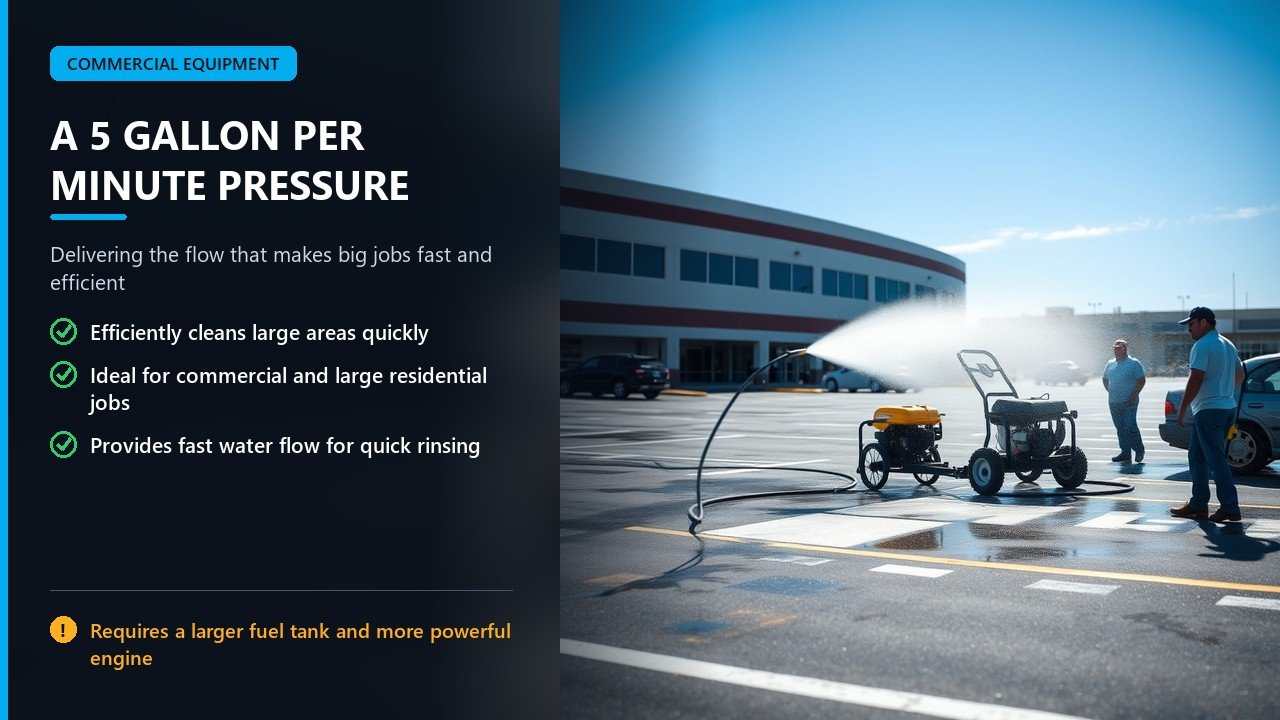
What Does 5 Gallon Per Minute Mean on a Pressure Washer?
Gallons per minute, or GPM, measures the volume of water a pressure washer pushes out every minute while it runs. A 5 gallon per minute pressure washer delivers five gallons of water in sixty seconds — 300 gallons an hour. For context, a typical electric homeowner unit moves around 1.8 to 2.3 GPM, and a mid-range gas machine runs about 2.5 to 4.0 GPM. Five GPM is a genuine step up into commercial territory.
Here is the part that confuses people: GPM is not the same as PSI. PSI (pounds per square inch) is the force behind the stream — the stripping power that lifts grime off a surface. GPM is the flow that flushes that loosened grime away. As SIMPSON Pressure Washers puts it, you can think of PSI as the “stripping” action and GPM as the “rinsing” action. A machine with huge pressure but tiny flow cuts at the dirt and leaves it lying on the concrete. A machine with strong flow washes the dirt off the property.
Multiply the two numbers and you get a single score called Cleaning Units (CU). A 5 GPM machine running at 3,000 PSI produces 15,000 cleaning units, which towers over the roughly 5,000 to 7,000 units a basic residential washer generates. That difference is exactly why Mark’s parking lot went from a slog to a two-hour job.
Why Flow Rate Often Matters More Than PSI
Walk through any online pressure washer debate and you will find two camps: the “more PSI is always better” crowd and the professionals who quietly buy higher-GPM machines. The flow-rate research from Goodway Technologies makes the case clearly: for large flatwork, production speed is governed by flow, not by a few hundred extra PSI. Two machines can have identical cleaning-unit ratings yet perform very differently — the one with more flow finishes faster because it rinses in one pass instead of three.
This matters most on flat, expansive surfaces: concrete driveways, parking lots, warehouse slabs, pool decks, and fleet vehicles. Water that flows generously carries suspended dirt away instead of leaving mud streaks that force you to go back over the same spot. Pro cleaners who use soap do not rely on pressure to scrub — the chemical loosens the grime, and the flow rinses it into the gutter. That is why a high-flow, moderate-pressure machine frequently out-produces a low-flow machine with a flashier PSI number.
| GPM | Class | Cleaning Units (at 3,000 PSI) | Typical Jobs |
|---|---|---|---|
| 1.8 – 2.5 | Residential electric | 5,400 – 7,500 | Cars, patios, small decks, furniture |
| 3.0 – 4.0 | Heavy residential / prosumer | 9,000 – 12,000 | Driveways, fences, siding, first-story exteriors |
| 5.0 | Light commercial | 15,000 | Large concrete, fleets, parking areas, equipment |
| 6.0 – 8.0 | Commercial | 18,000 – 24,000 | Daily commercial work, municipal lots, multi-unit rigs |
| 15.0+ | Industrial | 45,000+ | High-volume plants, tanks, trailers, surface cleaning skids |
Who Actually Needs a 5 GPM Pressure Washer?
A 5 gallon per minute pressure washer is not a machine you buy on a whim for washing one sedan on a Saturday. It earns its keep when cleaning volume, frequency, and surface size pile up. In practice, you should look hard at 5 GPM if you fall into one of these groups:
- Pressure washing business owners who bill by the job and need to finish faster than the competition.
- Mobile detailing and car wash operators rinsing fleets, undercarriages, and large vehicles in volume.
- Property and facility managers maintaining parking lots, sidewalks, dumpster pads, and entryways.
- Farm and ranch owners cleaning trailers, implements, barns, and feeding areas.
- Serious homeowners with long driveways, outbuildings, or multiple rental properties.
If none of those describe you, a 3.0 GPM machine will likely cover everything you do at a lower price and with a lighter footprint. To see how the middle of the range compares, our breakdown of the pressure washer 6 GPM class and the pressure washer 3.0 GPM class maps out exactly where each flow rate stops being enough.
Quick Note: Buy for the job you do most often, not the job you do once. A 5 GPM machine is overkill for occasional car washing, but underpowered if you already run a truck-mounted commercial setup cleaning parking lots all day. Match flow to your average workload.
What PSI Should You Pair With 5 GPM?
Flow alone does not clean — it needs enough pressure behind it to break the bond between dirt and surface. Most 5 GPM machines are engineered to run in the 3,000 to 3,500 PSI range, and that combination is the sweet spot for the work flow rate is bought for. At 3,000 PSI you can strip years of grime and mildew from concrete, strip paint, and blast heavy equipment clean. Push toward 3,500 PSI and you gain a little more bite for the toughest buildup without punishing the pump or burning extra fuel on every job.
The Briggs & Stratton pressure washer guide makes the key point that pressure and flow work together, and that chasing maximum PSI at the expense of a well-built pump is a losing trade. In real-world use, a well-made 5 GPM / 3,200 PSI machine will out-clean and outlast a cheaply built 5 GPM / 4,000 PSI unit every single time.
When you move onto softer surfaces — wood decks, painted siding, automotive paint — you do not abandon your 5 GPM machine. You swap to a wider-angle tip or a lower-pressure nozzle and let the flow do the rinsing at gentler pressure. That is the flexibility high flow buys you.
Matching Nozzles and Orifice Size at 5 GPM
The spray tip is the single component that decides whether your 5 GPM machine actually delivers 5 GPM. A nozzle is a controlled restriction; an orifice that is too small chokes flow, raises pressure dangerously, and strains the pump, engine, and unloader. An orifice that is too large drops your pressure and leaves you with a weak, wasteful stream. The right tip is sized to your machine’s rated flow and pressure simultaneously.
Nozzle labels encode two things: the spray angle and the orifice size. A tip labeled 2555 is a 25-degree pattern with a 5.5 orifice. The higher the working pressure, the smaller the orifice needed to pass 5 GPM. Use the table below as a starting point, then always confirm against your specific machine’s manufacturer chart.
| Working Pressure | Approx. Orifice Size for 5 GPM | Example 25° Tip Label | Where It Fits |
|---|---|---|---|
| 2,500 PSI | ~6.5 | 2565 | Gentle work on soft or painted surfaces |
| 3,000 PSI | ~5.5 – 6.0 | 2555 / 2560 | General flatwork and siding |
| 3,500 PSI | ~5.5 | 2555 | Tough concrete and heavy buildup |
| 4,000 PSI | 5.0 | 2550 | Maximum pressure for the most stubborn grime |
Angle matters just as much as orifice size. A 0-degree or 15-degree tip concentrates force for stripping, a 25-degree covers ground for general cleaning, a 40-degree rinses, and the black soap tip draws detergent without generating pressure. Our pressure washer nozzle guide walks through the full color-coded system so you always grab the right tip for the surface in front of you.
Gas vs Electric at 5 GPM
Here is a reality most shoppers discover late: true 5 GPM pressure washers are almost always gas-powered. To reach 5 gallons per minute, a machine needs a pump that can push serious volume, and that requires either a robust gas engine or heavy-duty 240V electric power with commercial-grade components.
Gas engines dominate this class for three practical reasons. First, they deliver the horsepower and RPM needed to drive a triplex pump that flows 5 GPM. Second, they are portable — you can wheel them across a parking lot or load them on a trailer without hunting for an outlet. Third, they cost less per unit of flow than electric equivalents at this performance level. The trade-offs are noise, exhaust, and fuel handling, which rule them out for indoor or emissions-sensitive environments.
Electric 5 GPM machines exist, but they usually mean 220–240V circuits, dedicated wiring, and a higher purchase price. They shine where quiet operation and zero emissions matter, such as indoor facility cleaning or enclosed spaces. If you want a permanent, wall-mounted wash station, electric is often the better long-term answer. If you need to roam, gas wins.
The Number One Mistake: Starving a 5 GPM Pump
A 5 GPM machine is a thirsty animal, and the fastest way to destroy it is to feed it less water than it demands. When the supply cannot keep up, the pump cavitates — it pulls a partial vacuum, the water inside literally boils, and the plungers hammer against vapor pockets instead of water. Cavitation sounds like gravel rattling inside the pump, and it scours bearings and seals from the inside out. Manufacturers like Tractor Supply’s pressure washer manual are blunt about it: the water source’s flow rate must exceed the machine’s rating by at least one GPM to absorb normal fluctuation.
Run the math on your own supply before buying. Grab a five-gallon bucket and a stopwatch, then time how long your outdoor spigot takes to fill it. If the bucket fills in under sixty seconds, your tap can theoretically feed 5 GPM — barely. If it takes seventy-five seconds, you have about 4 GPM and you have no business running a 5 GPM machine straight off that hose. Also factor in hose diameter and length: a 5/8-inch hose over 50 feet will struggle, and a 3/4-inch short hose is the minimum for full flow. If your tap cannot keep up, a buffer tank paired with a booster pump is the correct fix — our guide to a portable water tank pressure washer shows how that setup works.
Note: A machine on the label is only as good as the water behind it. Before you blame the pump for weak pressure, check the inlet filter, the supply hose diameter, and whether another tap or appliance is robbing your flow at the same time.
Attachments That Come Alive at 5 GPM
High flow transforms attachments that feel sluggish on smaller machines. A 20- to 24-inch surface cleaner is the classic pairing: more flow spins the bar faster and lets you cover large concrete in overlapping passes rather than slow back-and-forth strokes. Our overview of the surface cleaner attachment explains why it is the single biggest time-saver for flatwork.
Turbo (rotary) nozzles also benefit — the extra water volume keeps the spinning jet dense and effective, which is why a good pressure washer turbo nozzle becomes a favorite for stripping paint and heavy grime. Downstream injectors draw soap more consistently with higher flow, making fleet washing and house cleaning faster and more even. And because pressure drop over distance is a real concern at 5 GPM, run at least a 3/8-inch high-pressure hose; the 1/2-inch pressure washer hose class is even better for long runs.
Buying Guide: What to Look For
At 5 GPM, pump quality is your top priority. A triplex plunger pump from a recognized brand — think AR, General Pump, CAT, or Comet — is the standard that separates a machine that lasts thousands of hours from one that quits in a season. These pumps are rebuildable, hold oil, and are far more resistant to sustained high-flow abuse than the axial cam pumps found on cheap units. If you plan to run daily, triplex is not optional.
Beyond the pump, inspect the whole package:
- Engine: commercial-grade (Honda, Kohler, or similar) with easy service access and an hour meter.
- Drive type: belt-drive runs cooler and is preferred for daily commercial use; direct-drive costs less.
- Frame: welded steel with pneumatic tires if you move it across rough ground or a trailer.
- Protection: thermal relief valve, quality unloader, and inlet filter are non-negotiable.
- Wear items: do not skimp on hose, gun, and fittings — they fail first and often.
If you run a business, a machine built for commercial duty pays for itself in straight-line speed. Our look at the Honda industrial pressure washer shows what that level of build quality looks like in practice.
| If you… | Is 5 GPM Worth It? |
|---|---|
| Run a pressure washing or detailing business | Yes — it pays for itself in speed |
| Own acreage, long driveways, or outbuildings | Yes — big surfaces reward flow |
| Maintain commercial lots or fleet vehicles | Yes — production is the priority |
| Wash one car and a patio a few times a year | No — a 2.5–3.0 GPM unit is enough |
Maintenance Tips for a Long Life
A 5 GPM machine rewards basic care with years of service. Check pump oil before every long job and change it on the schedule the manufacturer specifies, starting with the break-in change. Flush the system with clean water after every detergent session so soap residue cannot dry inside the pump or injector. Never let the machine idle in bypass for more than a minute or two — trapped water heats up and cooks seals, which is exactly what a thermal relief valve exists to prevent.
Replace worn nozzles promptly, because an eroded orifice quietly raises load on the entire system. Keep the inlet filter clean and free of grit. In freezing climates, winterize thoroughly with pump antifreeze so ice cannot crack the manifold. General Pump’s service manual is a solid reference for the flow-versus-pressure relationships that keep a triplex pump healthy. Treat the machine well, and a quality 5 GPM setup can log thousands of hours before it needs attention.
Frequently Asked Questions
Is 5 GPM too much for home use? It depends on your property. If you have a standard suburban lot with a short driveway and wash a car occasionally, yes — a 3.0 GPM machine is more than enough. If you have a long driveway, multiple outbuildings, or you are starting a side business, 5 GPM can make sense.
Can my garden hose supply 5 GPM? Test it. Fill a five-gallon bucket from your outdoor tap and time it. If it fills in under a minute you have roughly 5 GPM available; if not, you will starve a 5 GPM pump and need a tank-and-booster setup instead.
Do I need 4,000 PSI to go with 5 GPM? No. Most 5 GPM machines are happiest around 3,000 to 3,500 PSI. Chasing 4,000 PSI with a weaker pump hurts reliability more than it helps cleaning speed.
Can a 5 GPM pressure washer damage concrete? Plain concrete is generally safe with a properly sized surface cleaner and a moderate nozzle. Damage risk climbs when you hold a narrow high-pressure tip too close or use excessive pressure on old, weak, or decorative concrete. Always test a small hidden area first.
Final Thoughts
A 5 gallon per minute pressure washer is the point where pressure washing stops being a chore and starts being a production tool. The extra flow rinses faster, covers more ground per pass, and turns jobs that used to eat a whole weekend into an afternoon. It is the right call for anyone cleaning large surfaces regularly, running a service business, or maintaining fleets and commercial property. Just respect its appetite: feed it more water than it is rated to move, match your nozzles and hose size to the flow, and it will reward you with speed no low-GPM machine can touch.
If you are still weighing where to land in the flow-rate spectrum, start by honestly measuring your water supply and your average workload. That single combination points to the right machine faster than any spec sheet. When in doubt, buy for the biggest job you take on with any regularity — because on those days, flow is the only number that matters.