When professionals shop for a 4000 PSI pressure washer, one engine name comes up again and again: Honda. A 4000 PSI pressure washer Honda machine is the combination many contractors treat as the default, and for good reason. Honda’s GX-series engines have a reputation for easy starting, smooth running, and surviving years of hard commercial use — exactly what a machine that runs all day at 4,000 PSI demands.
But “Honda” on the sticker is not the whole story. Which Honda engine powers the machine matters, because a GX270 suits a 3.5 GPM unit while a GX390 is needed for a full 4.0 GPM. Equally important are the pump, the drive type, whether the machine runs cold or hot water, and the accessories included. This guide explains what a Honda-powered 4000 PSI washer is, which Honda engines fit this class, the models that use them, why the engine matters, and how to choose and maintain one.
Quick Note: A 4000 PSI pressure washer with a Honda engine typically uses a GX270 (270cc, ~8.5 HP) for 3.5 GPM or a GX390 (389cc, ~11.7 HP) for 4.0 GPM. Honda GX engines are prized for easy starting, low-oil shutdown, and long commercial life.
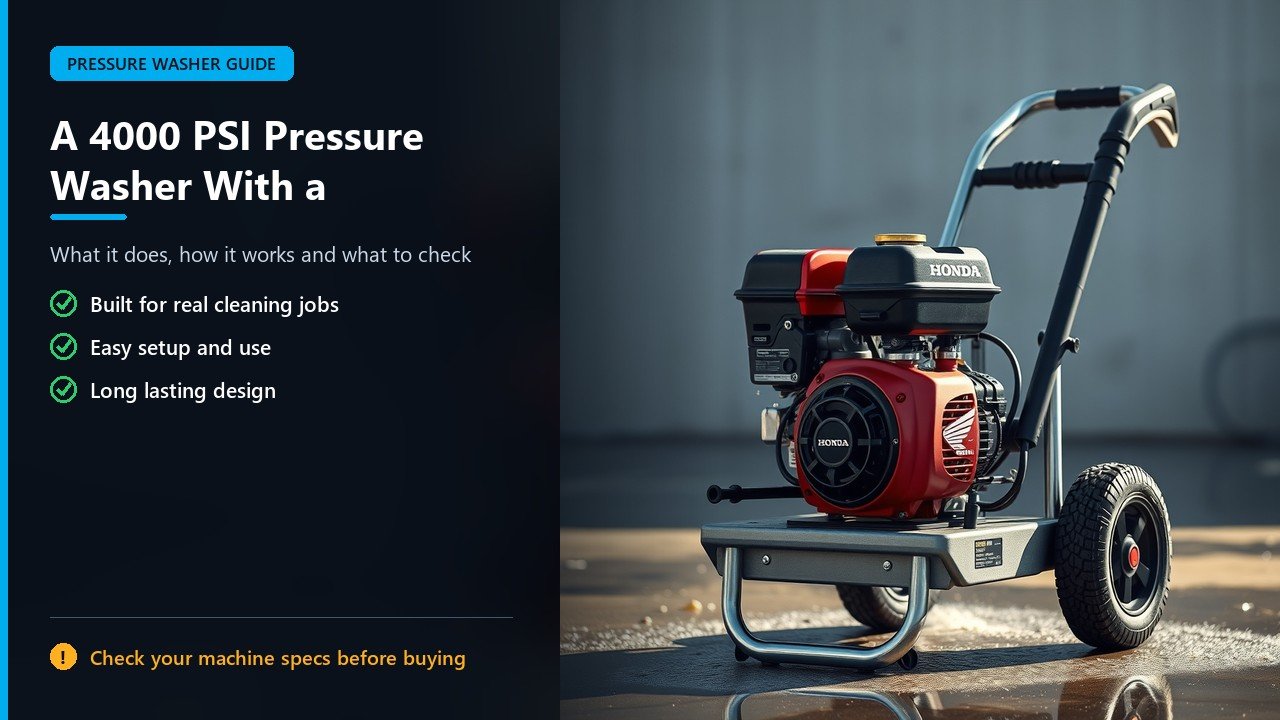
Why a Honda Engine Matters at 4000 PSI
At the residential level, engine brand is a minor detail — the machine runs for an afternoon and gets put away. At the commercial 4000 PSI level, the engine runs for hours, starts dozens of times a week, and is the difference between finishing a job and losing a day. In that context, the engine is not a footnote.
Honda’s GX series is built specifically for commercial duty, and pressure washing is one of its listed applications on Honda’s own pressure washer engine page. The engines’ advantages for this work include:
- Easy, reliable starting. Honda GX engines start on the first or second pull, which matters when you start a machine several times a day.
- Low-oil shutdown. Many GX-equipped machines shut down automatically if oil runs low, preventing catastrophic engine damage — a feature found on the Simpson PowerShot and American Pressure units.
- Durability under load. The GX series is designed for demanding commercial applications, from construction to rental fleets.
- Smooth, low-vibration running. Honda advertises reduced noise and vibration, which reduces operator fatigue over long jobs.
- Parts and service everywhere. Honda engines are serviced by dealers nationwide, a real advantage for a working machine.
- Broad fuel and climate tolerance. GX engines are EPA and CARB certified in the appropriate variants and start reliably in cold weather.
The Honda GX series spans several sizes, and Honda notes the larger GX models — GX240, GX270, GX340, and GX390 — are the OHV engines built for demanding commercial, construction, and rental applications. A 4000 PSI pressure washer is squarely in that territory.
Which Honda Engine for 4000 PSI?
Two GX engines dominate the 4000 PSI class, and choosing between them comes down to flow.
| Honda Engine | Displacement | Net Power | Typical 4000 PSI Use |
|---|---|---|---|
| Honda GX270 | 270cc | ~8.5 HP (6.3 kW) | 4000 PSI / 3.5 GPM cold water |
| Honda GX390 | 389cc | ~11.7 HP (8.7 kW) | 4000 PSI / 4.0 GPM cold and hot water |
| Honda iGX390 | 389cc | ~11.7 HP with auto governor | Premium electronic governor option |
The GX270, at 8.5 HP, comfortably drives a 4000 PSI, 3.5 GPM machine. The Simpson PowerShot PS60869 is built around exactly this pairing: 4,000 PSI, 3.5 GPM, a Honda GX270, and an AAA triplex pump, sold around the one-thousand-dollar mark. It is a common entry point into the Honda-powered commercial class.
For a full 4.0 GPM at 4,000 PSI, the machine needs the extra power of the GX390’s 11.7 HP. Honda’s own specification lists the GX390 at 11.7 net HP (8.7 kW), and it is the engine behind the majority of 4000 PSI machines that flow 4.0 GPM, both cold and hot water. The iGX390 adds an electronic self-tuning governor for more advanced load response, a premium option on some machines.
The lesson is simple: match the Honda engine to the machine’s flow. A GX270 on a 3.5 GPM unit is well matched; putting a 4.0 GPM pump on a GX270 would underpower it. Manufacturers pair these deliberately, and replacements should preserve that pairing. Our pressure washer engine guide explains the matching in more detail.
Honda-Powered 4000 PSI Models
The market offers Honda 4000 PSI machines across a wide range of configurations, from affordable cold-water direct-drive units to premium hot-water belt-drive machines.
| Model | Specs | Engine / Pump / Drive |
|---|---|---|
| Simpson PS60869 (PowerShot) | 4,000 PSI / 3.5 GPM cold | GX270 / AAA triplex / direct |
| American Pressure B4040HC | 4,000 PSI / 4.0 GPM cold | GX390 / CAT V-belt / belt |
| Simpson 65106 | 4,000 PSI / 4.0 GPM hot | GX390 / triplex / hot water |
| BE HW4013HBG | 4,000 PSI / 4.0 GPM hot | GX390 / General TSS1511 / belt |
| Simpson Big Brute 65462 | 4,000 PSI / 4.0 GPM hot | GX390 / triplex / gear |
The spread is instructive. The Simpson PS60869 is a value cold-water machine, while the American Pressure B4040HC steps up to a belt-drive CAT pump with an aircraft-grade aluminum frame and a lifetime frame warranty. The hot-water machines — the Simpson 65106, BE HW4013HBG, and Simpson Big Brute — add burners and cost several thousand dollars, because they dissolve grease and oil in ways cold water cannot.
Notice that every one of these machines pairs the Honda engine with a triplex pump, never an axial cam pump. That combination — a commercial Honda GX engine driving a triplex pump — is the signature of a genuine 4000 PSI professional machine. For a broader look at the class, see our guide to choosing a 4000 PSI pressure washer.
Quick Note: A genuine Honda 4000 PSI machine pairs a GX-series engine (GX270 for 3.5 GPM, GX390 for 4.0 GPM) with a triplex pump. If you see a Honda engine bolted to an axial cam pump, the machine is not a true commercial 4000 PSI unit.
The Rest of the Machine: Pump, Drive, and Build
A Honda engine is the headline, but the machine’s durability and performance also depend on the pump, drive, and frame behind it.
Triplex pumps. Every serious Honda 4000 PSI machine uses a triplex pump from a reputable maker — AAA, CAT, General, or AR. These feature forged brass or stainless manifolds, ceramic plungers, an adjustable unloader, and a thermal relief valve, and they are oil-lubricated and serviceable. The American Pressure B4040HC, for example, uses a heavy-duty CAT V-belt drive pump; the BE HW4013HBG uses a General TSS1511 triplex pump. The pump, not the engine, is usually the component that determines rebuild intervals, so its brand and serviceability matter. Our pump rebuild guide covers what to expect.
Drive type. Direct drive is the most common and affordable, mounting the pump straight to the engine shaft. Belt drive, as on the B4040HC and BE HW4013HBG, runs the pump more slowly and cooler and increases component life — a real advantage for daily commercial work and especially for hot-water machines. Gear drive, as on the Simpson Big Brute, offers efficient power transfer in a compact package.
Frame and accessories. Commercial frames are welded steel or aircraft-grade aluminum, with pneumatic or flat-free tires for rough ground. Expect a 50-foot braided hose (3/8-inch), a heavy-duty gun and lance rated to 5,000 PSI, a full set of quick-connect nozzles, and often a downstream chemical injector. These accessories separate a working machine from a toy. Our guides to the 3/8-inch pressure washer hose and trigger guns cover the details.
Cold Water or Hot Water
Honda 4000 PSI machines come in cold-water and hot-water versions, and the choice is one of the biggest decisions a buyer makes.
| Factor | Cold Water | Hot Water |
|---|---|---|
| Typical price | ~$1,000-$2,200 | ~$5,000-$6,000+ |
| Weight | ~130 lb | 400-500+ lb |
| Adds | Simple, durable | Burner, fuel, thermostat |
| Best for | General exterior cleaning | Grease, oil, industrial |
Cold-water Honda 4000 PSI machines handle driveways, facades, fleet washing, and deck restoration. Hot-water versions heat water to around 200 degrees Fahrenheit, which dissolves grease and oil that cold water only spreads around — invaluable for engine bays, kitchens, farm equipment, and industrial floors. The Simpson Big Brute 65462, a hot-water gear-drive machine with a GX390, weighs over 500 pounds and costs nearly six thousand dollars, illustrating just how different hot-water equipment is. Buy hot water only if grease and oil removal is regular work; otherwise a cold-water machine saves a great deal of money and weight. Our propane hot-water guide and the professional benchmark guide cover adjacent options.
Buying Checklist for a Honda 4000 PSI Washer
- Confirm the engine model. GX270 for 3.5 GPM, GX390 for 4.0 GPM. Insist on a genuine GX series, not a consumer Honda or an off-brand.
- Verify the pump is triplex and from a serviceable brand (AAA, CAT, General, AR) with an unloader and thermal relief valve.
- Choose the drive: belt for high-duty and hot water, direct for value, gear for efficient compact power.
- Decide cold or hot water based on whether grease and oil removal is regular.
- Check the accessories: a 50-foot 3/8-inch hose, 5,000 PSI gun and lance, complete nozzles, and a chemical injector.
- Look for low-oil shutdown on the engine, a valuable safeguard for a commercial machine.
- Examine the frame and wheels: welded steel or aluminum with pneumatic or flat-free tires.
- Review the warranty: quality machines offer multi-year engine, pump, and frame coverage.
- Confirm water supply can feed 3.5 to 4.0 GPM at adequate inlet pressure.
Note: A Honda engine is a strong signal of quality, but it is not a guarantee on its own. Verify the pump is a triplex unit and the machine is configured for your flow and water type. A Honda engine on a poor pump is still a poor machine.
Maintaining a Honda 4000 PSI Pressure Washer
Honda engines are famously durable, but they still need routine care to deliver their legendary lifespan.
| Task | Interval | Notes |
|---|---|---|
| Check engine oil | Before each use | Low oil triggers shutdown for a reason |
| Change engine oil | First 5-8 hrs, then per manual | Break-in change is critical |
| Service air filter | Per manual / dusty conditions | Dirty filter causes hard starting |
| Change spark plug | Per manual | Fresh plug aids easy starts |
| Change pump oil | Per pump manual | Triplex pumps are oil-lubricated |
| Check/adjust belt | Belt-drive models, regularly | Slipping belt loses pressure |
| Winterize | Before freezing weather | Trapped water cracks pumps |
Beyond the engine, protect the pump by never running it dry, keeping the water supply strong, and letting the unloader bypass work as designed. Use fresh, stabilized fuel and store the machine dry and covered. Add a pump saver to guard against mineral and freeze damage. Care for a Honda-powered machine this way and it can serve for many seasons; neglect it and even a legendary engine cannot save the pump bolted behind it.
Honda GX vs Consumer Honda Engines
Not every Honda engine is a commercial GX, and the difference matters enormously on a 4000 PSI machine. Honda builds engines in several families, and they are not interchangeable in intent.
GX series (commercial). The GX engines — including the GX270 and GX390 used on 4000 PSI machines — are horizontal-shaft, air-cooled, OHV engines designed for demanding commercial, construction, and rental use. Honda’s own pressure washer engine page lists the GX240/270 and GX340/390 as “commercial use,” and these are the engines a serious 4000 PSI machine should carry. They feature cast-iron cylinder sleeves for durability, ball-bearing supported crankshafts, and robust governors.
GCV and GS series (residential/light commercial). These smaller, lighter engines appear on residential pressure washers — the GCV200 (201cc, vertical shaft, residential) on a Champion 3200 PSI unit, for example. They are excellent for home machines but are not built for the continuous heavy duty of a 4,000 PSI professional washer.
When shopping, “Honda powered” is not enough — look for the GX designation. A machine that pairs a GX390 with a triplex pump is a genuine commercial tool; a machine with a consumer Honda engine and an axial pump is a residential machine wearing a beloved name. The distinction protects you from paying a premium for the wrong engine. Our engine guide explains shaft types and how to vet a replacement.
The Specs That Matter on a Honda Engine
When you compare Honda-powered machines, a few engine specifications tell you more than the badge.
- Displacement and net power. The GX390 displaces 389cc and makes about 11.7 net HP (8.7 kW), while the GX270 displaces 270cc at about 8.5 HP. Net power determines how much flow the engine can sustain at 4,000 PSI.
- Shaft type and size. GX engines use horizontal shafts, commonly 1-inch with a keyway, which must match the pump’s coupling or pulley. A mismatch means the pump will not mount.
- Governor type. Mechanical centrifugal governors on GX engines hold RPM steadily; the iGX adds electronic self-tuning for more responsive load handling. Steady RPM is essential for constant pressure.
- Starting system. Recoil is standard; many hot-water and premium cold-water machines use 12V electric start with a battery for effortless ignition.
- Low-oil shutdown. A sensor stops the engine if oil runs low, protecting an expensive commercial engine. Confirm the machine has it.
- Fuel tank and run time. Commercial machines carry larger tanks for longer run times between refuels; the GX390’s tank capacity exceeds the GX270’s.
- Certification. EPA and CARB compliance matters depending on your state; some commercial machines are sold as “49-state” for that reason.
Reading these specs lets you judge a machine beyond the marketing. A well-specified Honda 4000 PSI washer has a commercial GX engine of the right displacement, matched to the pump, with low-oil shutdown and a strong frame behind it.
How the Hot-Water System Works
On Honda 4000 PSI hot-water machines, the engine also indirectly supports a burner system, and understanding it explains the price and weight.
A hot-water machine adds a heating coil and a burner fired by diesel or kerosene, ignited by a 12-volt system. Water passes through the coil on its way to the gun and is heated to roughly 200 degrees Fahrenheit, controlled by an adjustable thermostat. The BE HW4013HBG, for instance, uses a 330,000 BTU burner system with a thermostat settable up to 200 degrees Fahrenheit. That heat is what dissolves grease, oil, and stubborn residues that cold water cannot.
The trade-offs are real: hot-water machines weigh several hundred pounds more, use a third fuel (diesel) in addition to gasoline, require a battery for electric start and ignition, and need more maintenance. The Simpson Big Brute 65462 illustrates the scale — over 500 pounds and nearly six thousand dollars. Operators of hot-water machines also learn specific habits, such as avoiding rapid trigger squeezing on burner start, which can splash unburned fuel into the coil and produce heavy smoke.
For a buyer, the decision is straightforward: cold water for general exterior cleaning, hot water only when grease and oil removal is a regular, revenue-critical part of the work. Honda powers both, with the same trusted engine doing the heavy lifting. Our propane hot-water guide covers an alternative fuel approach.
Quick Note: On a Honda hot-water machine, the engine drives the pump while a separate diesel burner heats the water to about 200 degrees Fahrenheit. Hot water dissolves grease and oil, but it adds hundreds of pounds, a second fuel, and significant cost.
Startup and Shutdown Procedure
Even the best Honda engine and pump last longer with a consistent startup and shutdown routine. Commercial operators follow one because it prevents the most common failures.
To start a Honda 4000 PSI machine:
- Connect the water supply and confirm it flows freely; a good inlet strainer keeps grit out.
- Check the engine oil (and pump oil) level.
- Turn on the water, then squeeze the trigger to purge air from the hose and gun before starting.
- Set the choke, turn the fuel valve on, and start the engine — recoil or electric.
- Open the choke as the engine warms; fit the correct nozzle for the job.
To shut it down:
- Release the trigger and let the machine idle briefly to cool the pump.
- Turn off the engine.
- Shut off the water supply.
- Squeeze the trigger once more to relieve residual pressure.
- Disconnect hoses and drain them; winterize if freezing is near.
This routine purges air before the pump works, avoids deadheading, and relieves pressure before disconnection. Following it protects the pump seals, the unloader, and the engine, and it extends the life of every component downstream of the Honda engine.
Applications for a Honda 4000 PSI Washer
- Concrete and flatwork — driveways, sidewalks, parking lots, and warehouse floors, faster with a surface cleaner.
- Fleet and heavy equipment washing — trucks, trailers, and construction machinery.
- Building exteriors — facades, brick, and masonry.
- Deck and wood restoration — stripping finish and preparing for stain.
- Paint preparation and graffiti removal.
- Grease and oil removal (hot-water models) — engine bays, kitchens, and industrial floors.
- Mold and mildew remediation across large surfaces.
The common thread is scale and frequency. A Honda 4000 PSI machine shines when cleaning is frequent or large, where its speed and durability justify the investment. For occasional residential tasks, a smaller machine is more sensible. Our guide to the 4000 PSI, 4 GPM benchmark helps gauge whether this class fits your workload.
Common Mistakes to Avoid
- Buying a consumer Honda engine. Confirm the machine uses a commercial GX series, not a GCV or GS residential engine.
- Underfeeding the pump. A restricted inlet starves a 4 GPM pump; supply more water than it consumes.
- Running the pump dry. Even brief dry running destroys seals and voids warranties.
- Neglecting oil. Low engine oil triggers shutdown (or damage), and triplex pumps need their oil changed.
- Deadheading. Holding the trigger off for long stretches without letting the unloader bypass overheats the pump.
- Ignoring belts. On belt-drive machines, a loose or glazed belt slips and drops pressure.
- Skipping winterization. Trapped water freezes and cracks pumps and manifolds.
- Wrong nozzle. A mismatched tip changes pressure, hurts performance, and stresses the pump.
Avoiding these mistakes is largely about discipline: respect the water supply, the oil, and the freeze cycle, and the Honda engine will run for years. Our pump rebuild guide covers the pump side of that care.
Frequently Asked Questions
What Honda engine is on a 4000 PSI pressure washer? Most 4000 PSI Honda machines use either a GX270 (270cc, about 8.5 HP) for 3.5 GPM or a GX390 (389cc, about 11.7 HP) for a full 4.0 GPM. Some premium units use the iGX390 with an electronic governor.
Is Honda better than other pressure washer engines? Honda GX engines are widely regarded as the standard for commercial duty because of easy starting, low-oil shutdown, durability, and nationwide service. Other commercial engines (such as Powerease, Kohler, or CRX) are capable, but Honda is the most recognized for reliability.
How much is a Honda 4000 PSI pressure washer? Cold-water direct-drive machines start around one thousand dollars, and belt-drive units with CAT or General pumps rise to roughly two thousand. Hot-water Honda 4000 PSI machines cost five to six thousand dollars or more.
Does a Honda 4000 PSI washer use a triplex pump? A genuine commercial Honda 4000 PSI machine always pairs the engine with a triplex pump from AAA, CAT, General, or AR. If you see a Honda engine on an axial cam pump, it is not a true commercial unit.
Can I use a Honda 4000 PSI machine for home use? You can, but it is more machine than most homes need. A 3200 PSI unit costs far less and handles typical residential cleaning. Choose 4000 PSI Honda power when you clean professionally or have large, tough jobs.
Are GX390 and iGX390 the same? Both are 389cc, 11.7 HP engines, but the iGX390 adds an electronic self-tuning governor for more advanced load response. The iGX is the premium option and typically appears on higher-end machines.
How long does a Honda pressure washer engine last? A commercial Honda GX engine, properly maintained with regular oil changes and clean fuel, can run for thousands of hours. Its lifespan usually outlasts the pump it drives, which is why pump oil and care deserve equal attention.
Final Thoughts
A 4000 PSI pressure washer with a Honda engine is the combination professionals reach for because it pairs trusted power with commercial-grade cleaning. The Honda GX series — GX270 for 3.5 GPM and GX390 for 4.0 GPM — starts easily, shuts down on low oil, and endures years of hard use, which is exactly what a machine running at 4,000 PSI needs.
But the engine is only part of the package. Insist on a triplex pump from a serviceable brand, choose the right drive for your duty, decide honestly between cold and hot water, and check the hose, gun, and nozzles before buying. Then maintain the engine oil, pump oil, filters, and belts, keep fuel fresh, and winterize faithfully. Do that, and a Honda 4000 PSI machine becomes one of the most dependable tools a cleaning business can own — and if you want to weigh the whole class first, our guide on choosing a 4000 PSI pressure washer is the place to start, and our 4000 PSI shopping guide covers specific models in depth.