Shopping for a 4000 psi 4 gpm pressure washer puts you squarely in the commercial class, where the machine is built for real work and the buying decisions actually matter. At this level you are choosing among cold-water and hot-water machines, direct-drive and belt-drive configurations, and pump brands that can make or break a decade of service. Get the selection right and you own a machine that earns its keep for years; get it wrong and you spend the difference on repairs and frustration.
Nate learned this when he bought his first commercial machine on price alone. The engine was fine, but the cheap axial pump failed within two seasons of hard use. His second purchase — a 4,000 PSI, 4.0 GPM unit with a triplex pump and a belt-drive system — cost a little more and has run trouble-free ever since. The lesson was not to spend more, but to spend on the right parts. This guide shows you where those parts are and how to evaluate them.
Below we cover what to look for in a 4000 PSI, 4 GPM pressure washer, the difference between cold and hot water, direct versus belt drive, which pumps and engines to trust, what a complete package should include, price bands to expect, and the verification steps that separate a good purchase from a costly mistake.
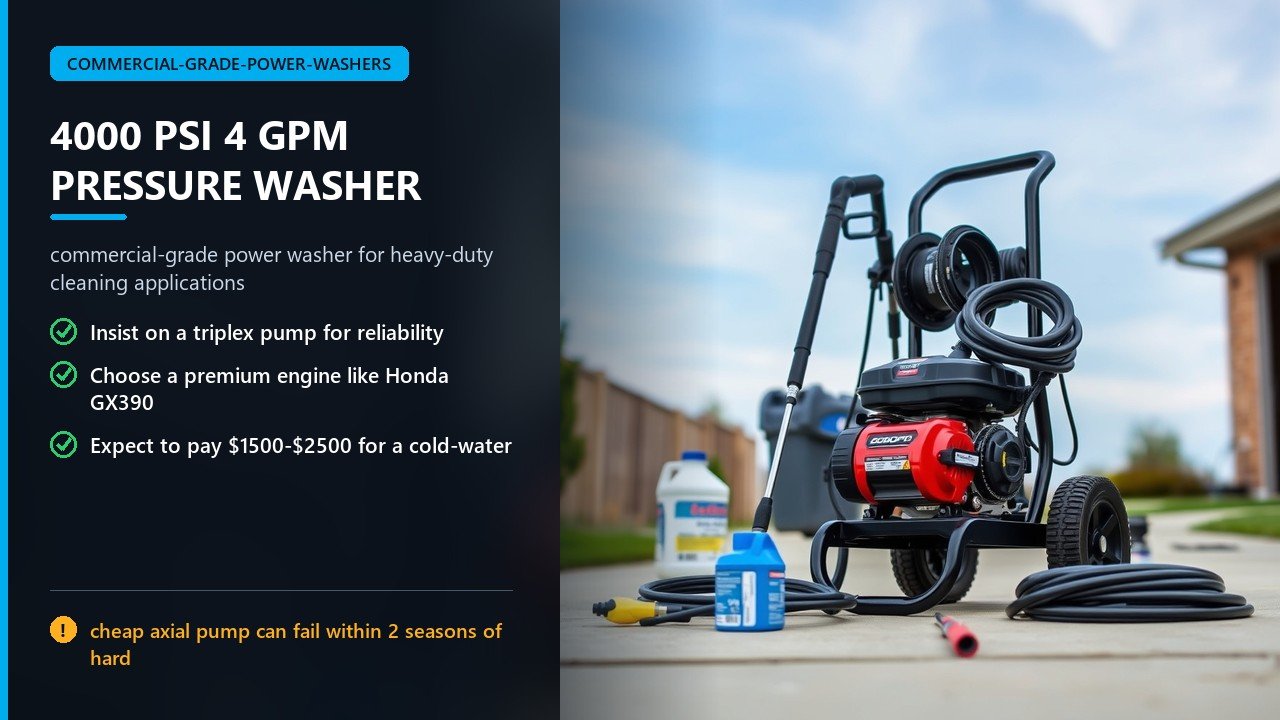
Quick Note: A 4000 PSI, 4 GPM pressure washer is a commercial-grade machine producing about 16,000 cleaning units. Expect to pay roughly $1,500–$2,500 for a quality cold-water unit and $4,000–$9,000 for a hot-water model. Insist on a triplex pump and a premium engine such as the Honda GX390.
Start With the Two Non-Negotiables
Before comparing brands and prices, fix the two fundamental choices that define everything else: cold water or hot water, and direct drive or belt drive.
Cold-water machines handle concrete, paint stripping, mud, and most exterior dirt. They are simpler, lighter, and far cheaper. Hot-water machines add a burner and coil that heat the water, which dissolves grease, oil, and chemical contamination that cold water cannot. If your work involves food service, fleets, or industrial grime, hot water is worth every dollar. If you clean concrete and buildings, cold water at this rating is more than enough.
Drive type determines durability and feel. In a direct-drive machine, the pump bolts directly to the engine, which is compact and affordable but runs the pump at engine speed and transfers vibration. A belt-drive machine connects engine and pump with belts and pulleys, letting the pump run slower, cooler, and smoother, and allowing the pump to be repaired without removing the engine. For commercial, sustained use, belt drive is generally preferred. Our companion article on the 4000 PSI, 4 GPM benchmark covers the performance side; here we focus on the purchase.
| Configuration | Pros | Cons |
|---|---|---|
| Direct drive | Compact, lower cost, fewer parts | Higher pump speed, more vibration, harder to service |
| Belt drive | Smoother, cooler pump, easier service, longer life | Bulkier, heavier, higher cost |
The Pump: Where Quality Lives or Dies
At the 4000 PSI, 4 GPM level, the pump is the component that most determines how long the machine lasts. Buy a triplex plunger pump from a recognized brand — General, CAT, AR, Udor, or Comet — and you are buying the three ceramic plungers, forged brass manifold, and serviceable valves that sustain high pressure over thousands of hours.
Model names appear in the listings and are worth recognizing. BE uses General and AR triplex pumps across its 4000 PSI, 4 GPM line, including the HW4015RA with an AR RSV4G40 pump. Pressure-Pro’s Eagle II EB4040HA pairs a belt-driven triplex pump with a GX390. American Pressure offers 4,000 PSI, 4 GPM units with CAT and AR belt-drive pumps. When you see a specific pump brand named in the listing, that is a good sign; when the listing is vague about the pump, be cautious.
Features that signal a quality pump include an external unloader (which runs cooler and is easy to service), a built-in or external thermal relief valve to protect against bypass heat, ceramic plungers, and removable valve caps for maintenance. A pump that can be rebuilt is worth far more than a sealed unit that must be thrown away. Our guide on whether to rebuild, replace, or buy new explains why serviceability matters so much at this level.
Note: Do not buy a 4000 PSI, 4 GPM machine with an axial-cam pump. Axial pumps are fine for light residential use but cannot withstand sustained commercial duty at this pressure and flow. A triplex plunger pump is the standard for a reason.
The Engine: Trust the Commercial Standard
Nearly every quality 4000 PSI, 4 GPM machine uses the Honda GX390, a 389cc commercial engine that has become the de facto standard for the class. It starts reliably, includes low-oil shutdown, and takes regular abuse without complaint. Competitors such as the Kohler, Briggs & Stratton Vanguard, Powerease, and Predator 420 series also appear, and a few are perfectly good, but the GX390 is the safe, proven choice and typically comes with electric start on larger models.
Whether you need electric start depends on your routine. Recoil start is fine for occasional use; electric start with a marine battery (often included) is a convenience worth having if you start the machine many times a day. Our article on the Honda industrial pressure washer explains why this engine family dominates commercial work.
What a Complete Package Should Include
At this price level, the machine should arrive ready to work, not as a bare pump and engine. Expect the following in the box, and treat their absence as a reason to negotiate or look elsewhere.
- A 3/8-inch high-pressure hose, typically 50 feet. Steel-braided, non-marking, with quick-connect fittings, is the commercial standard.
- An insulated trigger gun and wand, rated for the machine’s pressure, with a safety lock.
- A full set of quick-connect nozzles — 0°, 15°, 25°, 40°, and a soap nozzle — so you can match spray to surface.
- A detergent injector for downstream chemical application.
- A welded steel frame with pneumatic or flat-free tires, and often a roll cage, lift point, or trailer-mount brackets.
- Quality fittings and a thermal relief valve on the pump.
One of the best values at this level is a “pro pack” that adds a surface cleaner and extra hose to the base machine. American Pressure’s 4 GPM bundle is an example, pairing the washer with a Whisper Wash surface cleaner, two 50-foot hoses, a chemical injector, and nozzles. If you will clean flatwork, such a package can save hundreds versus buying accessories separately. Our guide to the surface cleaner attachment explains what to look for in the tool.
Cold Water, Hot Water, and Price Bands
Prices at 4000 PSI and 4 GPM spread widely, driven mostly by cold versus hot water and by drive type and pump brand. The table below shows representative models and prices to set expectations.
| Type | Example | Approx. Price |
|---|---|---|
| Cold, direct drive | 3R 4000/4 GX390 Comet direct drive | ~$1,800 |
| Cold, belt drive | Pressure-Pro Eagle II EB4040HA | ~$1,700 |
| Cold, belt drive | American Pressure CAT belt drive | ~$2,200 |
| Cold pro pack | American Pressure AR + surface cleaner | ~$2,500 |
| Hot water | HPW40H, 4000/4 GX390 hot water | ~$4,100 |
| Hot water | BE HW4013HG, General pump | ~$5,800 |
| Hot water, belt Drive | 3R hot water GX390 belt drive General | ~$9,200 |
As a rule, a quality cold-water 4000 PSI, 4 GPM machine costs roughly $1,500 to $2,500, while hot-water versions run from about $4,000 to over $9,000 depending on pump, drive, and burner. Prices vary with pump brand, frame, and included accessories, so compare like for like. If a listing seems dramatically cheaper, check the pump type first — that is almost always where the cost was cut.
How to Verify Before You Buy
A few checks protect you from an expensive mistake.
- Confirm the pump is a named triplex. General, CAT, AR, Udor, or Comet. If the listing does not say, ask.
- Confirm the engine. Honda GX390 or an equivalent commercial engine with low-oil shutdown.
- Check the drive type. Belt drive for sustained commercial work; direct drive if budget or size is the priority.
- Verify the hose. 3/8-inch, 50 feet, rated for the machine’s pressure, with quick connects.
- Confirm the nozzle set and injector are included.
- Read the warranty. Good commercial machines offer multi-year pump and frame warranties — for example, a 5-year pump and 10-year frame.
- Check your water supply. A 4 GPM machine needs at least 4.8 GPM of supply, as our benchmark article explains.
- Ask about service and parts. A rebuildable pump with available parts is worth more than a sealed bargain.
These checks take minutes and separate a machine that will serve for a decade from one that will frustrate within a year. On a purchase of this size, a little diligence is the best accessory you can buy.
Cold, Hot, or a Pro Pack?
The decision between cold water, hot water, and a bundled pro pack comes down to your work. Choose cold water if you clean concrete, buildings, and paint; choose hot water if grease, oil, and food residue fill your schedule; and choose a pro pack if you will regularly clean flatwork and want the surface cleaner and extra hose bundled at a discount. There is also the option of a hot-water machine built for dual-gun operation should your crew grow, as our article on the 5 GPM class explores at higher flow.
Match the machine to the work and the platform to how you will carry it. Our guide to the pressure washer mount explains skid, trailer, and truck options if you plan to move the machine between jobs, and our article on the 4,000 PSI pressure washer class covers what these machines can handle.
Accessories Worth Adding at Purchase
Buying the right accessories with the machine often saves money and avoids mismatches later.
- A surface cleaner sized for 4 GPM, for fast, even flatwork.
- A turbo nozzle for concentrated stubborn spots — see our turbo nozzle guide.
- A hose reel to keep the 50-foot hose tidy and protected, as our reel guide explains.
- Spare quick-connect O-rings and a coupler set, covered in our coupler guide.
- A pump saver for winter storage, as described in our pump saver guide.
- Extra nozzle tips in case of loss or wear — our nozzle guide covers selection.
Buying these with the machine is usually cheaper than buying them piecemeal later, and it means the setup is complete from day one. The one accessory to resist is a cheap one: a bargain surface cleaner or hose that fails early costs more in the end than the premium version.
Reading the Spec Sheet Like a Pro
Manufacturers list a lot of numbers, and knowing which ones matter keeps you from being dazzled by marketing. The essentials are pressure, flow, cleaning units, engine displacement, and pump type.
PSI is the force of the water; GPM is the volume. Both matter, and their product, cleaning units, summarizes overall capability. At 4,000 PSI and 4.0 GPM you get about 16,000 cleaning units, the professional benchmark. Engine displacement in cubic centimeters tells you how much power is available to drive the pump; the GX390 is 389cc, and 420cc engines appear on some near-equivalents. Pump type should read “triplex” or “triplex plunger,” and ideally name the brand.
Other numbers deserve a glance. Hose length and diameter affect reach and flow; 3/8-inch by 50 feet is the commercial norm. Weight determines how you will move and store the machine, so check it against your vehicle and storage. Warranty terms for the frame, pump, and engine tell you how much confidence the maker has in each part. Read the sheet with these in mind, and the important differences between machines become obvious.
New vs. Used Commercial Machines
A used 4000 PSI, 4 GPM machine can be an excellent value or a money pit, and the difference is usually the pump and the hours. Commercial machines are built to be rebuilt, so a well-maintained used unit with a serviceable triplex pump can serve for years at a fraction of the new price.
If you shop used, inspect carefully:
- Pump oil condition. Milky or metal-filled oil signals internal wear.
- Engine hours and oil. A commercial hour meter is a plus; clean oil suggests diligent care.
- Pump brand and serviceability. A recognizable triplex pump with available parts is far better than a sealed mystery unit.
- Frame and coil condition. Rust, cracks, or a leaking coil are expensive to fix.
- Proof it runs. Insist on a demonstration at pressure, listening for cavitation and watching for leaks.
- Burner and gas system on hot-water units, which should be inspected by a qualified technician.
Buying used makes most sense when you can verify service history or trust the seller. When in doubt, the warranty and support that come with a new commercial machine are worth the premium. For a first commercial purchase, many buyers choose new for exactly that reason.
Where to Buy: Dealer, Box Store, or Online
The sales channel affects price, support, and what arrives on your doorstep.
Equipment dealers specialize in commercial pressure washing. They offer expert advice, service, parts, and setup, and they will help you match a machine to your water supply and work. You typically pay closer to list price, but the support and service access are real value for a business. For hot-water machines especially, a dealer relationship makes maintenance and gas-system service far easier.
Big-box and online retailers offer competitive prices and convenience, and they carry reliable machines from Simpson, Pressure-Pro, BE, and others. The trade-off is limited hands-on advice and after-sales service. If you are confident in your specifications and comfortable arranging your own maintenance, this route can save money.
Direct-from-manufacturer and specialty shops sit in between, often bundling machines with surface cleaners and hoses as pro packs. Whichever channel you choose, confirm the pump brand, engine, drive type, and included accessories before ordering, because those details are what you are really paying for.
Budgeting Beyond the Machine
The sticker price is only part of the cost of ownership. A realistic budget covers the machine plus the supporting items that make it work and last.
- Accessories: surface cleaner, turbo nozzle, hose reel, and spare nozzles.
- Consumables: pump oil, engine oil, filters, spark plugs, and O-rings.
- Protection: a pump saver for winter, and covers for storage.
- Transport and mount: a cart, skid, or trailer if you move between jobs — our mount guide explains the options.
- Water supply: a buffer tank or feed improvements if your spigot cannot supply 4.8 GPM.
- Fuel and maintenance: the ongoing cost of running a commercial machine hard.
Adding these to your budget at purchase time prevents the common surprise of a machine that cannot go to work because a hose, reel, or supply is missing. For a hot-water machine, also budget for burner fuel and periodic service of the coil and burner.
Delivery, Setup, and the First Run
These machines are heavy — a 4000 PSI, 4 GPM unit often weighs well over 100 pounds, and hot-water versions can exceed 500 pounds. Plan for delivery, unloading, and storage before the machine arrives.
- Confirm freight and unloading. Heavy units ship by freight and may need a loading dock, forklift, or liftgate. Ask before ordering.
- Read the manual first. Understand the controls, oil requirements, and break-in procedure before the first start.
- Check and fill fluids. Engine oil and pump oil must be at the correct levels; some pumps ship without oil.
- Connect a proper water supply. Confirm at least 4.8 GPM available, with a short, large-diameter feed hose.
- Prime the pump by running water through before starting, and never let it run dry.
- Do a break-in run at moderate use, then check oil levels and fasteners.
- Register the warranty and note service intervals.
A careful first run protects the pump and engine during the period when they are most vulnerable to a careless mistake. Follow the manual’s break-in guidance, keep the pump oil clean, and check for leaks at every fitting before you take the machine to a paying job.
Matching the Machine to Your Jobs
The last step before you buy is to run your actual workload against the machine’s capabilities. A 4,000 PSI, 4 GPM pressure washer is powerful, but it is not the right answer for every buyer, and matching it to your jobs prevents both overspending and disappointment.
| Your Work | Recommended Setup |
|---|---|
| Home driveways and siding, occasional | Smaller machine; a 4,000 / 4 GPM unit is more than you need |
| Professional concrete and flatwork | Cold water 4,000 / 4 GPM with a surface cleaner |
| Fleet and equipment washing | Cold or hot water 4,000 / 4 GPM, belt drive preferred |
| Grease, oil, and food service | Hot water 4,000 / 4 GPM with detergent injection |
| Two-person crews, high volume | Consider 5–6 GPM or dual-gun capability |
If your work matches the middle rows, a 4000 PSI 4 GPM pressure washer is a sound investment that will pay for itself in productivity. If you only clean your own property a few times a year, a smaller machine will do the job for far less, and you will not miss the commercial output. Be honest about how much you work, and buy for that reality rather than for the largest number on the shelf.
Common Mistakes to Avoid
- Buying on price without checking the pump. An axial pump at this level is a false economy.
- Choosing hot water you do not need, or cold water when grease demands heat.
- Overlooking the water supply. A 4 GPM machine starves without at least 4.8 GPM available.
- Ignoring drive type. Belt drive pays off in commercial duty; direct drive suits lighter schedules.
- Underestimating the weight. These machines are heavy; plan how you will move and store one.
- Forgetting accessories. Budget for the surface cleaner, reel, and spares you will want.
- Skipping the warranty check. A strong pump warranty signals confidence in the design.
- Assuming bigger numbers mean better. 4,000 PSI at a mismatched flow is less useful than a well-chosen 4 GPM setup.
Frequently Asked Questions
How much does a 4000 PSI 4 GPM pressure washer cost? A quality cold-water unit typically runs $1,500 to $2,500, while hot-water versions cost roughly $4,000 to over $9,000 depending on pump, drive, and burner.
Is a 4000 PSI 4 GPM pressure washer good for commercial use? Yes. With about 16,000 cleaning units and a triplex pump, it is a genuine commercial-grade machine suited to concrete, fleets, buildings, and, in hot-water form, grease and oil work.
Should I choose direct drive or belt drive? Belt drive is generally preferred for sustained commercial work because the pump runs slower, cooler, and is easier to service. Direct drive is more compact and affordable but less durable under heavy use.
What pump should a 4000 PSI 4 GPM pressure washer have? A triplex plunger pump from General, CAT, AR, Udor, or Comet. Avoid axial-cam pumps at this level; they cannot withstand sustained commercial duty.
Do I need hot water at 4000 PSI and 4 GPM? Only if you clean grease, oil, or chemical contamination. Hot water dissolves those soils far better but costs two to four times as much and adds burner maintenance.
What should be included with the machine? A 3/8-inch 50-foot hose, an insulated gun and wand, a full nozzle set, a detergent injector, and a sturdy frame. Many buyers also add a surface cleaner and hose reel.
Is a 4000 PSI 4 GPM pressure washer worth it for a homeowner? Usually not. This is a commercial-grade machine with a commercial price and demanding water-supply needs. A homeowner cleaning a driveway and some siding a few times a year is better served by a smaller, less expensive machine that is easier to run and store.
Can I run a surface cleaner with a 4000 PSI 4 GPM machine? Yes, and it is one of the best pairings at this level. A surface cleaner sized for 4 GPM cleans flat concrete quickly and evenly. Many machines are even sold in a pro pack that includes one.
Final Thoughts
Buying a 4000 PSI 4 GPM pressure washer is a commercial-grade purchase, so treat it like one. Fix your cold-versus-hot choice and your drive type first, then insist on a named triplex pump and a proven engine, and confirm the machine arrives with the hose, gun, nozzles, and injector that make it ready to work. Expect to pay roughly $1,500 to $2,500 for cold water and $4,000 and up for hot water, and treat dramatically cheaper listings as a signal to inspect the pump.
Do those things and you buy a machine with a decade of service in it. Skip them and you buy a second machine sooner than you should. The difference is not the brand on the box — it is the pump, the engine, and the drive, which is exactly where a careful shopper looks. Choose well, add the right accessories, and this class of pressure washer will reward you with faster jobs, cleaner surfaces, and dependable service season after season.