Power Pressure Washer Pump: How to Match and Replace It
A power pressure washer pump is the component that turns a spinning engine or motor into a focused jet of water, and when it fails, the whole machine stops working. The good news is that a pump is often the cheapest major part to replace, and swapping one is a job most owners can handle. The catch is matching the right pump to your machine, because pumps are not universal. Shaft size, mounting pattern, pressure and flow ratings, and inlet and outlet connections all have to line up.
This guide walks through what a power pressure washer pump does, how the two main designs differ, and how to choose and install a replacement that fits. For the deep dive on pump internals, our pump part guide covers what fails and why.
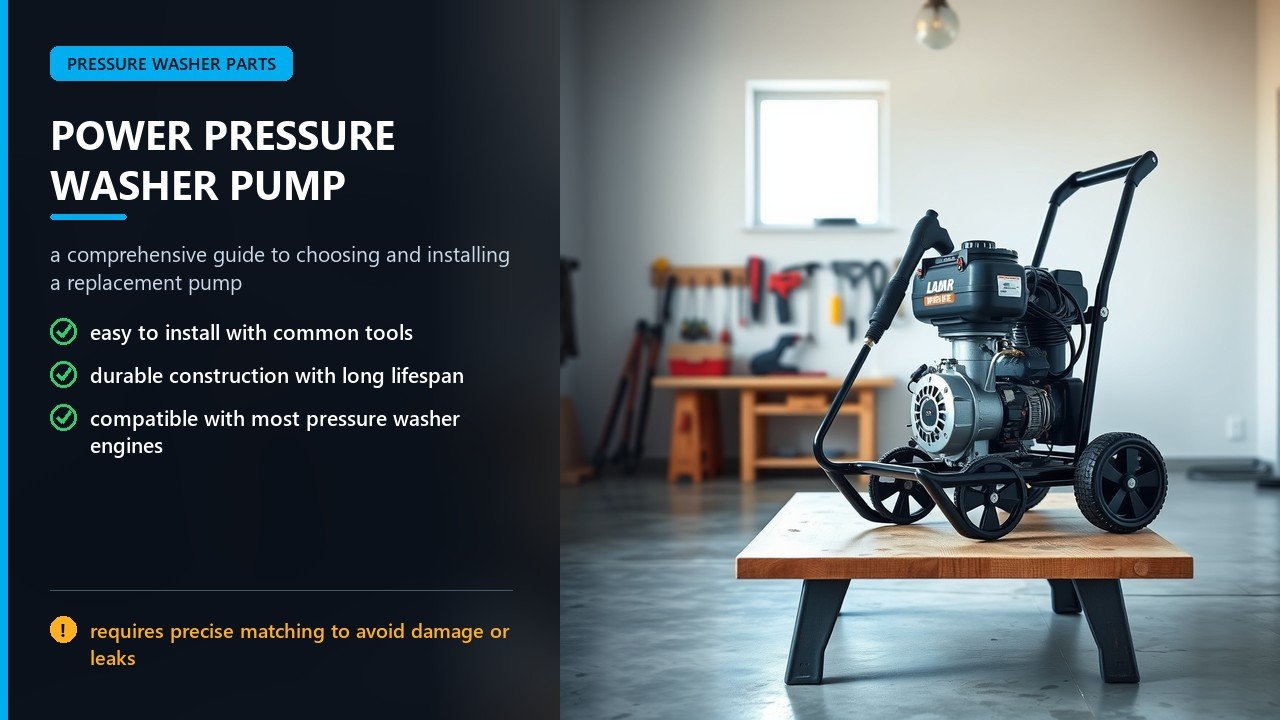
What the Pump Does
The pump takes low-pressure water from your supply and forces it through a small nozzle at high pressure. It is driven by the engine or motor shaft, and it is the part that actually creates the pressure your machine is rated for. Inside, pistons or plungers move back and forth in cylinders, drawing water in through inlet valves and pushing it out through discharge valves. Seals and O-rings keep the water where it belongs.
Because the pump works hardest of any part on the machine, it is usually the first major component to wear out. Leaks, lost pressure, and strange noises almost always trace back to the pump or its unloader. Our 3000 PSI pump guide covers a common rating in detail.
Axial Cam Versus Triplex Plunger
There are two main pump designs, and they behave very differently. An axial cam pump uses a wobble plate to push pistons back and forth along the pump axis. It is simple, light, and cheap, which is why it comes on most residential machines. A triplex plunger pump uses three plungers driven by a crankshaft, which spreads the load and produces steady, efficient pressure with far greater durability.
Axial pumps typically cover roughly 1,500 to 2,800 PSI and 1.4 to 2.5 GPM, while triplex pumps climb well beyond that in both pressure and flow. The trade-off is cost and weight: an axial pump is cheap to replace, and a triplex pump costs more but lasts several times longer. If you use your machine hard, upgrading to a triplex is often the smart move. Our triplex versus axial guide explains the difference.
The Shaft Is the First Match Point
Before anything else, the replacement pump must fit the engine shaft. Pumps come in common shaft diameters, and the most frequent are 3/4 inch, 7/8 inch, and 1 inch, each with a standard keyway of about 4.78mm. The shaft can be solid or hollow, depending on the pump design, and the two are not interchangeable. It also matters whether the engine shaft is horizontal or vertical, because the pump is built for one orientation only.
Measure the shaft diameter and note its orientation before you shop. A pump built for a 7/8 inch vertical shaft cannot go onto a 3/4 inch horizontal engine. Getting this wrong is the most common reason a replacement pump will not fit. Our pump specs and replacement guide covers the measurement basics.
Match PSI and GPM to the Engine
The pump’s pressure and flow ratings must suit your engine’s power. A pump that demands more horsepower than the engine provides will bog down and never reach its rating, while an undersized pump wastes the engine’s potential. As a rule, engines in the 5.5 to 7 HP range pair with pumps around 2.5 to 3.3 GPM at 2,700 to 3,300 PSI, while a 13 HP engine like the Honda GX390 drives a 4.0 GPM pump at up to 4,400 PSI.
You can replace a pump with one of the same or lower ratings without issue, but stepping up requires enough engine power to support it. Check the pump’s required brake horsepower against your engine. When in doubt, match the original pump’s ratings. Our 3500 PSI pump guide shows how ratings cluster.
Mounting Pattern and Connections
Most gas pressure washer pumps bolt to the engine with a standard four-bolt SAE pattern, which is what makes many pumps interchangeable across brands. Even so, the bolt pattern, the shaft key, and the flange depth must match, and some engines use a non-standard layout. On the water side, the inlet is usually a garden hose thread, and the discharge is an M22 or similar fitting that connects to your high-pressure hose.
Check the inlet and outlet orientation too, since a pump that points the wrong way will not fit the machine even if the ratings are right. Replacement kits usually include a siphon tube with a filter, mounting bolts, a shaft key, and instructions, which covers everything needed for a clean swap. Our rebuild or replace guide helps you decide whether to fix or swap.
Choosing a Replacement Pump: A Checklist
| Spec | What to Match |
|---|---|
| Shaft diameter | 3/4, 7/8, or 1 inch |
| Shaft type | Solid or hollow, per pump design |
| Orientation | Horizontal or vertical engine |
| Mounting | SAE four-bolt pattern, flange depth |
| Pressure and flow | PSI and GPM within engine power |
| Inlet and outlet | Garden hose inlet, M22 discharge |
| Keyway | About 4.78mm standard |
Retailers such as Pittsburgh Spray Equipment and Spraywell list pumps by shaft size, orientation, and rating, which makes cross-referencing an original easy. Once your checklist is complete, buying the right pump is straightforward.
Unloader and Thermal Relief
The unloader is the valve that routes water back to the inlet when you release the trigger, preventing dangerous pressure spikes. Many pumps include an integrated unloader with an easy-start feature and sometimes a hand-turn knob to reduce pressure for delicate jobs. A thermal relief valve (TRV) is a small fitting that bleeds off hot water from the pump during long bypass periods, keeping the pump from overheating.
When you replace a pump, keep or replace the unloader and TRV with equivalent parts. A worn unloader causes surging pressure and premature pump failure, and a missing TRV can cook the pump seals. Quality replacement kits include an integrated stainless unloader and a thermal relief provision for exactly this reason. Our pump part guide covers both.
Real-World Replacement Examples
Knowing common kits helps you see how the specs fit together. The Simpson AAA AX300 90052 is a 3,500 PSI, 2.5 GPM axial cam pump for horizontal engines with a 3/4 inch shaft, and it ships with stainless pistons, an integrated stainless unloader, and a thermal relief valve. The OEM Technologies 90026 is a 3,100 PSI, 2.4 GPM axial cam unit for vertical engines with a 7/8 inch shaft and a maintenance-free crankcase.
For higher output, an AAA triplex kit rated 4,400 PSI at 4.0 GPM fits a 1 inch horizontal shaft such as the Honda GX390 and uses dual oversized ball bearings for long life. Comet and AR make both axial and triplex replacements in many sizes. Our guide to AR pumps and our look at the CAT pump upgrade both show the premium end of the market.
Installing a Replacement Pump
Replacing a pump is a manageable job with basic tools. Disconnect the water inlet, the high-pressure outlet, and the unloader linkage, then unbolt the pump from the engine flange. Note the orientation of everything before removing it, because a photo prevents reassembly mistakes. Pull the old pump free of the shaft, keeping the key and any spacers.
Slide the new pump onto the shaft with the key in place, align the bolt holes, and tighten the bolts evenly. Reconnect the hoses and fittings, fill the pump crankcase with the specified oil if it is not sealed, and prime the pump with water before starting. Run the engine briefly and check for leaks and correct pressure. Our connecting rod guide shows what is happening inside once it runs.
Priming and First Start
Never start a freshly installed pump dry. Running it without water destroys the seals and can score the plungers in seconds. Connect a water supply, open the valve, and let water flow through the pump before starting the engine, with the trigger held open to purge air. Once water flows steadily from the nozzle, release the trigger and start the machine normally.
If the pump does not build pressure, check for air leaks on the inlet side, a clogged inlet strainer, or a closed supply valve before suspecting the pump itself. Most first-start problems are supply issues, not pump defects. Our replacement guide covers priming and troubleshooting.
Pump Care and Oil
Pump life depends heavily on oil and water quality. Use the oil type the manufacturer specifies, change it per the manual or after the first break-in period, and keep the inlet water clean with a filter. Never run the pump dry, never run it against a closed trigger for long stretches, and protect it from freezing with a pump saver fluid before winter storage.
Some newer pumps advertise a maintenance-free sealed crankcase, which simplifies care but still requires clean water and no dry running. For oiled pumps, using the wrong oil or neglecting changes is a common cause of early failure. Our guides to pump oil and to pump protector fluid cover the details.
When to Rebuild Instead of Replace
If the pump is a quality triplex unit and only the seals or valves are worn, a rebuild kit is cheaper than a whole new pump and restores performance. Rebuilding makes sense when the body and plungers are sound but the seals leak or pressure has faded. Replacing makes sense when the pump is a cheap axial unit, the body is damaged, or the cost of the rebuild approaches the cost of a new pump.
Weigh the value of the pump against the work. A high-end triplex pump with a damaged seal is worth rebuilding; a budget axial pump usually is not. Our rebuild, replace, or buy new guide helps you decide, and our piece on pump saver fluid protects whichever pump you end up with.
How a Pump Builds Pressure
Water enters the pump from the garden hose at low pressure, typically somewhere between 10 and 60 PSI, and leaves as a high-pressure jet feeding your hose and nozzle. Between those two points, a set of one-way valves and moving pistons trap a fixed volume of water and squeeze it into a smaller space on every stroke. That squeezing does the work. The tighter the trapped volume and the faster the strokes, the higher the pressure.
Because water is nearly incompressible, a pump cannot create pressure unless the outlet is restricted. That is the job of the nozzle. A small orifice resists flow, and the pump keeps pushing until the pressure rises to meet that resistance. This is why the same pump produces different pressures with different nozzle sizes, and why a worn nozzle can make a healthy pump look weak. If you replace a pump and pressure is still low, check the nozzle before blaming the new part.
The valves are simple but critical. On the intake stroke, the inlet valve opens and the discharge valve stays shut, filling the cylinder with water. On the push stroke, the inlet closes and the discharge opens, moving the water downstream. Worn valves leak backward, so the pump runs but never fully builds pressure. That is one of the most common pump failures, and on many units a valve kit fixes it for far less than a new pump.
Pump Sizing and Brake Horsepower
Every pump demands a certain amount of power to hit its rated pressure and flow, and engines are sold by horsepower. If the pump needs more power than the engine can deliver, the machine bogs down and the rating is a fiction. The rough relationship is that a gallon per minute at a thousand PSI needs about one and a half brake horsepower, so pressure and flow multiply together to set the demand.
For example, a pump rated 4.0 GPM at 4,000 PSI needs roughly 11 brake horsepower, which is why these machines use a 13 HP engine with a little headroom. A 2.5 GPM pump at 3,000 PSI needs closer to 7 HP worth of demand. When you shop for a replacement, compare the pump’s required horsepower against your engine. Stepping up the pump without stepping up the engine rarely works and often damages the machine.
You can also think in cleaning units, which is simply PSI multiplied by GPM. Two machines can wash differently even at the same pressure if their flow differs, because flow carries the dirt away while pressure loosens it. Matching a replacement pump at or near the original cleaning units keeps the feel of the machine consistent. Our 3500 PSI pump guide shows how these figures pair up in practice.
Water Supply and Inlet Requirements
A pressure washer pump can only pressurize the water it receives, so a weak supply is a hidden cause of poor performance. A pump rated 2.5 GPM needs at least 2.5 GPM flowing to its inlet, and a 4.0 GPM pump needs more than that, because the pump pulls harder than most garden spigots comfortably deliver. A supply that keeps up at the start may fall behind, causing the pump to cavitate or run dry at the worst moment.
Check that the supply delivers more than the pump demands, that the hose is wide enough and not kinked, and that the inlet strainer is clean. Insufficient supply shows up as surging pressure, a pump that sounds like it is pulling air, and seals that fail early. On big pumps, a buffer tank with a float valve is often the fix, letting the tank refill between draws while the pump runs at full flow.
Cavitation is the silent killer here. When the pump starves for water, small vapor bubbles form and collapse violently against the internal surfaces, eroding metal and destroying seals over time. The damage looks like the pump failed on its own, but the root cause was the supply. Our pump specs guide covers matching supply to demand.
Brands and Quality Tiers
Pumps fall into clear quality tiers, and knowing the names helps you judge any machine or replacement. At the top are commercial triplex pumps from makers such as CAT, General Pump, AR, Comet, and UDOR, which use heavy crankcases, quality seals, and serviceable parts and can run for thousands of hours. Below them are the OEM-branded pumps that ship on mid-range machines, often made by FNA Group under names like AAA and OEM Technologies and on machines from Simpson, DeWalt, and Delco.
At the budget end are generic axial cam pumps that many value machines use. They work fine for occasional jobs but have a shorter life and are usually not worth rebuilding. The badge on the machine does not always tell you which pump is inside, so check the pump label itself. Our AR pump guide and our CAT pump guide profile two of the most respected names.
When you replace a pump, replacing like with like keeps things simple. Swapping a budget axial pump for another budget axial pump is the fastest path back to work, while upgrading to a triplex pump repays the extra cost in longevity if your machine otherwise supports it. The brands worth paying up for are the ones that sell service parts, because a pump that can be rebuilt is a pump that can last.
Signs the Pump Is Failing
| Symptom | Likely Cause |
|---|---|
| Pressure fades gradually | Worn valves or seals |
| Water drips under the pump | Failed seals or O-rings |
| Surging or pulsing pressure | Unloader or air in the inlet |
| Pump runs dry, no pressure | Supply or inlet problem |
| Oil looks milky | Water entered the crankcase |
| Loud knocking or grinding | Worn bearings or internal damage |
| No pressure at all, cold water only | Sheared key or stripped shaft |
Milky oil is a worrying sign because it means water has crossed into the crankcase, which points to a seal failure bad enough that rebuilding or replacing the pump is soon necessary. Grinding or knocking usually means bearings, and a pump that suddenly produces no pressure at all can have a sheared shaft key that is failing to turn the pump internals. Diagnosing the symptom saves you from replacing a pump that a valve kit would have fixed. Our pump part guide maps symptoms to parts.
Winterizing and Storage
Freezing water is one of the fastest ways to destroy a pump, because water expands as it turns to ice and cracks seals, valves, and even the pump housing. If you live where temperatures drop below freezing, the pump must be protected before the season ends. The simplest method is to drain the pump and run a pump saver or antifreeze fluid through it so no standing water remains.
To winterize, disconnect the water supply, drain the inlet and outlet lines, and pour or siphon pump protector fluid into the inlet while turning the engine over briefly to draw it through. The fluid is usually a blend of propylene glycol, lubricants, and corrosion inhibitors built specifically for this job, and it also lubricates seals during storage. Automotive antifreeze is not a substitute and can damage seals. Our guides to pump protector fluid and to pump saver fluid walk through the process.
Store the machine indoors if possible, and never leave water trapped in the pump or hoses. A machine that is properly winterized starts the next season as if nothing happened, while one that freezes often needs a new pump before the first job. This one step prevents a huge share of avoidable pump replacements.
Pump Care During the Season
Between storage seasons, small habits extend pump life. Keep the inlet strainer clean so grit never reaches the valves, use the correct pump oil and change it on schedule, and avoid running the machine against a closed trigger for more than a short pause. Long bypass periods make the pump recirculate the same water, which heats up and stresses the seals, which is exactly what the thermal relief valve exists to manage.
Never run the pump dry, even briefly. A few seconds without water is enough to score seals and plunge wear, and the damage compounds. When you finish a job, let the machine idle down through the normal shutdown, then drain and store it correctly. Treated well, a triplex pump can outlast several engines, which is another reason the upgrade pays off over time. For oil specifics, our pump oil guide lists the right type by brand.
Frequently Asked Questions
How do I know which pump fits my pressure washer? Match the shaft diameter and type, the engine orientation, the four-bolt mounting pattern, and the PSI and GPM ratings. Check the inlet and outlet connections as well.
Can I upgrade my axial pump to a triplex pump? Sometimes. A triplex pump needs compatible mounting and shaft, and enough engine power. If the fit and power match, a triplex pump is a worthwhile upgrade.
Why did my pressure washer pump fail? Common causes are running dry, freezing, a worn unloader, dirty inlet water, and simply reaching the end of its service life. Axial pumps fail sooner than triplex pumps.
Is it worth replacing a pressure washer pump? Often yes. A new pump costs far less than a new machine and restores full performance, provided the engine and frame are otherwise in good shape.
What oil goes in a pressure washer pump? Use the oil the manufacturer specifies, typically a non-detergent pump oil or the grade listed in the manual. Never substitute engine oil unless the maker approves it.
How long should a pressure washer pump last? A cheap axial pump may last a season or two of regular use, while a quality triplex pump with proper care can last many years or thousands of hours.
Direct Drive Versus Belt Drive
How a pump connects to the engine also affects its life. Direct drive couples the pump straight to the engine shaft, so the pump spins at engine speed, usually around 3,400 RPM. This is compact, cheap, and common on residential machines, but the fast spinning pump works harder and does not last as long. Belt drive runs the pump off a belt and pulley, slowing the pump to around 1,450 RPM, which cuts wear dramatically and isolates the pump from engine heat and vibration.
Belt drive also lets you adjust the ratio to tune pressure and flow, and it survives pump jams better because the belt can slip. The trade-offs are bulk, a belt to maintain, and higher cost. Commercial machines favor belt drive for these reasons, and a direct drive unit that keeps eating pumps may be telling you the layout, not the pump, is the problem. If you replace a pump on a direct drive machine, choose one rated for that speed.
The Bottom Line
A power pressure washer pump is the heart of the machine, and replacing one is one of the most cost-effective repairs you can make. Match the shaft, orientation, mounting pattern, and ratings, choose axial for budget or triplex for durability, and keep the unloader, thermal relief, oil, and water supply in good order. Do that, and your pump will deliver steady pressure for years.
Measure carefully, prime the pump before the first start, and protect it from freezing and dry running. A well-matched, well-cared-for pump turns a tired machine back into a reliable workhorse and saves you the cost of buying a whole new pressure washer.