A wand is the right tool for a lot of things, and industrial concrete cleaning is not one of them. Anyone who has tried to clean a two thousand square foot parking lot with a pistol grip knows the telltale result: overlapping arcs, dark and light patches, and a slice of the day gone before the first row is finished. The job does not need a stronger operator. It needs a concrete cleaner machine built to cover flat ground evenly.
The term covers more ground than most people expect. It can mean a rotating attachment that bolts to a pressure washer, a walk-behind cleaner with wheels and a handle, a water broom for rinsing, or a ride-on floor scrubber that cleans thousands of square feet of indoor slab in an afternoon. Choosing badly wastes money in one of two directions: spend too little and the tool cannot keep up, or spend too much and the machine sits because the work never justified it.
This guide sorts the whole category into practical decisions. You will see what each type of concrete cleaner machine actually is, the sizing rule that keeps an attachment matched to its pressure washer, when hot water or recovery capability changes the answer, how to match a machine to driveways, garages, warehouse floors, and parking structures, and the maintenance and chemistry habits that keep the equipment productive.
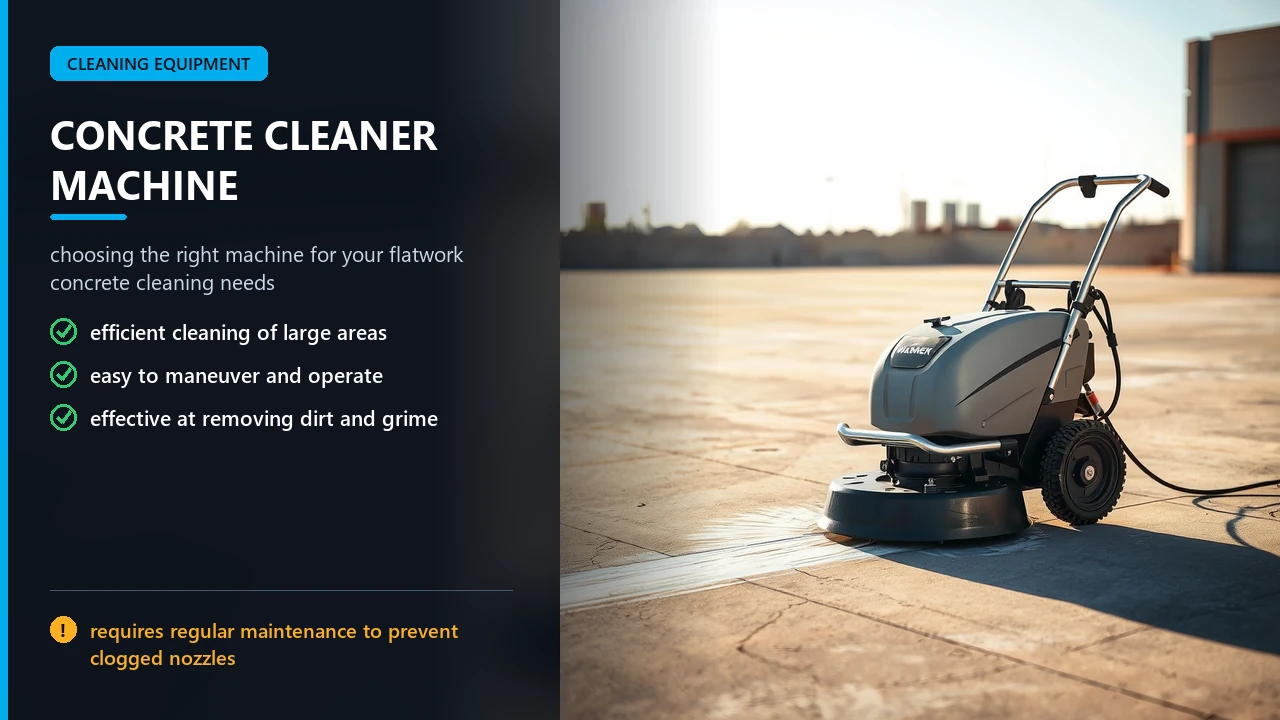
What Counts as a Concrete Cleaner Machine
The category splits into tools that ride on your existing pressure washer and tools that are complete machines in their own right.
- Rotary surface cleaner. A round shroud with a spinning spray bar inside, fed by the pressure washer. The workhorse for exterior flatwork.
- Wheeled surface cleaner. The same principle on casters, sized larger and pushed like a vacuum across parking lots and wide slabs.
- Water broom. An open bar that rinses and pushes water without the sealed shroud. Good for clearing after a clean, not for deep soil removal.
- Walk-behind scrubber. A self-contained indoor machine with brushes, cleaning solution, and vacuum recovery in one pass.
- Ride-on scrubber. A larger version for warehouses and retail floors where thousands of square feet are the normal job.
The two families rarely overlap in the field. Exterior concrete wants pressure delivered evenly across a wide path. Interior concrete wants mechanical scrubbing plus immediate recovery so the floor is dry and safe behind you. A tool that does one well is usually wrong for the other.
Our existing guides to the flat surface cleaner and the rotary surface cleaner cover the attachment side in detail.
The Sizing Rule Nobody Should Skip
Almost every disappointing surface cleaner story traces back to a mismatch between the tool and the flow behind it. Contractors buy a big deck because bigger promises more coverage, then run it on a machine that cannot spin the bar at speed. The result is exactly the striping they bought the machine to avoid, only now it is attached to a heavy tool that is slow to push.
The industry rule is simple and consistent across nearly every manufacturer. Match flow to deck diameter at one gallon per minute for every four inches.
| Machine Flow | Maximum Deck Diameter | Typical Use | Notes |
|---|---|---|---|
| 2.0 to 2.5 GPM | 12 to 15 inches | Small patios, steps, spot work | Bar spins slowly; keep expectations modest |
| 3.0 to 3.5 GPM | 15 to 18 inches | Residential driveways and walks | Practical starter setup |
| 4.0 GPM | 20 inches | Full residential flatwork | The professional baseline |
| 5.0 to 5.5 GPM | 20 to 24 inches | Mixed residential and light commercial | Real productivity step up |
| 8.0 GPM and up | 24 to 30 inches or more | Commercial lots and parking decks | Wheeled units earn their keep here |
Three-nozzle decks demand more flow than two-nozzle decks of the same diameter, so always check the machine’s stated flow requirement rather than the diameter alone. If you are ever unsure, size down. A slightly undersized cleaner runs at full speed and cleans evenly, while an oversized one streaks and forces multiple passes.
Our professional surface cleaner guide walks through the same sizing logic from a buying perspective.
Wheeled or Floater
Once the size is right, the next decision is how the deck travels across the concrete.
Floaters rely on water pressure to hover just above the surface. They are light, maneuverable, and precise, which makes them ideal for residential driveways, patios, sidewalks, and tight turns around landscaping. Their weakness is uneven or rough concrete, where the deck catches and the cleaning pattern suffers.
Wheeled units ride on casters or tires and are pushed like a piece of equipment. They are heavier, more stable, and far less tiring over large areas, which is why they dominate gas stations, strip malls, parking structures, and new construction slabs. Their weakness is maneuverability in tight residential settings and on severely cracked surfaces.
The practical answer for many contractors is one of each. A floater handles the fine work around a home, and a wheeled unit handles the wide-open commercial slabs where fatigue would otherwise end the day early. Buying only the largest wheeled machine and forcing it into residential work is as common a mistake as buying a tiny floater for a parking lot.
Cold Water, Hot Water, and Recovery
Temperature and water capture are the two features that most often decide whether a job is profitable or painful.
Cold water handles dirt, mildew, and organic staining perfectly well, and it is what the majority of residential flatwork needs. Hot water becomes essential the moment petroleum is involved. Heat lowers the viscosity of oil and grease so detergent can penetrate the pores of the concrete, and no amount of pressure substitutes for that thermal action. Gas stations, restaurant pads, loading docks, and auto shops are hot-water territory.
Recovery turns a surface cleaner into a compliant tool on sites that restrict runoff. A recovery deck captures the wash water through a vacuum port so it can be contained rather than sent toward a storm drain. It adds weight, hose drag, and complexity, so it earns its place where regulations or site rules demand it rather than on every job.
Our guide to the power washer heater covers the hot-water side of this decision.
When the Right Machine Is a Standalone Scrubber
Not every concrete surface can be pressure washed. Warehouse floors, retail aisles, and institutional corridors are usually too enclosed and too finished for a pressure stream, and the water needs to be recovered immediately for safety and slip control.
That is where a walk-behind or ride-on scrubber takes over. These machines lay down cleaning solution, agitate with rotating brushes or pads, and vacuum the water back up in a single pass, leaving the floor nearly dry behind the operator. On a concrete floor with a pH-neutral cleaner, a scrubber removes everyday soil without altering the surface chemistry of the slab.
Choosing between them is a matter of square footage and obstructions. Walk-behind units suit spaces under roughly fifteen thousand square feet, areas with tight aisles, and sites where maneuverability beats speed. Ride-on machines take over in warehouses, big-box retail, and facilities well above twenty thousand square feet, where operator comfort and throughput become the deciding factors.
Our coverage of scrubber attachments explains the brush-and-pad options that pair with these systems.
Matching the Machine to the Job
Read the job first, then choose the tool. The matrix below reflects how professional crews actually divide the work.
| Concrete Job | Best Machine | Why |
|---|---|---|
| Residential driveway | 18 to 20 inch floater on a 4 GPM pressure washer | Maneuverable, evenly sized to flow, fast enough for a two-car slab |
| Patios and walkways | 15 to 20 inch floater, wand for edges | Close work around landscaping and steps |
| Paver and stamped concrete | Floater at reduced pressure, or soft wash pre-treat then rinse | Decorative surfaces etch under high pressure |
| Gas station and restaurant pad | Wheeled 24 to 30 inch cleaner with hot water | Petroleum needs heat and volume, large area needs coverage |
| Parking garage decks | Wheeled unit with recovery or dual reels | Runoff rules, long pulls, and tight ramps |
| New construction slab | Wheeled cleaner on a high-flow machine | Large bare concrete with construction soil and mud |
| Warehouse and retail floor | Walk-behind or ride-on scrubber | Indoor, enclosed, needs immediate water recovery |
| Pool deck | 20 to 24 inch cleaner, careful pressure control | Even finish without etching around coping |
The pattern is that exterior work flows from floater to wheeled cleaner as area and soil increase, while interior work leaves the pressure washer behind entirely and moves to a scrubber. Sequencing matters too. The productive routine pre-treats stains, runs the cleaner across the field while chemicals dwell, then returns with a wand or turbo nozzle for edges and stubborn spots.
For the wand side of that workflow, see our guide to flat surface cleaning and the circular attachment overview.
The Chemistry That Makes the Machine Work
Equipment and chemistry are partners, and the wrong chemical wastes the machine’s capability.
- Organic staining. Algae, mildew, and moss respond to sodium hypochlorite at a controlled strength. A concrete cleaner machine scrubs and rinses, but the chemistry kills the growth at the root.
- Petroleum stains. An alkaline degreaser applied before the machine passes gives the cleaner something to lift. On heavy oil, hot water and a longer dwell matter more than more pressure.
- Efflorescence. The white chalky bloom is mineral, not organic, and needs a mild acid rather than bleach. Rinse thoroughly and consider sealing to prevent recurrence.
- Rust. Oxalic acid or a dedicated rust remover, never bleach, which sets the stain.
- Interior indoor concrete. Use a pH-neutral cleaner. A high-pH floor cleaner can etch a polished or finished slab that is already near the pH of the concrete itself.
One hard rule for surface cleaners specifically: do not run harsh alkaline cleaners through the machine’s swivel and internal components. Apply the chemical first, let it dwell, and use clean water for the cleaning pass so the abrasive chemistry never travels through the head.
Our broader guide to soap for concrete and other surfaces covers the product side.
Building a Rig Around the Machine
A concrete cleaner only performs as well as the system behind it. Before buying the machine, decide what the whole setup looks like, because the deck is the cheapest part of the decision and the easiest to get right.
| Setup Level | Pressure Washer | Concrete Cleaner | Supporting Gear | Work It Handles |
|---|---|---|---|---|
| Starter residential | 3.0 to 4.0 GPM, 3,000 to 4,000 PSI | 15 to 20 inch floater | 100 to 150 feet of hose, wand, nozzle set | Driveways, patios, small walks |
| Working residential | 4.0 GPM with a reel and buffer tank | 20 inch floater plus wand | Downstream injector, hose reel, tank | Full homes, larger slabs, recurring routes |
| Light commercial | 5.0 to 5.5 GPM, optional hot box | 20 to 24 inch wheeled or floater | Reels, injector, tank, spare nozzles | Restaurant pads, small lots, gas stations |
| Production commercial | 8.0 GPM belt-drive skid with heater | 24 to 30 inch wheeled with recovery | Dual reels, soft wash pump, buffer tank | Parking structures, big lots, fleet work |
| Indoor floor care | Not used on the floor | Walk-behind or ride-on scrubber | pH-neutral cleaner, pads, spare squeegee | Warehouses, retail, corridors |
The progression is deliberate. You do not buy a deck that outruns your machine, and you do not buy a machine that outruns the jobs you can book. A starter setup with a correctly matched twenty inch floater will embarrass a half-ton production rig running an oversized head on low flow, because the matched tool actually spins and rinses instead of dragging across the slab.
The supporting gear matters more than most buyers expect. A buffer tank keeps the pump from starving on sites with weak supply, a hose reel cuts setup and teardown time, and a downstream injector lets you pre-treat without a separate sprayer. None of it is glamorous, and all of it determines whether the concrete cleaner is a bottleneck or a profit center.
Indoor and Outdoor Workflows Differ Sharply
The two settings share a surface and almost nothing else about the process.
Outdoors, the sequence is pre-treat, clean, and rinse. You apply chemistry to break down soil and organic growth, let it dwell while it works, run the surface cleaner across the field to scrub and flush, then finish edges, expansion joints, and borders with a wand or turbo nozzle. Water flows away from the work and toward a drain or the edge of the property, which is why runoff rules matter on commercial and roof-adjacent jobs.
Indoors, the sequence is completely different. A scrubber lays solution, agitates with brushes or pads, and recovers the water in the same pass, leaving the floor nearly dry and immediately safe underfoot. There is no waiting for a rinse waterway to clear, no runoff leaving the property, and no high-pressure stream that could damage a finished slab or drive water into a wall base. The machine replaces the pressure washer rather than supplementing it.
Confusing the two is how contractors damage floors and frustrate clients. Pressure washing an indoor slab pushes water where it cannot drain and can etch a surface that a scrubber would have cleaned gently. Scrubbing an exterior driveway with the wrong tool leaves embedded staining that chemistry and a surface cleaner would have removed in a fraction of the time. Match the method to the setting first, then choose the machinery within that method.
Common Mistakes With Concrete Cleaners
- Oversizing the deck. The classic error. A machine that cannot spin a wide bar cleans slower than a smaller one running at full speed.
- Using a surface cleaner on delicate paver or stamped concrete at full pressure. Etching is permanent.
- Running a wheeled unit on rough or sloped residential concrete. Casters catch, the seal breaks, and results suffer.
- Skipping pre-treatment. A machine removes soil, but chemistry determines how easily it releases.
- Running chemicals through the swivel. Abrasive alkaline cleaners wear internal components faster than anything else.
- Ignoring worn nozzles. Uneven spray from a worn tip is the leading cause of streaking on an otherwise properly matched machine.
- Neglecting the swivel bearings. The swivel is the number one failure point on commercial units, and it fails silently until it grinds.
- Choosing a pressure washer for an indoor concrete job. Enclosed floors need a scrubber with recovery, not a high-pressure stream.
- Forgetting edges and details. A machine cleans the field; a wand cleans the borders. Skipping the wand leaves an obviously unfinished job.
Maintenance That Keeps a Cleaner Working
- Grease the swivel. Lubricate the bearings on a schedule rather than waiting for a grinding sound. Rebuild kits are inexpensive compared with a mid-job failure.
- Inspect and replace nozzles. Keep a spare set of correctly rated tips and swap them the moment the spray pattern goes uneven.
- Check the shroud and skirt. A torn skirt loses the seal and throws water, reducing cleaning power and soaking everything nearby.
- Clean the deck underside. Concrete slurry and grit build up and interfere with rotation.
- Inspect wheels and casters. A seized caster turns a wheeled unit into a heavy drag across the slab.
- Flush the system after chemical jobs. Residue in the lines and head accelerates wear.
- Store components dry. Freezing water cracks fittings and heads, especially in cold climates.
- Track hours on scrubbers. Brush and pad wear, squeegee condition, and battery health all drive the maintenance schedule.
Our tip on non-marking hose is a small detail that prevents a specific call-back: the dark streaks a hose can leave across freshly cleaned concrete.
Frequently Asked Questions
What is the best concrete cleaner machine? For exterior flatwork, a rotary surface cleaner matched to your machine’s flow. For indoor concrete floors, a scrubber with vacuum recovery. The best machine depends entirely on whether the job is outdoors under pressure or indoors with recovery.
How much flow do I need for a surface cleaner? One gallon per minute for every four inches of deck diameter. A twenty inch cleaner needs at least five gallons per minute, and three-nozzle decks need more.
Can I clean concrete with just a pressure washer wand? You can, but it is slow and leaves striping that even passes struggle to remove. A cleaner attachment covers roughly four times the area per pass with a uniform pattern.
Do I need hot water? For petroleum stains, yes. Heat thins oil and grease so detergent can work. For ordinary dirt, mildew, and organic staining on concrete, cold water is sufficient.
Is a wheeled cleaner better than a floater? Neither is universally better. Floaters are more maneuverable for residential work, wheeled units are less tiring and more stable on large commercial slabs.
Can a surface cleaner damage concrete? At excessive pressure on soft, aged, or decorative concrete, yes. Test a hidden area and use the lowest pressure that cleans effectively.
What size scrubber do I need? Walk-behind units suit spaces under about fifteen thousand square feet and tight aisles. Ride-on machines fit large warehouses and retail floors above roughly twenty thousand square feet.
How long do concrete cleaner machines last? Commercial-grade surface cleaners commonly last three to five years of daily use when maintained, while inexpensive plastic units often fail within a season. The swivel and bearings wear first.
Can I use my concrete cleaner on pavers? With care. Reduce pressure, keep the deck moving, and confirm sand joints are intact. The even pattern actually reduces the striping a wand can cause on patterned pavers.
How many square feet per hour can one clean? A well-matched twenty inch cleaner behind a four gallon per minute machine often covers roughly twelve hundred to fifteen hundred square feet per hour, faster than a wand by two to three times depending on soil and cut-outs.
Do I need a buffer tank for a concrete cleaner? It is strongly recommended on any high-flow rig. Concrete cleaning runs long duty cycles, and a pump that outdrinks its supply will cavitate and lose pressure partway through a slab.
How do I clean expansion joints and cracks? The machine cleans the field; a wand with a focused tip finishes joints, edges, and borders. Skip this step and the finished slab shows an obvious unfinished grid.
Is a water broom a real concrete cleaner machine? It is a rinsing and pushing tool, not a deep cleaner. It excels at clearing wash water and light surface debris after a clean rather than removing embedded soil.
Final Thoughts on Concrete Cleaner Machines
The right machine turns concrete cleaning from a test of endurance into a predictable process. Match the deck to your flow, choose floater or wheeled based on the site, decide honestly whether the job needs heat or recovery, and keep the wand ready for edges. On indoor slabs, leave the pressure washer in the truck and bring a scrubber that recovers its own water.
Buy for the work you actually run, keep the swivel greased and the nozzles fresh, and pair the machine with the right chemistry rather than leaning on pressure alone. Do that and the tool pays for itself in completed square footage and cleaner results, which is the only measure that matters on flatwork.
The contractors who get the most from a concrete cleaner machine treat it as one component of a system rather than a magic attachment. They size it to flow, feed it with a tank, pre-treat with the right chemistry, recover water where rules require it, and finish every job with a wand so the edges match the field. That combination is what turns flatwork from the slowest part of the week into the most dependable line in the schedule.
Sources and Further Reading
- Cleaner Times, surface cleaner selection guidance for contractors: cleanertimes.com
- Powerwash.com, pressure washer surface cleaner facts to know: powerwash.com
- JR Racenstein, commercial concrete cleaning equipment guide: jracenstein.com
- DiamaPro Systems, choosing a cleaning method for concrete surfaces: diamaprosystems.com
- U.S. Occupational Safety and Health Administration, hand and power tool safety: osha.gov