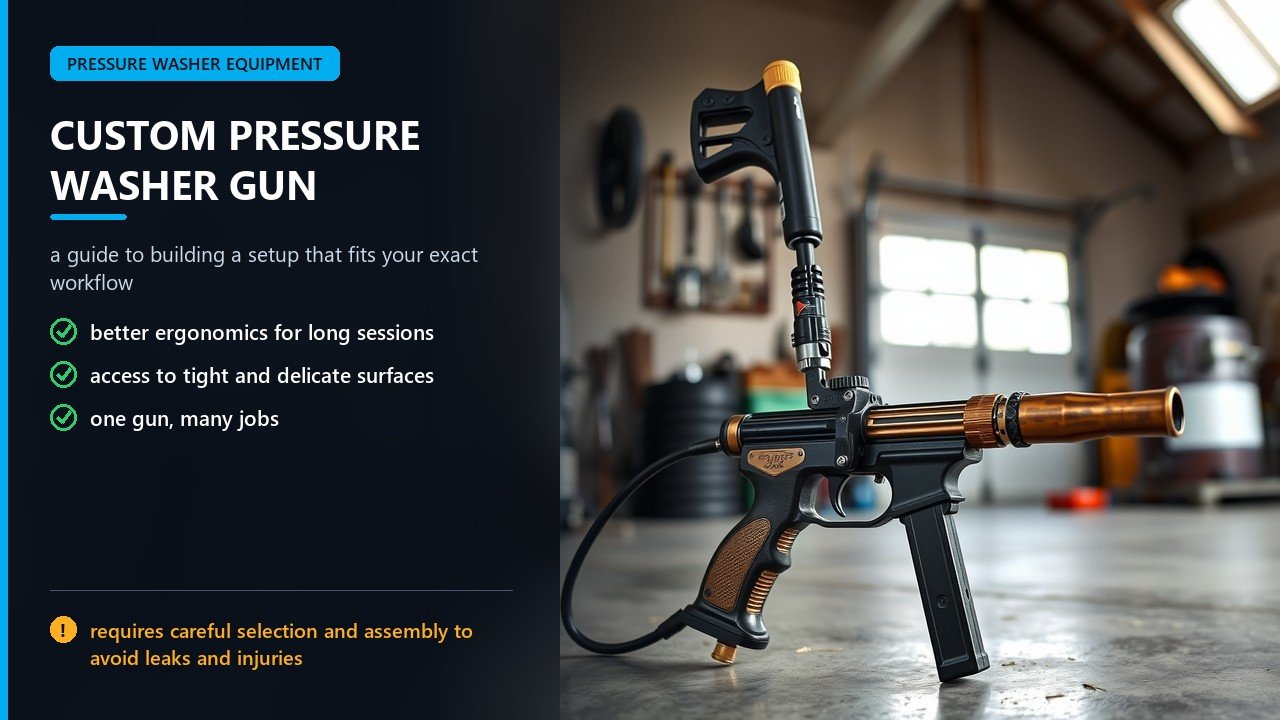
Custom Pressure Washer Gun: Build a Setup That Fits Your Exact Workflow
Marcus had been detailing cars out of a two-car garage in Ohio for six years when he finally admitted the problem wasn’t his technique. It was his gun. Every wash, he wrestled a four-foot spray wand around mirrors, wheel wells, and front grilles, banging the barrel on paint and losing control at the worst moments. One Saturday, after a customer pointed out a fresh scratch on a fender, Marcus ordered a stubby custom pressure washer gun with a swivel inlet and a 1/4-inch quick connect. Two weeks later, his average wash time dropped by nearly twenty minutes, and he stopped dreading tight spaces entirely. That single change, built around the way he actually worked, was worth more than upgrading his machine.
If you have ever felt like your pressure washer was built for somebody else’s job, you are in exactly the right place. A custom pressure washer gun is not about spending a fortune on boutique parts. It is about matching the trigger, the inlet, the outlet, and the accessories to your real-world tasks so the tool disappears into the work. This guide walks you through what a custom gun really is, how to choose every component, the mistakes that cause leaks and injuries, and how to assemble a setup that feels like it was made for you, because it was.
What a Custom Pressure Washer Gun Really Means
When people search for a custom pressure washer gun, they usually mean one of three things: a short “snub nose” gun that replaces the stock wand, a gun configured with specific fittings for their machine, or a gun paired with accessories like a foam cannon, an extension wand, or a swivel. All three answers share the same root idea. You are choosing the parts that control pressure, flow, and ergonomics instead of accepting whatever arrived in the box.
The stock gun and wand that comes with most consumer machines is a compromise. Manufacturers build one configuration that works “well enough” for siding, driveways, and cars, then ship millions of them. It is long enough to reach the ground comfortably, heavy enough to feel substantial, and threaded with whatever fitting keeps costs down. For a homeowner washing a deck twice a year, that is fine. For anyone who cleans often, or cleans awkward things like wheels, engine bays, gutters, fences, or soft-top convertibles, that generic setup becomes friction.
A custom gun removes that friction. You decide how short the body is, how light the trigger pull feels, whether the hose spins freely at the inlet, and what the outlet connects to. The result is a tool that matches your body, your machine, and your work.
The Three Building Blocks of Any Custom Gun
Every pressure washer gun, no matter how fancy, is defined by three things:
- The body and trigger — short or long, metal or composite, standard pull or easy-pull, with or without a trigger lock and safety latch.
- The inlet — where the high-pressure hose connects. This is usually a threaded port (M22 male or female, or 3/8-inch NPT) or a female quick connect.
- The outlet — where the wand, nozzle, or foam cannon attaches. This is most often a 1/4-inch female quick connect in the detailing world, or a threaded 1/4-inch NPT for commercial duty.
Get those three right and everything else, the swivels, extensions, and cannons, snaps into place.
Why Bother Building a Custom Gun?
There is a practical case for going custom, and it shows up in the first hour of real work.
Better Ergonomics for Long Sessions
A short, balanced gun keeps your wrist in a neutral position instead of forcing it to lever around a long wand. Detailers, mobile washers, and fleet cleaners who hold a gun for hours report far less fatigue with a compact body and an easy-pull trigger. The energy you save on your hands and forearms is real, especially across a full workday.
Access to Tight and Delicate Surfaces
Wheel spokes, grilles, mirrors, motorcycle fairings, HVAC fins, and the gap between a house and its siding all punish a long wand. A short gun lets you move the nozzle close to the surface with precision instead of swinging a long lever into something expensive.
One Gun, Many Jobs
With quick-connect outlets, one custom gun body can run a rinsing nozzle, a soap cannon, a turbo nozzle, a surface cleaner attachment, and a set of extension wands. You stop swapping whole assemblies and start swapping tips and accessories in seconds. That flexibility is the heart of a pressure washer gun kit.
Flow and Pressure That Match Your Machine
Commercial machines push 4 to 12 GPM and 4,000 to 5,000 PSI. A cheap stock gun with a narrow flow path can choke that output, costing you cleaning speed. A properly rated custom gun keeps the water moving and the pressure honest from pump to nozzle.
Start With the Ratings: PSI and GPM
Before you fall in love with a particular gun body, confirm it can handle your machine. Ratings matter in both directions. A gun rated far below your washer’s output will leak, stick, or fail. A gun rated for a pressure washer you do not own is simply more money than you need to spend, though buying a bit of headroom is smart if you plan to upgrade.
| Gun Class | Typical PSI Rating | Typical GPM Rating | Best For |
|---|---|---|---|
| Consumer / light duty | Up to 2,600 PSI | Up to 2.5 GPM | Electric machines, occasional car washing, patio touch-ups |
| Prosumer / mid duty | 3,000 to 4,000 PSI | 3 to 8 GPM | Detailing setups, gas washers, fence and siding work |
| Commercial / pro | 4,000 to 5,000+ PSI | 8 to 12 GPM | Fleet washing, soft wash and washdown systems, contract cleaning |
The golden rule: choose a gun whose PSI and GPM ratings meet or exceed your washer’s output. Underspec it and you invite leaks and premature failure. Overspec it slightly and you buy durability and future-proofing.
Don’t Confuse Pressure With Flow
Pressure (PSI) cuts and lifts; flow (GPM) carries dirt away and determines how fast you cover a surface. A high-flow machine needs a gun with a wide enough internal path. If you want a deeper look at how flow changes your results, our guide on PSI vs GPM explains why more GPM often beats a bigger PSI number for real cleaning speed.
The Inlet and Outlet: Where Most Builds Go Wrong
This is the section that saves people the most money and frustration. Fittings are boring until they leak, strip, or refuse to connect, and then they ruin your afternoon.
Inlet Threads and Adapters
The most common inlet on a custom gun is M22, a metric thread that comes in two flavors: M22-14mm and M22-15mm. They look almost identical and thread nearly identically, which is exactly why people accidentally force the wrong one. The 14mm is common on many gas and imported machines; the 15mm shows up on certain European and specific brands. Cross-threading them is one of the most frequent causes of a weeping connection.
Some pro guns skip M22 entirely and use a 3/8-inch female NPT inlet. That is the standard on high-flow commercial machines, and it pairs with a 3/8-inch quick connect or a 3/8-inch hose fitting. If your hose ends in a 3/8-inch plug, you want a 3/8-inch inlet gun. If your hose ends in M22, you want an M22 gun or an adapter.
Outlet: Quick Connect vs Threaded
For detailing and most home and mobile work, the outlet is a 1/4-inch female quick connect, which accepts 1/4-inch plugs on nozzles, foam cannons, and wands. For heavy commercial duty, the outlet is often 1/4-inch female NPT, threaded to take a specific lance or a threaded adapter that then steps down to quick connect. Either is fine; just know which one you are buying before you order accessories.
Quick Connect Sizes Are Not Interchangeable
There are three quick connect sizes worth knowing: 1/4-inch, 3/8-inch, and the less common 1/2-inch. They do not fit each other. The 3/8-inch size is the high-flow standard for hose-to-gun and hose-to-pump connections; the 1/4-inch size is the standard for gun-to-nozzle connections. Mixing them up is why people think their new fitting “doesn’t fit” when they simply bought the wrong end. Our breakdown of quick connect fittings and sizes covers the thread charts in detail.
Short Gun vs Standard Wand: Which Fits You?
The single most popular custom upgrade is the switch from a long wand to a short, or “snub nose,” gun. Here is how the two compare so you can pick honestly.
- Standard long wand: Great for reaching the ground and high siding without bending, good leverage for flat surfaces, but heavy on the wrist and clumsy in tight spaces.
- Short snub gun: Compact, maneuverable, close control for detailing and intricate work, easier on the arm, but you may need an extension wand for the ground or high areas.
Many owners end up with both: a short gun for vehicles and detail work, and a longer wand or extension for broad, flat surfaces. If you go short, our guide on wand quick connects shows how to switch between the two in seconds.
Swivels, Triggers, and Ergonomics
A swivel inlet is one of those upgrades you cannot un-feel once you try it. It lets the hose rotate freely at the gun, so the line no longer twists, kinks, or fights your wrist. For anyone doing continuous work, a swivel is worth the small premium. If a swivel ever starts weeping, our article on pressure washer hose swivels walks through the seal replacement.
Trigger feel matters more than most buyers expect. A stiff, long-throw trigger exhausts your hand. An easy-pull or short-throw trigger keeps you shooting steadily for hours. Look for a gun with a clear safety latch and a lock-off so you can set it down safely between passes. We compare options in our guide to choosing a pressure washer gun kit.
Pairing Your Gun With a Foam Cannon
For car care, the killer combination is a short gun plus a foam cannon. The cannon threads or quick-connects to the gun’s outlet, and because the gun is short, you can point the cannon precisely and coat a panel evenly. A custom gun with a swivel inlet makes this even smoother, because the hose stops dragging the cannon off-angle as you move around the vehicle. If you are building a wash setup, see how foam and soap transform the job, and match it with the right chemistry using our soap selection guide.
Hot Water and Temperature Ratings
If you run a hot water machine, your gun must be rated for the temperature. Many consumer guns top out around 140 to 176 degrees Fahrenheit, while pro guns are rated near 200 to 300 degrees. Pushing a cold-water gun with hot water degrades seals fast. Our piece on the hot water pressure washer pump explains why heat stresses every downstream component, gun included.
Step-by-Step: Building Your Custom Gun
Here is a practical sequence that keeps you from ordering the wrong parts or assembling a leaker.
1. Identify Your Machine’s Specs
Write down your PSI, GPM, and the thread on your high-pressure hose. Check the owner’s manual or the fitting itself. If you are not sure, our guide to matching a gun and wand helps you decode it.
2. Choose the Gun Body
Decide short or long, then pick a PSI and GPM rating with a little headroom. Prefer a gun with serviceable seals and a metal trigger if you clean often.
3. Match the Inlet
Buy a gun whose inlet matches your hose, or buy the correct adapter. M22-14mm and M22-15mm are the usual suspects; 3/8-inch NPT is the commercial standard. Don’t force a thread that resists.
4. Decide the Outlet Setup
For detailing, a 1/4-inch quick connect outlet is ideal. For commercial lances, a 1/4-inch NPT outlet gives you threaded flexibility.
5. Add the Comfort Parts
A swivel inlet, an easy-pull trigger, and a durable grip transform a good gun into a great one.
6. Assemble and Leak-Test
Tape the threads, hand-tighten, then snug with a wrench only where flats exist. Never overtighten a swivel or quick connect. Pressurize with the nozzle pointed in a safe direction and check every joint.
7. Organize the Accessories
Add a nozzle holder or a wand holder so tips and attachments live on the gun instead of in your pocket. Our guide to swapping attachments quickly pairs well with a tidy setup.
What a Custom Build Costs
A custom gun does not have to be expensive. Here is a realistic breakdown of where your money goes. Prices vary by brand and market, but the proportions hold.
| Component | Budget Range | What It Buys You |
|---|---|---|
| Short gun body (consumer) | Low | Lightweight, compact, fine for occasional detailing |
| Pro gun body (commercial) | Mid to high | High PSI/GPM ratings, serviceable seals, hot water capability |
| Swivel inlet | Low to mid | Tangle-free hose, less wrist strain |
| Quick connect adapters/fittings | Low | Correct match to your hose and accessories |
| Foam cannon or wand | Low to mid | Extends the gun to soap work or reach work |
| Extension wand | Low to mid | Reach for ground and high surfaces when using a short gun |
Most people build a capable custom setup for about the cost of a mid-tier accessory, and the payoff shows up in comfort and speed on every job.
Three Real Custom Builds for Three Real Jobs
Abstract advice only goes so far. Here is how a custom gun comes together for three very different owners, because the right answer depends entirely on the work in front of you.
The Weekend Detailer
Picture a homeowner who washes two family cars every other weekend. The goal is gentle, swirl-free cleaning with minimal fatigue. The build: a light short gun body with a swivel inlet, an M22-14mm adapter to match the electric machine, a 1/4-inch quick connect outlet, a foam cannon, and a 40-degree tip for rinsing. This owner never reaches for a long wand, because a short gun plus a cannon covers the entire job. The swivel keeps the hose from dragging the cannon across paint, and the easy-pull trigger means two cars do not leave hands aching.
The Mobile Washer
Now imagine a mobile detailer who cleans driveways, house exteriors, and vehicles in a single day. This person needs one gun that adapts. The build: a mid-duty pro body rated for 4,000 PSI and 8 GPM, a 3/8-inch inlet with a swivel, a 1/4-inch NPT outlet with a threaded-to-quick-connect adapter, a short gun for vehicles, and a pair of extension wands for the ground and siding. One gun body, many configurations, packed neatly on the truck. This owner cares about hot-water compatibility too, so the pro body is temperature-rated for the occasional heated water job.
The Commercial Contractor
Finally, consider a contractor running a 4 GPM to 5 GPM, 4,000 PSI machine on fleet trucks and concrete. Here, durability and steady flow outrank compactness. The build: a heavy-duty, high-flow gun rated to 5,000 PSI and 12 GPM, a 3/8-inch high-flow inlet, a threaded 1/4-inch outlet, and a serviceable trigger valve so seals can be replaced instead of the whole gun. A second gun body stays as a spare. This owner buys headroom not for style, but because a failed gun on a jobsite costs far more than a spare part ever will.
Common Mistakes and How to Avoid Them
Learn from the mistakes that fill forum threads and return bins.
- Wrong thread pitch. M22-14mm and M22-15mm look alike. Measure or test before you force. Cross-threading ruins both parts.
- Mismatched quick connect sizes. A 3/8-inch plug will never fit a 1/4-inch socket. Confirm both ends.
- Undersized gun rating. Running a 2,600 PSI gun on a 4,000 PSI machine destroys seals fast.
- Overtightening. Many connections seal on an O-ring, not on torque. Extra force crushes the seal and causes leaks.
- Forgetting the nozzle. The nozzle controls the final pressure and pattern. A perfect gun with the wrong tip still damages surfaces or underperforms.
- Ignoring temperature ratings on hot water machines.
- Skipping the safety latch. A gun without a working lock is an accident waiting to happen.
Maintaining a Custom Gun So It Lasts
A built setup deserves a little care, and it rewards you with years of service.
- Rinse and dry after every use, especially after soap or chemicals.
- Check O-rings on quick connects and swivels; replace them at the first sign of wear. O-rings are cheap; leaks are not.
- Store the gun off the ground, indoors, and never let water freeze inside it. Our winterizing guide covers freeze protection.
- Lubricate swivels sparingly with a compatible grease if the maker allows it.
- Re-tape threaded joints whenever you disconnect and reconnect.
If a gun starts leaking, sticking, or losing pressure, most problems trace back to seals, debris, or a worn trigger valve, not the whole unit. Our troubleshooting guide on pressure washer gun problems helps you diagnose it before you buy a replacement. And when replacement is the answer, see what to look for in a gun replacement that fits and feels right.
Custom Gun vs Stock Gun: A Quick Comparison
| Factor | Stock Gun and Wand | Custom Gun Setup |
|---|---|---|
| Ergonomics | One-size-fits-all, often heavy | Matched to your hand and tasks |
| Reach vs control | Fixed compromise | Choose short, long, or extendable |
| Accessory flexibility | Limited to stock fittings | Quick connect swaps for any accessory |
| Flow performance | May restrict high-GPM machines | Rated to keep flow moving |
| Hot water use | Often cold-water only | Temp-rated pro bodies available |
| Upfront cost | Included with machine | Small to moderate premium |
Frequently Asked Questions
Is a custom pressure washer gun worth it for a homeowner?
Yes, if you clean more than a few times a year or own anything delicate like a car, boat, or painted fence. Even an affordable short gun with a swivel makes routine jobs faster and gentler on your hands.
Can I use any gun on any pressure washer?
Only if the PSI, GPM, and fittings match. The gun must be rated at or above your machine’s output, and its inlet must match your hose, either directly or through an adapter.
What is the most common inlet size?
M22-14mm is the most common on consumer and many gas machines, while 3/8-inch NPT dominates commercial high-flow equipment.
Do I need a swivel?
You do not need one, but a swivel inlet dramatically reduces hose tangles and wrist strain. Most people who try one never go back.
Can I run a foam cannon on a custom gun?
Absolutely. A 1/4-inch quick connect outlet gun is ideal for foam cannons, which is why short guns and cannons are such a popular pairing.
The Bottom Line
A custom pressure washer gun is the simplest high-impact upgrade in this entire hobby and trade. You are not chasing a gimmick; you are matching the four things that decide how a pressure washer feels in your hand: the trigger, the inlet, the outlet, and the accessories. Get the ratings right, respect the threads, add a swivel and a comfortable trigger, and you will clean faster, hurt less, and finish jobs that used to fight you. Marcus did it with one order and a Saturday afternoon. You can too, starting with the parts that fit what you actually do.