A homeowner named Marcus compared two pressure washers side by side. One promised 4,000 PSI and the other only 3,000 PSI, so the choice seemed obvious, and he bought the higher number. On his long concrete driveway, though, the “weaker” 3,000 PSI machine actually finished the job faster, because it moved more water. Marcus had measured cleaning power by pressure alone, and the lesson cost him a return and a weekend. The number that decides how fast you clean is not the one on the front of the box. It is the one people usually ignore.
PSI and GPM are the two numbers that define any pressure washer, and understanding them is the difference between buying the right machine and buying the wrong one. PSI measures how hard the water hits. GPM measures how much water comes out. A machine needs both to clean well, but the balance between them decides whether it is fast, gentle, aggressive, or weak. This guide breaks down what each number means, how they work together, which one matters more for different jobs, and how to read a spec sheet so you are never fooled by a big number again.
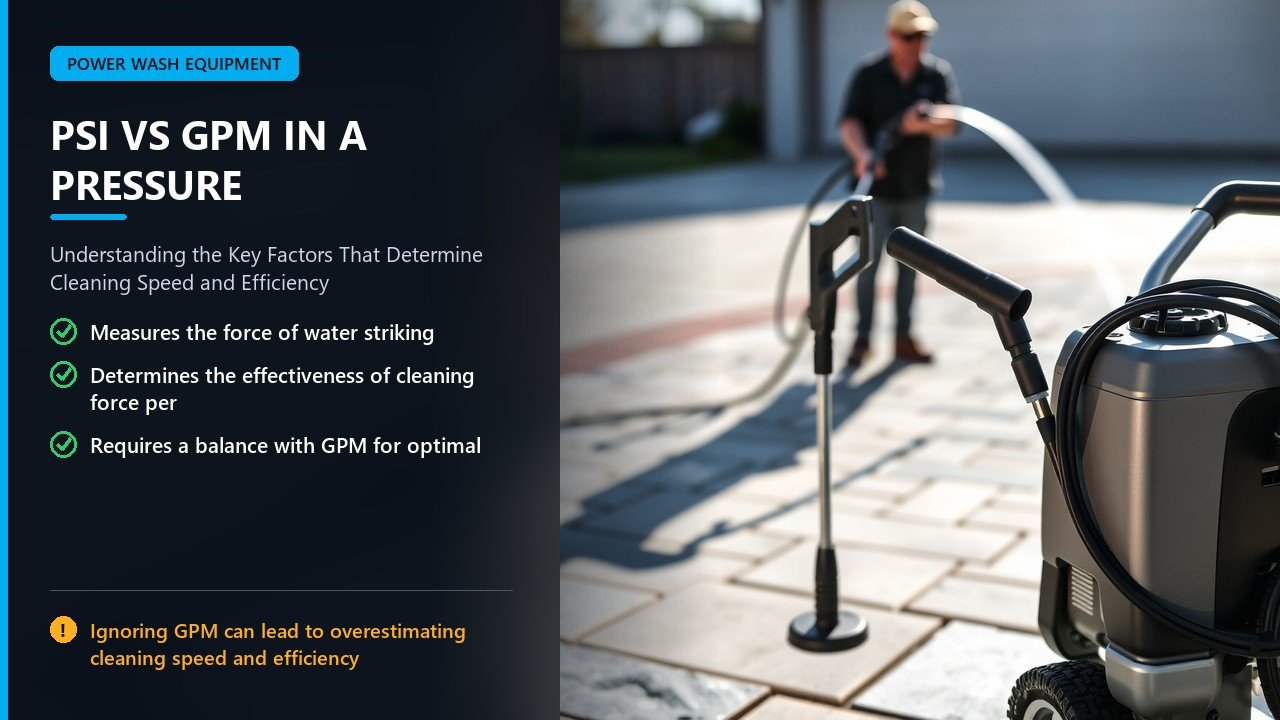
What PSI Actually Means
PSI stands for pounds per square inch, and it measures pressure. In a pressure washer, it describes how forcefully the water leaves the nozzle and how hard it strikes a surface.
Pressure is impact. High pressure lets water cut through caked mud, strip loose paint, and blast stains out of concrete. It is the reason a narrow nozzle feels so aggressive. PSI is what gives a pressure washer its bite, and it is the number most shoppers focus on first.
Pressure alone does not clean everything. A machine with extreme pressure and very low flow pushes a thin, powerful jet that removes one small stripe of dirt at a time. It bites hard, but it covers ground slowly. Pressure is force, not speed, and confusing the two leads to the wrong purchase. Our guide to what a 3,000 PSI rating really means explains how pressure is measured.
Too much pressure is a problem. More PSI is not always better. Excess pressure damages wood, etches concrete, strips paint, and even pierces skin in accidents. High-pressure water can cause serious injection injuries, which is why the Occupational Safety and Health Administration treats pressure washing as a genuine hazard. For many home jobs, a moderate pressure with good flow cleans better and safer than a high-pressure machine with poor flow.
What GPM Actually Means
GPM stands for gallons per minute, and it measures flow, or the volume of water the machine moves.
Flow is speed and rinsing power. A high-flow machine moves more water across a surface, which carries away loosened dirt and covers large areas quickly. Flow is what makes a pressure washer feel productive. It is the number that decides how many square feet you clean per hour.
Flow decides how fast you finish. Two machines with the same pressure but different flow will clean at very different speeds. The higher-flow machine loosens and flushes in the same pass, while the low-flow machine loosens dirt and then struggles to wash it away. Our guide to why flow rate decides how fast you clean digs into this.
Flow is limited by your water supply. A machine cannot deliver more water than its supply provides. If a pump needs four gallons per minute but the garden tap supplies only two, the machine starves, loses pressure, and can be damaged. Flow has to be matched to the source, not just the nozzle. Our guide to keeping your pump fed covers the supply side.
How PSI and GPM Work Together
Neither number works alone. Cleaning power and cleaning speed come from the combination, and the product of the two has a name.
Cleaning units. Multiply PSI by GPM and you get a rough measure often called cleaning units. A 3,000 PSI machine at 2 GPM produces 6,000 cleaning units, and a 2,500 PSI machine at 3 GPM produces 7,500. Despite lower pressure, the second machine has more total cleaning power, which is why it can clean faster on large surfaces.
Cleaning units are a guide, not a law. They do not capture everything, because a surface cleaner or a different nozzle changes how the numbers translate to real results. But cleaning units are far more useful than PSI alone when comparing two machines, because they account for both pressure and flow. Our guide to why GPM matters as much as PSI makes the case.
The balance matters. A balanced machine has enough pressure to bite and enough flow to rinse and cover ground. An unbalanced machine is either a slow, biting jet or a weak, high-volume spray. The best choice for most people is a machine with solid flow and moderate pressure, not one that maxes out a single number.
| Spec | What It Measures | What It Decides |
|---|---|---|
| PSI | Pressure, or impact force | How hard water hits, and cutting power |
| GPM | Flow, or volume per minute | How fast you clean and how well you rinse |
| Cleaning units | PSI multiplied by GPM | Overall cleaning capability, a fairness check |
Which One Matters More
The honest answer is that it depends on the job, and that is exactly why understanding both numbers matters.
Pressure matters more for tough, tough stains. Stripping paint, removing heavy rust, blasting caked-on mud, and cutting through thick grime all reward pressure. When the dirt is stubborn and firmly bonded, a concentrated, high-pressure jet does what a wide, gentle spray cannot. Tools like a turbo nozzle concentrate pressure further. Our guide to choosing a turbo nozzle shows how to add cutting power.
Flow matters more for large areas and rinsing. Cleaning a long driveway, a big patio, a fleet of vehicles, or a building’s siding is a game of coverage. Flow determines how quickly you move across the surface and how well you carry away the loosened dirt. On these jobs, a higher-flow machine beats a higher-pressure one almost every time. Our guide to the 2 GPM sweet spot shows a common balance point.
Flow matters more for professional work. If you clean for a living, time is money, and flow is the spec that buys speed. This is why commercial machines emphasize flow, and why professionals often choose a machine around 4 GPM even when its pressure is not the highest available. Our guide to a 4 GPM machine covers the commercial case.
Gentle surfaces need flow, not force. On car paint, wood, and delicate finishes, you want enough flow to rinse clean and controlled pressure to avoid damage. Here a wide nozzle and good flow win, and high pressure is a liability. Our guide to the 40-degree nozzle covers gentler cleaning.
| Job | What Matters More | Why |
|---|---|---|
| Stripping paint or heavy rust | Pressure | Needs concentrated impact |
| Long driveways and patios | Flow | Needs coverage and rinsing |
| Washing vehicles | Flow with moderate pressure | Cleans without damage |
| Commercial cleaning | Flow | Speed is money |
| Tight, stubborn spots | Pressure | Focuses force on one area |
How to Read a Pressure Washer Spec Label
Marketers know that pressure is the number shoppers recognize, so labels are written to lead with it. Reading them carefully is the key to honest comparison.
Rated versus peak pressure. Peak pressure is the highest momentary number a machine can hit, while rated, or working, pressure is what it delivers under continuous use. Peak numbers are inflated for the box. Compare rated pressure and flow, not peak.
Look for both numbers together. A pressure washer is defined by a pair, such as 3,000 PSI at 2.5 GPM. A label that shows a huge PSI and hides the GPM is telling you the flow is unimpressive. Insist on both numbers before you judge.
Check the flow against your water supply. Confirm your tap or tank can supply the machine’s GPM. A machine that outruns its supply loses pressure and can be damaged, so the flow spec and your water source have to match. Our guide to the right water supply explains how.
Avoid the single-number trap. A machine advertised as “4,000 PSI!” with no flow figure may clean more slowly than a well-balanced 3,000 PSI machine. The pressure alone tells you how hard the water hits, not how much work gets done. Manufacturers publish detailed spec sheets for a reason, and reading them the way a buyer should, as Simpson Cleaning and other reputable makers present them, means comparing rated pressure and flow together. Our guide to a 4,000 PSI machine in context shows what the number really buys.
The Nozzle Changes Everything
Here is the part many owners miss. The nozzle decides how the machine’s pressure and flow translate into cleaning, and the same machine can behave very differently with a different tip.
A narrow nozzle raises pressure and lowers coverage. The machine produces the same flow, but forcing it through a smaller opening increases the speed and impact of the jet while narrowing the spray. A 0-degree tip concentrates the full force into a pinprick.
A wide nozzle lowers pressure and raises coverage. A wider opening spreads the same flow over a larger area, softening the impact and covering more ground. A 40-degree tip cleans gently across a broad swath.
Flow is fixed, impact is adjustable. The nozzle does not change how much water the machine moves, but it changes how that water is delivered. That is why the same machine can strip a stain with one tip and wash a car with another. Our guide to pressure washer nozzle colors covers the full range of tips.
| Tip Type | Effect on Impact | Effect on Coverage |
|---|---|---|
| 0 degrees (red) | Maximum impact | Minimum, pinpoint |
| 15 degrees (yellow) | High impact | Narrow |
| 25 degrees (green) | Moderate impact | Medium, all-purpose |
| 40 degrees (white) | Low impact | Wide, gentle |
Common Mistakes Buyers Make
Buying by PSI alone. The single biggest mistake. High pressure feels impressive but does not necessarily clean faster. Always weigh flow alongside pressure, and consider cleaning units.
Ignoring the water supply. A high-flow machine on a weak tap starves, loses pressure, and risks damage. Match flow to your source before you buy.
Overbuying pressure for delicate work. If most of your cleaning is cars, siding, and wood, extreme pressure is a liability. Moderate pressure with good flow, used with wide tips, gives safer and often better results.
Confusing peak with rated. Inflated peak numbers mislead. Compare the rated, continuous figures for an honest picture of power.
Forgetting the accessory ratings. A hose, gun, or nozzle rated below your machine’s pressure or flow will restrict or fail. Match every accessory to the machine’s ratings. Our guide to the 3/8-inch high-flow hose explains how flow travels through the system.
Choosing by Job, Not by Number
The right PSI-and-GPM combination depends on what you clean, so start with the job rather than the spec sheet.
Light home use. Cars, patio furniture, and small surfaces need moderate pressure and modest flow. A machine around 1,500 to 2,000 PSI with around 1.5 GPM is plenty, and it is safer for delicate surfaces. Electric machines suit this range.
General home and property. Driveways, siding, decks, and fences call for a step up, roughly 2,500 to 3,000 PSI with 2 to 2.5 GPM. This balance bites enough for grime and flows enough to cover ground reasonably.
Serious and commercial work. Large driveways, fleets, and contract jobs reward flow, roughly 3,000 to 4,000 PSI with 3 to 4 GPM. Here time is money, and the extra gallons per minute pay for themselves in speed. Our guide to the 4,000 PSI and 4 GPM benchmark covers this class.
Specialty cleaning. Jetting drains, stripping coatings, or blasting heavy deposits may call for high pressure with specific nozzles, where pressure matters more than flow. Match the machine to the specialty, not to a general rule.
How Flow Travels Through the Whole System
GPM is not just a number on the pump. Flow has to travel from the water source, through the machine, down the hose, and out the nozzle, and every part of that path can restrict it. Understanding the journey explains why a machine can underperform even when its specs look good.
The supply comes first. A pressure washer can never move more water than its source provides. A garden tap may deliver several gallons per minute, but long or narrow supply hoses, closed valves, and low household pressure reduce that. A machine rated at 4 GPM on a tap that supplies 2 GPM will starve, lose pressure, and risk pump damage. Our guide to keeping your pump fed covers the supply side in detail.
The high-pressure hose carries the flow. Once the pump pressurizes the water, the high-pressure hose delivers it to the gun. A hose that is too narrow or too long adds friction loss, quietly robbing the machine of pressure and flow at the nozzle. Matching the hose diameter to the machine’s flow keeps the delivery strong. Our guide to the 3/8-inch high-flow hose explains why diameter matters.
Fittings and connections add resistance. Every quick connect, adapter, and coupling adds a small restriction. A few are negligible, but a stack of mismatched fittings can measurably reduce flow. Keeping the path clean and correctly sized preserves the machine’s output.
The nozzle is the final gate. The tip converts pressure and flow into the spray you actually use. A worn or wrong nozzle changes the pattern and the impact, and a partially clogged tip starves one side of the stream. Inspect tips often and replace worn ones, because even a perfect machine is only as good as the tip on the end.
Two Machines, Two Jobs, Two Answers
Abstract numbers become clear when you apply them to real tasks. Consider two machines: Machine A at 4,000 PSI and 1.5 GPM, and Machine B at 2,800 PSI and 3 GPM. Their cleaning units are close, but they are very different tools.
Machine A on a stone wall. High pressure and low flow suit concentrated, stubborn work. On a stained stone or brick wall where the grime is bonded, Machine A’s powerful narrow jet bites hard and strips the dirt in tight stripes. It is slow to cover ground, but for tough, focused cleaning it is effective.
Machine B on a driveway. High flow and moderate pressure suit large, dirty surfaces. On a long concrete driveway, Machine B floods the surface with water, loosens the film of dirt across a wide swath, and rinses it away in one pass. It covers ground far faster, and for flatwork it is the clear winner.
Machine A on a car. High pressure is a liability on paint. Machine A would need a very wide tip and constant care to avoid damage, and even then it is awkward. Flow, not force, is what a vehicle needs.
Machine B on a car. Moderate pressure and strong flow, paired with a wide white tip or a foam cannon, clean a vehicle safely and quickly. This is the combination detailers prefer. Our guide to the 40-degree nozzle shows why gentle tips plus flow win on delicate surfaces.
The lesson. Neither machine is universally better. The right choice depends on the job, and the same person may need different balances for different tasks. That is why understanding PSI and GPM, rather than memorizing a single number, is the real skill.
Frequently Asked Questions
Is PSI or GPM more important? Both matter, but flow generally decides how fast you clean while pressure decides how hard the water hits. For large surfaces and rinsing, flow matters more. For tough, bonded stains, pressure matters more. Weigh both together.
What are cleaning units? Cleaning units are PSI multiplied by GPM, a rough measure of overall cleaning capability. They let you compare machines fairly instead of judging by pressure alone.
Does higher PSI always clean better? No. Higher pressure increases impact but can also damage surfaces and does not improve coverage or speed. A balanced machine often cleans better and safer than a high-pressure one with poor flow.
Can I increase the GPM of my machine? Not easily, because flow is set by the pump and limited by your water supply. You can change the nozzle to alter impact, but you cannot make the pump move more water than it is designed to.
Why does my high-PSI machine feel weak? A likely cause is a water supply that cannot keep up with the pump, so the machine starves and loses pressure. Check your supply, hose, and inlet filter before blaming the pressure rating.
What pressure is safe for cars? Keep pressure moderate and use a wide tip, such as a 40-degree white nozzle, or a foam cannon. High pressure and narrow tips can damage paint, so flow and gentleness matter more than raw PSI on vehicles.
Why do some machines list only peak pressure? Peak pressure is a higher, momentary figure that looks impressive on a box. It is not what the machine delivers in continuous use. Compare rated pressure and flow instead, because those describe real performance.
Would a bigger nozzle give me more cleaning power? A larger nozzle opening spreads the same flow over a wider area, lowering impact but increasing coverage. It does not increase the machine’s flow. To change how the water is delivered, swap tips, but to change the overall capability, you need a different machine.
Final Thoughts on PSI vs GPM
PSI and GPM are not rivals. They are partners, and a pressure washer is defined by both. PSI is the force that gives the machine its bite, and GPM is the flow that gives it speed and rinsing power. Multiply them for a fairness check called cleaning units, and read rated rather than peak numbers to avoid marketing inflation.
For large surfaces, rinsing, and professional work, flow tends to matter more. For tough, bonded stains and specialty cleaning, pressure tends to matter more. The nozzle lets you redistribute the balance, raising impact with a narrow tip and softening it with a wide one. Match the machine and the tip to the job, keep your water supply ahead of the pump, and rate every accessory to the machine.
Do that and you will never again make Marcus’s mistake of buying the biggest pressure number. You will look at both figures, weigh the job, and choose the machine that cleans fastest and safest for what you actually do. That is the whole secret behind two simple numbers, and it is the difference between a tool that fights you and one that simply works.