The first time you watch a good pressure washer work, something clicks. A concrete driveway that looked permanently gray suddenly reveals the pale sand color hiding under years of grime, and the water does not scrub at all, it lifts. There is no brush, no soap on that first pass, no effort from the person holding the wand beyond keeping it steady. Just high pressure water doing what a garden hose could never do, and doing it in seconds instead of days. It is one of those everyday technologies most people use without ever asking how it works, even though they rely on it every time they clean a deck, a car, or the side of a house.
Understanding high pressure water is more than trivia. It explains why one machine cleans circles around another, why a tip is more important than a bigger motor, why some surfaces get damaged and others do not, and why the same force that restores a driveway can send someone to the emergency room if it is misused. It is the invisible variable behind every cleaning job and every purchasing decision. This guide breaks down what high pressure water actually is, how it is created, how it compares to the water pressure you already have at home, where it is used far beyond the driveway, and how to respect it so it works for you instead of against you.
What High Pressure Water Actually Is
Water pressure is measured in pounds per square inch, or PSI. It describes how hard the water pushes against a surface. Your municipal water supply typically delivers somewhere around 40 to 80 PSI at the tap. A pressure washer turns that modest feed into a stream measured in the thousands of PSI. The word “high pressure” is relative: high compared to a garden hose, low compared to the waterjet that cuts steel plate.
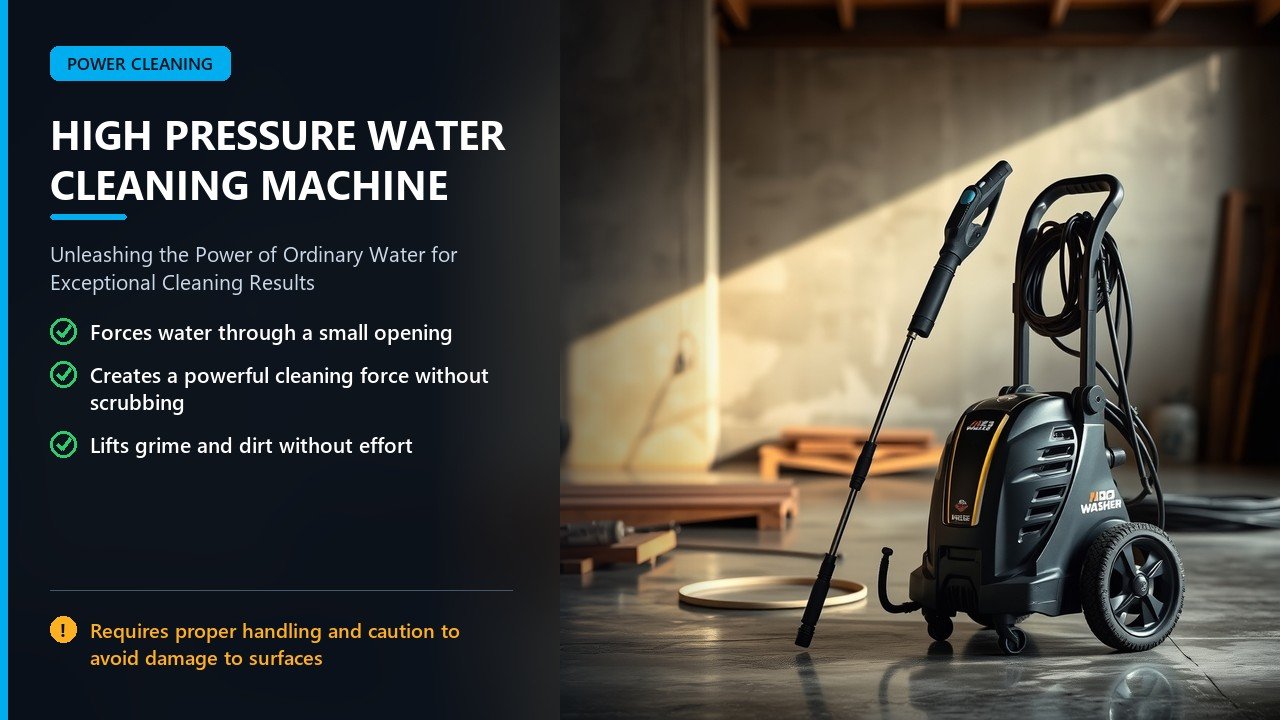
The same water, a different force. The water molecule does not change. What changes is velocity and concentration. When you force a gallon of water through a tiny nozzle, that water speeds up dramatically and focuses all its energy on a small area. The result is a stream that can strip paint, cut through caked mud, or slice a tomato, all depending on how much pressure and how small the opening.
The Bernoulli idea in plain terms. Push a fluid through a narrower opening and its speed increases while its pressure drops in the wider section. This is why a nozzle concentrates energy: you are trading a large, slow volume for a small, fast jet. The energy was always there in the flowing water; the nozzle simply aims it. Our explanation of how pressure washer tech turns water into cleaning power walks through the pump, nozzle, and flow together.
Where the Pressure Comes From
A pressure washer is two machines working together: an engine or motor that spins a shaft and a pump that converts that spin into pressurized water. Understanding the parts demystifies the whole thing.
The pump is the source. A pump pulls in water at low pressure and forces it out at high pressure through a small volume. Consumer machines use compact axial cam pumps; prosumer and commercial machines use triplex plunger pumps that last much longer under continuous duty and can be rebuilt. The pump sets the maximum pressure the machine can produce.
Flow and pressure trade off. A pump moves a certain number of gallons per minute, or GPM. As you squeeze that flow through a smaller nozzle, pressure rises. Choose a larger nozzle and you get more flow but less pressure. This relationship is why nozzle size controls cleaning feel so much, and why flow matters as much as pressure for speed. Our deep dive into GPM and why it matters as much as PSI explains the balance.
The nozzle is the last word. All the pressure in the world is useless if the nozzle is wrong. A worn or oversized nozzle wastes flow and drops pressure; a tiny nozzle concentrates force but widens the spray very little. Matching the nozzle to the pump and the job is the single most underrated skill in pressure washing.
| Source of Water | Typical Pressure | What It Can Do |
|---|---|---|
| Garden hose at the tap | 40 to 80 PSI | Rinse, water plants, wash mud |
| Electric pressure washer | 1,300 to 3,400 PSI | Cars, siding, patios, light concrete |
| Gas pressure washer | 2,500 to 4,500 PSI | Driveways, decks, paint prep, commercial |
| Industrial / hot water unit | 4,000 PSI and up | Heavy grease, fleet, municipal work |
| Waterjet cutter | Upward of 30,000 PSI | Cutting steel, stone, and glass |
Pressure Versus Flow: The Pair That Decides Everything
Beginners fixate on pressure, but cleaning performance is really a product of pressure and flow. This is the concept that separates people who understand pressure washing from people who just own a machine.
Pressure penetrates. PSI determines how hard the water hits and how well it gets into textured concrete, grout lines, and grainy wood. Higher pressure strips paint, blasts oil stains, and removes caked mud. It also does damage faster when aimed at the wrong surface, which is why the highest number is not automatically the best choice.
Flow carries dirt away. GPM determines how quickly you cover ground. Two machines at the same PSI clean at very different speeds if one moves twice the water. For large flatwork, flow matters so much that professionals chase it deliberately, which is why a 5.5 GPM machine cleans faster than higher PSI when the job is a big driveway.
The sweet spots. For routine home cleaning, roughly 2,500 to 3,200 PSI at 2.3 to 2.5 GPM handles decks, siding, fences, and vehicles. For paint prep and heavy concrete, step up to about 3,400 PSI and beyond with more flow. Anything above roughly 4,000 PSI is commercial territory and demands both experience and the right attachments.
Why High Pressure Water Cleans So Well
High pressure water works through three mechanisms, and knowing them helps you clean smarter.
Kinetic energy. Moving water carries energy proportional to its mass and speed. Concentrating it through a nozzle delivers a focused punch that dislodges dirt rather than dissolving it. This is why plain water often beats soap for flatwork; the force does the work.
The wedge effect. Water finds tiny cracks and gaps in grime and lifts from the seam outward. That is why a pass with the correct tip peels a whole patch of buildup instead of wearing it down slowly.
Rinsing volume. Flow flushes loosened dirt away before it settles again. Without enough flow, you loosen grime and leave it sitting, which is the classic mistake of a high-PSI, low-GPM machine on a big surface. The right combination penetrates, lifts, and carries away in one motion.
High Pressure Water in the Real World
Pressure washing is the most familiar use, but high pressure water shows up in far more places than most people realize.
Home and property cleaning. Driveways, sidewalks, siding, decks, fences, roofs, gutters, and vehicles are the everyday jobs. This is where most people meet high pressure water, and where matching pressure to the surface prevents damage. Our guide to safer, faster pressure washer habits covers the technique that keeps concrete clean and paint intact.
Commercial and industrial cleaning. Fleet washing, parking lots, restaurant grease pads, factory floors, and construction cleanups rely on high pressure, often with hot water, because heat plus pressure dissolves grease that cold water cannot touch. That is why an industrial hot water washer is standard equipment in food and fleet operations.
Municipal and utility work. Cities use high pressure water to clean sewers, strip road markings, and remove graffiti. It is a tool of public works as much as of the weekend detailer.
Beyond cleaning entirely. Hydrodemolition uses ultra-high pressure water to remove concrete from bridges and structures without damaging rebar. Waterjet cutting shapes metal, stone, and food products. Mining uses high pressure jets to break rock. The cleaning wand in your garage shares its physics with tools that build and dismantle infrastructure.
The Safety Truth About High Pressure Water
This is the part that matters most, because high pressure water is genuinely dangerous when it is not respected. It does not look dangerous, which is exactly why injuries happen.
Injection injuries. A high pressure stream can pierce skin and force fluid, bacteria, and debris into tissue. The wound can look tiny while the damage underneath is severe, and it can require surgery. The National Institute for Occupational Safety and Health documents these injuries because they are far more common than people assume. The rule is absolute: never point the wand at a person or animal, and never use your hand to check whether the spray is on.
Falls and recoil. The recoil of a powerful machine can knock you off balance, especially on a ladder or a wet roof. The Occupational Safety and Health Administration treats fall prevention as a core priority, and pressure washing is a common trigger. Work from the ground wherever possible and brace your stance.
Electrical hazard. Water and electricity are lethal together. Never spray toward outlets, meter boxes, light fixtures, or overhead lines, and keep a clear margin around anything electrical. Keep the machine and cords away from standing water.
Eyes and skin. Rebound spray carries grit and debris. Safety glasses and gloves are the minimum, and closed shoes protect feet from the stream and from slips. Our dedicated piece on high pressure water jet injuries you cannot see goes deeper into prevention.
Choosing an Approach That Matches the Surface
High pressure water is powerful; matching it to the surface is what makes it safe and effective. The same nozzle that rescues a driveway will destroy a wooden deck or strip a car’s paint, so the surface always sets the limit.
Hard, rough surfaces like concrete and brick tolerate high pressure and reward a tight tip or a surface cleaner. This is where the numbers shine. Medium surfaces like siding, fences, and decks want moderate pressure and a wide tip, angled down to push water with the grain rather than into it. Delicate surfaces like car paint, soft wood, and screens want low pressure, a wide fan, distance, and often a different tool entirely. Our guide to matching angle tips to surfaces is the practical companion to this idea.
The hose carries the load. High pressure water demands a hose built for it. A standard garden hose will burst under pressure washer loads, which is why the working line is a rated high-pressure hose. Understanding how to choose a high pressure water hose prevents both leaks and accidents, and knowing the ratings a 4000 PSI hose handles helps you buy the right one the first time.
How High Pressure Water Compares to Other Cleaning Forces
High pressure water is not the only way to clean a hard surface, and knowing where it fits keeps you from overspending or under-cleaning. Each method uses a different mechanism, and each has jobs it owns.
High pressure water versus steam. Steam uses heat and low moisture to sanitize and loosen grime, often indoors and on delicate surfaces. It excels at grease, upholstery, and areas where water volume is a problem. High pressure water uses force and volume, which is faster on large outdoor surfaces. Many professional setups combine both, using heat to break grease and pressure to flush it away.
High pressure water versus abrasives. Sandblasting and media blasting remove coatings by abrasion, which is more aggressive and creates dust and cleanup. Wet abrasive systems tame the dust, but they still abrade the surface. High pressure water cleans without abrasion, which is why it is safer on substrates you do not want to etch, though it is less effective on hard coatings that need to be physically removed.
High pressure water versus chemicals alone. Chemical cleaning relies on dwell time and reaction, which works well for organic growth such as mold and algae. Pressure alone cannot always kill what causes a stain, so the best soft-wash and cleaning routines pair a detergent with pressure for the rinse. The chemistry of adding soap to a pressure washer is about letting the cleaner do its job before the water does its own.
| Method | How It Cleans | Best For | Main Limitation |
|---|---|---|---|
| High pressure water | Force and flow | Concrete, siding, fleet, flatwork | Can damage delicate surfaces |
| Hot water pressure | Heat plus force | Grease, kitchens, industrial | Fuel or power cost, size |
| Steam | Heat, low moisture | Indoor, upholstery, sanitation | Slow on large areas |
| Abrasive blasting | Abrasion | Stripping hard coatings | Dust, surface erosion |
| Chemical / soft wash | Reaction and dwell | Mold, algae, roofs | Needs rinse and safety care |
Getting the Most From High Pressure Water
Once you understand the force, the payoff is in technique. These habits separate a fast, clean job from a slow, streaky one.
Pick the widest tip that still cleans. The temptation is to reach for the most aggressive nozzle, but a tighter tip is harder to control and easier to damage with. Start wide, and only tighten if the surface demands it. At height, wide is also safer and easier to steer.
Keep the tip moving. Holding a stream in one place concentrates energy and etches the surface. Overlapping passes, always in motion, clean evenly and protect the substrate. This single habit prevents most zebra striping on concrete.
Work with the flow, not against it. Push dirt toward a drain or off the edge rather than into a corner where it redeposits. On vertical surfaces, work top to bottom so dirty water runs over already-rinsed areas instead of re-soiling them.
Match pressure to the age of the surface. Old, weathered wood, oxidized paint, and loose mortar all tolerate less than new, sound surfaces. When in doubt, drop pressure and test on a hidden spot before committing.
Keep the water supply strong. A pump starved of water cavitates, which sounds like marbles rattling and destroys seals. Use a short, large-diameter supply hose and keep it straight. Never let the machine run without water, and never let the supply line kink.
Maintain the machine like the force depends on it, because it does. Worn nozzles, tired o-rings, and kinked hoses all steal pressure before it ever reaches the surface. Regular checks keep the high pressure water working where it counts. Our guide to preventative maintenance for pressure washing machines covers the schedule that protects both power and hardware.
Common Misunderstandings About High Pressure Water
More pressure is always better. No. Extra pressure beyond what a surface can take causes etching, stripping, and damage. The goal is the least pressure that does the job, paired with the most flow you can control.
Soap does the cleaning. On flatwork, plain high pressure water often does most of the work. Soap helps with grease and organic films, but force and flow lead. Understanding when to add a soap injector is about chemistry, not about replacing pressure.
A garden hose can substitute in a pinch. It cannot. The pressure and the hose construction are both inadequate, and attempting it risks burst hose and injury. Use rated equipment.
Hot water is just warmer. Heat chemically helps break down grease and oils, which is why hot water machines clean certain jobs dramatically better. It is a genuine capability, not a comfort feature, as our look at hot water versus cold cleaning explains.
Frequently Asked Questions About High Pressure Water
What PSI is considered high pressure water? There is no strict cutoff, but for cleaning, anything from about 1,300 PSI upward is commonly called high pressure. Household taps run 40 to 80 PSI; pressure washers run thousands; industrial waterjet cutters run tens of thousands.
Is high pressure water just water? Yes. The water is ordinary. What changes is the force and focus applied to it, which is what gives it cleaning and cutting power.
Can high pressure water damage concrete? It can if the tip is too tight or held too close, leaving etched streaks called zebra striping. A surface cleaner and the correct tip prevent this while cleaning evenly.
Is high pressure water dangerous? Yes, when misused. The main risks are injection injuries, cuts, falls from recoil, and electrical contact. Proper technique, protective gear, and working from the ground keep it safe.
What is the difference between pressure washing and power washing? Power washing adds heat. Both use high pressure water, but power washing uses hot water to tackle grease and organic buildup more effectively.
How much pressure do I need for a driveway? Most sources suggest roughly 2,500 to 3,500 PSI for concrete and asphalt, ideally with a surface cleaner. Flow and even coverage matter as much as raw pressure.
A Short History of High Pressure Water
High pressure water feels modern, but the idea of using a fast, focused stream to do work is older than the pressure washer itself.
From mining to the driveway. The technique grew out of hydraulic mining in the 1800s, when miners used powerful water jets to wash away soil and expose ore. The same principle spread into industrial cleaning in the twentieth century as pumps grew stronger and more portable. What began as a way to move earth became a way to strip, clean, and cut.
Into the home. As compact pumps and reliable small engines became affordable, the pressure washer moved from job sites into garages. Today, a homeowner can buy a machine that produces more pressure than early industrial equipment, and the technology keeps improving. Efficiency, noise reduction, and better sealing have all advanced, even as the core physics stayed the same.
The frontier today. At the high end, engineers push pressure into the tens of thousands of PSI for cutting and hydrodemolition, while at the low end, battery machines bring modest pressure to places a cord cannot reach. The range is extraordinary, and every point on it uses the same basic truth: force water through a small opening and it becomes something far more capable than water at rest.
Final Thoughts on High Pressure Water
High pressure water is one of the most useful forces in everyday life, and one of the least understood. It restores driveways, rescues siding, powers fleets and food plants, cleans city sewers, and at its extreme, cuts steel. At its heart, though, it is nothing more than ordinary water aimed with intention, and that is the insight worth keeping.
Once you understand that pressure penetrates, flow carries, and the nozzle decides the rest, every cleaning decision gets clearer. You stop chasing the biggest number and start matching the tool to the surface. You stop blaming the machine when the real issue is a worn tip or a long hose. And you stop underestimating the danger of a stream that looks harmless and is not.
Choose pressure to match the job, add flow for speed, respect the surface, and treat the wand like the serious tool it is. Do that, and high pressure water stays what it should be: a powerful, controllable ally that makes hard work look easy, one clean pass at a time.