A customer once asked Dave why his brand-new pressure washer could not remove a patch of oil from his driveway. The machine had plenty of power. The problem was the tip screwed onto the end of the wand: a wide 40-degree fan meant for rinsing, not for cutting grime. The moment he switched to a concentrated jet nozzle, the stain lifted in seconds. That small tapered piece of metal controls more of your cleaning power than the engine or motor behind it. Understanding the jet nozzle for pressure washer tools means understanding the difference between blasting a surface and actually cleaning it.
A jet nozzle for pressure washer is the tip that shapes the water stream as it leaves the gun. The nozzle converts the pump’s pressure and flow into a spray pattern, and it quietly decides how much force reaches the surface, how wide the cleaning path is, and how much water you use. This guide explains nozzle types, spray angles, sizing, materials, drain-jetting nozzles, and how to choose the right jet for every job.
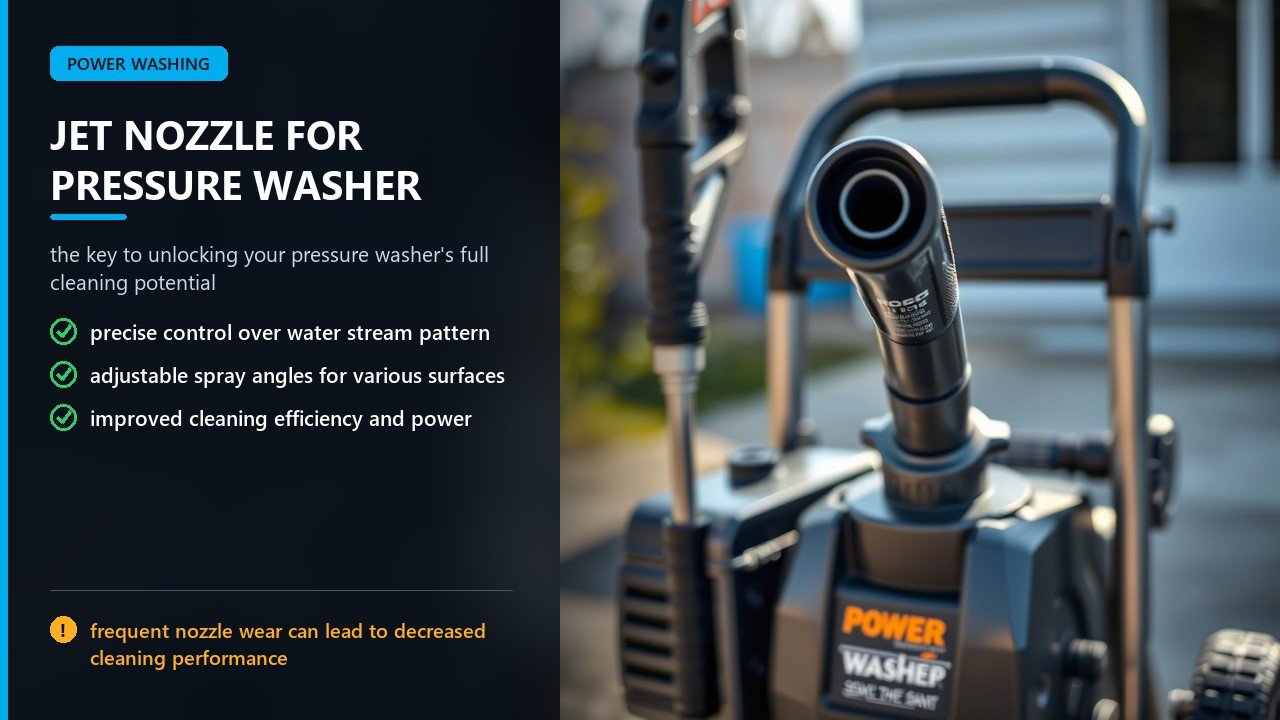
What a Jet Nozzle Actually Does
Water leaves the pump at high pressure but low velocity. The nozzle converts that pressure into speed by forcing the water through a small, precisely shaped orifice. The smaller the orifice and the tighter the fan angle, the faster and more concentrated the stream. That is why a 0° jet can etch concrete while a 40° spray gently rinses a car.
The nozzle also controls flow. A worn or oversized orifice lets more water through, dropping pressure and cleaning power. A clogged or undersized one restricts flow and can strain the pump. In other words, the nozzle is not a passive accessory; it is a tuning device that balances pressure, flow, and pattern.
The Nozzle Color Code
Most consumer pressure washers use a color-coded nozzle set. The colors indicate the spray angle, and each angle suits different surfaces.
Red (0°). A pencil-thin jet for stripping and stubborn spots. Use with extreme care; it can cut wood and etch concrete.
Yellow (15°). A focused fan for heavy grime on hard surfaces like concrete and brick.
Green (25°). The all-around workhorse for driveways, patios, and decks.
White (40°). A wide, gentle fan for siding, windows, and vehicles.
Black (soap). A low-pressure tip that applies detergent without blasting it away.
Quick Note: The color code is a convention, not a law. Always check the angle stamped or printed on the nozzle, and remember that low-pressure soap tips look different from high-pressure tips in most kits. See our nozzle guide for a full breakdown.
Types of Jet Nozzles
Beyond the standard fan tips, several specialized jet nozzles serve specific jobs.
Fixed Fan Nozzles
The classic angled tips — the ones in the color set. They deliver a fixed pattern and are the default for general cleaning.
Adjustable (Variable) Nozzles
A single nozzle that twists to change the spray from a tight jet to a wide fan. Convenient for mixed jobs, but the seals can wear and the pattern is less precise than a dedicated tip.
Turbo / Rotating Nozzles
A water-driven head that spins a 0° jet in a circular pattern, combining the cutting power of a pinpoint stream with the coverage of a fan. Excellent for concrete and masonry. Our article on rotary pressure washer tools explains how they work.
Sewer / Drain Jetting Nozzles
These are a different breed. A sewer jet nozzle uses rear-facing orifices to propel the hose down a drain while forward and side jets scour the pipe walls. They are the heart of drain cleaning and require a hose and machine rated for the task.
| Jet Type | Pattern | Best Use | Caution |
|---|---|---|---|
| 0° red | Pinpoint | Stripping, tough spots | Etches most surfaces |
| 15° yellow | Narrow fan | Concrete, brick, heavy grime | Keep off paint and wood |
| 25° green | Medium fan | General cleaning | Test delicate surfaces |
| 40° white | Wide fan | Siding, cars, rinsing | Low pressure only |
How to Choose the Right Jet Nozzle
Match the angle to the surface. Hard, durable surfaces tolerate narrower jets; soft or painted surfaces need wider ones.
Match the orifice to your machine. Nozzle size is expressed by orifice number or by GPM at a given pressure. Fitting the wrong size steals pressure or floods the pattern. Use a nozzle size chart and pick the orifice that matches your machine’s flow and target pressure.
Match the fitting. Most tips use a 1/4-inch quick-connect, but some use threaded M22 or other connections. Confirm the fit before buying, and review our fitting guide if you are unsure.
Choose quality materials. Hardened stainless steel resists wear far better than brass and holds its pattern longer. A worn nozzle loses its shape and its cleaning power.
Why Nozzle Wear Matters More Than You Think
Over time, the abrasive force of water wears the orifice larger and rounds off the sharp edges that shape the spray. The result is a softer, wider, weaker stream even though your machine has not changed. Many people blame the pump when the real culprit is a worn nozzle. Replacing a tip is cheap; rebuilding a pump is not.
Inspect your nozzles each season. If the spray pattern looks ragged, if you have to hold the wand closer to get results, or if a nozzle that once cut well now seems weak, it is likely worn. Keep spare tips on hand, especially the workhorse angles you use most.
Using a Jet Nozzle Safely
The force that cleans can also injure. Never point a pressure washer jet at a person, pet, or yourself. At close range, even a 40° tip can break skin and cause a serious injection injury. Wear safety glasses to protect against flying debris, and never use a 0° jet on a surface you are not prepared to damage. Keep both feet on stable ground, and manage the reaction force — narrow jets produce noticeable kickback.
For workplaces, the U.S. Occupational Safety and Health Administration provides guidance on pressure washer safety that covers guarding, training, and safe operating practices.
Nozzle Compatibility and Fitting Types
Most pressure washer nozzles attach with a 1/4-inch quick-connect plug, which lets you swap tips in a second. Some machines use threaded nozzles, and a few use proprietary mounts. If your nozzles are threaded, note the thread type and size and use the correct adapter rather than forcing a fit. As with all pressure fittings, matching the standard prevents leaks and stripped threads. Our guide to threaded pressure washer nozzles covers the details.
Nozzle Orifice Sizing Explained
Every nozzle has an orifice, and its size is matched to a specific combination of pressure and flow. The chart below gives a rough guide: as pressure rises at a fixed flow, the required orifice shrinks, and as flow rises at a fixed pressure, it grows. Using the wrong size is the most overlooked cause of disappointing performance.
| Machine Flow | Orifice Size (typical) | Result If Too Small | Result If Too Large |
|---|---|---|---|
| 2.0–2.5 GPM | 3.0–3.5 | Higher pressure, pump strain | Low pressure, weak jet |
| 3.0–4.0 GPM | 3.5–4.5 | Overpressure, short pump life | Flow starved, poor cleaning |
| 5.0–8.0 GPM | 5.0–8.0 | Erratic pressure, heat buildup | Wasted flow, low impact |
If you are unsure which size fits your machine, start with the tip that came with the washer and note its marking, then buy spares of the same size in the angles you use most. Correct sizing keeps the pump in its comfortable range and delivers the cleaning power the machine was designed to produce.
Matching the Jet to the Job
Different surfaces call for different jets, and choosing well protects both the surface and your time.
| Surface | Best Tip | Why |
|---|---|---|
| Concrete / pavers | 15° or turbo | Cuts embedded grime fast |
| Vinyl / stucco siding | 25°–40° | Wide spray avoids driving water in |
| Wood decks / fences | 25°–40° | Prevents grain raising and splinters |
| Vehicles | 40° + soap | Cleans without harming paint |
| Drains / pipes | Sewer jet nozzle | Scours walls and propels hose |
Common Mistakes to Avoid
Using a 0° jet for everything. It is the fastest way to etch concrete, gouge wood, and strip paint.
Spraying against the grain of siding. Water driven behind vinyl or into seams causes rot and mold. Spray downward and at an angle.
Ignoring orifice size. A wrong-size nozzle drops pressure or overloads the pump.
Never replacing worn tips. A few dollars of new nozzles restores lost cleaning power instantly.
Using the soap tip for rinsing. Soap tips are deliberately low pressure; rinse with a fan tip.
Fixed, Adjustable, or Turbo: Which Should You Use?
Each style has a personality. Fixed fan tips are the most precise and durable; they deliver exactly the pattern printed on them and hold that pattern until they wear out. If you want predictable results and the longest service life, a full set of fixed tips is the way to go.
Adjustable nozzles trade precision for convenience. One tip replaces a set, which is handy when you are moving between tasks, but the internal seal can wear and change the pattern over time. Keep one as a backup rather than a primary tool.
Turbo nozzles are the specialists. By spinning a 0° jet, they combine aggressive cutting with a wider cleaning swath, which makes short work of concrete, stone, and heavily soiled flatwork. They are less suited to delicate surfaces and can leave swirl marks if held too long in one spot, so keep the head moving and back off on softer materials. For many owners, the ideal kit is a few fixed fans for everyday work plus one turbo for tough concrete.
Maintenance and Storage
Rinse nozzles after every use to clear detergent and grit, then dry them before storing. A clogged orifice can be cleared with a fine pin, but never enlarge it — that permanently changes the flow. Store nozzles in a holder or pouch so they do not rattle together and nick their edges. Keep a small labeled set so you can grab the correct angle without guesswork, and replace tips at the first sign of a ragged pattern.
Frequently Asked Questions
What is the difference between a nozzle and a jet? A nozzle is the physical fitting; the jet is the stream it produces. People often use the terms interchangeably.
Can I use a pressure washer jet to clean a drain? Only with a proper sewer jetting nozzle, hose, and machine designed for it. Standard fan tips are not meant for drain lines.
Which nozzle is best for concrete? A 25° green tip covers most concrete cleaning, while a 15° or a turbo nozzle handles stubborn stains.
How do I know my nozzle is worn? A weak, ragged, or uneven spray pattern is the giveaway. Compare it to a new tip of the same color.
Final Thoughts
A jet nozzle for pressure washer work is where pressure becomes cleaning power. Choosing the right angle protects your surfaces and saves time, while matching the orifice to your machine keeps pressure and flow where they belong. Treat nozzles as consumables, replace them when patterns degrade, and always respect their force.
Build a small, organized set of tips, learn what each one does, and you will get more from the machine you already own. For the complete picture, read our nozzle color code guide and pair your tips with leak-free fittings for a setup that always performs.