When the call came in for three restaurants, a fleet yard, and a property manager who needed recurring work, Ben knew his pickup bed and portable washer were not going to cut it. He needed a real system. The decision to buy a pressure wash trailer for sale was not casual; it was the difference between losing the contract and building a business. Within six months, the trailer had paid for itself and started funding its own upgrades. That is the story of buying right.
Whether you are launching a pressure washing business or scaling one that has outgrown portable equipment, a pressure wash trailer changes what you can bid on, how fast you can clean, and how much work you can do per day. This guide breaks down the real options: single-axle vs tandem, cold water vs hot water, how to size GPM, PSI, and tank capacity, what to check before signing, cost ranges, legal requirements, and how to maintain the rig once you own it. By the end, you will know exactly what to look for when you search pressure wash trailers for sale.
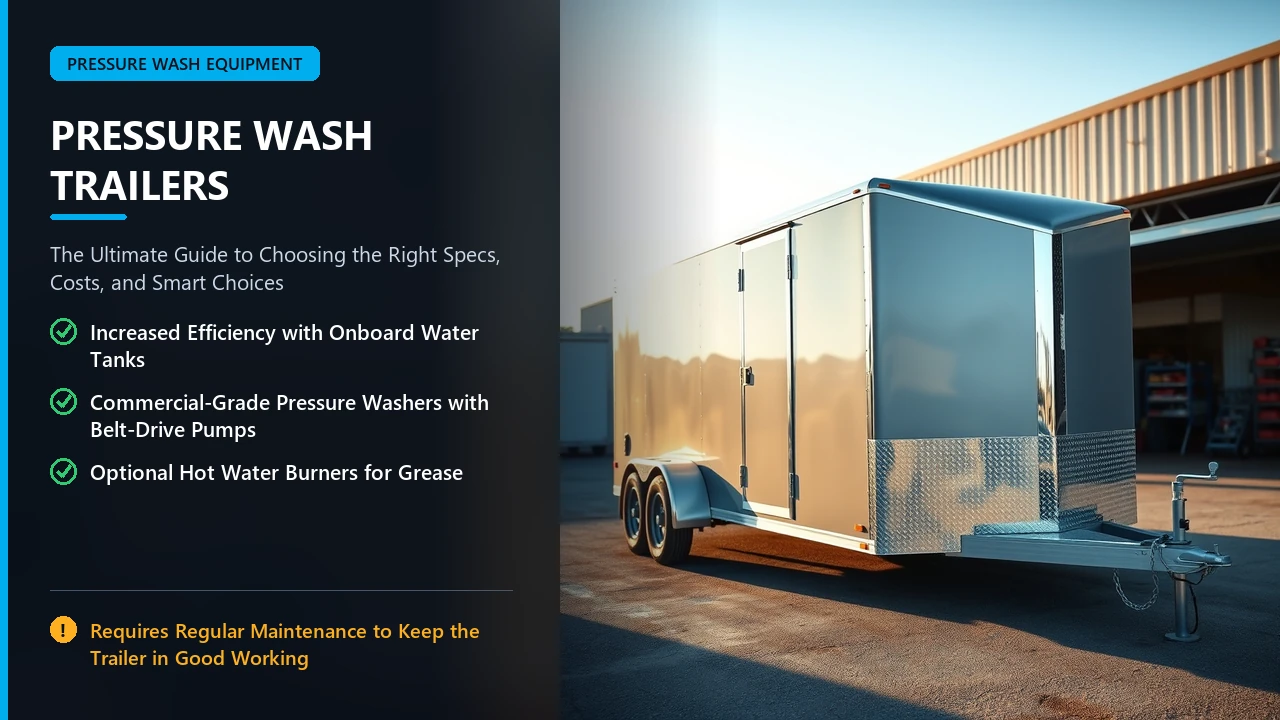
Why a Pressure Wash Trailer Changes Your Business
A pressure wash trailer is a mobile cleaning station. Instead of depending on a customer’s water supply or hauling gear in and out of a truck bed every day, everything mounts on a towable chassis:
- Onboard water tank so you can work anywhere, even where no spigot exists.
- Commercial-grade pressure washer skid with belt-drive pump and quality engine.
- Hose reels and nozzles for fast setup and teardown.
- Optional hot water burner so you can clean grease and oil that cold water only smears.
- Fuel tanks and storage for tools, chemicals, and accessories.
The result: one person can load, tow, and set up in minutes, then clean larger areas in less time. For an overview of how trailer packages turn into profit, see our trailer packages that pay for themselves guide.
Single-Axle vs Tandem-Axle Trailers
The axle choice is not just a spec; it is a safety and performance decision that determines how much water you can carry and how the trailer handles on the highway.
| Feature | Single-Axle Trailer | Tandem (Dual) Axle Trailer |
|---|---|---|
| Typical capacity | Up to ~3,500 lbs (with brakes) | 4,400-7,000 lbs and up |
| Water tank size | 100-200 gallons typical | 200-550+ gallons typical |
| Braking | Surge or electric brakes often optional | Standard on most models; electric or hydraulic |
| Maneuverability | Tighter turning, easier to park | Longer, but more stable at highway speed |
| Stability | Can sway if overloaded or poorly balanced | Distributed weight = smoother towing |
| Cost | Lower upfront | Higher, but scales with workload |
| Best for | Entry-level, single-operator, light-to-medium work | Commercial routes, dual-gun, larger tanks |
The general rule: if your loaded weight (trailer + water + equipment) approaches or exceeds 3,500 lbs, you need tandem axles. A 200-gallon tank alone weighs about 1,668 lbs when full. Add the skid, hose, tools, and frame, and you are at or over a single-axle limit. For detailed chassis specs, see our power washer trailer guide.
Cold Water vs Hot Water Trailers
This is the single biggest decision when shopping pressure wash trailers for sale. Cold water handles about 70% of commercial pressure washing work: driveways, siding, decks, gutters, and general exterior cleaning. Hot water is essential for grease, oil, diesel spills, industrial equipment, and food-service cleaning.
| Feature | Cold Water Trailer | Hot Water Trailer |
|---|---|---|
| Burner | None | Diesel or oil-fired burner with heating coil |
| Max temp | Ambient water temperature | Up to 195-200°F (hot water) or 250°F+ (steam option) |
| Cleaning power | Excellent for dirt, mildew, grime | 3-5x faster on grease, oil, and heavy soils |
| Fuel tanks | Engine fuel only | Engine fuel + burner fuel (diesel/kerosene) |
| Winterization | Drain and protect pump | Drain pump AND coil; coil freeze damage is expensive |
| Cost | Lower | Higher, but justifies premium pricing |
| Best for | House washing, flatwork, light commercial | Restaurant routes, fleet washing, industrial, grease-heavy work |
If you plan to bid on restaurants, fleet yards, or industrial sites, a hot water trailer is not optional; it is a requirement. Heat breaks the bond between oil and surface, so cleaning happens faster with less detergent. For the full breakdown, see our hot water trailer build and buyer guide.
Sizing GPM, PSI, and Tank Capacity
These three numbers determine how fast you clean and how long you can work without stopping.
PSI (Pounds per Square Inch)
PSI is pressure. Higher PSI blasts off tougher material. For commercial work:
- 3,000-3,500 PSI: Most common commercial range. Handles flatwork, siding, equipment.
- 3,500-4,000 PSI: Heavy-duty flatwork, industrial, equipment cleaning.
- 4,000+ PSI: Specialized industrial or surface prep work.
GPM (Gallons Per Minute)
GPM is flow. Higher GPM rinses faster and covers more area per pass. For commercial work:
- 4.0-5.0 GPM: Entry-level commercial. Single operator, lighter jobs.
- 5.0-6.5 GPM: Strong single-operator commercial. Handles most routes.
- 8.0+ GPM: Dual-gun capable or high-volume single gun. Faster on large areas.
Water Tank Capacity
Size the tank to your job trigger time. A 4 GPM machine uses 4 gallons per minute the trigger is held. Effective use is usually 50-80% of that, since you trigger off between passes.
| Machine Flow | Tank Size | Approximate Trigger Time |
|---|---|---|
| 4.0 GPM | 150-200 gallons | ~35-65 minutes (with efficiency factor) |
| 5.5 GPM | 200-300 gallons | ~30-55 minutes |
| 8.0 GPM | 300-550 gallons | ~30-55 minutes |
Most commercial trailers use 200-330 gallon tanks as standard, with 400-550 gallon options on dual-axle rigs. Add a fill hose so you can refill from a customer spigot between jobs. For deeper sizing math, see our mobile trailer setup guide.
Key Components to Check Before You Buy
Pressure wash trailers for sale range from budget builds to premium commercial rigs. Here is what separates a good trailer from a money pit.
| Component | What to Look For | Red Flags |
|---|---|---|
| Trailer frame | Powder-coated steel, welded construction, DOT-compliant lighting | Paint-only finish, lightweight angle iron, missing reflectors |
| Axle & brakes | Rated for fully loaded weight; electric or surge brakes on tandem | Under-rated axle, no brakes on heavy load, bald tires |
| Engine | Honda, Vanguard, Kubota, Kohler; electric start | Unknown brand, no electric start, hard to find parts |
| Pump | Belt-drive triplex (General Pump, AR, CAT); forged brass manifold | Direct-drive axial cam (short life), plastic components |
| Heating coil (hot water) | Schedule 80 pipe, stainless wrap, multi-year coil warranty | No warranty, thin-walled tubing, unbranded burner |
| Burner | Beckett or similar; fuel-water separator; proper airflow | No separator, poor exhaust routing, no high-limit switch |
| Water tank | Baffled polyethylene, drain valve, UV-resistant | No baffles (sloshing), no drain, fiberglass |
| Hose reels | Steel construction, rated for PSI, swivel quality | Plastic reels, no swivel rating, small capacity |
| Wiring | Marine-grade or sealed, protected from heat and abrasion | Exposed household wire, no loom, loose connections |
| Plumbing | Stainless fittings, bypass valve, 3-way ball valve | Plastic quick-connects in high-pressure lines |
Pressure Wash Trailers for Sale: Cost Ranges
Prices vary widely by engine, GPM/PSI, hot water capability, tank size, and accessories. These are realistic 2026 U.S. market ranges for commercial-grade rigs.
- Basic cold water single-axle (entry commercial): $9,000 – $14,000
- Cold water tandem-axle (larger tank): $13,000 – $18,000
- Hot water single-axle (commercial): $13,000 – $19,000
- Hot water tandem-axle (high volume): $18,000 – $28,000+
- Custom / dual-gun / recovery systems: $25,000 – $45,000+
Beyond the sticker price, budget for:
- Towing vehicle. A fully loaded dual-axle rig often needs a 3/4-ton or 1-ton truck with a brake controller.
- Insurance. Commercial auto and liability coverage for towing and on-site work.
- Accessories. Surface cleaner, extra hose, chemical tanks, and soft wash systems are often add-ons.
- Registration and title. Varies by state; factor in sales tax if applicable.
- Maintenance fund. Engine oil, pump oil, burner fuel, filters, and winterization supplies.
Custom vs Turnkey: Which to Choose
| Path | Best For | Pros | Cons |
|---|---|---|---|
| Turnkey package | First-time buyers, operators who want ready-to-work rigs | Matched components, single warranty, DOT-compliant, fast to deploy | Higher upfront cost, limited customization |
| Custom build | Experienced operators with specific layout needs | Exact tank size, reel placement, dual-gun, soft wash integration | Longer lead time, requires careful component matching |
| Used / refurbished | Budget-conscious buyers willing to inspect carefully | Lower cost, proven equipment | Unknown history, may need pump/burner/tire work |
If this is your first trailer, a turnkey package from a reputable builder removes the most expensive mistakes. If you already know your exact workflow, custom builds let you spec the rig precisely. For a build-vs-buy deep dive, see our hot water trailer guide.
What to Check Before You Buy (Buyer’s Checklist)
- GVWR vs fully loaded weight. Verify the trailer’s rating exceeds trailer + water + skid + accessories + fuel. Get this in writing.
- Brake requirement. Know your state’s brake laws. Electric brakes with a controller are standard on quality tandem rigs.
- Tires and wheels. Check load rating, tread depth, and age. Tires dry-rot before they look worn.
- Engine and pump warranties. Get terms in writing. Reputable brands offer 3-7 year warranties on pumps and coils.
- Hose reel capacity. Confirm the reel holds the hose length advertised (100-200 ft typical).
- Tank baffles and drain. Ask for a full-tank tow test if possible. Sloshing water is a safety hazard.
- Hot water components. Burner, coil warranty, fuel-water separator, and high-limit switch should all be present.
- Weight distribution. Tank should be slightly forward of the axle, skid centered, fuel secure.
- Electrical. Look for protected wiring, proper grounding, and functioning lights.
- Service network. Know where you will get parts and service locally. A great rig with no nearby support is a problem.
Legal and Safety Requirements for Towing
- GVWR and tow vehicle rating. Your truck’s tow capacity must exceed the fully loaded trailer weight. Check the door jamb sticker and your truck’s manual.
- Brake controller. Required on most tandem-axle trailers. Install a quality proportional controller for smooth braking.
- DOT compliance. Functional lights, reflectors, safety chains, and tires rated for the load.
- Hitch type. 2-inch ball is standard; verify coupler rating matches trailer weight. Some heavy rigs use lunette ring with pintle hitch.
- Wastewater discharge. Many jurisdictions restrict discharge into storm drains. Some contracts require water recovery. Learn the rules before bidding work near sensitive areas. See the EPA NPDES program for federal baseline rules.
- Insurance. Commercial auto coverage must include the trailer. Liability coverage protects you on customer property.
- Carbon monoxide. Never run gas engines or diesel burners in enclosed spaces. Position exhaust away from the operator. See CDC/NIOSH CO guidance.
Maintenance to Keep Your Trailer Earning
- Pre-trip: Tire pressure, lights, hitch, safety chains, brakes, and load security.
- Daily: Inspect hoses, fittings, gun, and nozzles for leaks or damage.
- Weekly: Check pump oil, engine oil, fuel-water separator, and belt tension.
- Monthly: Grease bearings, inspect tires for wear, check coil for soot or scale.
- Seasonally: Change engine and pump oils, replace filters, descale coil if needed.
- Winter: Drain tank, coil, and pump; use pump-safe antifreeze; store covered. See our winterization guide.
- Recordkeeping: Log hours and services. This protects resale value and warranty claims.
Common Mistakes When Buying Pressure Wash Trailers for Sale
- Undersizing the tank. A 100-gallon tank on a 5.5 GPM machine empties fast. Size for your real jobs.
- Buying cold water when you need hot. If you plan to clean grease, cold water will not cut it. Spec heat at build time; retrofitting is expensive.
- Ignoring tow rating. A trailer that exceeds your truck’s capacity is dangerous and illegal.
- Skipping brakes. Heavily loaded trailers without brakes are a safety hazard and often illegal.
- Cheap pumps and burners. Unknown brands save money upfront but fail early. Stick with General Pump, AR, CAT, Beckett, or similar.
- No service plan. If no one nearby can service your engine or pump, you lose days waiting for parts.
- Overbuilding beyond demand. A 550-gallon dual-axle rig is impressive, but if you only have three small jobs a week, you are financing idle capacity.
Popular Pressure Wash Trailer Configurations
| Configuration | Specs | Best For | Price Range |
|---|---|---|---|
| Entry commercial (cold) | 4.0-5.0 GPM, 3,500 PSI, 200 gal tank, single axle | Startups, residential + light commercial | $9,000 – $14,000 |
| Mid-range (hot) | 4.5-5.5 GPM, 3,500 PSI, 200-300 gal tank, single or tandem | Restaurant routes, mixed commercial | $14,000 – $20,000 |
| High-volume (hot) | 8.0 GPM, 3,000-4,000 PSI, 300-550 gal tank, tandem | Fleet, industrial, dual-gun capable | $20,000 – $30,000+ |
| Custom / recovery | Any GPM/PSI, 300-1,000 gal, water recovery, soft wash | Municipal, eco-sensitive, large contractors | $28,000 – $45,000+ |
Frequently Asked Questions
How much does a pressure wash trailer cost?
Most commercial trailers range from $13,000 to $28,000+, depending on GPM, PSI, hot water capability, tank size, and accessories. Entry cold-water rigs start under $10,000; fully loaded hot water dual-axle rigs can exceed $30,000.
What size water tank do I need?
Size it to your machine’s GPM and typical job trigger time. Most commercial rigs use 200-330 gallon tanks. High-flow (7-8 GPM) machines often need 400-550 gallons to avoid constant refilling.
Do I need a tandem axle?
If your fully loaded weight approaches or exceeds 3,500 lbs, yes. A 200-gallon tank alone weighs about 1,668 lbs full. Add the skid, hoses, and frame, and tandem axles are often necessary for safe towing.
Should I buy cold or hot water?
If you clean grease, oil, food residue, or industrial soil regularly, buy hot water. For house washing and light flatwork, cold water is sufficient. Many operators start cold and upgrade once grease-heavy contracts justify it.
What GPM do I need for commercial work?
4.0-5.0 GPM for entry commercial; 5.5-6.5 GPM for a strong single-operator rig; 8.0+ GPM for dual-gun or high-volume work. Higher GPM cleans faster but costs more and requires larger tanks.
Can I tow a pressure wash trailer with a half-ton truck?
Single-axle light rigs often can. Tandem-axle hot water trailers with full tanks usually require a 3/4-ton or 1-ton truck with a brake controller. Always verify against your specific fully loaded weight and tow rating.
Do I need water recovery?
It depends on local regulations and your customers’ requirements. Discharging into storm drains is restricted in many areas. Some contracts, especially municipal and food-service, require recovery. Check local ordinances before bidding.
Final Thought
Buying a pressure wash trailer for sale is a real business investment. The right rig gives you mobility, higher capacity, and the ability to bid on work that portable equipment cannot touch. The wrong rig costs you in downtime, repairs, and lost contracts.
Match the trailer to proven work. Never undersize the tank or axle. Buy hot water if grease is in your future. Choose a reputable builder with real warranties. And maintain the engine, pump, burner, and chassis like the investment they are. Do that, and your pressure wash trailer does exactly what Ben’s did: it stops being a purchase and starts being the engine of your business.