Pressure Washer PSI 3000: What the Rating Really Means
A pressure washer sold as a “3000 PSI” machine sounds straightforward. Three thousand pounds per square inch of cleaning force, right? Not quite. In the pressure washer world, that headline number is usually a maximum, a momentary peak the machine can touch under ideal conditions for a fraction of a second. The pressure you actually clean with — the working pressure at the nozzle — is often hundreds of pounds per square inch lower. Understanding that gap is the difference between buying the machine you think you are getting and the one that shows up at your door.
This article unpacks what a 3000 PSI rating really means. It explains the difference between max, rated, and working pressure, why manufacturers advertise the highest number, how cleaning units tell a truer story, and how to read a spec sheet so the 3000 PSI on the box matches the 3000 PSI you feel at the wand. If you have ever wondered why a “3000 PSI” washer feels weaker than expected, the answer is usually hiding in the fine print.
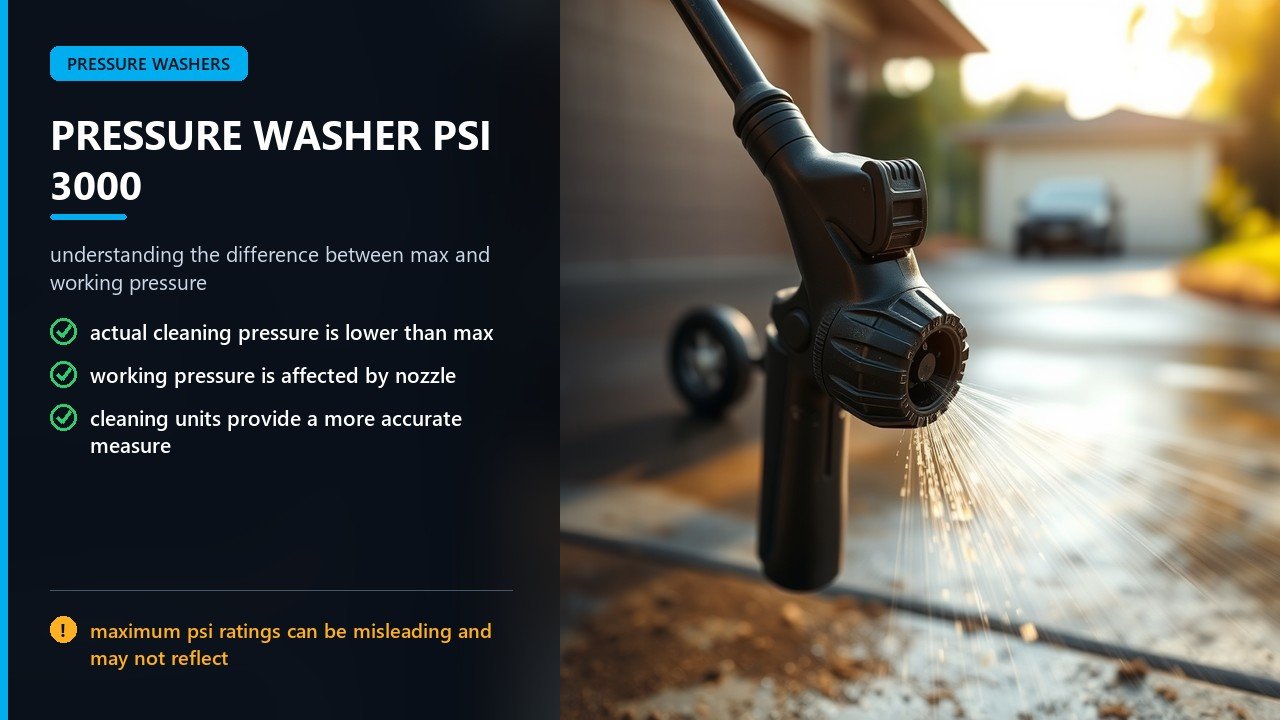
Quick answer: A 3000 PSI rating is almost always maximum pressure, not working pressure. A unit rated 3000 PSI max commonly delivers around 2,200 to 2,400 PSI at the nozzle during normal use, and its flow may be lower than the max GPM claim. When comparing machines, use the rated (working) numbers and multiply PSI by GPM to get cleaning units.
What the “3000 PSI” Label Claims
When a box or product page says 3000 PSI, it is describing the highest pressure the pump and nozzle combination can produce under a specific set of test conditions. Those conditions include a particular nozzle orifice, a particular engine or motor speed, and a brief measurement window. The machine can reach 3000 PSI, but it does not sustain it for the entire job, and it certainly does not deliver 3000 PSI at every nozzle in the kit.
Pressure washing works by forcing water through a narrow opening. The pump moves a fixed volume of water, and the nozzle restricts it. The smaller the opening, the higher the pressure and the lower the flow; the larger the opening, the lower the pressure and the higher the flow. Because the nozzle controls that trade-off, a 3000 PSI machine only produces 3000 PSI with a specific tip. Swap to a wider tip and the pressure drops while flow rises. The headline number describes one point on that curve, not the whole machine.
This is not deception by itself; it is a measurement convention. The problem comes when shoppers compare the max number from one brand against the rated number from another, or assume the max is what they will feel on every job. Consumer Reports highlighted exactly this trap years ago when it noted that a box claiming 3000 PSI and 5.0 GPM delivers one or the other, never both — at 3000 PSI the flow fell to 2.3 GPM, and at maximum flow the pressure dropped to about 400 PSI. The large print told one story; the small print told another. You can read that analysis at Consumer Reports.
Max PSI vs Rated PSI vs Working PSI
Three different numbers can hide behind the word “pressure,” and telling them apart is essential. Maximum pressure, sometimes written “PSI Max,” is the highest instantaneous pressure the machine can reach. Rated pressure, sometimes called “working pressure” or “rated PSI,” is the pressure the machine is designed to deliver continuously during normal cleaning. Working pressure at the nozzle is the pressure you actually experience once the system is running, hose losses are accounted for, and the trigger is open.
The spread between max and rated is often large. A pressure washer might be marketed as 3000 PSI Max while its rated working pressure is around 2300 PSI — a difference of more than thirty percent. In one well-documented case, an electric model advertised at 3000 PSI Max and 1.30 GPM had actual working specs of 2300 PSI and 1.1 GPM. Every number that mattered to the buyer was lower than the headline, and only the working numbers reflected what the machine would do on the driveway.
Westinghouse offers a transparent example on its own product page. The ePX3030 electric pressure washer is listed as delivering 2000 max PSI and 1.76 max GPM at lowest pressure, with 1800 rated PSI and 1.2 rated GPM of continuous flow. The company prints both sets of figures side by side so the buyer sees the peak and the working reality. That transparency is the exception, not the rule. You can review the full spec panel at Westinghouse.
The three pressures:
- Max PSI — the momentary peak, achieved only with the smallest tip and ideal conditions. This is the big number on the box.
- Rated (working) PSI — the sustained pressure the machine is built to deliver. This is the number that matters.
- Pressure at the nozzle — working pressure minus losses from hose friction, fittings, and age. This is what actually hits the surface.
Why the Gap Between Max and Working Exists
The gap is not a defect; it is physics and marketing meeting. On the physics side, a pressure washer’s pump produces flow, and the nozzle converts flow into pressure. Peak pressure depends on running the pump near its maximum output against a matched small orifice. In real use, the engine or motor rarely sits at the exact speed that produces peak output, the nozzle may be wider than the one used for the peak test, and friction in the hose and fittings skims off a few percent before the water ever reaches the tip.
On the marketing side, the number that sells is the biggest one. Consumers compare 3000 PSI against 2800 PSI far more readily than they compare cleaning units or rated flow. So manufacturers lead with the peak figure and bury the rated figure in the specifications table. This is why the pressure washer market has a reputation for inflated claims, and why third-party certification programs exist to cut through it.
Understanding the gap also helps you set expectations. A 3000 PSI max machine that works at 2300 PSI is not a bad machine; it is a normal one. The mistake is believing it will out-clean a machine honestly rated at 2800 PSI working pressure. Side by side at the nozzle, the honest machine may win. The lesson is to compare like with like, always using rated numbers.
Cleaning Units: The Number That Tells the Truth
Pressure alone does not determine how fast a machine cleans; pressure and flow together do. The two are combined in a figure called cleaning units, calculated by multiplying PSI by GPM. A machine that produces 3000 PSI at 2.2 GPM generates 6,600 cleaning units. A rival at 2800 PSI and 2.3 GPM generates 6,440. The first has the higher headline pressure, but the second is close enough that flow, nozzle choice, and technique may decide the winner on a given surface.
Consider three machines: Model A at 3000 PSI and 2.2 GPM yields 6,600 cleaning units. Model B at 3100 PSI and 2.1 GPM yields 6,510. Model C at 2800 PSI and 2.3 GPM yields 6,440. Model A has neither the highest pressure nor the highest flow, yet it has the most overall cleaning power. This is why savvy buyers stop staring at PSI and start multiplying. The full explanation of the PSI-GPM relationship is well worth reading on the SIMPSON Cleaning blog.
Flow rate also governs how quickly a job finishes, because water is what carries loosened dirt away. A machine with high pressure but low flow attacks a small area aggressively and then takes longer to rinse the residue off a large surface. For driveways, siding, and any broad area, flow is often the limiting factor on speed. That is why professionals frequently prefer more GPM over more PSI, relying on detergent to loosen grime and on flow to flush it away. Our guide to why flow rate decides how fast you clean goes deeper on this. So when you see 3000 PSI, immediately ask: at what GPM?
The Nozzle Sets the Real Pressure
Even with a fixed pump, the nozzle you install determines the pressure at the tip. A narrower orifice produces higher pressure and lower flow; a wider orifice produces lower pressure and higher flow. That is why the same 3000 PSI machine can strip paint with a 0-degree red tip and rinse a car safely with a 25- or 40-degree tip. The machine’s potential has not changed; the nozzle has redirected it.
Changing tips also changes the effective pressure rating. If the machine’s peak figure was measured with one orifice size, fitting a wider tip lowers the pressure below that peak. Fitting a narrower tip than the pump can support raises pressure but starves flow and can stress the pump. The correct approach is to match the nozzle to the pump’s flow so the machine runs at its designed pressure rather than at an extreme. Our guide to the nozzle color code explains which tip does which job.
Nozzle wear compounds the issue over time. A tip that has eroded from grit and hard water passes more water than it should, which lowers pressure and dulls cleaning. A worn nozzle can quietly rob a 3000 PSI machine of several hundred PSI. Replacing inexpensive nozzles periodically is one of the cheapest ways to keep a machine performing at its rated level. Our look at threaded nozzles covers sizing and replacement.
How 3000 PSI Is Certified
Because pressure claims vary so widely, industry certification programs exist to standardize them. PWMA, the Pressure Washer Manufacturers’ Association, and CETA, the Cleaning Equipment Trade Association, both run certification programs that verify a machine’s published performance. A certified machine carries a label stating its tested PSI and GPM, and those numbers come from standardized procedures rather than from an unregulated “max” measurement.
Buying a certified machine is the surest way to know that the 3000 PSI on the label reflects real, repeatable performance. Certification also typically requires that both PSI and GPM be reported at the same operating point, closing the “one or the other” loophole where a box quotes the top PSI and the top GPM as if they occurred together. When you shop, look for the certification seal and read the rated figures it certifies.
Certification does not make a machine better than an uncertified one of equal true performance; it makes the numbers trustworthy. For a buyer trying to compare a 3000 PSI machine from one brand against a 2900 PSI machine from another, that trust is worth a great deal. Without it, you are comparing marketing to marketing rather than performance to performance.
What a Real 3000 PSI Machine Cleans
Setting aside the max-versus-rated question, a machine that genuinely delivers around 3000 PSI at useful flow is a capable residential and light commercial tool. It will strip moss and grime from concrete and asphalt driveways, clean brick and stone patios, restore weathered decks, wash siding, and handle heavy equipment, fences, and garage floors. The Consumer Reports guidance that moss on an asphalt driveway may need 2,000 to 3,000 PSI fits squarely in this range.
The same 3000 PSI that makes quick work of concrete can damage softer surfaces if aimed poorly. Wood, painted siding, automotive paint, and older masonry demand a wider nozzle and greater distance. A 3000 PSI machine used carefully with the right tip is safe for these surfaces; used carelessly with a narrow tip, it etches wood, strips paint, and drives water behind siding. Pressure is a tool, and the operator decides how it is applied.
For comparison, a deck generally cleans well around 1,500 PSI, and a car wants lower pressure with higher flow so you can stand farther back. That means many jobs do not need 3000 PSI at all, and a machine capable of it simply gives you headroom. Our overview of the 3000 PSI class and the 3000 PSI power washer guide cover suitable applications in more detail. The key point here is that the rating describes potential, and the job decides how much of it you use.
Gas vs Electric at 3000 PSI
Reaching a true 3000 PSI is easier for a gas machine than an electric one. A gas engine can drive a triplex pump at the speed and power needed to sustain high pressure with useful flow. Simpson’s AL3425, for instance, pairs a Honda GX200 engine with an AAA triplex pump to produce 3600 PSI at 2.5 GPM at maximum pressure, carrying both CETA certification and a strong warranty. That is a machine whose high pressure is backed by real flow.
Electric machines reach 3000 PSI too, but often at low flow and sometimes only at peak. A corded electric rated 3000 PSI Max may flow around 1.1 GPM at that pressure, which yields roughly 3,300 cleaning units — strong for an electric, but well below a gas machine at the same pressure with more flow. Electric washers trade flow and sustained pressure for convenience, quiet operation, and no exhaust. When an electric claims 3000 PSI, check the GPM at that pressure before assuming parity with gas.
The practical takeaway is that “3000 PSI” means different things on different platforms. On gas, it usually signals real, sustained pressure. On electric, it may be a peak figure with modest flow. Neither is wrong, but they are not interchangeable. If sustained high pressure matters, gas or a high-end electric is the path. Our comparison of electric 3000 PSI machines and the 3000 PSI Honda combination explores both sides.
Pressure Losses Between Pump and Nozzle
Even a machine that produces 3000 PSI at the pump does not deliver all of it to the surface. Every component between the pump and the nozzle steals a little pressure. A long or narrow hose creates friction, fittings and quick connects add small losses, and a partially clogged inlet filter or a restricted water supply can starve the pump and drop performance further. These losses are why the pressure at the nozzle is always somewhat lower than the pressure the pump generates.
Hose friction is the largest of these losses, and it grows steeply with flow. A 3/8 inch hose loses far more pressure than a 1/2 inch hose at the same flow, and the loss doubles or more when flow increases. On a high-flow machine, an undersized or overly long hose can cost several hundred PSI before the water reaches the tip. Our guide to hose length, diameter, and lost pressure breaks down the numbers.
Supply-side problems cause the same symptom from the other end. If the faucet, supply hose, or filter cannot deliver enough water, the pump cavitates and pressure falls. A 3000 PSI machine needs a generous, unrestricted water supply to reach its rating. Blaming the machine for weak pressure is unfair if the garden hose feeding it is the real bottleneck. Always confirm an unrestricted supply before judging a machine’s performance.
Reading a 3000 PSI Spec Sheet Correctly
Given how many ways pressure can be reported, a methodical approach to spec sheets pays off. Start by finding the rated PSI and rated GPM, not the maximums. Look for language such as “rated,” “working,” or “continuous,” and treat “max” or “peak” numbers as upper bounds rather than expectations. Then multiply the rated PSI by the rated GPM to get cleaning units and compare that figure across machines.
Next, check whether the machine carries a PWMA or CETA certification, which signals that its numbers were verified. Look at the pump type — a triplex pump generally sustains pressure better and lasts longer than an axial cam pump, especially at higher pressures. Finally, note the nozzle sizes and hose diameter, because those determine how much of the rated pressure actually reaches the surface. A machine with great rated numbers and a restrictive hose may underdeliver.
Spec-sheet checklist:
- Find rated PSI and GPM, and ignore “max” for comparisons.
- Multiply rated PSI × rated GPM for cleaning units.
- Confirm PWMA or CETA certification.
- Note pump type (triplex vs axial cam).
- Check hose diameter and nozzle sizes for real-world delivery.
This discipline turns a confusing shelf of “3000 PSI” machines into a ranked list. Two units with the same headline pressure may differ by hundreds of cleaning units and by the quality of their pumps and hoses. The rated numbers plus certification plus hardware quality give you a realistic picture. Our broader tour of the PSI, GPM, and thread matching shows how the whole system fits together.
Common Misconceptions About 3000 PSI
Several myths surround the 3000 PSI figure. The first is that 3000 PSI is 3000 PSI is 3000 PSI, regardless of flow. In truth, two machines both rated 3000 PSI can clean at very different speeds if their flow differs, because cleaning units and rinse speed depend on GPM as much as on PSI. Pressure without flow attacks a small area; flow carries the loosened dirt away.
The second myth is that a higher PSI number always means a better machine. A 3400 PSI unit at 2.5 GPM (8,500 cleaning units) can actually finish a job more slowly than a 3100 PSI unit at 2.8 GPM (8,680 cleaning units) whenever the surface does not need the extra pressure. The lower-pressure machine rinses faster because it moves more water. This is why professionals weigh flow heavily, as the SIMPSON discussion of PSI versus GPM illustrates.
The third myth is that the number on the box is the number you feel. As established, it is a peak, and working pressure is lower. A buyer who understands this will not feel cheated when a “3000 PSI” machine cleans like a good 2300 to 2500 PSI machine. The fourth myth is that more pressure is always safer to own — in fact, more pressure demands more care, because the same machine that strips a driveway can scar siding and wood if misused.
What to Buy at the 3000 PSI Level
If you have decided you want a machine in the 3000 PSI neighborhood, buy on rated performance rather than headline claims. Look for a certified washer whose rated PSI is close to 3000 with healthy flow, ideally 2.3 GPM or more for gas machines, and a triplex pump if the budget allows. Prioritize brands that publish both max and rated figures, because honesty in spec sheets usually extends to build quality. Our guide to the complete 3000 PSI buying picture details what to expect.
Also consider what the machine attaches to. A 3000 PSI washer paired with an undersized hose, worn nozzle, or weak water supply will not perform to its rating, so budget for a proper 3/8 inch hose, fresh nozzles, and a surface cleaner for flatwork. The accessories often determine whether the pressure you paid for reaches the surface. Our look at neighboring power classes can help you confirm whether 3000 PSI or a step up or down suits your work.
Finally, match the machine to the work rather than to the marketing. If your jobs are decks, cars, and patio furniture, a 3000 PSI machine is more than enough and demands care to avoid damage. If your jobs are concrete driveways and heavy equipment, the pressure is appropriate and the flow becomes the deciding factor. Buy the rated performance your tasks require, not the biggest number on the shelf.
Frequently Asked Questions
Does a 3000 PSI pressure washer really produce 3000 PSI? It can reach 3000 PSI momentarily at peak, but its rated working pressure is usually lower — often around 2,200 to 2,500 PSI, depending on the model and nozzle. The 3000 figure is a maximum, not a continuous output.
Why does my 3000 PSI washer feel weaker than expected? Because you are feeling working pressure, not peak pressure, and because nozzle choice, hose condition, and water supply all affect what reaches the surface. A wider tip or a restricted supply will lower the pressure you feel.
Is 3000 PSI better than 2800 PSI? Not necessarily. Cleaning units (PSI × GPM) matter more than PSI alone. A 2800 PSI machine with higher flow can clean faster than a 3000 PSI machine with lower flow.
Do I need a certified pressure washer? It helps. PWMA or CETA certification verifies that the published PSI and GPM are accurate and measured at the same operating point, which makes comparison reliable.
Can 3000 PSI damage my car or deck? It can if misused. Use a wide nozzle such as 25 or 40 degrees, keep a safe distance, and start at low intensity. A deck typically needs only about 1,500 PSI, and car paint needs lower pressure with higher flow.
What GPM should a 3000 PSI machine have? More is generally better for speed, provided your water supply can sustain it. A gas machine at 3000 PSI commonly flows around 2.3 to 2.5 GPM; electrics at the same pressure often flow far less.
Why do pressure washers advertise max PSI instead of working PSI? Because the higher number sells. Manufacturers lead with the peak figure and put the rated figure in the specifications. Comparing rated numbers across brands is the fair approach.
Final Thoughts
“3000 PSI” is a maximum, a peak the machine can touch under ideal conditions. The pressure you actually clean with — working pressure at the nozzle — is lower, and it is the number that describes real performance. When you understand the difference and compare machines on rated PSI, rated GPM, and cleaning units, the 3000 PSI label stops being a marketing mystery and becomes a useful data point.
Read the fine print, look for certification, multiply PSI by GPM, and match the machine to the job. Do that, and the 3000 PSI washer you buy will be the one that matches your expectations rather than the one that merely looked strongest on the shelf. The rating is the beginning of the story, not the whole of it.