Replacement Pressure Washer Wand: How to Match and Buy One
A pressure washer wand, also called a lance, is one of the few parts you will eventually replace. The tube can dent, the grip can crack, the coupler can wear and leak, or the original may simply be too short or too long for the work you do. When that moment arrives, replacing a wand is straightforward — provided you match the right interfaces. Buy the wrong connection and even a perfectly good wand will not fit your gun.
This guide explains how to choose a replacement pressure washer wand with confidence. It walks through the two connections every wand has, the pressure and temperature ratings that must match your machine, the difference between fixed and telescoping wands, and how to decide between an exact OEM replacement and a universal upgrade. By the end, you will know exactly which specifications to check before you click buy.
Quick answer: A replacement wand must match four things: the gun-side connection (often M22 male or female, or a quick connect), the nozzle-side connection (usually 1/4 inch quick connect), the pressure rating (equal to or above your machine), and the temperature rating (cold or hot water). Length and material are secondary choices.
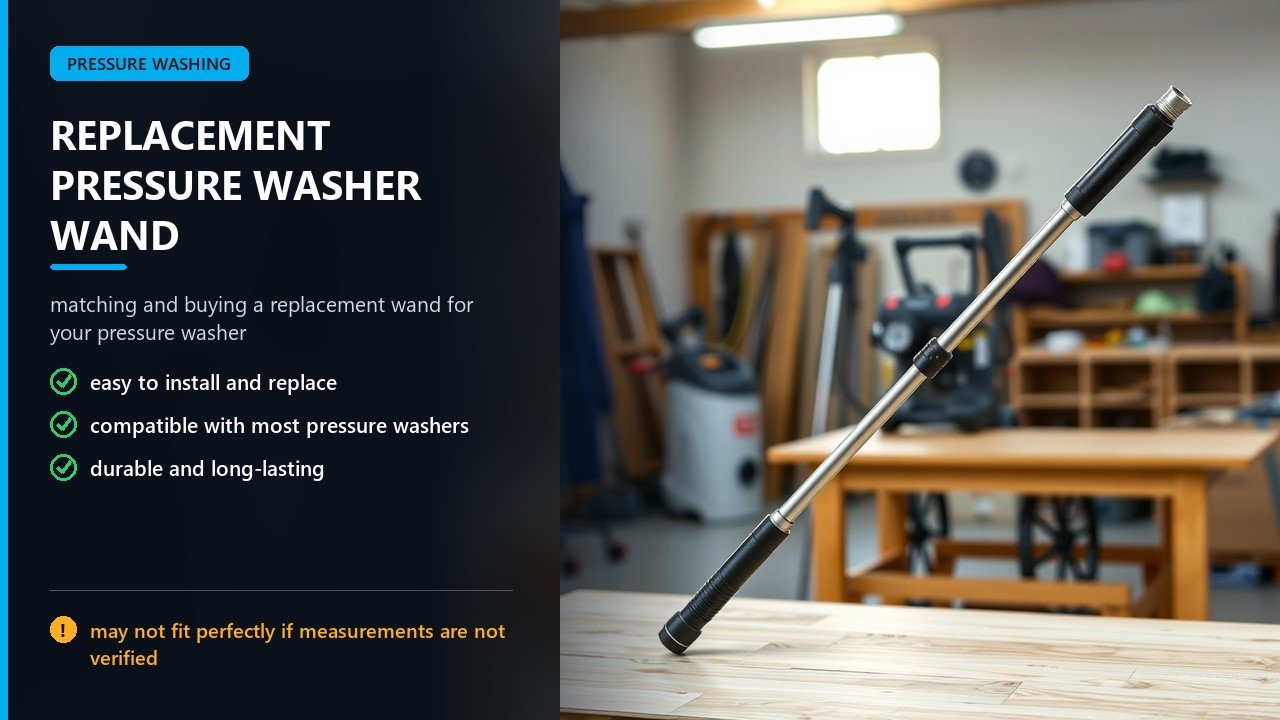
What a Pressure Washer Wand Does
The wand is the rigid tube between the spray gun and the nozzle. Water leaves the pump, travels through the hose to the gun, passes through the wand, and exits at the nozzle tip where the final pressure and spray pattern are formed. Because the wand sits between the gun and the tip, it carries full system pressure and must be rated for it. A wand is therefore a pressure-containing component, not just a handle.
Wands come in several forms. A fixed wand has a set length, commonly 16 to 40 inches, and a single tube. An insulated or vented wand adds a sleeve or vents to protect the operator from hot water. A telescoping wand extends from a few feet to as much as 18 feet for reaching second stories and roofs. Some wands include a built-in grip, a swivel, or dual-lance controls for switching between high pressure and soap. Each type serves a different job, but all share the same two interfaces that determine fit.
Understanding that the wand is a full-pressure part explains why you should never substitute a low-rated wand to save a few dollars. A wand rated below your machine’s pressure can fail at the coupler or the tube seam, and the failure happens while you are holding it. Matching the rating is a safety matter as much as a performance one. Our overview of wand types and lengths covers the choices in more detail.
The Gun-Side Connection: Match This First
The single most important specification is the gun-side connection, the end that attaches to your spray gun. This is where most replacement mistakes happen. The wand must connect directly to your gun’s outlet, or through an adapter you have confirmed will work. There are three main families of gun-side connection.
The most common is the M22 threaded connection, found on a great many electric and gas machines. M22 comes in male and female versions, and the thread size is measured by inside diameter, usually 14 millimeter or 15 millimeter. A 14 millimeter M22 and a 15 millimeter M22 look similar but do not seal together correctly, so you must know which your gun uses. Our guide to hose and fitting types explains how to identify them.
Some guns use a quick-connect outlet instead of threads. Quick connects come in 1/4 inch and 3/8 inch sizes, and a plug on the wand snaps into a coupler on the gun. This is fast for swapping wands but requires matching the quick-connect size exactly. A third family is proprietary or specialized, such as the plug-and-pin system on some Karcher K2 through K5 machines, which accepts only the maker’s own wands and has no universal adapter. Our comparison of matching guns and wands helps you sort out tricky interfaces.
Gun-side connections at a glance:
- M22 threaded — male or female, 14 mm or 15 mm; extremely common.
- Quick connect — 1/4 inch or 3/8 inch plug into a matching coupler.
- Proprietary — brand-specific systems that require the maker’s own parts.
The Nozzle-Side Connection
The other end of the wand holds the nozzle or an accessory. Almost all residential and light commercial wands use a 1/4 inch quick-connect socket on this end, which accepts standard 1/4 inch quick-connect spray tips. This is the near-universal standard, so matching the nozzle side is usually simple: as long as your wand has a 1/4 inch quick-connect socket, your existing colored tips will fit.
There are exceptions. Some wands have a fixed nozzle instead of a quick-connect socket, meaning you cannot change tips. Others use a threaded outlet, often 1/8 inch NPT or 1/4 inch NPT, which requires threaded nozzles rather than quick-connect tips. A few specialized wands use proprietary couplers. When replacing a wand, confirm that the nozzle end matches the tips you already own, or budget for new tips of the correct style.
The nozzle-side connection also matters for accessories. Surface cleaners, foam cannons, and turbo nozzles each have their own inlet, and most expect a 1/4 inch quick-connect plug. If your replacement wand provides a 1/4 inch quick-connect socket, those accessories will attach normally. Our guide to wand attachments covers how the nozzle end works with add-ons.
Pressure and Temperature Ratings
Once the connections match, the next check is pressure. The wand’s maximum pressure rating must equal or exceed your machine’s operating pressure. If your pressure washer produces 3,000 PSI, fit a wand rated for at least 3,000 PSI, and preferably higher for a safety margin. Wand ratings commonly run from 3,400 PSI up to 4,500 or 5,000 PSI for more robust models, which comfortably covers most residential and many commercial machines.
Temperature is the other rating that trips people up. Most standard wands are cold-water only, rated to about 140 degrees Fahrenheit. If your machine heats water, you need a hot-water wand, often insulated or vented and rated to 200 degrees Fahrenheit or higher, sometimes up to 300 degrees for stainless steel models. Using a cold-water wand on a hot-water machine can soften seals, warp the grip, and create a burn or burst hazard. Our guide to hot-water wands explains what to look for.
Rating rule: Choose a wand whose maximum PSI is at or above your machine’s pressure, and whose maximum temperature covers your water temperature. Cold wands top out near 140°F; hot-water wands reach 200–300°F or more.
OEM Replacement vs Universal Wand
When a wand fails, you have two paths: replace it with the exact OEM part from your machine’s maker, or fit a universal wand that matches the interfaces. The OEM path guarantees a perfect fit and identical specifications, which is reassuring when your machine uses a proprietary connection or an unusual length. Parts for brands such as Ryobi and others are widely available through parts retailers, and many manufacturers list replacement wand part numbers in their manuals.
The universal path often costs less and can improve on the original. A universal wand typically uses a common M22 gun-side connection and a 1/4 inch quick-connect nozzle socket, fits many brands, and may offer a better grip, a longer length, or a higher pressure rating than the wand that came with the machine. For example, a universal 27 inch replacement wand rated to 4,500 PSI fits most gas pressure washers with M22 trigger-handle couplers and accepts standard 1/4 inch quick-connect nozzles.
Universal wands are not truly universal, though. “Universal” in a product title still depends on the specified connections and ratings. Within a single manufacturer, gun-side connections can differ from wand to wand. The safe approach is to treat “universal” as “fits many,” and verify the four specifications — gun-side, nozzle-side, pressure, and temperature — against your machine before buying. A reference like the wand and lance guide shows how model-specific connections vary.
Real Replacement Wand Examples
Looking at actual products makes the specifications concrete. A 16 inch fixed wand may carry a 3,600 PSI rating, a 140 degree limit, an M22 male gun-side connection, and a 1/4 inch quick-connect socket. A 31 inch fixed wand might step up to 4,500 PSI with the same M22 male and 1/4 inch quick-connect combination, while a 48 inch insulated wand may be rated 5,000 PSI and 212 degrees with a 1/4 inch male NPT inlet and a 1/4 inch quick-connect socket for hot-water work.
Telescoping wands follow the same pattern with one twist. A 6 to 18 foot telescoping wand might be rated 4,000 PSI and 8 GPM with a 140 degree limit, but its gun-side connection can be a 3/8 inch quick-connect plug, with an M22 quick-connect adapter included, and a 1/4 inch quick-connect socket provided through an included extension. That removable extension is why telescoping wands often need an adapter to match the gun.
Other examples reinforce the point. An extension wand at 31 inches may be rated 4,000 PSI with an M22 connection and a 1/4 inch quick-connect, made of steel with a 90 day warranty. Manufacturers such as SIMPSON publish wand and lance specifications, and a universal spray gun like the SIMPSON 80147 illustrates the pairing: it is rated 3,400 PSI and 8.0 GPM, with an M22 female connection for the wand and an M22 male connection for the hose, cold water only. Matching a wand to that gun means matching the M22 interface and staying within the pressure and temperature limits.
Fixed, Telescoping, and Specialty Wands
Fixed wands are the default replacement. They are simple, durable, and available in lengths from about 16 to 48 inches. Shorter wands give more control and are easier to maneuver in tight space, while longer wands let you keep the spray farther from your body and reach slightly higher. Choose the length that matches your height and comfort; an ergonomic match reduces fatigue on long jobs.
Telescoping wands extend your reach dramatically, often to 18 feet, letting you clean second stories, roofs, and gutters without a ladder. They are heavier, more complex, and usually cold-water only, and they demand care because the extended length magnifies leverage on the coupler. If reach is your main need, a telescoping wand is a worthwhile specialty tool. Our guide to telescoping extension wands covers their use.
Specialty wands include dual-lance models with a soap mode, insulated wands for hot water, and swivel wands that rotate the nozzle for hard-to-reach angles. Some telescopes include curved rods for gutters. Each adds a feature at the cost of some weight or simplicity. A stainless steel wand, for instance, resists corrosion and handles chemicals and heat better than a coated or plastic one, which is why it is a popular upgrade. Our look at the stainless steel wand explains the material choice.
Diagnosing a Wand That Needs Replacing
Not every wand problem calls for a full replacement. Some issues are repairable, and knowing the difference saves money. A leak at the gun-side connection often means a worn O-ring or a loose fitting rather than a failed wand. Replacing a cheap O-ring can restore a leak-free joint and cost almost nothing. Leaks at the nozzle side may be a worn quick-connect O-ring or a cracked coupler.
A wand genuinely needs replacing when the tube is dented, kinked, or cracked; when the seam fails; when the grip is broken or the trigger-lock wand interface is damaged; or when a coupler is so worn that O-rings no longer seal. These are structural failures that cannot be fixed with a seal. Our guide to fixing wand leaks and parts helps you decide between repair and replacement.
O-rings deserve special mention because they are the most common wear item. Standard cold-water O-rings are typically NBR at about 90 durometer to resist extrusion under high pressure, while hot-water machines need EPDM or Viton rings that tolerate heat. Knowing whether your machine uses a 14 millimeter or 15 millimeter M22 fitting matters here too, since the O-ring must match. A reference such as this pressure washer O-ring guide explains the material and size choices. The complex system of connections is laid out further in the Obsessed Garage fittings guide.
Measuring and Verifying Before You Buy
The most reliable way to buy the right replacement wand is to measure your existing setup. Remove the current wand and inspect the gun-side end. Measure the thread diameter if it is threaded, and note whether the wand end is male or female. If it is a quick connect, measure the plug or coupler diameter and note whether it is 1/4 inch or 3/8 inch. Then examine the nozzle end and confirm whether it is a 1/4 inch quick-connect socket, a fixed nozzle, or a threaded outlet.
Record your machine’s pressure and water temperature, and add a margin. A 3,000 PSI gas machine calls for a wand rated at least 3,000 PSI, and a hot-water machine calls for a wand rated for its water temperature. With those numbers in hand, compare against product listings and pick the wand that matches all four points. When in doubt, a manufacturer’s part diagram or an adapter kit removes the guesswork.
Before you buy, confirm:
- Gun-side connection type, thread size, and male/female.
- Nozzle-side connection and whether it matches your tips.
- Maximum PSI at or above your machine.
- Temperature rating for cold or hot water.
- Length and material suited to your jobs.
Installing and Caring for the New Wand
Installing a threaded wand is simple: thread it onto the gun by hand, then snug it with a wrench, taking care not to overtighten and damage the seal. If the connection uses an O-ring, make sure the ring is clean and lightly lubricated. For a quick-connect wand, push the plug into the coupler until it locks, then tug gently to confirm it is seated. A proper connection should not leak when you pressurize the system.
Care after installation extends the wand’s life. Avoid dropping the wand on its coupler, which can deform the fitting and cause leaks. Do not use the wand as a pry bar or lean hard on it, especially a telescoping model. Flush the wand when you finish, and store it where it will not be crushed or bent. When you winterize, drain the wand along with the rest of the system so trapped water cannot freeze and split the tube.
Keep spare O-rings on hand and replace them at the first sign of weeping. A five-cent ring prevents a job-ending leak, and knowing your fitting size means you can buy the right ones in advance. With minimal care, a well-matched replacement wand will last for years and keep your machine delivering the pressure it was built to produce. For the wider system, see our guide to how guns and wands work together.
Popular Replacement Wand Options
The market offers replacement wands at every level, and a few patterns repeat. Universal wands in the 27 to 31 inch range, rated around 4,000 to 4,500 PSI with an M22 gun-side connection and a 1/4 inch quick-connect socket, are the workhorses. They fit a wide range of gas and electric machines and cost far less than a full gun-and-wand assembly. A 27 inch universal wand rated to 4,500 PSI, for example, screws into most M22 trigger handles and accepts standard quick-connect nozzles.
Branded replacement wands offer model-specific fit. DeWALT’s 31 inch extension wand is rated 4,000 PSI, uses an M22 connection with a 1/4 inch quick-connect, and carries a 90 day warranty, while SIMPSON publishes a range of wands including a 16 inch fixed unit at 3,600 PSI and a 31 inch fixed unit at 4,500 PSI, both with M22 male inlet and 1/4 inch quick-connect outlet. These branded parts are a safe choice when you want a known fit.
At the specialty end, insulated wands handle hot water and telescoping wands extend reach. An insulated 48 inch wand might be rated 5,000 PSI and 212 degrees with a 1/4 inch male NPT inlet and a 1/4 inch quick-connect socket, suitable for commercial hot-water cleaning. A 6 to 18 foot telescoping wand might be rated 4,000 PSI and 8 GPM with a 3/8 inch quick-connect plug and an included M22 adapter. Each of these illustrates the same rule: know your gun-side connection before choosing.
The price spread reflects materials and ratings rather than brand hype. A basic universal wand costs modestly, a branded cold-water wand a little more, and an insulated or telescoping wand considerably more. Since the wand is a pressure part, spend enough to get a rating above your machine rather than buying the cheapest option with an unclear specification. When a listing does not state the connection and ratings clearly, move on.
Mistakes to Avoid When Replacing a Wand
The most common mistake is ordering by appearance instead of by interface. Two wands can look nearly identical yet use different threads, different M22 diameters, or different quick-connect sizes. Buying on looks leads to a return and another wait. Always verify the connection before purchase, not after the box arrives.
The second mistake is ignoring the temperature rating, which is easy to do on a cold-water machine but dangerous on a hot-water one. The third is buying a wand rated below the machine’s pressure to save money; the wand is the wrong place to economize. The fourth is forgetting that the nozzle end must match your existing tips or accessories, which can leave a new wand unusable until you buy a matching tip.
Owners also misjudge length. A very long fixed wand feels awkward and fatigues the wrist, while a very short wand forces you to lean in. The best length matches your height and the reach your jobs require. Finally, some buyers overlook adapters, then discover at home that a 1/4 inch wand will not fit a 3/8 inch quick-connect gun. Confirm every interface, and when in doubt, order the adapter alongside the wand.
When to Upgrade Rather Than Simply Replace
A failed wand is also an opportunity to upgrade. If the original wand was plastic, a stainless steel or brass replacement resists heat, chemicals, and corrosion far better. If it was a fixed short wand, a longer or telescoping model can improve your reach. If the coupler kept leaking, a higher-quality wand with a better quick-connect may end the frustration for good. Upgrading at replacement time costs little more than a like-for-like swap.
The upgrade decision should follow the job, not the catalog. If you clean flat concrete at ground level, a sturdy mid-length stainless wand is ideal. If you wash two-story siding and roofs, a telescoping wand pays off. If you run a hot-water machine, an insulated wand is essentially mandatory. Matching the upgrade to your actual work delivers real value; upgrading for its own sake just adds weight and cost.
Whatever path you choose, the verification steps stay the same. Connect the gun-side correctly, match the nozzle side to your tips, and clear both the pressure and temperature bars. Do that, and whether you replace or upgrade, the new wand will serve your machine properly. Our broader guide to the spray wand ties the whole picture together.
Frequently Asked Questions
Are pressure washer wands universal? No. Many share an M22 gun-side connection and a 1/4 inch quick-connect nozzle socket, but others use threaded, quick-connect, or proprietary gun interfaces. Pressure, temperature, and length also vary. Always verify all four specifications.
How do I know what size wand my pressure washer needs? Inspect the gun outlet and the old wand’s gun-side end. Note the connection type, thread size (14 mm or 15 mm for M22), and whether it is male or female. Then match the pressure and temperature ratings.
Can I use a cold-water wand on a hot-water machine? No. Cold-water wands are usually limited to about 140 degrees Fahrenheit. Hot water requires an insulated or vented wand rated for the water temperature, often 200 to 300 degrees.
What is the difference between OEM and universal wands? An OEM wand is the exact part for your model and guarantees fit. A universal wand fits many machines through common connections and may cost less or add features, but it must still match your connections and ratings.
Can I repair a leaking wand instead of replacing it? Often yes. A leak at either connection is frequently a worn O-ring or a loose fitting. Replace the O-ring or snug the fitting. Replace the wand only if the tube, seam, grip, or coupler is structurally damaged.
What nozzle connection do most wands use? Most residential and light commercial wands use a 1/4 inch quick-connect socket that accepts standard colored spray tips. Some use fixed nozzles or threaded outlets instead, so check before buying tips.
How long should a replacement wand last? With normal care, a quality wand lasts years. Avoid dropping it on the coupler, do not use it as a lever, flush and drain it after use, and replace O-rings promptly to prevent leaks from damaging the fittings.
Final Thoughts
Buying a replacement pressure washer wand comes down to matching, not guesswork. Identify the gun-side connection, confirm the nozzle-side connection, and choose a wand whose pressure and temperature ratings cover your machine. Fixed or telescoping, OEM or universal, the wand that fits all four points will thread on, seal, and perform as it should.
Measure your old wand, write down the numbers, and compare carefully before you order. Do that, and your replacement wand will restore full cleaning force to your machine and may even improve on the original. A few minutes of verification up front is the difference between a wand that works on arrival and one that sits in a box because it will not attach.