Hot Water Pressure Washer Wand: The Lance Built for Heat and Steam
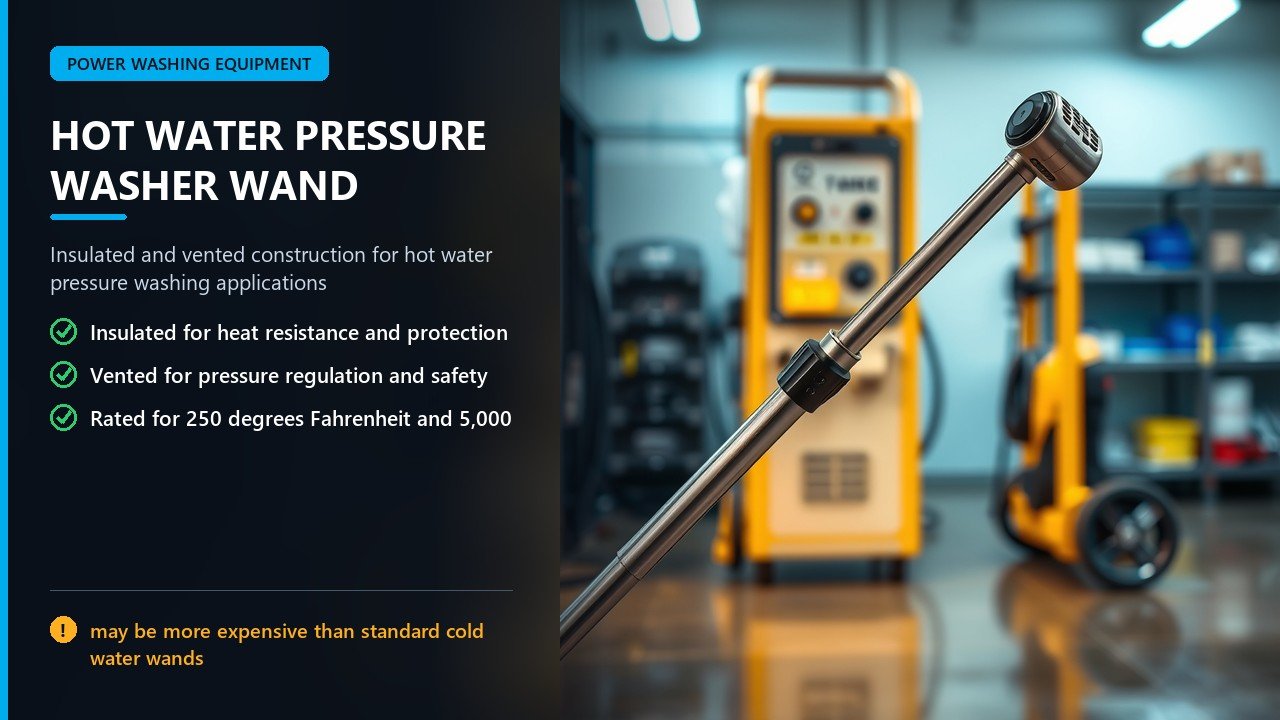
A “hot water pressure washer wand” is not the same part that ships on a cold machine, and it looks that way in the hand: insulated, often vented, frequently stainless, rated at 5,000 PSI and 250 degrees Fahrenheit. Cold-only wands use the same quick-connect collar but carry no meaningful temperature rating, which is exactly why installing one on a hot machine is a bad idea and why the replacement market for hot water lances exists as its own category.
This guide covers the construction that makes a hot water wand safe, the ratings to check before you buy, the lengths and dual-lance features professionals prefer, and the safety habits that keep you out of the steam cloud. If you run a hot water machine for restaurant kitchens, fleet washing, or wash racks, your wand is the part your hand depends on all day — getting it right matters.
Quick Note: A hot water wand is defined by its temperature rating and its insulation. Cold wands can spray hot water briefly; a rated, insulated lance does it all day without burning the trigger hand.
Why Hot Water Wands Are Different
Heat changes everything about the metal in your hand. On a cold machine the lance rarely exceeds the ambient air temperature even after an hour of work, so a thin painted steel tube is fine. A hot water machine pushes 180 to 250+ degree water through the same bore, and within minutes the wand becomes a heat path: hot enough to blister through gloves, chemically aggressive enough to attack plating, and connected to steam that hits your fingers around the trigger the moment you vent pressure.
Hot water lances solve all three problems at once. They add an insulated layer or a vented jacket to break the heat path between the water and your grip. They upgrade to stainless or heavy plated steel that survives the heat, the detergent, and the daily cycle. And they are built around a real operating temperature so the O-rings, collars, and seals stay inside their design envelope. The difference is invisible in a photo and obvious the first day it runs hot.
The math behind all three solutions is the same: thermal energy wants to travel from the hot fluid, through the pipe wall, and into your hand to be dissipated into the air. A cold lance is a straight copper-pipe situation — heat flows linearly along the metal, and the only reason your hand tolerates it is that there is no heat to speak of. A hot lance inserts a deliberate barrier — insulation, an air gap, or a vented jacket — that the heat has to cross through air or polymer rather than through bare metal. That barrier is a deliberate engineering decision, not a cosmetic cover, and it is the entire reason the same gun body can feel fine on both machine types while the wand absolutely cannot be swapped.
There is also a flow-rate angle that surprises new buyers. Hot machines in the 3,500 to 5,000 PSI class push 3 to 5 GPM through the bore, and a wand built for cold consumer machines often has a 1/4-inch internal bore optimized for 2 to 2.5 GPM. Run the big hot unit through the small bore and the wand becomes a restriction, so the machine spikes pressure and the pump fights itself. The rated hot wands commercial suppliers carry — the lance catalogs that list maximum flow as a spec next to pressure and temperature — exist precisely because performance and safety both scale with the pipe size.
Insulated and Vented Construction
Two design families keep heat off your hand. An insulated wand wraps the fluid bore in an insulating sheath, so the outer tube stays cool to the touch even at 200 degrees inside. The classic “cool-grip” wands on commercial machines use exactly this approach, and it is the single feature that most separates a safe lance from a dangerous one.
A vented or dual-wall lance goes further: an outer jacket sits around the hot core with a gap between, and that air gap acts as the insulator. Vented lances visibly bleed pressure and steam through the jacket vents instead of holding the heat against your fingers, which is why commercial guns paired with vented lances (such as the NorthStar hot water guns) are described as limiting heat transfer to the operator rather than just surviving it. For all-day degreasing shifts, vented is the pro’s pick; for occasional hot work, insulated is plenty.
Two secondary features ride along on better hot lances, and both deserve a glance before you buy. A molded or Zytel polymer cover on the barrel adds impact resistance so the wand shrugs off bangs against a trailer rack instead of denting the tube and kinking the flow path. And a trigger lock with positive detents matters more on hot machines than cold ones, because you frequently need to set the gun down mid-degrease without letting a near-boiling stream run free; a clean lock leaves the wand dead until the next squeeze.
Temperature and Pressure Ratings You Must Match
A hot water wand is only as good as its two printed ratings: maximum pressure and maximum temperature. The pressure number should meet or beat your machine’s output; the temperature number is the one that cannot be fudged, because a lance rated to 212 degrees Fahrenheit running a burner loop at 250 will fail exactly where you do not want failure — in your hand.
| Machine Class | Typical Pressure | Typical Water Temp | Wand Should Be |
|---|---|---|---|
| Small hot cart | 2,000 to 3,000 PSI | 180 to 200F | Insulated, rated 4,000/250F |
| Day-rate trailer unit | 3,500 to 5,000 PSI | 200 to 250F | Vented, rated 5,000/250F+ |
| Skid / industrial | 6 to 10 GPM | 250F+ | Stainless dual lance, man-rated |
The numbers on the parts are printed for a reason, and they should be greater than or equal to your machine’s numbers — the headroom protects you on the hottest day and the most peaked pressure. Our hot versus cold machine guide explains where those machine numbers come from so you can match them correctly.
Materials: Stainless Over Plated Steel Over Aluminum
The second decision is metal. Cold water wands in steel or aluminum do the job cheaply; hot water work narrows the field. Stainless steel resists the combination of heat, detergent, and scale that strips plating and pits aluminum, and stainless is also the least likely to transfer heat to the hand. That is why heavy-duty manufacturers fit stainless wands to machines that run hot all day — the Goodway and Hotsy lines that pair stainless with 180 to 200 degree output do it because anything less discolors and degrades within a season.
Zinc-plated and nickel-plated steel lances are the budget middle: fine for light hot use, heavier, and prone to plating wear where chemicals pool. Aluminum wands should stay on cold machines; the metal’s heat conductivity makes it the worst at the exact job a hot wand does — keeping your hand cool. The material table in our spray wand guide lays out the trade-offs across both hot and cold duty.
Material also drives weight, and on a hot machine that matters more than on a cold one because the wand is heavier to begin with. Stainless is the densest of the three, so a heavy-duty stainless dual lance feels substantial in the hand; crews either love the planted feel or switch to a plated steel wand for long overhead work on truck roofs. The honest answer to “which is right” is to hold both before committing to a season — weight at full reach and full length is a very personal tolerance, and the backpack-maintenance days add up faster than any spec sheet suggests.
Lance Length: Reach Versus Control
Hot water work happens at close range — hoods, undercarriages, wash racks — so length is a choice between reach and feedback. An 18-inch lance is the workhorse on cart machines: short enough to read the surface through the wand, long enough to keep steam off your shins. Truck and trailer crews step up to 24 to 36 inches with a bent or flexible tip for reaching roofs and tall gear, and telescopic extension wands let you adjust on the spot.
| Length | Best For | Trade-Off |
|---|---|---|
| 18 inch | Most cart and trailer work | Steam and spray close to legs |
| 24 to 36 inch | Roofs, hood stacks, trucks | Less feel, more leverage |
| Telescopic (36 to 96 inch) | Variable site reach | Heavier, more joints to seal |
The reach argument for a telescoping wand over a ladder fits hot work exactly as it fits cold, and the honest overview lives in our telescoping wand guide.
For most trailer and cart operators, the 18-inch lance wins by a mile because of how hot work actually flows: you are inches from the surface, watching grease stream off, and the wand is carrying 200-degree water in your hands. A longer tube adds reach to high spots and keeps the steam cloud off your shins, but it multiplies swing weight and fatigue over a ten-hour day. The practical rule is to buy the shortest lance that safely reaches your tallest recurring job, then add an extension only for the occasional tall task rather than living with a heavy wand every day.
Dual and Variable-Pressure Lances
Commercial hot machines frequently pair with a dual lance or variable-pressure wand, and the feature is worth understanding before you buy. A variable wand carries a valve at the gun that drops nozzle pressure without killing engine and pump revs, so you can degrease a hood at low power and rinse at full without walking back to the unloader. A dual lance runs two nozzles from one body — often one soap, one rinse — so chemical application and rinsing live side by side.
The detergent angle is where hot water earns its keep: grease melts and lifts at temperature, and applying degreaser through a low-pressure setting on the same wand keeps the surface wet until the chemistry finishes its dwell. Our detergent delivery guide and the chemical guide show how injectors and tanks feed that wand setting.
If your hot machine runs a downstream injector, your wand choice interacts with the soap system in one subtle way: pressure at the nozzle is what governs how the injector draws chemical, and a variable-pressure wand changes that draw as you adjust. On turbos and thick grease you want full compound flow, and on slow rinse you want the lightest useful pattern. The practical habit is to apply chemical with the wand at its low setting for dwell, then open to full for the strip rinse — a rhythm that keeps the chemistry wet, the surface hot, and the injector within its happy range. None of that is visible on the sales photo, but it is the entire workflow of a professional hot water day.
Matching the Wand to Your Gun and Quick Connects
Before buying, confirm that the wand end and your gun agree. Most consumer and pro setups use a 3/8-inch quick-connect on the gun side of the lance and a 1/4-inch quick connect on the nozzle end, with M22 threaded guns appearing on some European and electric brands. The inlet size (often 3/8-inch female) and outlet (1/4-inch or M22) are printed in the listing; our leak-free fittings guide and the connector matching guide cover the full identification drill.
Where you have a choice, buy the wand with the same connection family as your gun so you keep one pattern of quick connects and O-rings, and never mix a 1/4-inch bore into a path meant for 3/8-inch flow. On a 5 GPM hot machine, the small bore is a real restriction, not a rounding error.
The outlet end deserves the same scrutiny. Wands intended for hot machines commonly terminate in a 1/4-inch quick connect that accepts standard color-coded tips, but some insulated or dual-lance designs use threaded or proprietary seats. If your tips and adapters are 1/4-inch quick connect, buy the wand with that outlet and keep your existing nozzle collection — the tip chart stays exactly the same once the seat matches.
Nozzles on a Hot Water Wand
The nozzle tips that ride on the wand must carry the same temperature rating as the wand itself. Color-coded quick-connect tips (red, yellow, green, white, black soap) are standard, and the orifice must match your machine’s PSI and GPM exactly as on a cold rig — the sizing math does not change just because the water is hot. What changes is the risk: a tip rated only for cold water can soften and split under a hot 4 GPM stream, sending debris and scalding water toward the operator.
When replacing tips after a hot season, check for a temperature rating on the kit or source the metal-bodied tips commercial suppliers sell for hot water. The full color-code chart and the sizing drill are in our nozzle color code guide and the nozzle guide.
Replacing and Upgrading a Factory Wand
The factory wand on a hot machine is usually adequate but rarely ideal: often too short for you, sometimes in a thin plating that wears where the chemical pools, and always the cheapest part in a line that will cost you a day of work if it fails. Upgrading to a rated, insulated, stainless or vented lance is the classic first accessory purchase for a hot water business — and an inexpensive safety net for home hot users.
Two cautions for buyers. Never judge a wand by its “fit” alone on a hot machine — the temperature rating on the listing or the part is the line that keeps you safe, and a wand that clicks in perfectly but is rated for cold water is a scald waiting for a busy Saturday. And treat stainless as the standard for hot duty: it conducts less heat, shrugs off the detergent chemistry, and keeps its look far longer than plated steel under 200-degree service.
Buying Checklist: machine PSI and GPM, water temperature, insulated or vented construction, stainless or plated steel barrel, 3/8-inch in / 1/4-inch out quick connects, length for your tallest recurring job, and a temperature rating that exceeds the burner loop.
When you upgrade, buy for the machine’s numbers and your own height. The vented-lance hot water gun rated to 5,000 PSI and 250 degrees from NorthStar is a solid example of the category, as is the Powerhorse adjustable-wand hot-capable kit, and parts suppliers like Pressure Washer Parts host wands with temperature and pressure filters so you can sort by your machine’s specs.
Safety: Steam, Scald, and Backsplash
Hot water carries two injuries a cold machine never threatens. First is scalding: the stream is near boiling, so it must never be pointed at people, animals, or your own legs when crossing a boot path — the steam cloud wraps around corners and the backsplash hits shins before the eyes do. Second is rapid depressurization: releasing the trigger on a hot gun vents water vapor through the lance vents, which is precisely why vented wands bleed safely instead of pinching steam against your glove.
Wear thermal-rated gloves, long sleeves, and eye protection; keep the tip pointed low when someone is nearby; and never let a reactively-gloved hand linger on the collar at pressure. The safety-brief version of these rules belongs in our machine choice guide, and the day-to-day discipline is the part most new hot operators underrate.
Two additional cautions are specific to hot water nozzles and quick connects. First, the collar and nozzle seat reach operating temperature on a hot rig, so the “just grab the tip and rotate it” habit from cold washing burns fingers on a hot one — release pressure, let the line bleed through the locked gun, and only then touch the tip. Second, steam is invisible against a bright wash bay wall: the near-boiling vapor drifts and hits skin before the eye registers anything, which is why pros treat the stream like a blank water jet and never sweep it along a path where a teammate is kneeling. Hot water work rewards the same patience as electrical work: stop, cool, verify, then touch.
Caring for a Hot Water Wand
Heat and detergent do the wear, and the maintenance is short. Flush the wand with a moment of cold water before shutdown to push scale and chemical away from the bore. Rinse the outside after bleach-heavy jobs, because bleach corrodes plating and attacks seals at temperature. Inspect the collar O-rings and the lance vents seasonally — a blocked vent on a vented wand turns it back into a hot pipe. And store the lance off the ground, dry, where it cannot be stepped on: a bent bore does not kill the wand but does kill its coverage pattern. A cool, dry, upright storage spot on the cart rack is worth the two seconds it takes.
Our wand repair guide covers replacing the small parts that fail first, and the gun-and-wand system guide explains why caring for the pair as a unit extends both.
The seasonal checklist is short but non-negotiable: inspect both bore ends for scale crust at the collar, wipe the O-rings and replace any that have gone hard or square, pull the nozzle tip and clear any grit caught in the seat, and confirm the vents on a vented lance are open. On a daily basis, one habit outranks all the rest — a ten-second cold flush at shutdown. It costs nothing, takes longer to type than to perform, and it is the difference between a wand that lasts for years and one that sells you new seals every season.
Common Mistakes With Hot Water Wands
- Running a cold wand on a hot machine. Untracked heat transfers, plating wears, seals go. Fit a rated lance.
- Ignoring the temperature rating. Cheap “fits any gun” wands often max out under your burner loop.
- Choosing aluminum for hot duty. Aluminum conducts heat straight to your hand; stainless insulates better and resists the chemistry.
- Wrong quick-connect size. A 1/4-inch bore in a big-flow path chokes output and overworks the pump.
- Pointing hot flow at people or pets. The steam cloud scalds around corners; keep the stream low and away.
- Skipping the vent check. A blocked vent on a vented lance defeats its whole point.
- Buying for the click-fit first, the spec second. Fit matters, but only after the ratings match the machine.
Frequently Asked Questions
Can I use a regular wand on a hot water pressure washer? Briefly, but not safely long-term. The wand must be rated for your water temperature; an untracked lance transfers heat to your hand and its seals wear fast under sustained heat.
How hot can a hot water wand get? Commercial wands are commonly rated 212 to 250 degrees Fahrenheit, with heavy industrial lances to 300 or 340 degrees on the hottest machines. Match the number to your burner output.
What does “vented lance” mean? A vented lance has an outer jacket around the hot core with air between, and vents that let steam and pressure bleed away from your hand rather than trapping heat against it.
Do I need a stainless wand? For daily hot and chemical-heavy work, yes — stainless resists heat discoloration, detergent attack, and conducts less heat. Light hot use tolerates plated steel.
Do hot water nozzles differ from cold ones? The color code and orifice sizing are the same; the requirement is a temperature rating. Choose tips rated for hot water where the machine runs it all day.
Why does my wand get uncomfortably hot? Either it is not insulated/vented, the insulation has failed, or you ran a cold-rated wand on a hot machine. Fit a rated insulated or vented lance.
Can I leave a hot wand pressurized when I stop? No. Lock the gun off, trigger the wand to bleed the line, and let the burner circuit cool before you set the machine down; trapped near-boiling water is a scald sitting inside the system.
Is a longer wand safer on a hot machine? Longer keeps steam farther from your body, but it also weighs more at full reach and reduces control. Match length to the work; 18 to 36 inches covers nearly every hot water job.
Final Thoughts
The hot water pressure washer wand is the unsung half of the grease-cleaning equation: the machine makes the heat, and the lance decides whether that heat stays under control. Insulated or vented construction, a temperature rating that covers your burner, stainless for daily chemical service, and the length that fits your work are the four decisions that separate a professional hot setup from a machine that inconveniences you all day.
Match the wand to the machine’s numbers, treat steam as the hazard it is, and spend the small money on a rated upgrade rather than a blister. The difference shows up the first time your hand stays cool at full temperature — and your crew notices long before you do.
One final point worth repeating: the wand is the cheapest part you will ever regret cheapening. A hundred-dollar rated lance protects the most expensive asset on the job, which is the person holding it, and it protects the machine’s pump from the restriction a too-small bore creates. When you upgrade your hot water pressure washer wand, buy the insulation, the rating, and the metal that match your machine’s honest numbers — and the hand that works it all day will thank you before the first shift is done.