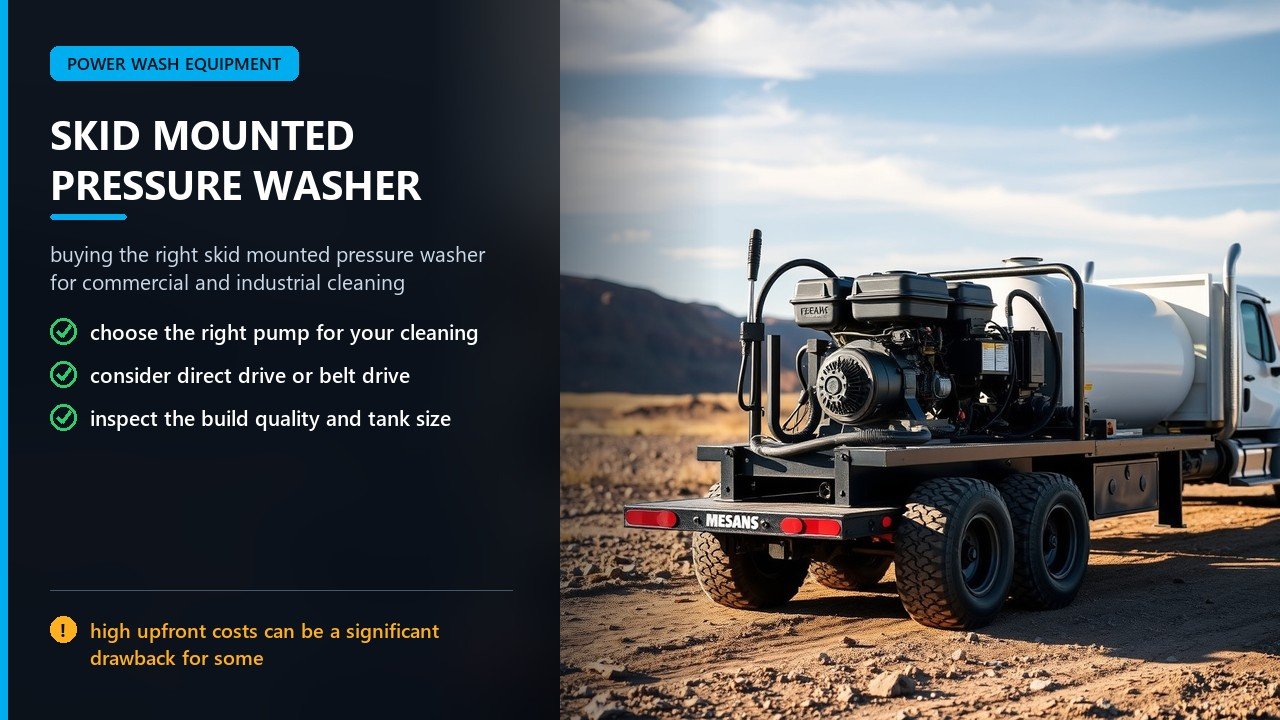
Skid Mounted Pressure Washer for Sale and How to Buy the Right Rig
Punch “skid mounted pressure washer for sale” into a search bar and the results look almost identical: yellow machines on welded frames, shiny pumps, and price tags that swing by thousands of dollars between listings that appear to be the same thing. The gap is not random. A skid mounted pressure washer is a complete cleaning power plant, engine and pump mounted on a self-contained steel skid, and the difference between one rig and another lives in the pump, the drive, the flow, and the build quality behind the paint. Buy the right skid and it earns money for a decade; buy the wrong one and you inherit a machine that cannot keep up, cannot be serviced, or costs more to run than it returns.
This guide walks an honest buyer through the skid mounted pressure washer market: what a skid mount actually is, how it differs from a trailer mount, the exact specifications that separate a good rig from a bad one, how to compare listings line by line, what to inspect on a used skid, how to price the whole package including accessories, and the questions that expose a seller who is hiding a problem. By the end, you will be able to read a listing the way an experienced operator does and walk away with a rig that fits the work you actually do.
What Exactly Is a Skid Mounted Pressure Washer?
A skid mount is a pressure washer package built onto a rectangular steel frame, the skid, that can be lifted, bolted, or slid onto a truck bed, a utility trailer, an ATV, or its own cart. The skid carries the entire working system: engine, pump, sometimes water tanks, sometimes a hose reel, sometimes a burner for hot water, plus the unloader, filters, and controls. It is essentially a portable cleaning station with no vehicle attached, which is why it is the versatile choice for anyone who already has a way to move it.
“Skid mounted” covers a wide range of machines, from small single-operator rigs with a five-gallon-per-minute pump and a twenty-gallon tank, all the way up to commercial hot-water packages with triple-digit-gallon tanks and multi-thousand-dollar pumps. That range is exactly why the for-sale listings vary so widely in price, and why you cannot shop by picture alone. Two yellow skids that look the same in a thumbnail can be a six hundred dollar lawn machine and a twelve thousand dollar commercial workhorse.
Skid Mount Versus Trailer Mount Versus Cart
Before you buy a skid, confirm it is the right form factor for how you work.
| Format | Mobility | Best For | Watch Out For |
|---|---|---|---|
| Skid mount | Needs a host vehicle or cart | Owners with a truck/trailer; fleets; fixed wash bays | Weight and lifting; must bolt it down safely |
| Trailer mount | Self-contained, road legal | Turn-key mobile businesses | Higher price; towing, plates, and storage |
| Cart / portable | Push it by hand | Small jobs, residential, light commercial | Limited tank size and hose range |
The skid is the modular option: you supply the vehicle, and the machine goes anywhere that vehicle goes. That flexibility is why many established operators prefer skids, and why a buyer with a suitable truck bed or trailer saves thousands over the trailer-mounted equivalent. Our overview of mounted pressure washers covers how the three formats compare in detail.
The Specifications That Actually Matter
Shopping by brand name and price is how people overpay for the wrong rig. Shop by these numbers instead.
- GPM (gallons per minute): the true measure of cleaning power and productivity. Flow determines how fast you work and how much surface one operator can cover. Commercial skids commonly run 4 to 8 GPM; anything under 4 GPM is light-duty.
- PSI: the force behind the water. Match PSI to the work; too much pressure damages surfaces, too little does not remove grime. Commercial rigs commonly run 3000 to 4000 PSI.
- Drive type: direct drive (pump bolted to engine, cheap and simple, less forgiving of running dry), belt drive (smoother, cooler, longer pump life, the pro standard), and gear drive (compact compromise). Belt is generally the most durable for commercial use.
- Pump brand and type: a triplex plunger pump from a known manufacturer outlasts a cheap axial pump by a wide margin. General, Cat, AR, and similar triplex pumps dominate serious rigs.
- Hot or cold water: hot water rigs need a burner, a fuel source, and more maintenance; they clean grease far better but cost more to buy and run.
- Tank size: a larger tank means longer runs between refills, but a full tank is heavy water. Match tank size to your water access and travel distance.
Reading a “For Sale” Listing Like an Operator
Every skid listing includes the same handful of claimed numbers, and how the seller presents them tells you a lot.
- Horsepower isn’t the headline. Engine HP sells engines, not cleaning power. The GPM and pump type contain the useful truth.
- “3500 PSI” without GPM is a red flag. A high PSI with no flow figure is often a small consumer pump pushed to its marketing limit. Ask for the GPM and the pump model number.
- “Commercial pump” without a name is another flag. Serious sellers name the pump brand, because serious buyers ask.
- Check the hours if it is used. Engine hours, if the meter works, tells you the real wear. Ask whether the pump has been rebuilt.
- Look for what is included. Hose reel, high-pressure hose length, gun, wand, surface cleaner, turbo nozzle, and filters all add real value and should be in the listing photos.
- Watch the wording. “Ready to work” from a working operator is a strong signal; “needs a tune” and “priced to move” usually mean a hidden cost.
A good listing answers all of that without being asked. A vague listing leaves you doing the interrogation, and the answers you get while asking the right questions are exactly the information you need to price the rig fairly. Skid mounted rigs frequently traverse the market with more than one owner, and our guide to buying used and refurbished pressure washers covers the tactics for the second-hand rig specifically.
New, Used, or Custom-Built Skid?
The three ways to get a skid each have a natural buyer.
| Route | Price Range | Best For | Trade-Off |
|---|---|---|---|
| New turn-key skid | High | Businesses that need a warranty and zero surprises | Highest cost; slow depreciation |
| Used commercial skid | Mid to high | Value buyers who can inspect and test | Wear unknown; may need immediate service |
| Custom-built skid | Varies widely | Owners with a specific layout and a build partner | Time, welding skill, and design risk |
New makes sense when downtime costs more than the price premium. Used makes sense when you can inspect the pump, engine, and frame carefully and know what a rebuild will cost. Custom-built makes sense when you have a very specific workflow and someone competent to build it, but for most buyers it quietly becomes the most expensive option once labor and mistakes are added, which is exactly what the buyers’ guide to skid mounted rigs that earn warns against. Match the route to your need, not to a fantasy of saving money.
Inspecting a Used Skid Before You Pay
If you are buying a used skid in person, run this inspection in order. It takes twenty minutes and can save you thousands.
- Engine: cold start from a dead stop; listen for knock, look for blow-by smoke, check oil condition and hours. A seller who has warmed the machine before you arrive is hiding a cold-start problem.
- Pump: identify the model, look for oil leaks around the crankcase, check for moisture at the sight glass, and listen for bearing noise. A gritty or howling pump is a rebuild or replacement bill.
- Drive coupling and belts: on belt drives, inspect belt condition and pulley alignment; on direct drives, check for play in the coupling.
- Unloader and controls: cycle the trigger; the unloader should engage and release cleanly, and the pressure should hold steady.
- Burner (if hot water): fire it up and confirm it ignites, holds temperature, and does not smoke badly or leak fuel.
- Tank and frame: look for rust-through on the skid, cracks at weld points, and a tank that seeps. Frame rust is a hidden cost that grows every season.
- Accessories: inspect the hose for soft spots, the gun and wand for wear, and the reel for smooth operation.
A machine that passes all seven is worth a firm offer. A machine with two or three failures is a project, and the price should reflect the parts and labor you will put in before it earns a dollar.
Pricing the Whole Package, Not Just the Skid
First-time buyers forget that the skid is only the beginning of the spend. Budget for the supporting equipment that makes the rig a business.
- High-pressure hose: commercial rigs want 100 feet or more of quality hose, and cheap hose fails at the worst moment.
- Water supply: a buffer tank or a secure water source, plus a float valve and inlet filter arrangement.
- Nozzles and surface cleaner: a proper rotary nozzle and a surface cleaner turn raw pressure into production.
- Chemical system: an injector or a dedicated soap tank and applicator for the work you do.
- Truck or trailer: the vehicle to carry the skid, plus tie-downs and, if you tow, the tow vehicle and taxes.
- Consumables and spares: oil, filters, belts, O-rings, and a spare gun.
Price the whole package and compare that figure, not the sticker on the skid, against the revenue you expect. A rig that earns will pay for itself faster than you think; a rig that was priced too optimistically will sit. If you are evaluating the move into mobile cleaning as a business, our piece on starting a mobile pressure washing business lays out the realistic costs and margins.
Where the Market Hides the Best Skids
The listing you want is not always the first one that turns up in a generic search, and knowing where each type of seller lives saves days of scrolling.
- Brand dealer lots and factory outlets: the most trustworthy source of new and certified-used skids, with service support and sometimes factory reman programs. Prices are firm but the machine is what it says it is.
- Equipment marketplaces and auction sites: the deepest pool of used commercial skids, but also the widest quality range. Read every spec, ask for hours and pump model, and expect to travel for the good ones.
- Facebook groups and contractor forums: where retiring operators sell working rigs to people who will use them, often with service records and a willingness to talk. These can be the best value in the entire market.
- Commercial cleaning company liquidations: when a business folds or upgrades its fleet, multiple skids come up at once, and a buyer with cash can negotiate hard on a package deal.
- Rental fleet retirements: rental companies rotate machines by hours, not by failure, so a well-maintained returned unit can outperform a private sale every time.
Post a “want to buy” in the contractor groups before you go shopping and you may find a machine that was never listed publicly. Operators prefer selling to people who understand the equipment, and a knowledgeable buyer often gets both a better price and an honest description of the machine’s history. If you are leaning toward a trailer over a skid, our rundown of pressure washer trailer basics helps you weigh the two formats before you commit.
Deciding on Tank Size and Water Supply
Tank size is where a lot of first-time skid buyers guess wrong, and the next thing they know they have either run dry mid-job or are hauling a load of water that kills their fuel economy and payload.
- Small tanks (10 to 30 gallons): enough for a quick residential stop with access to a customer spigot, light, and easy on the vehicle.
- Mid tanks (50 to 100 gallons): the sweet spot for a truck-mounted skid serving homes and small businesses, giving meaningful run time between refills without overwhelming a half-ton truck.
- Large tanks (100 to 200+ gallons): for commercial work where water access is unreliable, but only with a vehicle whose payload and axles can actually take it.
- Buffer versus supply tank: a small buffer tank protects the pump from a marginal spigot; a large supply tank lets you work where there is no water at all. They solve different problems, and the right answer depends on your customers.
If your jobs are mostly at addresses with working spigots, keep the tank small and light, and let the customer’s water do the heavy lifting. If your jobs are commercial, remote, or in areas without reliable taps, size the tank up and make sure your float valve and inlet filter arrangement is built to feed the pump steadily. A skid mounted pressure washer with tank is a different animal than a bare skid, and the tank drives both your capability and your expenses. Our guide to tanks that keep a machine supplied covers the plumbing and float details.
What a Fair Price Looks Like by Class
Prices swing widely, but the ranges cluster by class, and knowing them keeps you from overpaying for a consumer machine or underbidding on a commercial one.
| Class | Typical GPM / PSI | New Price Band | Used Price Band |
|---|---|---|---|
| Light homeowner skid | 2.5-3 GPM / 2700-3200 PSI | Entry thousands | Well under half of new |
| Mid commercial cold-water skid | 3.5-5 GPM / 3500-4000 PSI | Solidly mid thousands | Roughly half to two-thirds |
| Commercial hot-water skid | 4-5.5 GPM / 3500-4000 PSI | Upper thousands to low five figures | Highly variable; test the burner |
| Large multi-operator skid | 6-8+ GPM / 4000+ PSI | Five figures and up | Resale value holds for pro pumps |
The lesson in the numbers is that condition and components, not age, set the value. A ten-year-old belt-drive skid with a quality triplex pump and a fresh rebuild can be worth more than a three-year-old direct-drive unit with a tired axial pump, because the first one still has usable life in it and the second does not. Price the machine by what it will do for you and what it will cost to keep it doing it, not by the model year in the listing title.
Negotiating and Paying Safely
A skid purchase is a meaningful transaction, and both the negotiation and the payment deserve attention.
- Inspect before you negotiate. Price confidence comes from the inspection, not from the ad. Know what repairs the machine needs and put a dollar figure on them.
- Anchor on repairs, not on insult. “The pump needs a rebuild kit and the hose is shot, that is X dollars, so I can offer Y,” lands better than a lowball with no reasoning.
- Bundle intelligently. If the seller has extra hose, nozzles, or a surface cleaner, asking to include them often beats grinding the price further.
- Meet in daylight and at a safe location for private sales, and bring a second person if the price is high or you are carrying cash.
- Pay in a traceable way. Cash is common but offers no recourse; a bank transfer or a payment method with a receipt protects both sides, especially across state lines.
- Get it in writing. A simple bill of sale naming the make, model, engine hours, and price closes the loop and helps with any later paperwork.
The buyer who arrives prepared, quantifies the repairs, and negotiates on facts usually walks away with a fair deal. The buyer who shows up excited and pays asking price funds the seller’s upgrade instead of their own.
Transporting and Rigging the Skid
Getting a skid home safely is part of the purchase, and it is where unprepared buyers damage both machine and vehicle.
- Confirm the weight and dimensions before you commit a vehicle. Ask the seller for the loaded weight, or estimate conservatively from the pump, engine, tank, and frame.
- Bring rated straps, not rope. Four-point strapping to the vehicle’s rated tie-downs is standard; a loose skid shifts under braking and becomes a projectile.
- Block and brace the base. The skid should sit flat on the bed or trailer and be prevented from sliding, not merely held down from above.
- Protect the pump and engine. Pad contact points and secure the hose and gun so they do not drag or swing in transit.
- Check the load at every stop. Straps stretch, and a skid that was tight at the pickup can loosen on the highway.
If you are buying a skid to mount on an existing trailer rather than a truck bed, the securing math is the same, but the center of gravity matters more because trailers pivot. Keep the heaviest part of the skid over or slightly ahead of the axle, and never trust a single strap to hold a machine that outweighs a small car.
Frequently Asked Questions
How much is a skid mounted pressure washer?
Small cold-water skids start in the low thousands, while commercial hot-water rigs with large pumps and tanks run into the tens of thousands. Condition, drive type, pump brand, and hot-water capability drive the price far more than the paint.
What is the difference between a skid mount and a trailer mount?
A skid mount is the core package you mount on your own truck or trailer. A trailer mount includes the trailer and is road-legal out of the box. The skid is cheaper and more flexible; the trailer is turn-key and easier to move without an existing vehicle.
What GPM do I need for commercial pressure washing?
Most professionals consider 4 GPM the entry point for serious work and 5 to 8 GPM the productive range. Flow, not PSI alone, determines how fast you clean and how much you can earn per hour.
Can I put a skid mounted washer on a small pickup?
Yes, with attention to payload and how you secure it. Weigh the loaded skid, confirm your truck’s payload rating, and bolt or strap the skid to rated points. A loosely tied machine is a hazard on the first hard brake.
Belt drive or direct drive for a skid?
Belt drive is the professional standard because it isolates the pump from engine heat and vibration, runs cooler, and generally lasts longer. Direct drive is cheaper and simpler, and fine for lighter duty, but it is less forgiving of running dry and tends to wear the pump faster under heavy use.
How many GPM should I look for on a used skid?
For earning work, aim for at least 4 GPM and prefer 5 or more. A 4 GPM belt-drive triplex skid is the practical floor for commercial jobs, and higher flow multiplies your production and your hourly earning potential more reliably than higher pressure alone.
Should I buy a skid with a tank or add one later?
If you already know you will chase work at addresses without reliable water, buy the skid with the tank or budget to add one immediately. A skid mounted pressure washer with tank is a more complete tool, but if your customers all have spigots, a small buffer tank plus the customer’s supply often beats hauling a heavy tank you rarely need.
What should I check first on a used skid?
Start with the pump, then the engine. The pump is the most expensive single component and the most expensive to replace, so identify its brand and model, look for oil leaks, and listen for bearing noise before anything else. Engine condition and hours come next, then frame rust and accessory wear.
Can I finance a skid mounted pressure washer?
Many dealers and some manufacturers offer financing on new equipment and occasionally on certified-used units, which can make a commercial-class skid affordable while it earns. For private used sales, financing is rare, so budget cash or a bank loan arranged in advance.
The Bottom Line
Searching for a skid mounted pressure washer for sale is really a search for the right set of numbers, not the right picture. Know your GPM, PSI, drive type, pump brand, and whether you need hot water, then compare every listing against those figures instead of the claim on the sticker. Inspect used units cold and thoroughly, price the entire package including hose, tanks, nozzles, and vehicle, and buy from sellers who answer real questions with real details. Do that, and the skid you bring home is not just a machine, it is a cleaning power plant that repays its cost many times over.