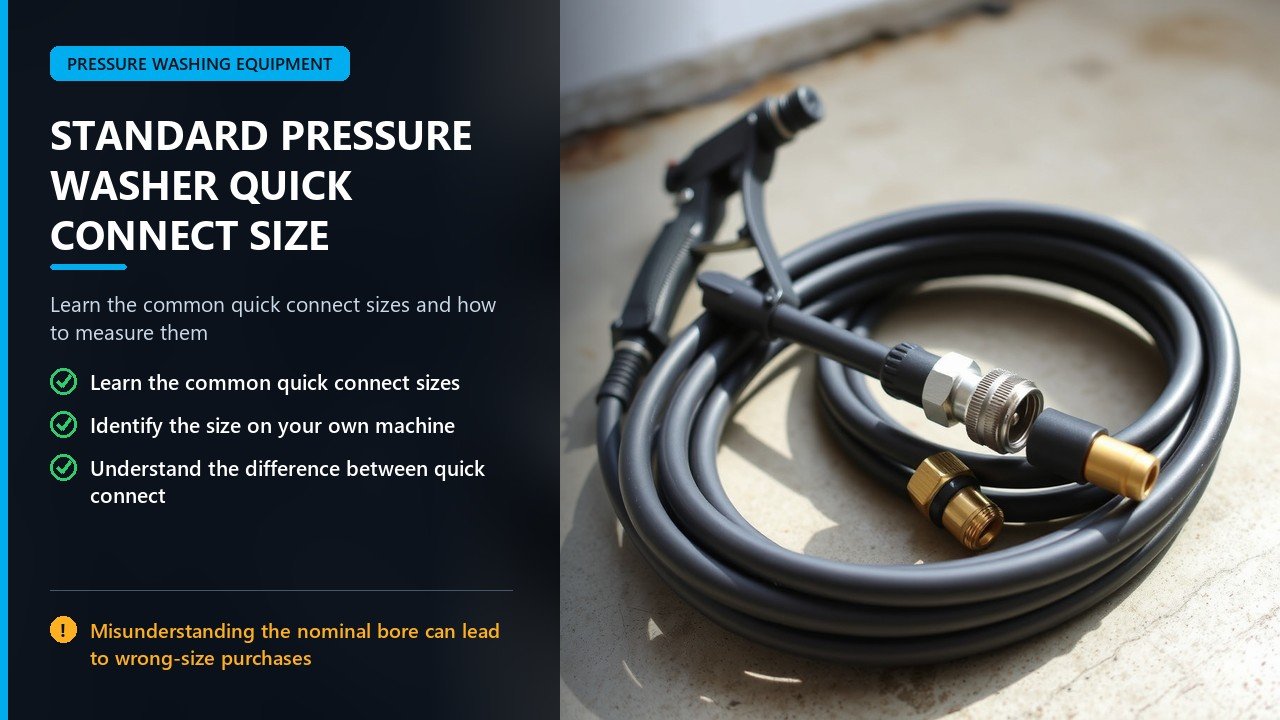
Standard Pressure Washer Quick Connect Size and How to Measure It Right
There is one moment that ruins more pressure washer projects than any broken part: standing in a hardware aisle holding two fittings that both claim to be the standard size, knowing that one will click perfectly into your gun and the other will never fit. The “standard” pressure washer quick connect size is not a single number, and that is exactly why so many owners order the wrong part. A handful of sizes dominate the market, they are described with confusingly similar language, and the difference between a 1/4-inch and a 3/8-inch system is invisible until you try to connect them.
This guide removes the guesswork. You will learn the common quick connect sizes and what the numbers actually measure, how to identify the size on your own machine in a minute or two, the difference between quick connect and threaded standards like M22, which size fits which class of machine, how to convert between sizes when you must, and the buying habits that stop wrong-size returns. By the end, you will know your machine’s fitting size the way you know its pressure rating, and the aisle will stop being a gamble.
The Sizes You Will Actually Meet
Pressure washer quick connects cluster into a few common sizes, and knowing the cast of characters shortens every shopping trip.
- 1/4-inch quick connect: the smaller standard, common on compact electric pressure washers, many spray guns, and most color-coded nozzle tips. Light and inexpensive, best for lighter flow.
- 3/8-inch quick connect: the most common “standard” on residential and prosumer machines, used for hose ends, guns, wands, and surface cleaner connections. The size most people mean when they say standard.
- 1/2-inch and larger: heavy commercial and high-flow couplings, used on big belt-drive rigs and multi-operator machines where serious volume must pass without restriction.
- M22 threaded couplings: not quick connects at all, but metric threads (M22-14 and M22-15) found on the hose-to-pump connection and on many gun bases. They are the other half of the confusion.
If you remember one thing, remember that 3/8-inch is the residential standard and 1/4-inch is the compact standard, while M22 is a thread, not a click. Everything else is a variation or an upgrade, and most homeowners will only ever deal with 3/8-inch quick connects and M22 threads.
What the Numbers Really Measure
Quick connect sizes are quoted by nominal bore, and the actual outside dimensions are much bigger. That is why a tape measure is the wrong tool for judging size at a glance, and why sellers describe fittings by the system they fit rather than by a diameter in inches.
| Nominal Size | Approx. Plug Shoulder | Typical Flow Class | Where You See It |
|---|---|---|---|
| 1/4-inch | Roughly 0.4 inch across the wide part | Lower flow, light duty | Compact electrics, spray guns, tips |
| 3/8-inch | Roughly 0.5 inch across the wide part | Standard residential flow | Hose ends, guns, wands, surface cleaners |
| 1/2-inch | Larger still, proportionally | High flow, commercial | Big rigs and high-GPM machines |
These shoulder measurements are approximate guides, not precision specs, because brands vary and coatings add thickness. Use them to tell 1/4-inch from 3/8-inch at a glance, then confirm with the machine’s documentation or by test-fitting a known connector. The point is direction and proportion, not a caliper reading.
How to Identify Your Size in a Minute
The fastest, most reliable route to your fitting size is not measuring at all, but reading what your machine already tells you.
- Read the manual or parts list. Nearly every machine lists its hose, gun, and fitting specs, and this is the ground truth. If you have the manual, you are done.
- Look up the model online. A model number search usually surfaces the fitting standard from a parts page or a forum answer.
- Compare to a known connector. If you already own one quick connect that clicks into the machine, use it as a visual reference against the new part.
- Measure the plug shoulder as a tiebreaker. Rough 0.4 inch points to 1/4-inch, roughly 0.5 inch to 3/8-inch, and noticeably larger to a commercial size.
- Check the thread on the pump side. If the connection you care about is threaded, measure or match the thread (M22-14 versus M22-15 are the usual suspects), because that side follows a different standard.
Doing that in order nearly always lands the correct size in under a minute, and it beats ordering three candidate fittings and returning two. Our guide to quick connect fittings and sizes walks through the identification with photos of each type.
Quick Connect Versus Threaded: The Real Split
Many “wrong size” complaints are actually standard mismatches, not size errors. The two families are simply different.
| Standard | How It Joins | Where It Lives | Common Confusion |
|---|---|---|---|
| Quick connect | Push and click, spring collar | Gun front, wand, tips, many hose ends | Sold as “M22 quick connect” which is not one thing |
| M22 thread | Threads on, needs sealant | Pump outlet, hose ends, gun base | M22-14 and M22-15 are not interchangeable |
| GHT (garden hose thread) | Threads, standard spigot thread | Water inlet from the tap | Confused with the high-pressure side |
If your machine’s connection is threaded, buying a quick connect plug for it will never fit, no matter the size. The fix is a thread-to-quick adapter that carries the correct thread on one end and the quick connect plug or socket on the others. Our guide to matching M22, GHT, and quick connect adapters covers exactly which adapter bridges which pair.
What Size Fits What Machine
Matching the size to the machine protects both fit and performance, because an undersized coupling restricts flow.
- Compact electric (up to ~2000 PSI): usually 1/4-inch quick connect on the gun and tips, often M22 at the hose.
- Mid and home gas (2000-3500 PSI, 2.5-3.5 GPM): typically 3/8-inch quick connect on the main line and tips, M22 at the pump and hose.
- Prosumer and commercial (4+ GPM): 3/8-inch and larger, with flow-conscious couplings so the bore does not steal GPM.
- High-flow rigs (5-8 GPM): larger bores, often 1/2-inch or dedicated high-flow quick connects.
If you ever upgrade to a higher-flow machine, revisit your couplings. A rig that moves serious volume through an undersized fitting loses effective pressure for no reason other than a bottleneck. Our explanation of PSI versus GPM shows why flow, and therefore bore, matters so much.
Converting and Adapting Between Sizes
Sometimes you cannot avoid mixing systems, and the right adapters make it clean.
- Thread-to-quick adapters: convert an M22 thread to a quick connect in the matching size, the most common conversion.
- Size reducers and bushings: mate a 1/4-inch accessory to a 3/8-inch line or the reverse, though reducing a big line down can cost flow.
- M22-14 to M22-15 adapters: bridge the two metric thread variants that look nearly identical but do not seal against each other.
- GHT to quick connect: used on the water inlet side to standardize your feed hose.
Adapt wherever the mismatch is real, but keep the number of adapters to a minimum. Every extra joint adds a seal that can leak and a bore transition that can disturb flow. A well-planned system has few adapters because the buyer chose the correct sizes up front. Our overview of choosing the right coupler set helps you plan a system that needs few conversions.
Buying the Correct Size Every Time
The habits that end wrong-size purchases are simple and quick.
- Identify your machine’s standard from the manual or model lookup before shopping.
- Photograph your existing connector and compare it to the product listing.
- Check whether the connection is quick connect or threaded, not just what size it is.
- Buy a small assortment of O-rings with any fitting order, since the seal is the usual failure point.
- Keep the packaging and receipt until the part clicks and holds pressure, so a wrong item is a quick return, not a lost cause.
- Standardize new builds on one size, so future parts are a known quantity.
Cheap fittings tempt buyers with a low price per piece, but the cost of returns, leaks, and wasted afternoons usually exceeds the savings. Our deep dive on quick connect fittings that lock tight covers the quality differences that make a fitting worth its price.
Anatomy of a Quick Connect Fitting
Understanding the parts of a quick connect helps you buy the right one and diagnose it when it fails. Every coupling is a two-piece set, and each piece has a role.
- The plug (male): the part with a groove around its tip. The groove is what the socket’s mechanism grabs, which is why a worn or nicked groove leaks or pops.
- The socket (female): the shell that receives the plug, containing a spring-loaded collar and a set of ball bearings that drop into the plug’s groove when the collar is released.
- The collar (sleeve): the ring you pull or push to release the plug. A stiff, loose, or jammed collar is a fitting on its way out.
- The O-ring: the actual seal, sitting inside the socket where it meets the plug’s face. Most leaks blamed on the coupling are really worn O-rings.
- The thread or tail: the end that attaches the coupling to a hose, gun, or wand, which may itself be quick connect, M22, GHT, or NPT depending on the design.
Sizing lives in two of those parts: the plug’s diameter class (which sets 1/4-inch versus 3/8-inch) and the tail’s thread or coupling standard. Buy a set that matches both, and the connection clicks and seals. Match the size but miss the standard, and you get the classic frustration of two pieces that almost fit. Our guide to matching every connection correctly breaks down the pairing rules by part.
Threads in Depth: M22, GHT, NPT, and BSP
The threaded side of a pressure washer has its own geography, and knowing it prevents a whole class of wrong purchases.
| Thread Standard | Typical Use | Key Detail |
|---|---|---|
| M22-14 | Hose-to-pump and some gun bases | 14 mm bore; common on many machines |
| M22-15 | Some hose and wand connections | 15 mm bore; looks like M22-14 but does not interchange |
| GHT (garden hose thread) | Water inlet from the tap | Standard spigot thread, low pressure side |
| NPT / BSP | Various fittings and accessories | Similar-looking tapered threads that are not compatible across standards |
The M22-14 versus M22-15 trap deserves special attention, because the two are visually similar and owners often buy the wrong one assuming “M22 is M22.” The bore differs, and a 14 will not seal against a 15. If your machine is threaded there, measure or confirm which variant you have before ordering a replacement hose or adapter. When in doubt, our guide to hose fitting types and threads helps pinpoint the exact standard on your machine.
Nozzle Tip Sizing and the Color Code
Quick connect fits the tips too, and tip sizing is a related skill that trips up the same buyers. Pressure washer nozzles follow a color code for spray angle, and a size number for orifice flow.
- Colors set the angle: red is 0 degrees, yellow 15, green 25, white 40, and black is usually the soap/low-pressure tip.
- Numbers set the orifice: the size number matches the orifice to your machine’s GPM so the nozzle delivers the intended pressure rather than choking or under-driving the pump.
- Size matching matters: a nozzle sized too small for your GPM spikes pressure; too large and you lose the cleaning force you paid for.
Most residential tips use the 1/4-inch quick connect standard, so if your machine uses 3/8-inch on the main line, you may need a 3/8-to-1/4 adapter at the wand or a tip holder. Our nozzle guide to the color and size chart pairs the two systems clearly, and it is worth keeping handy when you order tips.
O-Rings: The Real Seal, and the Real Failure
When a correctly sized quick connect leaks, the O-ring is almost always the cause, and O-rings come in sizes just like the couplings do.
- Quick connect O-rings sit inside the socket and seal against the plug face. They flatten, crack, or vanish over time, and a cheap replacement restores the seal instantly.
- Gun and wand seals are separate O-rings at the inlet and outlet, often a different size than the coupling rings.
- Material matters: standard rubber or EPDM handles most water; for hot water or chemical exposure, choose a higher-temperature or chemically resistant ring.
- Lubrication helps: a dab of silicone grease on a fresh ring seats it without tearing and extends its life.
Keeping a small assortment of O-rings sized for your system turns a leaking fitting into a two-minute fix instead of a trip to the store. If you standardize on one coupling size, buy its matching O-rings in bulk and you will rarely be caught short. Our leak-free guide to matching quick connects correctly covers the seal maintenance that prevents most drips.
Building a Size-Standardized Kit
The smartest money you spend on fittings is the money that makes every future purchase obvious. Build around one size and keep spares.
- Pick your main coupling size (usually 3/8-inch for a residential gas machine, 1/4-inch for a compact electric) and stay in it.
- Collect the adapters you actually need: the M22-to-quick adapters for your pump and gun, and a 3/8-to-1/4 bushing only if you use 1/4-inch tips.
- Buy the main parts in pairs: two plugs, one socket, plus an extra plug for the part most likely to get dropped.
- Add an O-ring assortment for your size and replace rings at the first sign of a seep.
- Label your spares by size so a rushed morning does not turn into a wrong-part decision.
A standardized kit pays for itself the first time you swap a wand or a tip without a trip to the store. It also makes your rig easier to hand to a helper, because everyone knows which parts fit which connection. Our article on choosing the right couplers walks through building that kit part by part.
Special Cases and Tricky Machines
A few situations reliably confuse buyers, and each has a clean answer once you know the pattern.
Old or off-brand machines. A machine with no manual and a faded label can still be sized by inspection: identify whether the connection is threaded or click, then match the size by comparing to a known part. If the connector is an unusual proprietary design, an adapter or a flexible replacement hose often solves it more cheaply than hunting the original part.
Surface cleaners and water brooms. These accessories usually connect by a single quick connect plug sized to your hose, but larger units may use a threaded swivel instead. Confirm both the coupling size and whether it is a plug or a socket before ordering, because a surface cleaner that will not connect is useless on the first big job.
Foam cannons and injectors. These usually take a 1/4-inch quick connect at the inlet, which means a 3/8-inch rig needs a bushing. That is fine for a foam cannon, whose flow is modest, but do not put the same bottleneck in front of a high-GPM nozzle pass.
Hot water rigs. Heat stresses both the O-rings and the collars, so use fittings rated for the temperature and consider a larger bore to reduce turbulence and hot spots. A fitting that works flawlessly cold can weep or bind once hot water runs through it.
If you can classify your machine into one of these cases, the correct size usually falls out immediately, and the purchase becomes a matter of ordering the right adapter rather than solving a puzzle.
A Quick Size Cheat Sheet
Keep these rules of thumb in your head and most size questions answer themselves. Residential gas and prosumer machines run 3/8-inch quick connects on the main line, wands, and most hose ends, with M22 threads at the pump and sometimes the gun base. Compact electric machines and virtually all color-coded tips run 1/4-inch quick connects. High-flow commercial rigs move up to 1/2-inch or larger. Garden hose inlets use GHT, and the high-pressure pump outlet and hose connections commonly use M22-14 or M22-15 depending on the manufacturer. When you cannot tell 1/4-inch from 3/8-inch at a glance, remember that the 3/8-inch plug is clearly the larger of the two across its shoulder, and when a connection is threaded rather than click, you are in the M22 world and need an adapter, not a differently sized coupling. Three sentences, and the aisle stops being intimidating.
Frequently Asked Questions
What size are most pressure washer quick connects?
The most common residential standard is 3/8-inch, while compact electric machines and most nozzle tips use 1/4-inch. Commercial rigs may use 1/2-inch or larger high-flow couplings. Confirm from your manual before buying.
Is a 3/8 quick connect the same as an M22?
No. A 3/8-inch quick connect is a push-and-click coupling; M22 is a metric threaded connection. They are different families and require a thread-to-quick adapter to join. Confusing the two is the most common fitting mistake.
How do I measure a quick connect fitting?
Look up the machine’s spec or model number first. If you must judge physically, compare the plug’s shoulder to a known connector, since a 3/8-inch plug is noticeably larger than a 1/4-inch one. The size refers to nominal bore, not outer diameter.
Can I use a 1/4 quick connect on a 3/8 hose?
Only with a bushing or adapter, and doing so restricts flow, especially on higher-GPM machines. It works for light accessories, but for the main line match the coupling bore to the hose and pump for full performance.
Why does my new quick connect not fit my gun?
Either the size differs (1/4-inch versus 3/8-inch) or the standard differs (quick connect versus M22 thread). Check both the size and the joining type, because a correct size in the wrong family still will not connect.
Are all pressure washer tips the same size?
Most residential tips use the 1/4-inch quick connect standard, but not all. Some machines and pro setups use threaded nozzles or a different coupling, so check your wand before ordering a tip set. The color code handles the angle; the size number and coupling handle the fit.
Can I upgrade a 1/4-inch machine to 3/8-inch fittings?
You can adapt the connections, but there is rarely a benefit on a machine whose pump only produces 1/4-inch-class flow. Upgrading the couplings does not add GPM. Save the 3/8-inch standard for machines that actually move more water.
Do quick connect sizes vary between brands?
The nominal sizes are standardized, so a 3/8-inch plug from one brand generally clicks into a 3/8-inch socket from another. The variance is in quality, materials, and coatings, not in the basic fit, which is why matching the nominal size across brands usually works.
The Bottom Line
The standard pressure washer quick connect size is 3/8-inch for most residential and prosumer machines and 1/4-inch for compact electrics and tips, with M22 threads handling the pump and hose connections on many models. The trick is to read those specs as nominal bore and joining style, not as a ruler measurement, then confirm your machine’s fit from its manual or model lookup before you buy. Do that, photograph your existing connector, and keep a few O-rings on hand, and the fitting aisle becomes a one-trip errand instead of a guessing game. Knowing your size cold is a small skill that saves a surprising amount of money, time, and irritation every season.