Dave bought his first pressure washer for a single reason: the black stripe running down his driveway. He spent a Saturday afternoon with the green 25-degree tip that came in the box, working in slow, careful rows, and when the sun went down he had cleaned roughly a third of the slab. The concrete looked better where he had been, worse where the rows overlapped, and exactly the same where he had not reached yet. His neighbor walked over, looked at the machine, and said the five words nobody wants to hear after eight hours of work: “You needed the turbo nozzle for that.”
The next weekend Dave tried one. He finished the driveway in under two hours, the oil stain near the garage came up without a second pass, and he spent the rest of the afternoon wondering why nobody had explained the thing properly when he bought the washer. That is the problem with turbo nozzles. Everybody sells them, half the people who own them use them wrong, and almost nobody sits down and explains what is actually spinning around inside that little chrome tip.
This guide does exactly that. Below you will find how a turbo nozzle works on a pressure washer, what it genuinely does better than a fixed spray tip, where it will destroy a surface if you are not careful, how to size one to your machine’s PSI and GPM, and the operating habits that separate a clean driveway from an etched one.
What a Turbo Nozzle Actually Is
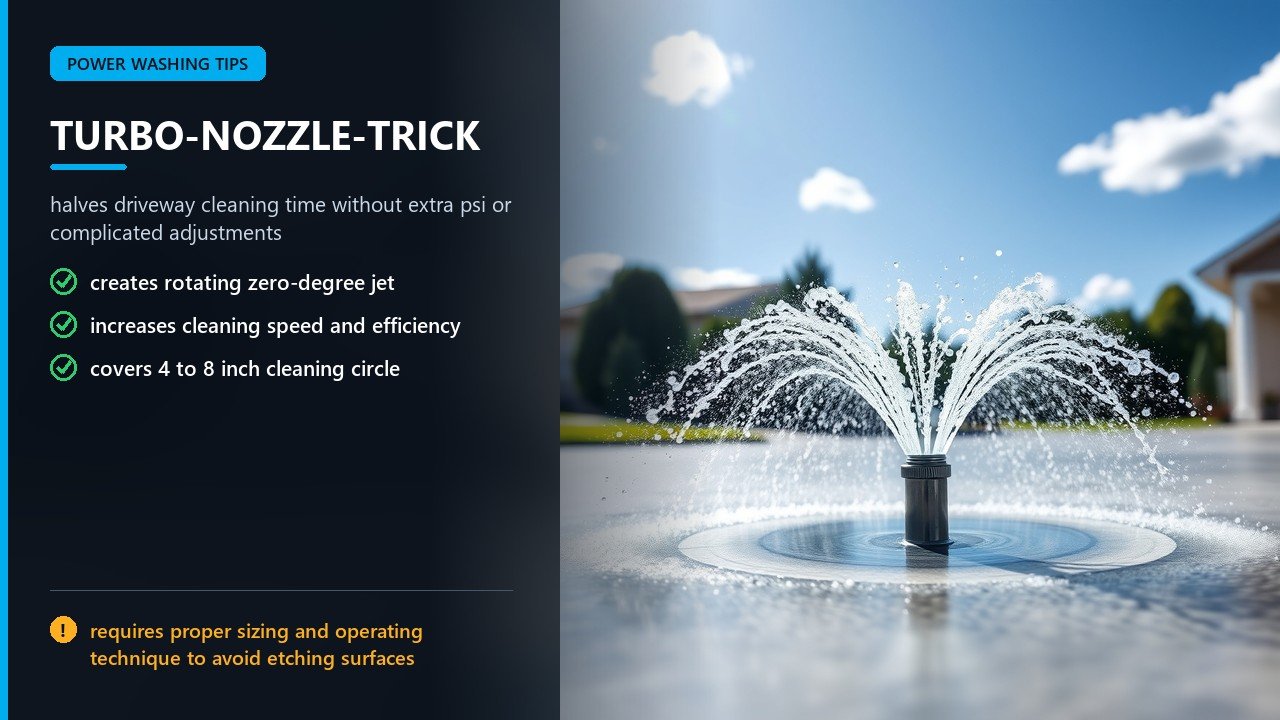
A turbo nozzle, also called a rotary nozzle or rotating nozzle, is a pressure washer accessory that converts a stationary pencil-thin stream into a rapidly spinning cone of water. The industry uses the names interchangeably, so if you see “rotary tip,” “rotating jet nozzle,” or “turbo lance tip” on a listing, you are looking at the same basic idea.
The concept has been around for decades, but the modern version relies on a precision ceramic rotor seated inside a machined housing. Water enters through a standard fitting, usually a 1/4-inch quick connect, passes through a small orifice that accelerates the stream, and then strikes the angled surfaces of the rotor. The reaction force spins it. As the rotor turns, it sweeps the concentrated jet around in a circle, and the pattern you see on the ground is a tight ring roughly the size of a coffee can lid.
What makes the design clever is that nothing electrical or mechanical is driving it. The energy comes entirely from the water your pump is already pushing. That is why a turbo nozzle works on a small electric machine and on an 8 GPM diesel rig alike, as long as the orifice size and pressure rating are matched correctly to the washer.
Compared with a standard spray tip, the difference is simple. A fixed nozzle holds one spray angle forever: 0 degrees, 15 degrees, 25 degrees, 40 degrees. A turbo nozzle takes the intensity of the 0-degree red tip and distributes it across a moving path, so you get the cutting power of a pinpoint stream with roughly the coverage of a wide fan. Our guide to power washing nozzle tips breaks down every fixed color if you want the full picture.
How a Turbo Nozzle Works Inside
Understanding the mechanics helps you use the tool well and diagnose it when it misbehaves. There are four stages, and each one matters.
Stage one: the orifice concentrates the stream
Water arrives at the nozzle under pressure, typically somewhere between 1,500 and 5,000 PSI on consumer and commercial machines. It is forced through a small hole called the orifice. Because the same volume of water has to squeeze through a smaller opening, it leaves faster, and a faster stream hits harder. This is the same reason a thumb over a garden hose makes the water jet stronger.
The orifice size is the single most important number on the nozzle. It is stamped on most tips as a fraction or a decimal, and picking the wrong one either starves your pressure or over-pressurizes the pump. We cover that sizing math in detail further down.
Stage two: the rotor converts linear flow into rotation
Inside the housing sits a ceramic or hardened-steel rotor, sometimes described as a spinning ball or turbine. The jet leaves the orifice at an angle and hits the rotor’s curved surface. Newton’s third law does the rest: the water pushes the rotor, the rotor pushes back, and the part spins freely at several thousand revolutions per minute. Most sources place typical rotor speed around 3,000 RPM, though it varies with flow and pressure.
Ceramic is the preferred material because it resists erosion. Water moving at high speed carries minerals and grit, and a soft metal rotor would wear out in hours. Ceramic holds its shape, which keeps the spray pattern consistent over a long service life.
Stage three: the spinning jet sweeps a circle
As the rotor turns, the jet sweeps with it, tracing a circular path typically 4 to 8 inches across. From the operator’s view, the stream looks like a blurry ring rather than a solid line. The jet itself still carries near-zero-degree intensity, but because it never rests on one square inch for more than a fraction of a second, the surface gets hammered from many angles instead of being drilled at one.
That is the entire trick. Concentrated impact, moving target. It is also why the pattern cleans faster: overlapping passes cover area while the impact stays high.
Stage four: the spray rebounds and lifts debris
Because the jet strikes the surface at a slight angle as it rotates, the water also gets under the dirt and throws it sideways instead of driving it straight down into the pores of the concrete. On porous surfaces like block, brick, and aged concrete, that lifting action is a large part of why a turbo nozzle outperforms a fan tip at the same pressure.
Turbo Nozzle Versus Fixed Spray Tips
Neither option is universally better. They solve different problems, and knowing which one to reach for saves time and prevents damage. The comparison below lays out the practical differences.
| Factor | Turbo Nozzle | Fixed Spray Tip (0/15/25/40) |
|---|---|---|
| Impact pattern | Near-zero-degree jet sweeping a 4 to 8 inch circle | Stationary fan or pencil stream held in one shape |
| Coverage per pass | Wide, circular, and forgiving of overlap | Narrow and exact; depends entirely on your sweep |
| Cleaning speed on hard grime | Typically cuts time roughly in half on concrete and brick | Slower; a 0-degree tip covers almost nothing on its own |
| Surface safety | Aggressive; can etch if held close or left stationary | Wider angles are far gentler and predictable |
| Detergent use | Not designed for soap application | Black low-pressure tip handles soap properly |
| Cost and upkeep | Higher price, moving parts, needs cleaning | Cheap, simple, essentially maintenance-free |
| Best everyday job | Concrete, brick, stone, stripped equipment | Vehicles, siding, decks, rinsing, soap |
The practical takeaway is that a turbo nozzle is a specialist. Contractors keep one on the truck for driveways, curbs, loading docks, steps, and anything with embedded grime, then switch back to a 25-degree or 40-degree tip for everything else. Our guide to choosing the best turbo nozzle covers the buying side of that decision in depth.
One warning worth repeating: a turbo nozzle is not a bigger number at the end of your wand. It does not raise pump pressure. It rearranges the pressure you already have. If your washer struggles with a job at 2,500 PSI, a turbo nozzle will help it bite harder, but it will not turn a 2.0 GPM electric machine into a 4 GPM commercial rig.
Where a Turbo Nozzle Excels and Where It Fails
Used in the right place, a turbo nozzle is the fastest attachment you can put on a wand. Used in the wrong place, it is a very efficient way to ruin a surface.
Strong fits:
- Concrete driveways and sidewalks. The classic use case. Oil stains, tire marks, algae, and embedded dirt come up quickly, and the circular action avoids the stripe pattern that fan tips often leave.
- Brick, block, and stone. The rotating jet reaches into mortar joints and textured faces without you having to angle the wand into every groove.
- Graffiti and paint removal. Concentrated moving impact breaks the bond between coating and substrate far faster than a wide fan.
- Heavy equipment and machinery. Caked mud on skid steers, tractor buckets, and trailer frames dissolves in a fraction of the usual time.
- Curbs, steps, and corners. Areas where a surface cleaner will not sit flat, and where a 0-degree tip would take all afternoon.
- Parking lots and loading docks. Commercial square footage where speed directly equals profit.
Poor fits and outright dangers:
- Wood decks and fences. The grain lifts, fibers fray, and the surface becomes splintery. Use a wider tip at reduced pressure instead. See our deck-safe nozzle guide for the correct approach.
- Vinyl and aluminum siding. You can cut the panel, force water behind it, and create a mold problem inside the wall.
- Painted surfaces. Expect striping or full removal depending on distance and dwell time.
- New, decorative, stamped, or sealed concrete. Fresh concrete has soft paste on the surface. A turbo nozzle held too close will expose aggregate or leave pale circular marks that never disappear.
- Weathered or repaired slabs. Weak areas can pit and crumble under concentrated impact.
- Tight, confined spaces. The spinning cone is wider than a pencil jet, so precision work in a narrow gap is awkward and less controlled.
How to Size a Turbo Nozzle to Your Machine
Choosing a turbo nozzle is not about picking the highest PSI rating on the shelf. It is about matching the orifice size to your washer’s flow rate and pressure. An orifice that is too large lets water pass too freely, your system never reaches working pressure, and the rotor spins weakly. An orifice that is too small restricts flow, pushes pressure above the design limit, cycles the unloader constantly, heats the pump, and can shatter the internal ceramic.
Manufacturers publish sizing charts, and you should always defer to the specific chart that comes with your nozzle. The table below shows how the relationship generally works so you can sanity-check any chart you are given.
| Your Washer Output | Typical Machine Class | Starting Orifice Size | What to Watch For |
|---|---|---|---|
| 1,200 to 1,600 PSI at 1.2 to 1.5 GPM | Small electric cold-water units | 4.0 to 5.0 | Many budget washers lack the flow to spin a turbo nozzle properly |
| 1,900 to 2,300 PSI at 1.7 to 2.0 GPM | Common homeowner corded electric | 3.0 to 4.0 | Buy a nozzle rated at or above your machine’s max PSI |
| 2,500 to 3,000 PSI at 2.4 to 2.8 GPM | Entry gas and premium electric | 2.5 to 3.5 | The most common consumer sweet spot |
| 3,000 to 3,600 PSI at 3.0 to 4.0 GPM | Contractor-grade gas machines | 2.5 to 3.0 | Confirm hot-water rating if you run a heated unit |
| 4,000 to 5,000 PSI at 4.0 to 8.0 GPM | Commercial and trailer rigs | 2.0 to 2.5, heavy-duty build | Cheap tips crack here; specify a high-impact housing |
Two rules cover almost every mistake people make. First, never go smaller than the chart says hoping for more pressure; you will overwork the pump and break the rotor. Second, always verify the nozzle’s maximum PSI rating is equal to or higher than your machine’s peak output, because the rating is what determines whether the ceramic survives the first ten minutes of use.
Flow rate deserves more attention than it usually gets. A turbo nozzle needs adequate GPM to keep the rotor turning. That is why the smallest battery and 12-volt units often disappoint with a turbo tip attached: they simply do not move enough water. If you run a high-flow machine, our breakdown of 5 GPM pressure washers explains why flow changes the math.
How to Use a Turbo Nozzle the Right Way
Technique matters more with this attachment than with any other tip you own. Follow this sequence and you will get professional results without damaging anything.
- Confirm the fit. Seat the nozzle fully into the 1/4-inch quick connect and make sure the collar snaps back over the collar groove. A partially seated tip can launch off the end of the wand under pressure.
- Check your ratings. Verify the PSI limit and orifice size against your machine before you connect water. This takes thirty seconds and prevents most equipment failures.
- Flush the line first. Pull the trigger with the old tip still on and run water through until it runs clear. Grit trapped in the hose will find the rotor immediately.
- Test on a hidden area. Pick a corner nobody sees. Work from a distance of 12 to 18 inches and move slowly toward the surface while you watch the result.
- Start the machine away from the surface. Pull the trigger before the stream reaches the slab so the jet does not blast one spot on startup.
- Keep moving. Steady walking pace, overlapping passes, never stopping in place. Dwell time is what etches concrete, and a turbo nozzle concentrates all that energy into one ring.
- Hold a slight angle. Working square-on drives the impact straight down; a shallow angle lets the rotating jet get under the dirt and throw it away from you.
- Use distance as your pressure dial. Move closer when you need more bite on a stubborn stain, back off when the surface looks clean.
- Relieve pressure before disconnecting. Shut the washer off, then squeeze the trigger once to bleed the line. Pulling a pressurized quick connect is how people chip teeth.
- Rinse and store dry. Flush the tip, shake out the water, and keep it out of freezing conditions. Our winterizing walkthrough covers the full cold-storage routine.
One habit separates experienced operators from everyone else: they never let the machine idle in bypass with the trigger released. The pump recirculates water, heat builds, and seals suffer. Shut down for any pause longer than a moment.
Turbo Nozzle Versus Surface Cleaner
This is the question that comes up on every concrete job, and the honest answer is that you usually need both. They are complementary tools with different strengths.
| Situation | Use the Turbo Nozzle | Use the Surface Cleaner |
|---|---|---|
| Large open driveway or patio | Edges, corners, and stubborn spots only | Main field work; faster and far more even |
| Steps, curbs, and vertical walls | Excellent; conforms to any shape | Awkward or impossible |
| Embedded oil and grease stains | Superior concentrated impact | Needs chemical pretreatment first |
| Uniform, streak-free finish | Can leave circles if your pace changes | Naturally consistent width per pass |
| Splash and overspray control | More scatter; expect mist and debris | Shrouded, much tidier near cars and windows |
| Setup time | Seconds; just swap the tip | Needs the right size housing for your GPM |
The professional pattern is straightforward. Run the surface cleaner for the main slab because it delivers even coverage at production speed, then follow with a turbo nozzle on the edges where the housing cannot reach, plus any spot that needs extra bite. Our surface cleaner guide explains how to match housing size to flow rate.
If you only own one attachment, the choice depends on your property. A small patio with corners and a couple of oil stains favors the turbo nozzle. A long, open driveway favors the surface cleaner, with a turbo tip bought later for the edges.
Common Turbo Nozzle Problems and What They Mean
Most turbo nozzle complaints come down to five causes. None of them usually mean the tool is finished.
- The rotor will not spin. Grit, mineral buildup, or a worn seat. Remove the tip, rinse it, and inspect the ceramic for chips. If the housing is scored or the ball will not turn freely by hand, replace it.
- The spray pattern is weak or mushy. Usually an oversized orifice for your machine, a partially closed garden hose, a clogged inlet filter, or a supply that cannot keep up. Rule out water supply before blaming the nozzle.
- The machine surges or the unloader keeps cycling. A classic sign the orifice is too small. System pressure is climbing above the pump’s comfort zone and the unloader is dumping it repeatedly. Step up one orifice size.
- Pressure dropped right after installing the tip. A worn orifice enlarges over time and loses the ability to build pressure. Nozzles are consumables; a dollar of wear shows up fast in cleaning performance.
- Streaks or uneven rings on the concrete. Inconsistent walking speed or stopping mid-pass. Slow down to a steady pace and overlap each pass by about half the pattern width.
If problems persist after you have checked the nozzle, the fault is probably upstream. A failing unloader, worn pump valves, a dirty inlet screen, or a hose that is too long for the flow will all imitate a bad tip. Our replacement nozzle guide walks through isolating the cause.
Safety Rules You Should Never Bend
A rotating zero-degree jet is not a toy, and the injury reports from the water-jetting industry make that clear. High-pressure water can penetrate skin and cause deep tissue damage that looks like a small scratch on the surface. Treat the tool with the same respect you would give a cutting disc.
- Wear eye protection and closed-toe boots. The rotating action throws debris in a full circle, not just forward.
- Never point the wand at people or animals. Not even briefly, not even at low pressure.
- Never press the tip against the surface. Keep distance; contact concentrates the jet and can kick the wand sideways.
- Keep the wand moving. Standing still for even a couple of seconds will mark concrete, soft wood, and thin metal.
- Watch your footing. Wet concrete plus a sweeping motion plus a wandering high-pressure stream is a bad combination.
- Stay clear of electrical fixtures, vents, and windows. Forcing water into a wall cavity or a light housing creates problems you cannot see.
- Manage runoff. Dislodged grease and contaminants should not reach a storm drain. Contain or recover wastewater on commercial jobs and follow local rules.
What to Look for When Buying a Turbo Nozzle
Prices run from under twenty dollars to well past a hundred, and the gap is not marketing. Here is what actually separates a good tip from a disposable one.
- Ceramic rotor quality. The heart of the tool. Cheap ceramic chips under grit and pressure; better grades hold their seat for seasons.
- Housing material. Stainless steel or anodized aluminum survives drops and job-site abuse. Thin chrome-plated brass is fine for occasional home use.
- Stated PSI and GPM range. A reputable nozzle will publish both. If a listing only advertises “universal fit” with no numbers, keep scrolling.
- Connection type. Most are 1/4-inch quick connect, but some thread directly onto the wand or use M22. Confirm before ordering so it matches your lance.
- Hot water rating. If you run a heated machine, the seals and lubricants must be rated for it. A cold-only tip will fail early on hot water.
- Serviceability. Some brands sell rebuild kits with a replacement rotor. On a working truck, a rebuildable tip costs less over a year than three throwaway ones.
- Pattern diameter. A 4-inch pattern bites harder and works in tight spaces; an 8-inch pattern covers ground faster on open slabs.
It pays to read listings carefully. A lot of the advice published in product descriptions is vague or simply wrong, which we covered in our piece on turbo nozzle listings. Buy from a manufacturer or supplier that publishes real sizing charts.
Frequently Asked Questions
Does a turbo nozzle increase pressure? No. It does not add PSI or GPM. It concentrates the pressure your pump already produces into a moving point, which makes the spray feel and clean more aggressively.
Is a turbo nozzle the same as a 0-degree nozzle? They are similar in impact but different in behavior. A red 0-degree tip holds the jet in one spot, while a turbo nozzle rotates it around a cone. The rotating path covers more area, though both can damage a surface if you get too close.
Can I use a turbo nozzle on a driveway? Yes, on sound, cured, uncoated concrete it is one of the best choices available. Test a hidden spot first, start farther away, and keep moving, because new, weak, or sealed concrete can show marks.
Why is my turbo nozzle not spinning? Usually grit or mineral buildup in the rotor, a worn seat, or insufficient water flow. Remove and rinse the tip, check that your supply is fully open, and confirm the orifice matches your machine.
What orifice size do I need? It depends on your PSI and GPM together. Small electric units generally land around 3.0 to 4.0, contractor gas machines around 2.5 to 3.0, and high-flow commercial rigs around 2.0 to 2.5. Always confirm against the manufacturer’s chart.
Do turbo nozzles work on wood? They should not be used on decks, fences, or any soft timber. The rotating concentrated stream raises grain and frays fibers. Use a 25-degree or 40-degree tip at reduced pressure instead.
Are turbo nozzles safe for cars? No. The impact is far too aggressive for paint, trim, and decals. Wash vehicles with a wide fan tip and plenty of distance, or use a dedicated surface brush.
How long does a turbo nozzle last? With clean water and proper sizing, many seasons. Hard water, gritty supply, over-small orifices, and freezing storage are what shorten the life.
Should I buy a turbo nozzle or a surface cleaner? For large open flatwork, the surface cleaner wins on speed and uniformity. For edges, steps, vertical masonry, and isolated heavy stains, the turbo nozzle wins. Most crews end up with both.
Final Thoughts on the Turbo Nozzle
The turbo nozzle earns its reputation honestly. On concrete, brick, stone, and equipment, a properly sized rotary tip cleans noticeably faster than any fixed fan and far more evenly than a stationary zero-degree stream. It is the attachment that turns an afternoon of slow, striped passes into an hour of steady work.
It earns a bad reputation when people treat it as a universal answer. Wood, siding, paint, delicate stone, and fresh concrete all want a wider, gentler tip. The tool does not know the difference between a driveway and a deck; that judgment is yours.
Get the orifice size right, confirm the pressure rating, test before you commit, keep the wand moving, and clean the rotor after every use. Do those four things and a good turbo nozzle will be the hardest-working accessory in your toolbox for years.
Sources and Further Reading
- PowerWash.com, turbo nozzles for professional contract cleaners: powerwash.com
- AR North America, turbo versus rotary nozzle knowledge base: arnorthamerica.com
- Generac, pressure washer nozzles explained by spray angle: generacpowerproducts.com
- Mi-T-M, how to choose the right pressure washer nozzle: mitm.com
- Angi, types of pressure washer nozzles and their uses: angi.com
- U.S. Occupational Safety and Health Administration, hand and power tool safety: osha.gov