If you have shopped for a serious gas pressure washer, you have noticed the same name keep appearing on the machines that cost more and last longer. It shows up on belt-drive rigs that push 4 gallons a minute at 4000 PSI, on trailer-mounted setups, and on equipment that rental yards trust to run all day. That name is the Honda GX270, and a Honda GX270 power washer is a different animal from the budget machines sitting beside it at the store.
The GX270 is a 270cc commercial overhead-valve engine, rated at roughly 8.5 to 9 horsepower. It is the next step up from the well-known GX200, and it exists because bigger pumps need more power to spin them. When you move from 2.8 GPM to 4 GPM, or from 3200 PSI to 4000 PSI, you need an engine with the torque to hold that load for hours without bogging down. That is exactly the job the GX270 was built to do.
This guide explains what the GX270 is, why it sits on the highest-quality gas pressure washers, what those machines do well, how to maintain them, and who should actually spend the money. If you are weighing a GX270 rig against a cheaper one, this will help you decide with clear eyes.
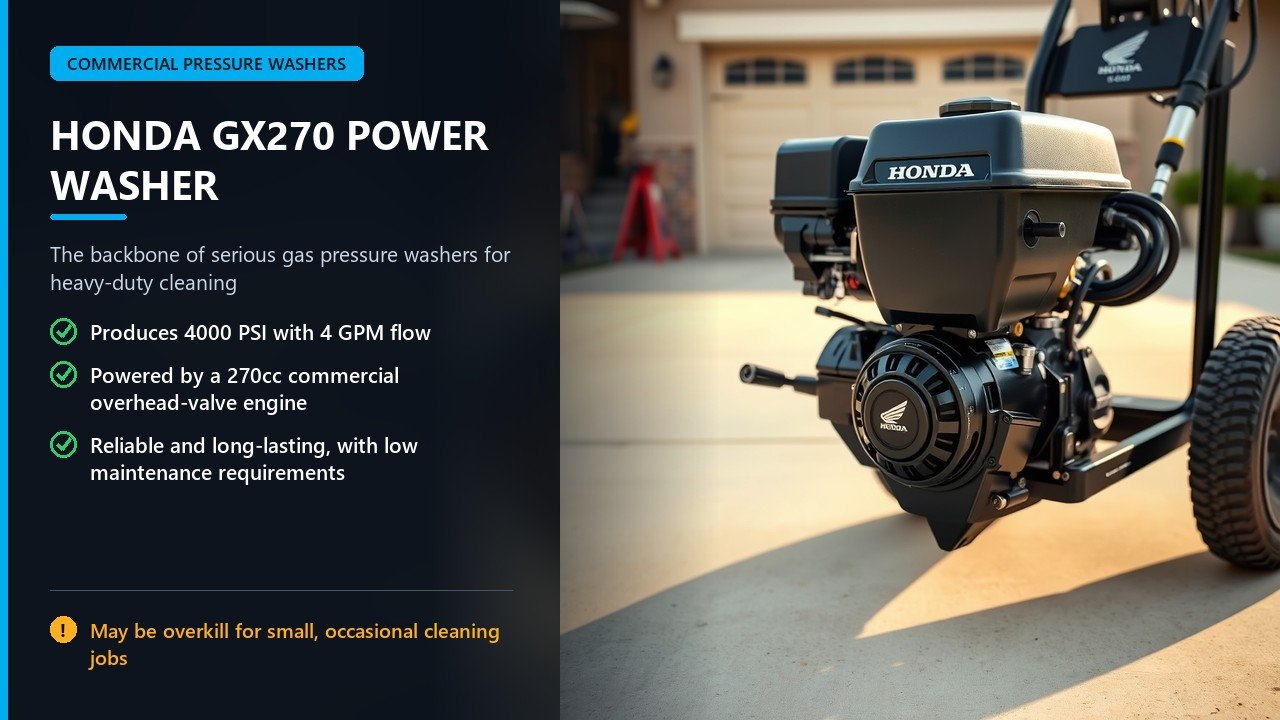
What the Honda GX270 Actually Is
The GX270 is a single-cylinder, air-cooled, overhead-valve engine displacing 270cc. It is part of Honda’s GX commercial series, and that distinction matters. The GX line is engineered for continuous duty in demanding equipment, from water pumps to generators to pressure washers, and it has earned a reputation as one of the most reliable small-engine platforms ever built.
Key characteristics that make it a good match for a pressure washer:
| Feature | What It Means for a Pressure Washer |
|---|---|
| 270cc displacement | Enough torque to drive large triplex pumps up to about 4 GPM without bogging |
| Roughly 8.5 to 9 horsepower | Holds pressure and flow under continuous load |
| Overhead valve design | Runs cooler and more efficiently than old flathead engines |
| Low oil shutdown (Oil Alert) | Protects the engine from the most common cause of failure |
| Recoil or electric start | Easy starting even on cold mornings |
| 25mm keyed shaft | Standard for direct and belt drive pump couplings |
| Available parts everywhere | Serviceable for decades, not disposable |
The engine is physically larger and heavier than a GX200, usually around 55 to 60 pounds by itself. That weight is a tradeoff for the extra power, and it is one of the reasons GX270 machines tend to be belt-drive or mounted on carts and trailers rather than carried by hand.
Why the Engine Is the Backbone of a Serious Rig
The pressure washer a homeowner buys at a big-box store and the pressure washer a professional depends on look similar from across the parking lot. They are not. The difference is usually the engine and the pump, and the GX270 is the engine half of that equation.
A cheap pressure washer pairs a residential engine with an axial cam pump. That combination works for light weekend use, but the pump is sealed and disposable and the engine is built to a price. A serious pressure washer pairs a commercial engine like the GX270 with a triplex plunger pump that can be rebuilt. The result is a machine that runs for thousands of hours, not a few dozen uses, and that can be repaired instead of replaced.
This is why you see the GX270 on belt-drive machines in particular. Belt-drive setups separate the pump from the engine with a belt and pulley system, which does several good things. It lets the pump run at a different speed than the engine for optimal performance, it isolates the pump from engine heat and vibration, it makes the pump easier to service, and it usually produces a smoother, more consistent flow than direct drive. The GX270 has the power to drive a big belt-drive pump comfortably, which is precisely why the pairing is so common on commercial machines.
What a Honda GX270 Power Washer Does Best
Machines built around this engine are aimed at real work. Here is where they earn their keep.
Commercial flatwork. At 4 GPM and 4000 PSI, a GX270 rig drives large surface cleaners efficiently. The flow rate is the key to fast, even concrete cleaning, and this class of machine has it.
All-day operation. The GX series is built for continuous duty. On a job where the machine runs for hours, a commercial engine and a rebuildable pump keep going where a budget machine overheats and quits.
Two-gun setups. Higher-flow belt-drive machines with a GX270 can often support two operators sharing the flow, which doubles productivity on large properties.
Fleet and rental use. Rental yards and cleaning companies value reliability above all, and the GX270’s reputation is exactly why it appears in those fleets. Easy starting, low oil shutdown, and easy service keep downtime low.
Long-term investment. A GX270 machine is designed to be rebuilt and kept. Over a decade, that ownership cost can be far lower than repeatedly replacing disposable units.
Where These Machines Fall Short
An honest look has to include the downsides, because a GX270 rig is not the right answer for everyone.
It costs significantly more than a residential machine, often several times as much. It is heavy, so portability suffers, and many of these machines are best moved on wheels or a trailer. It is a gas engine, so it is loud, produces exhaust, and must never be run indoors. Most are cold water machines, so heavy grease removal still calls for a hot water unit. And it is more machine than a casual user needs, which means you may be paying for capability you never use.
If your needs are light, an electric or a smaller gas machine will serve you well for far less. Our article on the 220v power washer covers the electric route for indoor and fixed-location work, and the guide on why the DeWalt 3200 PSI pressure washer holds up covers the middle ground.
GX270 vs GX200 vs Cheaper Engines
Understanding where the GX270 sits in the lineup helps you buy the right machine.
| Engine | Displacement | Typical Use | What It Powers |
|---|---|---|---|
| Honda GC series | Varies | Residential | Budget washers, light use |
| Honda GX200 | 196cc | Commercial light to medium | 2.5 to 2.8 GPM, up to about 3200 PSI |
| Honda GX270 | 270cc | Commercial medium to heavy | About 4 GPM at up to 4000 PSI |
| Honda GX390 | 389cc | Heavy commercial | 5 GPM and above, very high flow rigs |
The pattern is simple. As flow and pressure rise, the engine has to grow to supply the torque. The GX270 is the sweet spot for the popular 4 GPM by 4000 PSI class, which is why it is such a common sight on quality belt-drive machines. Step up to 5 GPM and above and you are in GX390 territory.
What to Check Before You Buy
Whether the machine is new or used, run this checklist.
Confirm the engine model on the plate. Look for GX270 specifically. Do not accept “Honda powered” as proof of the commercial GX line.
Identify the pump. A machine of this class should carry a name-brand triplex pump, such as General, Comet, or AR, not a sealed axial cam unit. The pump is the other half of the value.
Inspect the pump oil. A triplex pump has its own crankcase. Check the level and condition, and be wary of a milky or low reservoir. Our guide to the oil that goes in a pressure washer pump explains what to use.
On belt drive, inspect the belt and pulleys. Look for cracking, glazing, or misalignment. A worn belt is cheap to replace, but misalignment tells you the machine was abused.
Check for leaks at the pump and fittings. Drip marks, corrosion, and cracked housings are signs of trouble, and a rebuild is only worthwhile if the rest of the machine is sound.
Run it under load. Connect water and pull the trigger. Pressure should hold steady. Surging points to air, a clogged inlet screen, or an unloader problem.
Ask about the maintenance history. An owner who knows the oil change intervals and the last pump service has cared for the machine, and that is worth paying a little more for.
Maintenance That Keeps a GX270 Running for Years
The reason to buy commercial-grade is longevity, and maintenance is how you collect on that promise.
Change the engine oil at Honda’s recommended intervals and check it before every use, because the low oil shutdown is a safety net, not a substitute for checking. Keep the air filter clean so the engine breathes freely and runs efficient. Use fresh fuel and treat or drain the tank before storage so ethanol does not clog the carburetor. Check the pump oil regularly and top it with the correct grade. Inspect and replace the drive belt on schedule on belt-drive machines, and keep the pulleys aligned. Flush the pump with clean water after every use and always purge air before running. Store the machine indoors, drain the water, and protect the pump from freezing.
Accessories matter too. A worn or undersized hose chokes flow, and keeping the hose protected pays off. Our explainer on why a heavy duty pressure washer hose reel pays off covers hose care, and the guide on the pressure washer nozzle replacement helps you keep full cleaning power at the tip.
Who Should Buy a Honda GX270 Power Washer
Buy a GX270 machine if you are a professional or a serious property owner who needs dependable high-flow cleaning for concrete, large driveways, commercial flatwork, and multiple properties. It is the right choice if downtime costs you money and you want a machine that starts every time, holds pressure, and can be rebuilt for decades.
Do not buy it if you need something light and portable, if you work indoors, if you need hot water, or if your cleaning needs are occasional and light. In those cases, a smaller gas, electric, or hot water machine will serve you better and cost far less. The GX270 is a tool for people whose work depends on it.
What 4 GPM Actually Feels Like on the Job
Spec sheets do not convey the difference flow makes, so let us put it in practical terms. Flow, measured in gallons per minute, is what carries dirt away. Pressure breaks grime loose, but flow is what flushes it off the surface and lets you move. A machine at 4 GPM moves roughly a third more water than a 3 GPM machine and nearly double a 2.5 GPM unit, and that difference shows up directly in how fast you finish.
On a 2.5 GPM machine, cleaning a typical two-car concrete driveway with a surface cleaner can feel like a slow crawl, and you often end up going over the same patch twice to get it even. On a 4 GPM belt-drive rig with a GX270, the same driveway cleans noticeably faster with a single consistent pass. Multiply that across a full day, and the time savings are the reason professionals consider flow the most important spec on the machine.
The extra flow also unlocks better tools. A two-gun setup becomes realistic, letting two people clean at once while sharing the output. Larger surface cleaners work as intended instead of stalling. Rinsing takes less time because the water carries debris away instead of merely moving it around. For anyone who cleans for a living, this is not a luxury. It is the difference between finishing three jobs a day and finishing five. And it ties directly to the engine: without the torque of something like the GX270, a 4 GPM pump would bog down under load and never deliver its rated flow.
How a Belt-Drive GX270 Rig Is Set Up
Understanding the layout helps you buy the right machine and maintain it properly. Most GX270 pressure washers follow one of two designs.
Direct drive. The pump bolts directly to the engine shaft, so the pump spins at engine speed. This is simpler, lighter, and less expensive. It is fine for many applications, but the pump runs hot and receives engine vibration directly, which shortens its life compared with belt drive.
Belt drive. The engine and pump sit separately on a frame, connected by belts and pulleys. This arrangement is heavier and more expensive, but it offers real advantages. The pulley ratio lets the pump run at its ideal speed regardless of engine RPM, which improves efficiency and pump life. The belt absorbs shock and vibration. The pump stays cooler because it is farther from the engine. The belt acts as a mechanical fuse, slipping or breaking before expensive damage reaches the pump, and replacement is simple. The pump is also easier to reach for service.
A typical commercial GX270 belt-drive rig includes the engine, a triplex pump with an unloader and thermal relief valve, a large fuel tank for long runtime, a battery for electric start on some models, pneumatic tires, a hose reel, and a heavy steel frame that may be portable or skid-mounted. Some are built for trailers or truck beds, which is where the skid mounted pressure washer with tank design comes in for crews that work away from a water source.
Common Problems and How to Fix Them
Commercial machines are reliable, but knowing the usual failure points saves time and money when something acts up.
Engine will not start. Check fuel, the fuel valve, and the choke first. Then confirm the oil level, because the low oil shutdown will prevent starting even when everything else is fine. If the machine sat for months, old fuel in the carburetor is the likely cause, so drain and refresh it.
Engine starts but the pump makes no pressure. Confirm water is reaching the pump, purge any air, and check the inlet screen for debris. A clogged nozzle or a stuck unloader also kills pressure. If the pump is worn, oil level and condition will tell you a lot.
Pressure surges or pulses. This is almost always air in the system, a restricted inlet, or an unloader out of adjustment. Reconnect the supply, purge air fully, clean the inlet filter, and check the hose for kinks before suspecting the pump.
Pump runs hot. Running the machine with the trigger closed for long periods heats the water in the pump. The thermal relief valve helps, but you should still avoid long no-flow periods. Let water flow or shut the machine off when you are not spraying.
Belt squeals or slips. Tension is too loose, or the belt is worn or glazed. Re-tension or replace it, and check pulley alignment while you are in there.
Water leaking from the pump. Worn seals are the usual culprit, and a triplex pump is designed to be rebuilt. Stop using the machine before a leak turns into a cracked housing, and install a rebuild kit.
Accessories That Make a GX270 Rig More Productive
Because these machines are built for volume, the right accessories multiply their output.
A large surface cleaner. Match the deck size to your flow, and a GX270 rig will clean flatwork fast and even. This is the single highest-return accessory for concrete work.
A hose reel. Serious machines run serious hose lengths, and keeping that hose organized protects it and speeds every setup. Our guide to the heavy duty pressure washer hose reel covers why it matters.
Quality quick connects and fittings. Big flow does no good if the fittings choke it. Stainless quick connects keep the path open and make swaps instant. Our explainer on power wash fittings helps you avoid the leaks that cost time and pressure.
An extension wand. Reach siding, soffits, and second-story areas from the ground for both safety and speed.
A water tank and feed system. Working where no spigot exists means bringing your own water. A properly sized tank and feed setup keeps the pump supplied at full flow, which a machine this powerful demands.
A spare engine. Because the GX270 is sold as a standalone engine, keeping a spare or a rebuild kit extends the life of the whole rig and minimizes downtime.
Frequently Asked Questions
How many CC is the Honda GX270?
The Honda GX270 displaces 270cc and produces roughly 8.5 to 9 horsepower. It is a commercial overhead-valve engine in Honda’s GX series.
What size pressure washer does the GX270 power?
It is most commonly found on belt-drive and direct-drive gas pressure washers rated around 4 GPM at up to 4000 PSI. It supplies the torque needed to drive large triplex pumps without bogging.
Is the GX270 a commercial engine?
Yes. The GX series is Honda’s commercial line, built for continuous duty, easy starting, and long life. It includes a low oil shutdown to protect the engine.
What is the difference between the GX200 and GX270?
The GX200 is 196cc and typically powers machines up to about 3200 PSI and 2.8 GPM. The GX270 is 270cc, produces more power, and drives larger pumps around 4 GPM at 4000 PSI. The larger engine is needed for higher flow.
Can the GX270 work with a surface cleaner?
Yes, and it is well suited to it. The higher flow rate drives large surface cleaners efficiently, producing fast, even results on concrete without the streaks a wand leaves behind.
Is direct drive or belt drive better with a GX270?
Both work. Direct drive is lighter and less expensive. Belt drive is smoother, isolates the pump from engine heat and vibration, makes the pump easier to service, and often provides more consistent flow. The best choice depends on your budget and how you will use the machine.
How often should I service a GX270 pressure washer?
Follow Honda’s oil change schedule for the engine, check pump oil regularly, clean the air filter, and inspect or replace the belt on schedule if it is belt drive. More frequent service is cheap insurance on a machine you intend to keep for years.
Can I buy a GX270 engine to replace one on my existing machine?
Yes. The GX270 is sold as a standalone engine and is a common replacement, though a swap requires matching the shaft, mounting pattern, and pump coupling. If you are not comfortable with mechanical work, have a shop handle the install.
How much fuel does a Honda GX270 pressure washer use?
Consumption depends on load and RPM, but these engines are reasonably efficient for their size, and commercial rigs often carry larger fuel tanks than homeowner machines precisely so they can run for hours between refuels. Under heavy continuous use, expect to refuel over the course of a full working day.
Is a Honda GX270 power washer good for home use?
It is more machine than most homeowners need. A smaller gas or an electric pressure washer will handle typical driveway, deck, and siding cleaning for far less money. The GX270 makes sense when your cleaning volume is high, your jobs are large, or downtime costs you money.
What pressure and flow should I expect from a GX270 machine?
Most GX270 pressure washers are rated around 4 GPM at up to 4000 PSI. The exact figures depend on the pump it is paired with, so check the pump rating rather than assuming based on the engine alone.
Final Thoughts
A Honda GX270 power washer is a statement about how you intend to work. It is not the cheapest way to wash a driveway, and it is not meant to be. It is a commercial-grade engine paired with a rebuildable pump, built to start reliably, run all day, and last for years with basic care.
If your cleaning needs are serious and downtime matters, confirm the engine model, verify the pump brand, keep the oil fresh in both the engine and the pump, and store it properly. Do that, and this machine will outlast a stack of cheaper alternatives. For the middle ground, our look at the DeWalt 3200 PSI pressure washer shows what a great commercial engine and pump combo delivers without stepping all the way up to this class.