4000 Power Washer Power and What It Cleans
A 4000 power washer sits at the top of the portable class, delivering the kind of pressure and flow that professional cleaners and serious homeowners rely on for the toughest jobs. At 4000 PSI, often paired with around 4 GPM, a machine like this strips heavy grime, restores concrete, and removes paint that smaller units cannot touch.
This guide explains what a 4000 power washer really delivers, the specs to expect, how gas, electric, and hot-water versions compare, what it can clean, and how to choose, run, and maintain one safely. If you are considering a machine of this power, the details below will help you buy the right one and use it well.
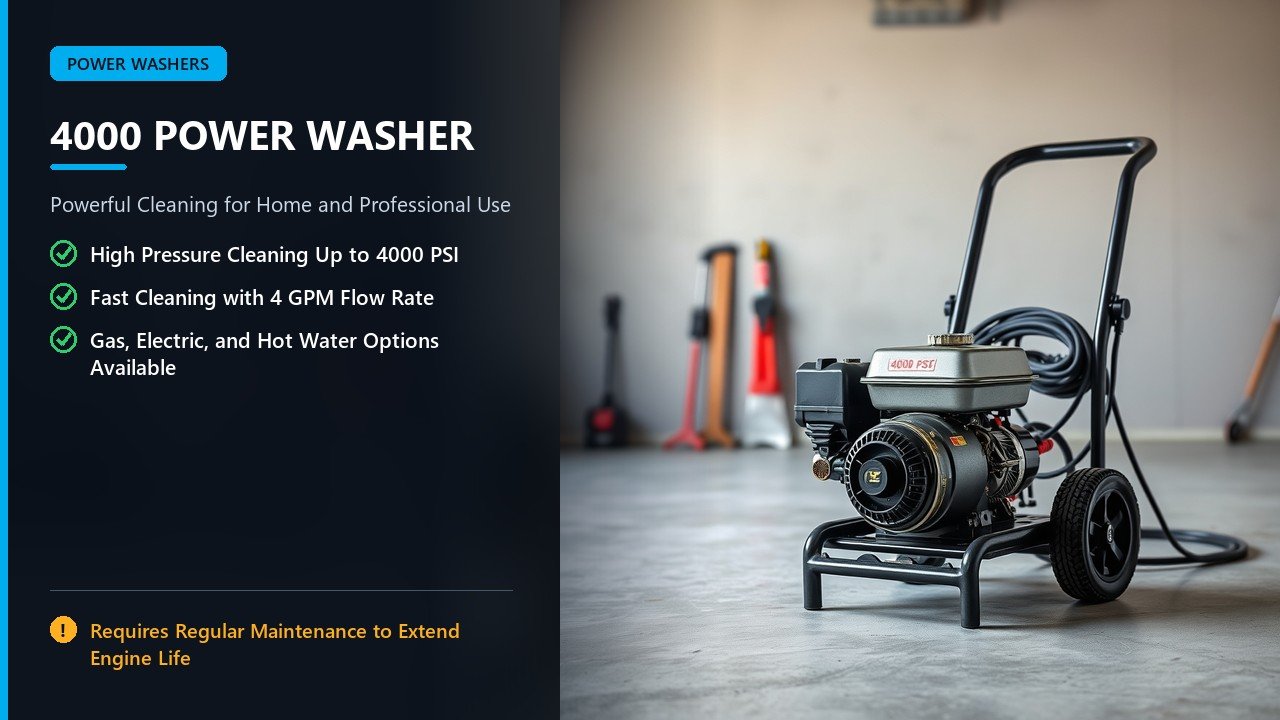
What 4000 PSI Really Delivers
PSI is the force of the water, and 4000 PSI is a lot of it. That pressure will strip old paint, remove oil stains, bleach weathered wood, and cut through caked dirt on concrete and machinery. It is well above the 2500 to 3100 PSI of mid-range gas washers and far beyond any typical electric unit.
Pressure alone is not the whole story, though. Flow, in gallons per minute, determines how fast the machine works. A 4000 PSI power washer usually flows around 4 GPM, giving an enormous cleaning-unit score. The combination of high pressure and high flow is what lets these machines cover big, dirty surfaces quickly.
Note: Compare rated PSI and rated GPM, not just the maximum figures on the label. The rated numbers describe the power and flow you can actually use, while the maximum figures are peak values measured under ideal conditions.
Typical Specs of a 4000 Power Washer
A 4000 PSI power washer generally arrives with professional-grade components: a large gas engine, a triplex pump, a heavy steel frame, and a full accessory kit. Some are direct drive, others belt drive, and some are electric start. Flow typically lands near 4 GPM, and the machine is built for frequent, heavy use.
| Spec | Typical Value |
|---|---|
| Pressure | 4000 PSI max |
| Flow | About 4 GPM |
| Engine | Gas, 200 to 420 cc class |
| Pump | Triplex, direct or belt drive |
| Start | Recoil or electric start |
| Nozzles | 0, 15, 25, 40 degrees plus soap |
| Frame | Heavy steel with pneumatic tires |
The engine size is worth checking closely. A larger-displacement engine gives the torque to drive a 4 GPM pump without straining, which improves both performance and durability. A small engine pushed to its limit will wear out faster and may struggle at altitude or in heat.
Cleaning Units and Real Cleaning Power
Multiply the rated PSI by the rated GPM and you get cleaning units, the clearest measure of how much work a machine can do. A 4000 PSI washer at 4 GPM scores around 16000 cleaning units, roughly double a 3100 PSI machine and several times a typical electric unit.
| Machine Class | PSI | GPM | Cleaning Units |
|---|---|---|---|
| Standard electric | 2300 | 1.5 | 3450 |
| Mid-range gas | 3100 | 2.5 | 7750 |
| 4000 power washer | 4000 | 4.0 | 16000 |
| Heavy commercial | 4000 | 5.0 | 20000 |
That score explains why professionals choose this class. It has the force to break stubborn dirt loose and the volume to wash it away fast, so a big job that would take hours on a small machine takes minutes here. The ceiling of the portable class is high for good reason.
Gas, Electric, and Hot Water at 4000 PSI
At 4000 PSI, most machines are gas driven, because producing this much power from a wall outlet is impractical for portable use. Electric models at this level exist but are usually stationary and wired for higher voltage. Hot-water versions add a burner and clean grease and oil far better than cold water.
Your choice depends on the job and the site. Gas is portable and independent of power. Electric suits fixed locations with the right supply. Hot water is the professional’s pick for grease, oil, and restaurant or fleet cleaning. Each has its place, and the pressure rating is shared while the rest of the machine differs.
| Type | Best For | Trade-off |
|---|---|---|
| Gas 4000 PSI | Portable heavy cleaning | Fuel and engine care |
| Electric 4000 PSI | Fixed industrial sites | Needs heavy power supply |
| Hot water 4000 PSI | Grease, oil, fleets | Higher cost and upkeep |
Our comparison of gas, electric, and hot-water 4000 PSI washers digs into the differences. If you mainly face grease and oil, hot water is worth the cost; for general outdoor work, gas is the practical default.
Direct Drive vs Belt Drive
Direct-drive pumps bolt straight to the engine, which keeps the machine compact and cheaper. Belt-drive pumps connect through a belt, which reduces heat and vibration, lets the pump run at its ideal speed, and generally lasts longer. At 4000 PSI, the pump and drive type strongly affect how long the machine survives.
For occasional heavy use, a direct-drive machine is a reasonable buy. For daily professional work, belt drive is worth the extra cost because it runs cooler and lasts longer, and the pump can often be rebuilt. Either way, a triplex pump is expected at this pressure level.
| Feature | Direct Drive | Belt Drive |
|---|---|---|
| Design | Pump bolted to engine | Pump driven by belt |
| Cost | Lower | Higher |
| Heat | More | Less |
| Pump life | Shorter | Longer |
| Best for | Occasional heavy use | Frequent professional use |
Our guide to direct vs belt drive at 4000 PSI goes deeper, and the machine behind the numbers shows how the parts add up to real performance.
What a 4000 Power Washer Can Clean
A machine at this level cleans almost anything outdoors and many things that smaller washers cannot. It restores concrete, strips paint and graffiti, cleans heavy equipment, and preps surfaces for coating. It handles commercial and industrial grime that would defeat a homeowner machine.
| Task | 4000 Power Washer Suitability |
|---|---|
| Concrete and pavers | Excellent with a surface cleaner |
| Paint and graffiti removal | Excellent |
| Heavy equipment and fleet | Excellent |
| Decks and fences | Very good, mind the wood |
| Roof and siding | Good, use wide tips and care |
| Delicate surfaces and cars | Possible with wide tips, risky at full pressure |
The power that makes it great on concrete makes it dangerous on soft surfaces. On wood, siding, and vehicles you must widen the tip and keep moving, or you will damage the surface. For flat concrete, a surface cleaner is the best way to harness that power evenly.
Engines and Pumps That Power the Class
Most 4000 PSI gas washers use engines from brands such as Honda, Kohler, or Briggs and Stratton, with Honda being the most popular for reliability. A GX-series Honda engine is common on professional machines because of its cast-iron sleeve and continuous-duty design. The engine must be large enough to drive a 4 GPM pump comfortably.
The pump is equally important and is often the weakest link on a cheap machine. A quality triplex pump with a rebuildable design will outlast a sealed pump and can be repaired rather than replaced. When you compare machines, weigh the pump brand and the engine brand together, because either one can limit the machine’s life.
A 4000 PSI washer with a Honda engine is a common and sensible pairing, offering reliable starting and long service. The engine badge alone is not enough, but it is a strong sign of quality when combined with a good pump.
Accessories Must Be Rated for the Power
At 4000 PSI and 4 GPM, every accessory must be rated for that pressure and flow. A hose, gun, or wand built for a homeowner machine can burst or fail under this load, and the risk of injury is real. Always check the rating before adding any part to the system.
Hoses need to handle both the pressure and the higher flow of a 4 GPM machine, and nozzles must match the flow rate. A nozzle too small for the flow will over-pressure the pump, while one too large wastes power. Matching accessories to the machine is not optional at this level; it is a safety requirement.
Note: Running a 4000 PSI machine with accessories rated for lower pressure is one of the most common and most dangerous mistakes. Inspect hoses for wear, replace damaged parts before they fail, and never mix in a component that was not built for this class.
Safety When You Have This Much Power
A 4000 PSI jet can cause serious injury in an instant, so safety must come first. Wear eye protection and gloves, never point the nozzle at people or animals, and never reach into the stream to clear a blockage. The jet can cut skin and inject water, which is a medical emergency.
Gas machines add exhaust and fuel hazards. Never run the engine indoors, let it cool before refueling, and store fuel safely away from ignition sources. Keep the gun’s safety lock engaged when not spraying, and shut the machine down before inspecting the nozzle. At this power level, discipline keeps you safe.
Maintenance That Protects the Investment
A 4000 power washer costs real money, so maintenance is what protects your investment. Change the engine oil on schedule, keep the air filter clean, and use fresh fuel with a stabilizer to protect the carburetor. For the pump, check and top off the oil if it is serviceable, and keep the inlet filter clean.
After every job, flush the system with clean water and drain it before storage, especially in freezing weather. A triplex pump left full of water can crack in winter. Grease or check the pump as the manual directs, inspect hoses and fittings for wear, and store the machine where it is dry and protected.
| Item | Interval | Action |
|---|---|---|
| Engine oil | Regularly | Change |
| Pump oil | Per manual | Check and top off |
| Air filter | Regularly | Clean or replace |
| Inlet filter | Each use | Rinse clean |
| Fuel | Before storage | Drain or stabilize |
| Water in pump | Before freezing | Drain fully |
Common Mistakes to Avoid
The most common mistake is using full pressure on surfaces that cannot take it. Wood, siding, and vehicles get gouged, etched, or stripped when the 0 or 15-degree tip is used at close range. Match the nozzle to the surface and keep the tip moving to avoid damage.
Another mistake is running the machine without water or with a clogged inlet, which destroys pumps quickly. People also use under-rated hoses and fittings that fail under the pressure, and they skip fuel and pump maintenance until something breaks. At this power level, small shortcuts lead to big repairs or injuries.
Finally, many owners never read the manual and use the wrong fuel or oil. A 4000 PSI gas washer is a four-stroke engine that takes straight gasoline, not a fuel-oil mix. Follow the manual for fuel, oil, and maintenance, and the machine will last for years.
How 4000 PSI Compares to Lower Ratings
Choosing between 4000 PSI and a lower rating comes down to the work you do. A 3000 PSI machine handles most home jobs, while 4000 PSI adds the power and flow needed for professional and heavy-duty tasks. The jump in cleaning speed is real, but so is the jump in cost, weight, and the care each tool demands.
For a homeowner who cleans a driveway and siding a few times a year, a 3000 to 3200 PSI washer is often the smarter buy. For a contractor, a fleet owner, or someone who cleans aggressively and often, the 4000 PSI class pays for itself in time saved. Match the tool to the workload, not to the biggest number.
| Rating | Typical GPM | Best For |
|---|---|---|
| 2500 – 3000 PSI | 2.3 – 2.5 | Home cleaning, cars, decks |
| 3100 – 3500 PSI | 2.5 – 3.0 | Big homes, mid-size commercial |
| 4000 PSI | 3.5 – 4.0 | Professional and industrial work |
Our comparison of 4000 PSI vs 3000 PSI breaks down the trade-offs in more detail, and the portable-class overview explains where this rating sits at the top of the range.
Professional Uses for a 4000 Power Washer
Professionals rely on this class because it turns large, dirty jobs into manageable ones. Fleet washing, construction cleanup, commercial concrete restoration, and paint removal all reward the combination of high pressure and high flow. The machine cleans better and, just as importantly, faster.
In these settings, downtime is expensive, so reliability matters as much as raw power. A machine with a quality engine and pump keeps working through long days, while a cheap unit fails when you need it most. For professional work, the 4000 PSI class is less a luxury and more a necessity.
Portable vs Trailer-Mounted
At 4000 PSI and 4 GPM, machines get heavy. A portable unit on pneumatic tires works for most one-person operations, but very large jobs and continuous use often call for a trailer-mounted setup with a water tank, hose reels, and a larger pump. The trailer adds cost and complexity but raises productivity sharply.
For a single operator moving between sites, a portable 4000 PSI washer is usually enough. For a crew that cleans all day, a skid or trailer unit with a water supply becomes the better tool. Decide based on how long you run and whether you always have a tap available.
Water Supply for 4 GPM
A 4000 PSI power washer moving around 4 GPM needs a serious water supply. A typical household tap may supply enough, but only if the hose is short and wide. A long, thin hose restricts flow, starves the pump, and cuts performance, no matter how powerful the machine is.
On sites without a good tap, a water tank and feed pump solve the problem and let the machine run from wherever you park. Always check the inlet filter, purge air from the line, and never run the pump dry. At 4 GPM, an unrestricted supply is essential to hit the rated flow.
Nozzle Selection Guide
The nozzle is how you aim the machine’s power, and at 4000 PSI the choice matters more than ever. The 0-degree tip is for the toughest, most isolated spots only. The 15 and 25-degree tips handle general concrete and hard surfaces, and the 40-degree tip is for gentle rinsing.
Never use the 0-degree tip on wood, siding, or vehicles, where it will cut and strip. For flat concrete, a surface cleaner spreads the flow for even results. Match the tip to the surface first, then to the stain, and always test in a hidden area.
| Nozzle | Angle | Use |
|---|---|---|
| Red | 0 degrees | Maximum force, isolated tough spots |
| Yellow | 15 degrees | Concrete, hard surfaces |
| Green | 25 degrees | General cleaning, brick |
| White | 40 degrees | Gentle rinse, delicate surfaces |
| Black | Low pressure | Soap application |
Buying Checklist for a 4000 Power Washer
When you shop, work through a simple checklist. Check the engine brand and size, the pump type and brand, the drive system, the pressure and flow ratings, and the accessory kit. Then confirm the warranty and whether parts are readily available. A machine is only as good as its weakest major component.
Prefer a triplex pump, an engine large enough to drive it, and a belt drive if you will clean often. Look for a sturdy frame, good tires, and an electric start if pulling is a concern. These factors decide how the machine performs today and how long it lasts.
| Check | What to Prefer |
|---|---|
| Engine | Quality brand, sized to the pump |
| Pump | Triplex, rebuildable |
| Drive | Belt for frequent use |
| Ratings | Strong rated PSI and GPM |
| Frame | Steel with pneumatic tires |
| Warranty | Solid coverage, parts available |
Cost and Value
A 4000 power washer is a significant purchase, but for heavy or professional use the value is clear. The time saved on big jobs and the years of service from a well-built machine usually outweigh the higher up-front price. Cheap machines in this class tend to fail early, costing more in the long run.
Budget for the machine, then for the accessories it needs: a rated hose, a surface cleaner, and good nozzles. These add cost but are part of using the machine safely and productively. Treat the total package as the real price, and buy quality the first time to avoid replacing a weak machine later.
Storage and Winterizing a 4000 Power Washer
A machine this powerful deserves careful storage between seasons. Left with water in the pump over a cold winter, a 4000 PSI unit can crack its pump body and cost far more to fix than the effort of draining it. Empty the pump, the hose, and the gun, and run a pump protector through the system if the manual allows.
Store the machine somewhere dry and protected from frost, with the fuel drained or stabilized. Cover it to keep dust and debris out of the engine and pump. A little care at the end of the season prevents the most expensive repairs and makes the next start-up far easier.
Running Costs of a 4000 Power Washer
Running a machine of this class costs more than a small electric unit, but the cost per job is often lower because it cleans so much faster. Fuel is the main ongoing expense, followed by oil, filters, and the occasional replacement of hoses, nozzles, or pump parts. These costs are predictable and modest relative to the work the machine does.
The biggest variable is how you treat it. Fresh fuel, clean oil, and a protected pump keep running costs low. Neglect the fuel system or let the pump freeze, and repair bills quickly eat the savings. Maintaining the machine is the cheapest way to keep its cost per job low.
Best Uses by Surface
Matching the machine to the surface is what separates a great result from damage. On concrete and pavers, the 4000 PSI class is in its element, especially with a surface cleaner. On metal equipment and machinery, it strips grease and grime fast. On brick and masonry, it restores years of weathering in minutes.
On wood, siding, and vehicles, the same power must be tamed with wider tips, more distance, and a steady hand. The machine can do these jobs well, but only when the operator respects the surface. Power is a tool to be aimed, not simply unleashed.
Why Rating the Whole System Matters
A 4000 PSI power washer is a system, not a single part. The engine drives the pump, the pump sends pressure and flow through the hose to the gun and nozzle, and every component must be rated for the load. A weak hose or an under-rated fitting can fail under the pressure, turning a good machine into a hazard.
This is why professionals replace worn hoses and fittings before they fail, and why they never mix homeowner-grade parts into a professional machine. Keeping the whole system rated for 4000 PSI protects both the machine and the operator. The details matter more at this power level than at any other.
Our guide to why every accessory must be rated for 4000 PSI explains the risks and the correct choices in full.
Frequently Asked Questions
Is 4000 PSI too much for a power washer? It depends on the job. For concrete, paint removal, and heavy equipment it is ideal, but it is too much for delicate surfaces unless you use wide tips and great care.
What GPM should a 4000 PSI washer have? Aim for around 4 GPM. That pairing gives a cleaning-unit score near 16000 and puts the machine at the top of the portable class.
Is a 4000 power washer gas or electric? Most 4000 PSI machines are gas, since portable electric power cannot easily reach this level. Electric versions are usually stationary and wired for higher voltage.
What can a 4000 PSI power washer clean? Concrete, pavers, heavy equipment, paint and graffiti, decks, and siding. It can also clean vehicles and soft surfaces if you use wide tips and take care.
How much does a 4000 power washer cost? Prices vary widely by engine, pump, and drive type. A quality professional machine costs significantly more than a mid-range gas washer, and the pump and engine split that difference.
Can a 4000 PSI washer remove paint? Yes. It strips loose and much well-bonded paint, which is one of its main professional uses. Use the right nozzle and work methodically for a clean result.
Final Thoughts
A 4000 power washer is the ceiling of the portable class and a serious tool for serious work. It combines high pressure with high flow to clean large, tough surfaces that smaller machines cannot handle, and it earns its keep on concrete, equipment, and paint removal jobs.
Choose a machine with a quality engine and pump, match every accessory to its rating, and follow the safety and maintenance rules. Do that, and a 4000 power washer will outperform and outlast lesser machines by years. For heavy-duty cleaning, it is the benchmark to measure others against.
Note: Buy from sources that stock professional-grade parts and accessories so you can keep a machine of this power running. Good options include the equipment at Simpson Cleaning, the range at Pressure Wash Supply, and the selection at Grainger, all of which carry the hoses, nozzles, and pumps that keep a 4000 PSI machine working.