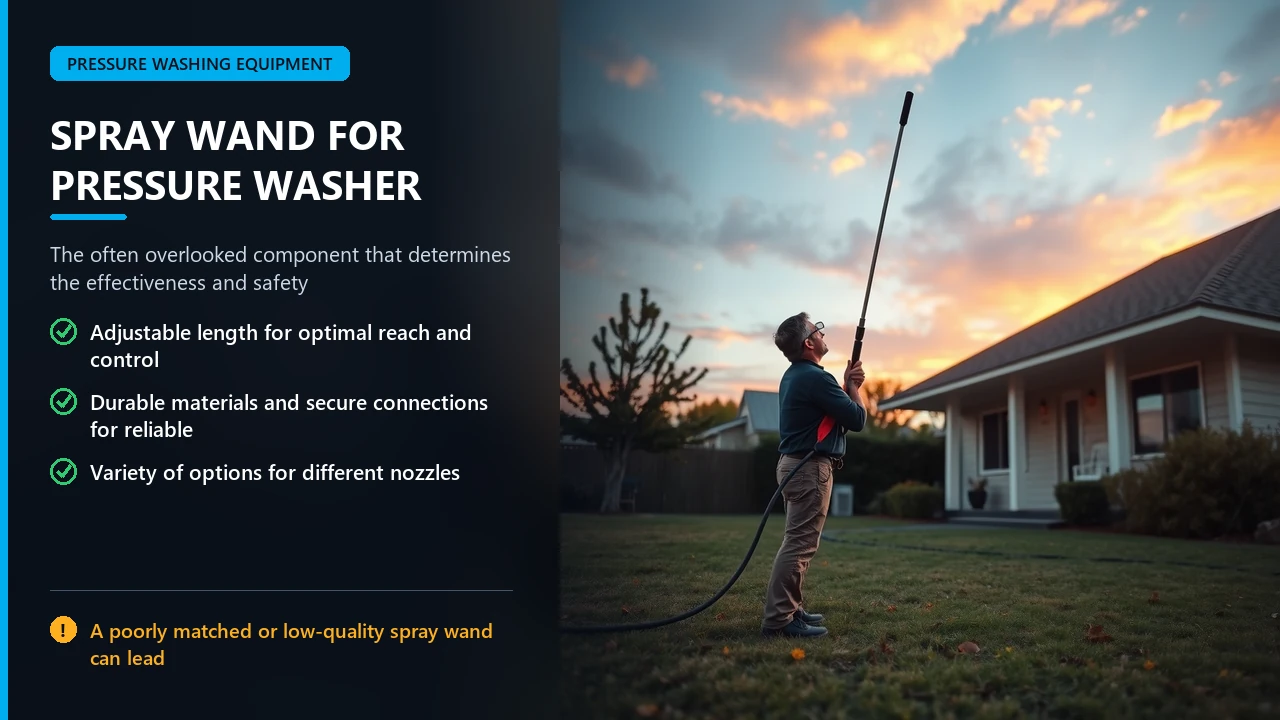
Dana thought she had a pressure washer problem. Her machine ran fine, the pump held pressure, and the nozzles were new, yet she could not reach the second story of her house without balancing on a chair and still soaking herself with backspray. The real issue was the thing she had never thought twice about: the wand. The rigid tube between her trigger gun and nozzle was too short, slightly too flexible at the joint, and topped with a fitting that quietly leaked. The day she swapped it for a longer, better-sealed spray wand for pressure washer duty, the whole job changed. She reached the high siding from the ground, aimed the stream exactly where she wanted, and finished in half the time.
The wand looks like the least important part of a pressure washer, but it decides what you can actually clean. It sets your reach, your control, and your comfort, and a small mismatch at either end can turn a strong machine into a frustrating, leaky mess. Understanding the wand is one of the most practical upgrades any owner can make.
To understand why the wand matters so much, it helps to see where it sits in the system. Water leaves the pump under pressure, travels through the hose to the trigger gun, then passes into the wand and out through the nozzle. The gun is the control point you hold and squeeze. The wand is the reach and the aim.
That short rigid tube does three important jobs. First, it keeps your hand and body away from the high-pressure spray, which protects you from backspray and from the blast itself. Second, it lets you direct the stream at a comfortable angle instead of crouching with your arm extended. Third, it gives you the mechanical reach to hit a surface without dragging the whole machine closer or climbing a ladder.
Manufacturers use the words wand, spray wand, and lance to mean the same thing. The naming difference does not matter nearly as much as the hardware at each end of the tube. Two wands that look identical can have completely different fittings, and that difference decides whether they work with your machine at all.
The Four Connection Points That Decide Everything
Before you fall in love with a wand’s length or finish, check the connections. A wand is only useful if it physically mates with your gun and your nozzles. There are four things to verify, and getting any one of them wrong means a leak or a wand that will not fit.
The gun-side fitting. This is where the wand screws or clicks into the gun. Many gas pressure washers use an M22 threaded connection, which looks like a large round threaded fitting. Others use a quick-connect plug, a push-and-click system. Some electric machines use proprietary plastic fittings that only accept the manufacturer’s own parts.
The nozzle-side connection. This is where the nozzle or an attachment like a foam cannon or surface cleaner attaches. The most common standard is a quarter-inch quick-connect socket. But do not assume it, because some wands use a threaded end instead.
The pressure rating. Every wand has a maximum PSI. Your wand’s rating should be at or above your machine’s maximum output so the safety margin covers the actual working pressure.
The flow and temperature rating. Flow is measured in GPM, and a wand that cannot handle your machine’s flow restricts performance. Temperature matters if you run a hot water machine, because a cold-water wand is not built to take hot water.
The Main Types of Spray Wands
Wands come in several practical forms, and each solves a different problem. Most people eventually own more than one, because a single wand rarely covers every job around a property.
| Wand Type | Typical Length | Best For | Watch Out For |
|---|---|---|---|
| Standard rigid wand | 36 to 45 inches | Driveways, decks, general cleaning | Limited reach for high or low spots |
| Short rigid wand | 12 to 20 inches | Car washes, foam cannons, tight bays | Less distance from backspray |
| Extension wand | Adds 1 to 4 feet | Extra reach without a ladder | Adds a joint that can leak |
| Telescoping wand | Extends 6 to 24 feet | Siding, gutters, tall vehicles | Harder to control under pressure |
| Dual lance | 36 to 45 inches | Switching between soap and rinse | Extra valve can wear out |
| Flexible or curved wand | 2 to 5 feet | Wheel wells, trim, awkward angles | Not a general-purpose replacement |
The standard rigid wand is what ships with most machines, and it covers the majority of everyday cleaning. The short wand is a favorite in detailing bays because it keeps you close to the work and pairs well with foam cannons. Extension wands bolt on extra rigid length, while telescoping wands extend in sections for serious reach. A dual lance carries two barrels and a valve so you can switch from soap to rinse without swapping tips. The flexible or curved wand bends around obstacles for those jobs a straight tube simply cannot reach.
Choosing the Right Length for the Job
Length is where most buyers make their mistake. New users assume longer is always better, but a long wand under high pressure is heavy, pulls against your arms, and magnifies every small movement at the handle. The goal is the shortest wand that reaches safely.
| Cleaning Task | Typical Wand Length | Main Control Concern |
|---|---|---|
| Cars, wheels, decks | 1 to 4 feet | Keep the nozzle 12 to 24 inches from the surface |
| One-story siding | 4 to 8 feet | Avoid forcing water behind the siding |
| Ground-level gutters | 6 to 10 feet | Use a downward angle and a wide, stable stance |
| Two-story siding | 12 to 18 feet | Pole flex and recoil increase fatigue |
| High gutters and fascia | 18 to 24 feet | Use a support strap where the maker approves it |
Notice that even a modest extension changes which surfaces become reachable from the ground. A standard wand plus a six foot telescoping pole can turn a two-story siding job from a ladder-and-balance act into a safe, standing operation. If reach is your main problem, our guide on extension wands for pressure washers walks through the options in more depth.
For delicate work like a shingled roof, no wand fixes the underlying issue: high-pressure water and delicate surfaces do not mix. In those cases a soft-wash approach is the smarter choice regardless of how much reach you have.
Fittings and Why They Cause So Much Frustration
The pressure washer world runs on two connection standards that do not talk to each other. One is the threaded M22 fitting, common on gun outlets and hoses. The other is the quarter-inch quick-connect system, common on nozzles, foam cannons, and surface cleaners. A wand built around one standard often needs a small adapter to reach the other.
This is why so many new wands seem like they almost fit. Unless the seals match and the threads line up, no amount of hand strength will stop the leak. The honest fix is to identify your connections before you buy, then pick a wand that matches directly, or choose a correctly rated adapter.
If your wand uses a quick-connect end, you gain real convenience because you can swap nozzles in seconds. Our breakdown of a pressure washer wand with quick connect explains why that speed adds up across a full day of cleaning. If instead you are chasing a stubborn drip at the gun connection, the same fitting knowledge helps you fix it, which we cover in the guide on a replacement gun for a pressure washer.
When in doubt about a fitting, the safest move is to check the manufacturer’s own specification sheet for your machine rather than guessing from a photo. Major brands such as Simpson and their competitors publish the exact connection types and ratings for their guns, hoses, and wands, and that document removes all the ambiguity before you spend money.
Materials, Build Quality, and What Lasts
The best wand for occasional use is not always the best wand for daily commercial work. Material and construction tell you a lot about how long a wand will survive.
Stainless steel wands resist corrosion and handle repeated use well, which is why they dominate commercial and heavy-duty setups. Aluminum wands are lighter and easier on the arms during long jobs, especially on telescoping poles where weight multiplies with length. Brass fittings hold up better than cheap plated ones and seal more reliably over time. The grip matters too, because a comfortable, textured grip reduces fatigue and keeps your hand steady when the trigger kicks.
Two details separate a sturdy wand from a flimsy one. The first is a good O-ring at every connection, since that ring, not the metal, is what keeps water in. The second is the quality of the coupler collar. A cheap collar wears and starts popping loose under pressure, which can turn a routine job into a soaked surprise.
Hot Water, Chemicals, and Special Cases
Length and fittings are the common concerns, but two special cases catch people by surprise: hot water and chemicals.
Hot water changes what counts as a suitable wand. A standard cold-water wand is usually rated to about 140 degrees Fahrenheit, while a hot water machine can push water well beyond that. Use a wand built for the temperature, and look for an insulated grip so the barrel does not turn into a stovetop burner against your hand. For cold water cleaning, almost any quality wand will do, but for a hot water rig you want one that is explicitly rated for the heat.
Chemicals are the other factor. If you pull detergent through your wand, the seals see the chemical, not just water. Some aggressive cleaners attack certain rubber compounds, which shortens O-ring life and starts leaks. Choose chemical-tolerant seals where you can, and always flush the wand with clean water after running any strong cleaner so nothing sits on the seals between jobs.
Positioning the Wand Correctly
How you hold and move the wand has as much to do with a clean result as the wand itself. The angle of the spray determines whether you lift grime or drive it in.
For flat surfaces like concrete, keep the wand at a shallow angle and work in consistent overlapping passes rather than frantic back-and-forth strokes. For siding, aim slightly downward so water runs off instead of getting forced up behind the panels. For vehicles, keep the nozzle a foot or two away and avoid holding it in one spot, because concentrated pressure can lift paint or drive water past trim.
The wand should extend your arm, not replace your judgment. When you keep the tip at the right distance and angle, you clean faster and protect the surface. When you crowd it, you risk damage that no second pass can undo.
Safety is not just about the surface. High-pressure water can break skin and cause serious injury, so treat every wand with the same caution you would a cutting tool. The Occupational Safety and Health Administration sets the workplace standards that professional cleaning crews follow, and CETA, the Cleaning Equipment Trade Association, publishes guidance that helps operators understand equipment safely and correctly. When you move up to long wands, ladders, and overhead work, following established industry practice is what keeps a job routine instead of dangerous.
Mistakes That Cost Time and Money
Most bad wand experiences trace back to a handful of predictable errors.
Buying on length alone. A long wand with the wrong fitting is useless. Check compatibility first, length second.
Assuming universal fit. The word universal on a package rarely means universal. Verify the thread size, the quick-connect style, and the pressure rating against your machine.
Overtightening to stop a leak. Leaks come from seals, not from being insufficiently tight. Replace the O-ring and check the fitting sizes instead of forcing the threads.
Ignoring the flow rating. A wand too restrictive for your GPM chokes performance and can feel like a weak machine even when nothing is actually wrong.
Running cold-water gear on hot water. This is a fast route to failed seals and a wand that suddenly sprays sideways.
Quick-Connect vs Threaded Ends
One of the most practical choices is whether you want a quick-connect end or a threaded one. Each has a place.
A quick-connect wand lets you swap nozzles, foam cannons, and surface cleaners in seconds without tools. If you switch attachments often, this convenience pays for itself every single job. The tradeoff is that every quick-connect joint is a potential leak point, so quality couplers and fresh O-rings matter.
A threaded wand offers a more rigid, sealed connection with fewer moving parts. It is common on fixed wands that stay paired with one nozzle. The tradeoff is slower changes when you want a different tip.
Many people end up with a threaded wand at the gun and a quick-connect at the nozzle, which combines a secure mount with fast tip changes. That hybrid is a good default for most homeowners.
How Much Should a Wand Cost
Wand prices range widely, and the spread reflects materials and build quality more than brand name alone. A basic short wand for light homeowner use can cost very little. A stainless extension wand for regular work costs more but lasts far longer. Telescoping wands climb higher still, and commercial-grade poles with better fittings and grips top the range.
The sensible approach is to match the wand to how often you clean and how hard you push it. A once-a-year user does not need a commercial pole. A cleaning business running hot water daily should not rely on the cheapest tube on the shelf, because a failure mid-job costs far more than the upgrade would have.
Matching the Wand to Your Nozzles
A wand is only as good as the nozzle on the end of it, and the two need to work as a pair. The nozzle sets the spray pattern and the cleaning intensity, while the wand sets where that pattern lands. If you install a tip that is too narrow for your flow, you lose pressure and pattern quality. If you choose a tip that is too wide, the stream feels weak even though the machine is running perfectly.
The quick-connect system makes this easy to manage because you can swap tips in seconds. Match the tip’s quick-connect size to your wand’s outlet, then choose the pattern for the job. A narrow angle cuts hard and concentrates force, while a wide angle rinses gently. Understanding the color code makes selection almost automatic, and our guide on the pressure washer color code explained for every nozzle shows exactly which color does what. If you want to fine-tune the actual orifice size, the tips in our nozzle size for a pressure washer guide will help you dial in the right match for your machine’s GPM.
On the gun side, the wand works best with a gun that seals properly and stays comfortable in your hand. A worn gun leaks at the wand connection and undermines an otherwise good wand, so it pays to keep the whole assembly healthy. Our overview of guns for pressure washers covers the types and what to look for if yours is due for replacement.
Telescoping vs Sectional Extension Wands
When you need real reach, you have two main approaches, and each has clear strengths.
Sectional extension wands are separate rigid pieces that join together. Each section is stiff, simple, and affordable, and a few pieces can build several feet of solid lance. The downside is that assembly takes longer, and every joint adds a possible leak point or a slight restriction to flow.
Telescoping wands extend in a smooth sliding motion within one telescoping pole, usually covering a wide range from a compact package. They reach much farther and set up fast, but they are heavier and harder to control at full length, and a long pole under pressure magnifies every wobble. If you are weighing the two for a typical home, our guide on a telescoping pressure washer extension wand that reaches a second story is a practical starting point.
A common compromise is to carry a standard wand for everyday work and a sectional or telescoping wand for the occasional high or low job. That way you enjoy light, nimble control most of the time and bring out the long reach only when a specific job demands it.
A Simple Buying Checklist
Bring this list with you, whether you are shopping online or in a store. It turns a confusing wall of similar-looking wands into a clear set of decisions.
| Check | What to Confirm |
|---|---|
| Gun outlet | Exact fitting family, size, and gender (M22, quarter-inch plug, or proprietary) |
| Wand inlet | Must mate with the gun directly or through a correctly rated adapter |
| Nozzle outlet | Quarter-inch quick-connect or the specific end your attachments need |
| Pressure rating | At or above your machine’s maximum PSI |
| Flow and temperature | Rated for your GPM and for cold or hot water as applicable |
| Length | Shortest wand that reaches the job safely and comfortably |
| Material and grip | Stainless or aluminum build, brass fittings, comfortable grip |
Run through that checklist once and the fitting guesswork disappears. If everything lines up, you know the wand will bolt on, hold pressure, and handle whatever nozzle and temperature your machine throws at it.
Care and Long-Term Storage
A few simple habits keep a wand working for years. Flush clean water through it after every job so detergent and grit do not dry inside the tube. Check the O-rings at both ends and replace any that look cracked, flattened, or missing, since those tiny rings do most of the sealing work. Inspect the quick-connect collar for wear, and store the wand flat in a dry place so it cannot get bent or crushed.
If a wand ever gets bent, stop using it. A bent tube throws the spray off target and stresses the fittings unevenly, which leads to leaks and inconsistent cleaning. Straight is not a cosmetic preference; it is a functional requirement. When you keep the tube straight, the seals fresh, and the connections clean, the wand becomes one of the most reliable parts of your whole setup.
Frequently Asked Questions
What is a spray wand for a pressure washer? It is the rigid lance between the trigger gun and the nozzle. It provides reach, control, and safety by keeping the high-pressure stream away from your body while letting you aim it where you need it.
Are pressure washer wands universal? No. They share common standards such as M22 threads and quarter-inch quick-connects, but the exact fitting, pressure rating, flow rating, and temperature rating must match your machine. Different M22 internal sizes and proprietary electric fittings can stop an otherwise perfect match.
What length wand should I buy? Base it on the job. A one to four foot wand handles cars, decks, and close work. Four to eight feet suits one-story siding. Six to ten feet reaches ground-level gutters. Twelve to twenty-four feet covers two-story siding and high gutters, but it demands a stable stance and stronger control.
Can I use an extension wand with an electric pressure washer? Yes, if the fittings match and the wand is rated for your washer. Many electric units use proprietary connections, so you may need an adapter. Small electric washers often rinse well through a long wand but feel weak for heavy cleaning at distance.
Why does my new wand leak? The usual causes are a missing or damaged O-ring, mismatched M22 sizes, or a loose quick-connect coupler. Depressurize the machine, inspect the seals, and replace worn O-rings before cranking anything tighter.
Do I need a special wand for hot water? Yes. Cold-water wands are usually rated to about 140 degrees Fahrenheit, while hot-water machines can reach far higher. Use an insulated, hot-water-rated wand so the accessories are not damaged and the grip stays comfortable.
Is a longer wand always better? No. Extra length adds weight, recoil, and control difficulty. Choose the shortest wand that solves your reach problem safely. A wand you can control well cleans faster than one that fights you the whole time.
Should I use an adapter to make my wand fit? If the fitting does not match, a correctly rated adapter is a fine solution, as long as it is rated for your pressure and flow. Avoid stacking several adapters, because each one adds a leak point and possible flow restriction.
Can I switch nozzles on any wand? Only if the nozzle matches the wand’s outlet. A quarter-inch quick-connect nozzle needs a quarter-inch quick-connect wand end. If your wand is threaded, you will need the matching threaded tips or an adapter.
Final Thoughts
The spray wand for a pressure washer is easy to overlook until it is the reason a job stalls. Once you understand the four connection points, match the length to the task, and respect the pressure and temperature ratings, the whole system starts working the way it should. A standard wand covers most daily cleaning, and one well-chosen extension or telescoping wand opens up the high, low, and tight spots that used to require a ladder or a different machine entirely.
Start with what you actually clean most often, buy a wand rated above your machine’s peak output, and keep an eye on your O-rings. Do those three things and your wand will quietly do its job for years, letting you stand comfortably while the water does the hard work. For a full walkthrough of picking an extension and the right nozzle together, see our guide on pressure washing wands and choosing the right extension and nozzle.