Ask a group of professional pressure washers which part of their rig they would replace first, and the answer is rarely the pump or the engine. It is the gun. The high pressure spray gun is the one component your body touches on every single job, the part that decides whether your wrist aches after an hour or feels fine after six, and the part that quietly controls how much pressure actually reaches the nozzle. A machine can be perfectly specified and still feel disappointing because the gun fights the operator.
That was the lesson Ryan learned during his first summer of driveway cleaning. His washer was a solid 3,200 PSI gas unit, but the stock gun had a stiff trigger, a hose that twisted every few minutes, and a front-entry inlet that always seemed to be in the worst possible place. By lunch his hand cramped, and by late afternoon he had wasted real time untwisting the hose. Swapping to a lightweight short gun with a swivel inlet cut his fatigue and sped up his work more than any other change he made that season.
This guide walks through everything that matters about a high pressure spray gun: how it works, the specs that actually affect performance, the difference between standard and short guns, why swivels and entry positions matter so much, how to match the gun to your hose and wand, and how to keep it sealing and triggering properly for years. If the gun is the part you feel most, it deserves the most thought.
Quick Note: A high pressure spray gun does two jobs: it starts and stops the flow of pressurized water, and it gives you control over the spray. Match its PSI, GPM, temperature, and connection type to your machine, and choose its shape for the work you do most.
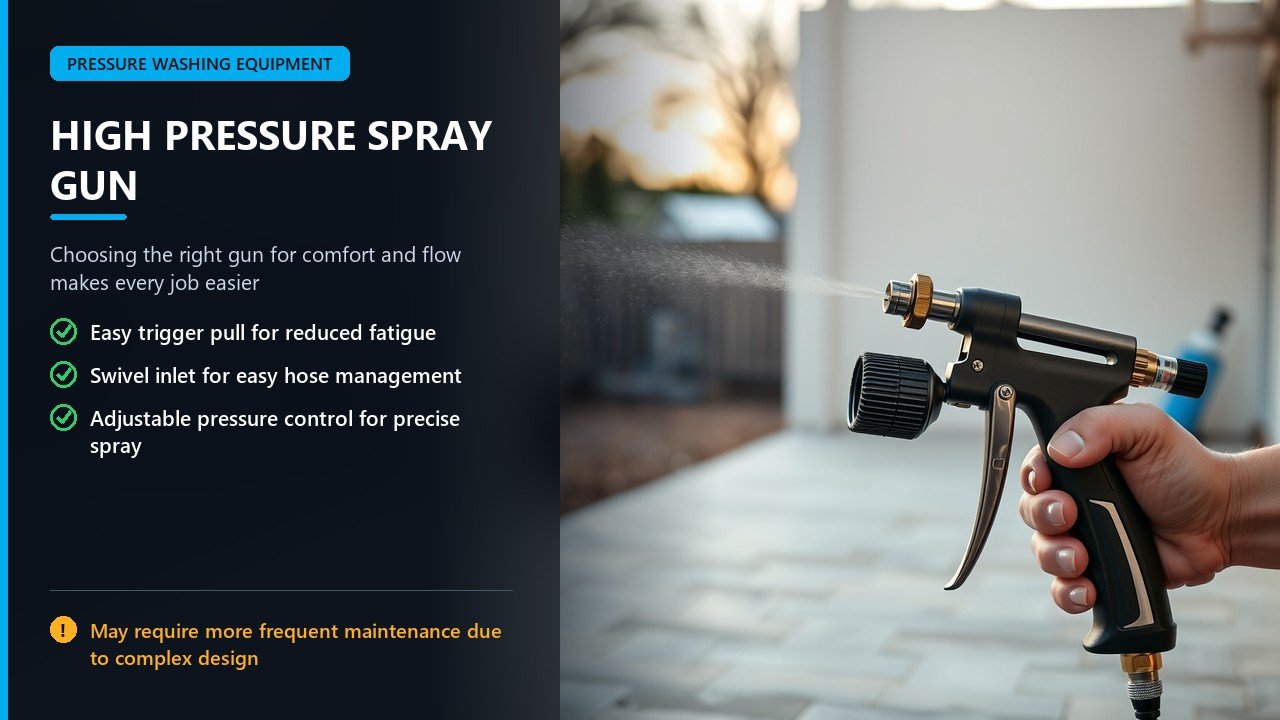
What a High Pressure Spray Gun Actually Does
At its core, a pressure washer spray gun is a valve you squeeze. When the trigger is released, the gun stops the flow, and the machine’s unloader valve redirects the water into bypass so pressure does not keep building. When you squeeze the trigger, the gun opens and delivers full-pressure water to the wand and nozzle. This constant opening and closing is why the gun takes so much mechanical abuse compared to the rest of the machine.
Inside the gun, a spring-loaded valve seals against a small ball or seat. Better guns use stainless steel or ceramic balls because they resist wear and chemicals far longer than plastic. The body channels water from the inlet, through the valve, and out the outlet to the wand. Every one of those passages is a potential point of pressure loss or leakage, which is why material quality in the gun matters more than it appears to.
The Briggs & Stratton pressure washer buying guide describes the spray gun simply as the component that controls the application of water onto the cleaning surface with a trigger. Simple in concept, demanding in execution — especially at commercial pressures and flows.
The Specs That Actually Matter
Shopping for a gun can feel like reading a foreign language. Here are the numbers that genuinely affect whether a gun will work, and what each one means.
- Maximum PSI. The gun must be rated at or above your machine’s working pressure. A 4,000 PSI machine needs a gun rated to at least 4,000 PSI, ideally with a margin for pressure spikes.
- Maximum GPM (flow). Often overlooked, but critical. A gun rated for 7 GPM will flow fine on a high-flow machine, while an undersized gun will restrict flow and rob you of performance. High-flow machines demand high-flow guns.
- Maximum temperature. Cold-water guns are typically rated to 140°F. If you run a hot-water machine, you need a gun rated to 200°F or more, with heat-resistant and insulated components.
- Inlet connection. How the gun attaches to the hose: M22 threaded, quick connect, or NPT. This must match your hose.
- Outlet connection. How the gun attaches to the wand or accessory: usually M22 or 1/4-inch quick connect.
- Entry position. Front-entry guns have the hose port at the front of the handle; rear-entry guns have it at the back. Rear-entry tends to feel more balanced and keeps the hose out of your way.
| Spec | Why It Matters | Watch For |
|---|---|---|
| Max PSI | Must contain your working pressure | Buy above your machine’s rating for safety margin |
| Max GPM | Controls flow — too low chokes the machine | High-flow setups need high-flow guns |
| Max temp | Cold guns fail on hot-water machines | Hot water needs 200°F+ and insulation |
| Inlet/outlet type | Determines compatibility | M22-14mm vs M22-15mm vs quick connect |
| Entry position | Affects balance and hose routing | Rear-entry usually feels better |
Standard Guns vs. Short (Stubby) Guns
The biggest practical choice you make is gun length. Traditional pressure washer guns use a long wand that keeps you at a comfortable distance from the surface and gives you reach without bending. Short, or “stubby,” guns replace that long wand with a compact body and a quick-connect outlet, putting the nozzle closer to your hand.
Each has a clear place. Long guns are ideal for broad surfaces where you want reach and leverage — washing siding, sweeping a driveway with a fan tip, or reaching lower walls without stooping. Short guns shine for detail work: wheel wells, bumpers, grills, tight corners, and any job where maneuverability beats reach. A short gun paired with a foam cannon has become the standard setup for car detailing precisely because it keeps the weight close to the hand and lets you work one-handed.
The market reflects this split. The Westinghouse short pressure washer gun, for example, is designed around a pistol shape for easy maneuverability with low hand strain during long sessions, while still fitting most standard machines with an M22-14mm inlet and a 1/4-inch quick-connect outlet. Many owners keep both a long wand and a short gun and switch based on the job.
The Importance of Inlet and Outlet Connections
Nothing derails a gun purchase faster than a connection mismatch. There are several common standards, and they are not all interchangeable.
- M22-14mm. The most common threaded connection on consumer and prosumer machines.
- M22-15mm. Looks similar to 14mm but will not always interchange. A frequent source of leaks and cross-threading.
- Quick connect. Usually 1/4-inch on the wand side, and increasingly on the outlet of short guns. Push-and-click convenience.
- NPT (National Pipe Thread). Common on commercial and hot-water guns, often 3/8-inch NPT inlet and 1/4-inch NPT outlet.
| Connection | Common On | Notes |
|---|---|---|
| M22-14mm | Most homeowner & prosumer machines | The default; fits many replacement guns |
| M22-15mm | Some brands & European models | Not always compatible with 14mm — check |
| 1/4″ Quick Connect | Wands, nozzles, accessories | Fast swaps; tiny pressure drop |
| 3/8″ NPT | Commercial & hot-water guns | Higher flow, robust threaded seal |
If your connections do not match, adapters can bridge the gap, but each adapter is another potential leak and a small pressure loss. Whenever possible, buy a gun whose native connections fit your hose and accessories directly. When you do need to adapt, quality brass or stainless fittings and fresh O-rings are non-negotiable. Our guide to hose fittings for pressure washers covers how to build joints that stay dry.
Types of High Pressure Spray Guns
Beyond length, guns come in several functional designs, each suited to a different kind of work.
Standard Trigger Guns
The everyday workhorse found on most machines. A pistol grip, a trigger, a safety lock, and threaded or quick-connect ends. Reliable and inexpensive.
Swivel Guns
A swivel gun has a rotating inlet that lets the hose turn freely without twisting the gun or kinking the line. This is one of the most underrated comfort features in pressure washing. As the detailing-focused listings consistently note, a swivel keeps the hose from tangling and twisting so you spend less time fighting equipment and more time cleaning. For any job involving lots of movement — cars, tight patios, fences — a swivel gun is a meaningful upgrade.
Variable-Pressure Guns
Some guns include an adjustable valve that lets you dial pressure up or down at the gun, useful when you need to move from blasting concrete to gently rinsing a car in the same session. It saves trips back to the machine and reduces the need to swap nozzles mid-job.
Easy-Pull Guns
These use lighter trigger springs and larger contact surfaces to reduce hand fatigue, which matters enormously for all-day commercial work. A stiff trigger that feels fine for ten minutes becomes torture after four hours.
Hot-Water and Steam Guns
These are built with heat-resistant housings and insulated couplers to protect the operator from hot water. A representative example is the NorthStar hot water trigger spray gun, rated to 5,000 PSI and 250°F with a high-impact housing and stainless steel components. Never run a hot-water machine through an unrated cold-water gun.
Surface Cleaner Guns
Large, often two-handled guns designed to push a rotary surface cleaner across flat concrete. They are built for high flow and held differently than a standard pistol gun.
| Gun Type | Best For | Key Benefit |
|---|---|---|
| Standard trigger gun | General home & light work | Affordable, universal |
| Short / stubby gun | Detailing, tight spaces | Maneuverable, low strain |
| Swivel gun | Any mobile work | No hose twist or kinks |
| Variable-pressure gun | Mixed surfaces in one job | On-gun pressure control |
| Hot-water / steam gun | Hot-water cleaning | Heat-rated, insulated |
Materials and Build Quality
Two guns with identical specs can differ wildly in durability based on materials. Look for stainless steel or ceramic valve components, which resist wear and chemical attack far better than plastic. The housing should be impact-resistant — high-impact polymers such as Zytel appear on commercial guns precisely because they survive drops, heat, and chemical exposure. Brass or stainless fittings at the inlet and outlet seal better and last longer than pot metal. Ergonomic over-molded grips reduce fatigue and improve control.
This is where price differences become justified. A cheap gun may work fine for occasional home use but will leak, stiffen, or fail under daily commercial abuse. Professionals treat guns as wear items and often keep a spare, because a failed gun mid-job means stopped work. If you use your machine for income, buy the gun that will not fail you at the wrong moment.
How the Gun Interacts With the Unloader and the Whole System
To appreciate why a gun matters so much, it helps to understand what happens the instant you release the trigger. The water has to go somewhere. When the gun closes, pressure in the line spikes, and the machine’s unloader valve senses that spike and diverts the flow into bypass, sending water back to the tank or pump inlet instead of through the hose. When you squeeze again, the unloader re-engages the spray. This cycle happens dozens of times per job, and the gun sits at the very start of it.
A gun with a slow or mushy valve places extra strain on the unloader because pressure builds unevenly during the transition. A crisp, well-sealed valve makes the whole system respond more predictably. That is why professionals sometimes notice that a new gun makes the entire machine feel sharper — the pump and unloader are doing the same work, but the commands they receive are cleaner.
This interaction is also why a gun rated below your machine’s flow can be genuinely harmful, not just inefficient. Restricting flow at the gun raises pressure and heat, works the pump harder, and shortens the life of seals throughout the system. The gun is not an isolated accessory; it is part of a closed hydraulic loop, and every restriction ripples backward to the pump. Matching the gun’s GPM rating to your machine protects the components you cannot see.
Quick Note: A gun that is undersized for your machine’s flow does not simply deliver less water — it raises internal pressure and heat, straining the pump and seals. Always match or exceed your machine’s GPM rating, not just its PSI.
Trigger Feel, Deadband, and Real-World Control
Two guns with identical specs can feel completely different to use, and the difference comes down to trigger design. “Deadband” is the travel of the trigger before the valve opens and water starts to flow. A short, positive deadband feels responsive and precise, which matters when feathering the trigger to control overspray near delicate surfaces like car paint, window frames, or wood siding. A long, vague deadband feels sloppy and makes fine control difficult.
Trigger return force matters just as much. A heavy spring keeps the trigger crisp and prevents accidental firing, but it also tires your hand. An easy-pull design trades a little firmness for dramatically reduced fatigue, which is the right call for anyone working hours at a time. The ideal gun balances a defined opening point with a return force you can live with all day.
Grip shape and over-molding complete the picture. A grip that fills your palm without forcing your fingers into an awkward curl reduces the strain that builds into soreness. Many commercial guns add textured, chemical-resistant over-molds precisely because wet hands lose grip, and a gun that slips is both inefficient and dangerous. When you can, handle a gun before buying, or choose one whose ergonomics have been designed deliberately rather than added as an afterthought.
Cold Water, Hot Water, and Chemical Compatibility
The fluid flowing through your gun is not always plain cold water. Detergents, degreasers, and hot water all place demands on the materials inside. Chemical compatibility is often ignored until a gun fails, yet it is easy to reason about once you know what to check.
Many detergents are mildly alkaline or acidic, and cheap seals and housings degrade faster when exposed to them repeatedly. O-rings made from the right compound resist swelling, cracking, and hardening. Stainless and ceramic valve parts shrug off chemicals that would corrode lesser metals. If you run a downstream injector or a foam cannon frequently, choosing a gun with chemical-resistant seals and a robust housing pays for itself in reliability.
Hot water raises the stakes further. Heat softens seals, expands metal, and turns an otherwise fine gun into a leak waiting to happen. Hot-water and steam guns are built with heat-rated seals, insulated couplers, and housings that tolerate elevated temperatures. Running hot water through a cold-water gun is one of the fastest ways to destroy it, and the failure often comes without warning mid-job. If your machine heats water, only use a gun explicitly rated for the temperature you run.
Cleaning residual detergent out of the gun after use directly extends its life. Residue that dries inside the valve stiffens the trigger and corrodes the seat, producing the gritty feel and slow leaks that send people shopping for replacements. A thirty-second flush is cheap insurance for an expensive-to-replace component.
Safety Features You Should Not Skip
A high pressure spray gun is a power tool that can cause serious injury. The stream is powerful enough to penetrate skin, and manufacturers warn explicitly that a high-pressure spray can cause injection injuries. Several safety features exist for good reason.
- Trigger safety lock. Prevents accidental firing when you set the gun down or hand it to someone. Always engage it when not spraying.
- Insulated couplers (hot water guns). Protect your hand from scalding metal.
- Two-hand operation (surface cleaner guns). Keeps control during high-flow, high-recoil work.
- Pressure relief awareness. Always squeeze the trigger after shutting off the machine to release trapped pressure before disconnecting anything.
One golden rule overrides everything: never point the gun at any person or any part of your body. Injection injuries from pressure washers are medical emergencies that require immediate professional care. Respect the tool and it serves you for years.
Note: Never use your hand or fingers to test for a leak in a pressurized line or gun. High-pressure water can inject through skin without obvious pain at first, and the injury worsens quickly. Test with a piece of cardboard instead, and seek medical help at once if an injection is suspected.
How to Choose the Right Gun for Your Setup
Start with compatibility, then optimize for comfort and the work you actually do.
- Match the connections. Confirm your hose inlet and wand outlet types before buying. When unsure, M22-14mm with a quick-connect outlet covers the widest range of homeowner setups.
- Exceed your machine’s pressure and flow. Choose a gun rated above your working PSI and at or above your GPM.
- Match the temperature. Cold-water gun for cold water; heat-rated and insulated for hot water.
- Pick the shape for your jobs. Long wand for reach and broad surfaces; short gun for detailing and tight spaces.
- Prioritize a swivel inlet if you move a lot. The anti-kink benefit alone justifies it for mobile work.
- Upgrade the ergonomics if you work long hours. Easy-pull triggers and over-molded grips reduce fatigue and let you work longer, more accurately.
If you are unsure where to start, our related guides on power washer guns and the pressure cleaning gun dig into the fit, flow, and feel that separate a gun you tolerate from one you rely on.
Compatibility With Wands, Nozzles, and Accessories
A gun rarely works alone. Most setups pair the gun with a wand and a set of quick-connect nozzles selected for the surface. A 1/4-inch quick-connect outlet lets you snap on a wand, a turbo nozzle, a foam cannon, or a surface cleaner without tools. If you use a range of accessories, standardizing on quick connect at the outlet is the simplest way to stay flexible. Our primer on the pressure washer nozzle guide explains how to match tips to the surface once the gun and wand are in place.
High-flow accessories need a high-flow path, so keep GPM in mind across the whole chain. A gun rated for 7 GPM feeding a 10 GPM machine will bottleneck performance no matter how good the pump is. On commercial systems, everything from the pump to the nozzle should be sized for the same flow. Our article on the 5 gallon per minute pressure washer explains why flow consistency matters end to end.
Maintenance and Troubleshooting
Guns are simple enough to maintain yourself, and most failures are easy to diagnose. Leaks usually trace to a worn O-ring or a loose fitting. A trigger that sticks or feels gritty often has debris in the valve or a failing spring. A gun that loses pressure may have a worn valve seat or a partially blocked outlet.
- Replace O-rings regularly. They are cheap and the most common failure point. Keep a spare kit on hand.
- Flush after use. Rinse detergent residue from the gun so it does not dry and stiffen the trigger or corrode the valve.
- Do not overtighten fittings. Overtightening crushes O-rings and can crack housings.
- Release pressure before storage. Trapped pressure stresses seals and surprises the next user.
- Winterize. Water left inside a gun freezes and cracks it. Store guns where they will not freeze.
Many guns are rebuildable with a repair kit for the valve and trigger. If the housing itself cracks or the inlet threads strip, replacement is the right call. Because a gun is comparatively inexpensive relative to a pump, replacing a badly worn one is usually smarter than nursing it along. Our guide to hose and reel upgrades is a good companion for keeping the whole ergonomic chain working smoothly.
Common Mistakes to Avoid
Most gun complaints come down to a handful of avoidable errors.
- Ignoring the GPM rating. People check PSI and forget flow, then wonder why their high-flow machine underperforms.
- Using a cold-water gun on a hot-water machine. The seals and housing are not built for heat and will fail.
- Buying by price alone. A cheap gun leaks, stiffens, and fails well before a quality one.
- Forgetting the safety lock. It exists to prevent injuries, especially around children and pets.
- Mismatched connections. M22-14mm versus 15mm confusion leads to leaks and cross-threading.
- Letting detergent dry inside the gun. Residue stiffens triggers and corrodes valves.
- Leaving the gun in freezing temperatures. Trapped water cracks housings and seals.
Frequently Asked Questions
What should I look for in a high pressure spray gun? Match its maximum PSI and GPM to your machine, confirm the temperature rating, and choose the right inlet and outlet connections. Then pick the shape — long wand or short gun — for the work you do most, and add a swivel inlet if you move around a lot.
Are all pressure washer guns compatible with all hoses? No. Inlet connections vary between M22-14mm, M22-15mm, quick connect, and NPT. Check your hose and machine before buying, and use quality adapters only when necessary.
Can I use a short gun on a gas pressure washer? Yes, as long as its PSI, GPM, and connection ratings match your machine. Short guns are popular for detailing on both gas and electric units. The connection is the main compatibility check.
Why does my gun leak at the inlet? Usually a missing, worn, or wrongly sized O-ring, or a loose fitting. Mismatched M22 sizes (14mm versus 15mm) are a common cause. Replace the O-ring first and check the thread type.
Does a swivel gun reduce pressure? Only negligibly. A quality swivel adds a small, well-sealed joint that costs almost nothing in pressure but eliminates hose twist and kinks, which improves real-world performance and comfort.
Can I repair a leaking or sticking gun? Many guns are rebuildable with valve and O-ring kits. If the housing is cracked or the threads are stripped, replace the gun instead. Gun parts are inexpensive relative to a pump, so replacement is often the practical choice.
Final Thoughts
The high pressure spray gun is the part you live with on every job, and it is the easiest component to upgrade for a big jump in comfort and control. Get the compatibility right — PSI, GPM, temperature, and connections — then choose the shape and features that match how you actually clean. A swivel inlet, an easy-pull trigger, and a short body for detail work can transform a tiring machine into one you enjoy using.
Do not treat the gun as an afterthought tacked onto a good pump. It is the interface between your body and the machine’s power, and it deserves the same careful thought you give the pump and engine. Choose it deliberately, maintain the O-rings, respect the safety lock, and your high pressure spray gun will keep triggering smoothly, sealing fully, and saving your hands for many years of work.