Heavy Duty Pressure Washer Hose: What Makes One Commercial Grade
A heavy duty pressure washer hose is the difference between a cleaning rig you trust on the job and one that springs a leak three feet from the gun. The term gets thrown around loosely, but “heavy duty” is not a color or a marketing label. It is a set of measurable traits: how many wire braids reinforce the tube, how high the pressure rating climbs, what the outer cover is made of, and how the hose behaves when the water is hot and the surface is rough. Understand those traits and you can tell a genuine commercial-grade hose from a dressed-up residential one in seconds.
This guide breaks down what actually makes a pressure washer hose heavy duty, how the ratings map to real work, and how to match a hose to your machine without overspending or cutting corners. For a broader look at hose selection, our complete hose guide covers the full range of sizes and fittings.
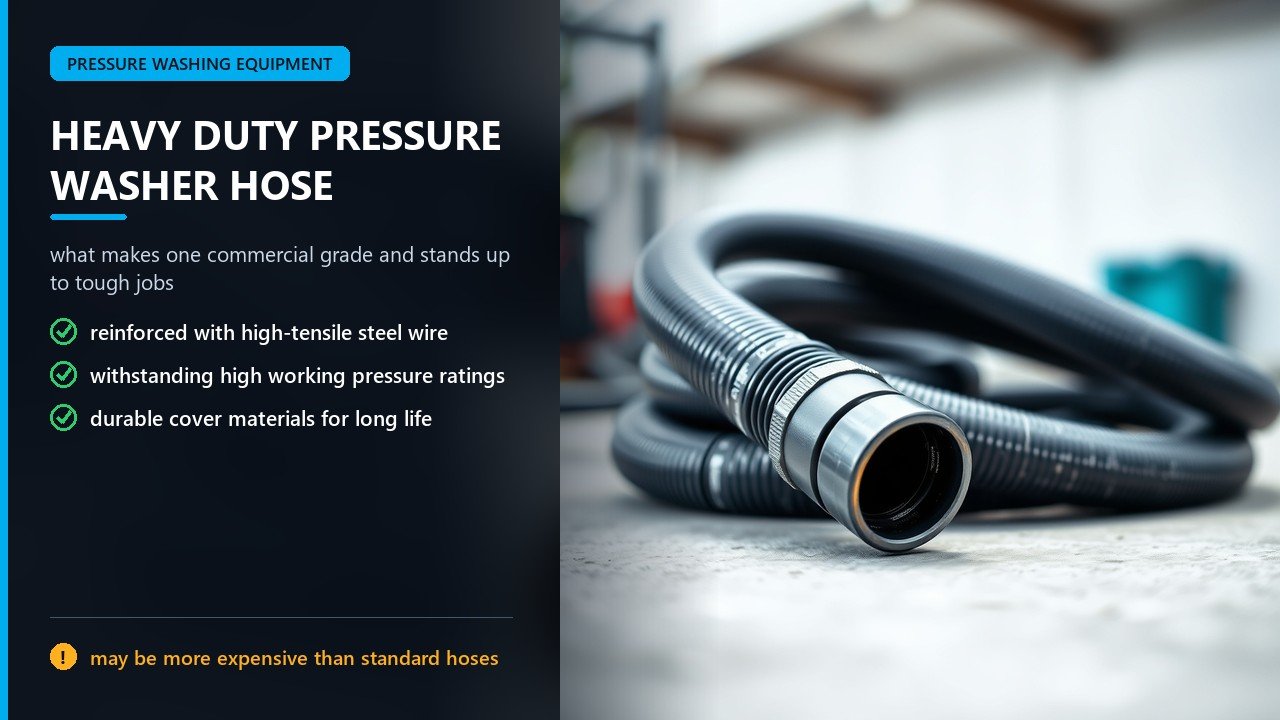
What Makes a Hose Heavy Duty
Three things separate a heavy duty hose from a standard one. First is the reinforcement: the layers of wire braid that keep the tube from expanding under pressure. Second is the working pressure rating, which tells you the load the hose is built to carry continuously. Third is the cover material, which decides how the hose survives abrasion, sunlight, chemicals, and heat. A hose that wins on all three earns the heavy duty name. One that wins on only pressure rating but uses a thin cover is a compromise.
The reinforcement is the most important. A single braid of high-tensile steel wire, called R1, supports roughly 4,000 PSI. A double braid, called R2, pushes that toward 6,000 PSI and adds a margin of safety and fatigue life. For most residential machines up to about 4,000 PSI, a well-made R1 hose is plenty. For commercial rigs running all day at high pressure, R2 is the right call. Retailers like Portland Compressor stock both single- and double-wire hoses side by side, which makes the difference easy to see. Our article on the 3/8 hose explains why that diameter dominates the heavy end of the market.
Wire Braid Ratings: R1, R2, and Beyond
The braid count directly sets the pressure ceiling. A single-wire braid hose like the Milton 3/8 inch assembly is rated to 4,000 PSI and stays lightweight, which makes it easy to drag around a job site. A two-wire braid hose such as the 3/8 inch 6,000 PSI version sold by Pressure Washer Products is stiffer but far stronger, and it holds up to the shock loads that come with a trigger gun on a big machine.
Adding braids adds weight and reduces flexibility, so more is not automatically better. The goal is to match the braid to the machine. If your washer peaks at 3,200 PSI, a 4,000 PSI single-braid hose already gives you a comfortable safety margin. Stepping up to a 6,000 PSI double-braid hose buys durability and hot-water headroom, not more cleaning power. Our guide to a high pressure hose that lasts walks through the trade-offs.
Reading the Pressure Rating Correctly
The number on the label is the working pressure, not the burst pressure. Most quality hoses carry a burst-to-working safety factor of about 3 to 1, so a 4,000 PSI working hose bursts near 12,000 PSI. That margin absorbs water hammer, pump spikes, and the surge when you release a trigger. Never buy a hose whose working rating merely equals your washer’s peak output. Leave at least 500 to 1,000 PSI of headroom, and more if your machine has a strong unloader or you run long lengths that magnify pressure spikes.
Temperature is part of the rating too. A cold-water hose rated to 4,000 PSI may only tolerate 140°F, while a hot-water hose with the same pressure rating handles 250°F. If you own a hot water machine or plan to add one, choose a hose rated for the temperature first and the pressure second. Running a cold-water hose on hot water shortens its life fast and can fail at the crimp.
Cover Materials and Durability
The outer jacket is what meets the concrete. Rubber covers resist abrasion and stay flexible in cold weather, and they are the traditional choice for heavy duty work. Polyurethane covers, like the translucent jacket on the SIMPSON Monster Hose, are non-marring and up to three times more abrasion resistant than rubber, which makes them ideal on driveways and painted surfaces. A wrapped or smooth cover resists snagging and wipes clean, while a textured cover grips better but collects dirt.
Non-marking covers matter more than people expect on a commercial job. A black rubber hose can leave scuff marks on light concrete, driveways, and interior floors, so a gray non-marking hose pays for itself by avoiding callbacks. Our guide to non-marking hoses covers the materials that prevent streaks. A heavy duty hose should have a cover engineered for the surfaces you clean, not just for the pressure it carries.
Fittings, Bend Restrictors, and Swivels
A heavy duty hose earns its rating at the ends as much as in the middle. Crimped-on fittings must match the hose’s pressure class, and brass quick connects should be rated at or above the hose. Bend restrictors at each end, often four inches or longer, keep the hose from kinking at the coupling, which is where most failures start. A swivel at one end lets the hose turn with the gun instead of twisting, and it dramatically reduces kinks on long runs.
The SIMPSON Monster Hose, for example, uses 3/8 inch male and female quick connects with four-inch bend protectors to extend service life. The Milton single-wire hose pairs a swivel end with a fixed end and four-finger grip restrictors. When you compare heavy duty hoses, look past the pressure number and check the fittings, the restrictors, and the swivel. Those details decide how long the hose actually lasts. Our article on hose fittings and threads helps you match the ends.
Hot Water Changes Everything
If you run hot water, the hose must be built for it. Gates markets its Clean Master pressure wash hose specifically for hot and cold commercial cleaning in car washes, food processing, and sanitation, where heavy duty service is the norm. It is compounded to handle harsh environments, meets 300°F intermittent service, and resists abrasion, ozone, and oil. That is a different class of hose than a cold-water residential line, and it is priced accordingly.
Hot water accelerates every failure mode in a hose. Seals harden, covers soften, and the tube swells against the braid. A hose rated for 250°F hot water, like the SIMPSON Armor Hose and the Milton rubber hose, uses heat-resistant compounds throughout. If your machine heats water, buying anything less is false economy. Our industrial accessories guide covers the rest of a hot-water setup.
Heavy Duty Versus Standard: A Simple Comparison
| Trait | Standard Hose | Heavy Duty Hose |
|---|---|---|
| Reinforcement | Single braid or thermoplastic, R1 | Single or double steel braid, R1/R2 |
| Working pressure | 2,000–3,000 PSI | 4,000–6,000 PSI |
| Cover | Basic PVC or light rubber | Rubber or polyurethane, abrasion resistant |
| Temperature | Cold water, about 140°F | Hot or cold, up to 250°F |
| Ends | Basic crimped, short restrictors | Crimped brass, long bend restrictors, swivel |
| Best for | Occasional home use | Daily and commercial cleaning |
The table is a starting point, not a rulebook. Plenty of single-braid hoses are genuinely heavy duty because they use premium rubber and long restrictors, and a few double-braid hoses cut corners on the cover. Judge the combination, not one spec in isolation.
Choosing the Right Length and Diameter
Heavy duty work usually means long reaches, and length costs pressure. A three-eighths inch hose loses less pressure over a given distance than a quarter-inch hose, which is why commercial rigs standardize on 3/8 inch. Going up to one-half inch raises flow capacity but adds weight and bulk. For most machines, 3/8 inch in 50 to 100 foot lengths is the heavy duty sweet spot.
Our guide to the 100 ft power washer hose explains how reach and flow interact. If you need to feed a hose reel, a short jumper hose connects the pump to the reel so the main hose can stay heavier and longer. Our article on length, diameter, and lost pressure helps you size the run.
Matching the Hose to Your Machine
Start with your machine’s rated PSI and GPM, then add margin. A 3,000 PSI residential washer is well served by a 4,000 PSI single-braid hose. A 4,000 PSI commercial machine deserves at least a 4,000 PSI hose with a strong margin, and ideally a 5,000 PSI or R2 line if it runs hot or works all day. If you own a 5,000 PSI machine, the hose should be rated at or above that, with brass quick connects to match.
Then consider the job. Car washes and food plants need hot-water capability and chemical resistance. Mobile detailing needs non-marking covers and manageable weight. Construction cleaning needs maximum abrasion resistance and long lengths. The right heavy duty hose is the one tuned to your work, not the one with the biggest number on the box. Our guide to Gates pressure washer hose and our look at professional-grade Parker hose both show how industrial makers build to the application.
Care That Keeps a Heavy Duty Hose Heavy Duty
Even a commercial hose fails early if you abuse it. Coil it in large loops instead of tight kinks, and never drive over it or pull it around sharp corners. Keep it away from engine mufflers and exhaust, which cook the cover from the outside. Rinse off chemical residue after use, and store it out of direct sun when the machine is idle for long stretches. A wound-up hose holds water, so drain it before storage, especially before freezing weather.
Inspect the crimps and the cover at each use. A bulge near a fitting means the braid is failing, and that hose should be retired before it bursts. Small cover nicks are normal on a working hose, but exposed wire braid is a warning. Treat a heavy duty hose as a consumable that earns its keep, and replace it on schedule rather than after a failure. Our hose care guide covers the full routine.
When a Standard Hose Is Enough
Not every job needs commercial grade. For a homeowner who washes a car and a driveway a few times a season, a good single-braid 3/8 inch hose at 3,000 to 4,000 PSI is heavy duty enough. Spending more than that buys durability you may never use. The point of understanding the specs is to spend only where it counts: on pressure margin, temperature, and cover quality that match the work you actually do.
If your machine is light and your cleaning is occasional, save the money. If you clean for a living or run big equipment, the heavy duty hose is the cheapest insurance on the machine. Our hose kit guide helps you assemble a complete setup without overbuying.
Understanding the Layers of a Pressure Washer Hose
Every pressure washer hose is built in layers, and the layers explain the price. At the center is the tube, the part water actually touches. It must resist the chemicals you pull through a downstream injector and stay smooth so flow is not lost to friction. Around the tube sits the reinforcement, one or more spirals of high-tensile wire braid that hold the tube against the pressure trying to burst it. Outside that is the cover, which protects the braid from abrasion, sunlight, oil, and heat. A heavy duty hose invests in all three layers, while a budget hose thin-skinned all three.
The bond between layers matters as much as the layers themselves. If the tube, braid, and cover are not bonded properly, the hose can delaminate, blister, or fail at the crimp under pressure cycling. Reputable makers cure the assembly as a single unit, which is why a hose from an established brand tends to outlast a no-name hose with the same headline rating. Our complete hose guide explains the construction in more detail.
Thermoplastic, Rubber, and Hybrid Hose
The tube and cover material define the hose’s character. A thermoplastic hose is light, inexpensive, and resistant to many chemicals, but it stiffens in cold weather and has a lower abrasion ceiling. A rubber hose is heavier, stays flexible across a wide temperature range, and shrugs off rough concrete, which is why heavy duty work often favors rubber. A hybrid hose combines a rubber core with a thermoplastic or polyurethane cover to get rubber flexibility and a tough, non-marking exterior.
The SIMPSON Monster Hose is a good example of a hybrid philosophy in reverse: a dual steel-over-polyester braid with a polyurethane jacket that is flexible, non-marring, and up to three times more abrasion resistant than rubber. The Milton single-wire hose takes the all-rubber route, delivering all-weather flexibility from sub-zero cold to 250°F. Neither is objectively better; each suits a different job. Choose the material that matches your climate and surfaces, not the one with the longest spec sheet.
The Safety Factor You Never See
The burst-to-working ratio, usually about 3 to 1 on quality hoses, is invisible in daily use but protects you every time you pull the trigger. When a trigger gun closes, the moving water column slams to a stop and pressure spikes well above the pump’s steady output. Water hammer from a fast-closing valve can momentarily double the line pressure. A hose rated with margin absorbs that spike without fatigue; a hose at its limit weakens a little with every surge.
That is why buying a hose whose working rating exactly equals your machine’s peak is a mistake. The pump may hold 4,000 PSI steadily, but the spikes at the gun push higher. Leave 500 to 1,000 PSI of headroom, and more on a machine with a sharp unloader. The extra margin costs little and buys years of service, especially on a hose that runs long lengths where pressure waves reflect and compound.
Quick Connect Versus Threaded Ends
Heavy duty hoses come with either quick connect ends or threaded ends, and the choice affects how fast you work. Quick connects let you snap the hose to the gun and pump in seconds and are standard on most replacement and extension hoses, including the brass connects on the SIMPSON and Pressure-Pro lines. Threaded ends, usually 3/8 inch male NPT, screw on and seal on the threads, and they are common on permanently plumbed commercial systems where the hose rarely comes off.
Both styles must match the hose’s pressure class. A cheap quick connect on a 6,000 PSI hose becomes the weak link, so upgrade the fittings along with the hose. If you mix ends, use a proper adapter rather than forcing threads, and always use thread sealant only on threaded connections, never on quick connects, which seal on an internal O-ring. Our article on hose fittings and threads covers the matching rules.
Common Heavy Duty Hose Mistakes
The most common mistake is buying on pressure rating alone. A 6,000 PSI hose with a thin cover and short restrictors will fail on a rough job before a well-made 4,000 PSI hose does. The second is ignoring temperature: a cold-water hose on a hot-water machine hardens and cracks long before its pressure life is used up. The third is undersizing the diameter for a long run, then blaming the pump for weak performance that is really pressure loss in the hose.
Other frequent errors include driving over the hose, wrapping it tight around a corner post, and leaving it coiled wet through a freeze. Each shortens life and none shows up until the hose fails mid-job. A little discipline in handling prevents most of it. Our guide to choosing, using, and replacing a hose covers the day-to-day habits.
Sizing a Hose for a Commercial Rig
Commercial machines deserve commercial hose, and sizing follows the pump. A 4,000 PSI, 4 GPM machine moves a lot of water, and a three-eighths inch hose handles that flow without choking it. If the machine is a 5,000 PSI unit, the hose rating should sit at or above that with brass quick connects rated for the pressure. Pushing a smaller hose to save weight backfires at the nozzle, where flow is what cleans.
Length is the other lever. Long runs magnify pressure and flow loss, so keep the working hose as short as the job allows and add a short jumper hose only to bridge the pump to a reel. Our guide to the 100 ft power washer hose shows how to balance reach against delivered pressure, and our piece on length, diameter, and lost pressure gives the numbers.
Storing a Heavy Duty Hose for Long Life
How you store a hose decides how many seasons you get from it. Coil it in loose, even loops rather than tight wraps, and hang it or lay it flat instead of piling it in a heap. Drain the water before storage so freezing does not split the tube, and keep it out of direct sun when the machine sits idle for weeks, because ultraviolet light dries and cracks the cover over time.
Rinse off chemical residue and road grit before storage, since dried detergent and abrasive dust work their way into the cover and braid. A hose reel makes coiling easy and keeps the hose off the floor, which protects it from being stepped on and driven over. Our guide to washers with a hose reel and our look at the best hose reel for a pressure washer both help if you want to protect a heavy duty hose with proper storage.
Chemical and Cold-Weather Compatibility
A heavy duty hose has to survive more than pressure. If you pull detergent, degreaser, or roof cleaning mix through a downstream injector, the tube and cover must resist those chemicals, or they will soften and swell from the inside. A rubber tube with a high oil and chemical resistance, like the Gates Clean Master line, handles harsh environments that break down lesser hoses. Check that the hose is rated for the chemistry you actually run before you trust it on a chemical job.
Cold weather is the other quiet killer. Thermoplastic hoses stiffen and can crack when they are bent below freezing, while a quality rubber hose stays pliable down to sub-zero temperatures, which is exactly why the Milton single-wire hose advertises all-weather flexibility. If you clean year-round in a cold climate, choose a rubber or hybrid hose and drain it fully before storage. A frozen hose left coiled with water inside can split its tube, and no pressure rating protects against that. Our non-marking hose guide covers cover choices that also shrug off weather.
Frequently Asked Questions
What PSI hose is considered heavy duty? Most people treat 4,000 PSI and above as heavy duty, with 5,000 to 6,000 PSI double-braid hoses at the commercial end. The rating should always exceed your machine’s output with margin.
Is a steel braided hose better? Steel braid adds strength and pressure capacity, so a braided hose generally outlasts a thermoplastic one under heavy use. The number of braids matters more than the fact of braiding.
Can I use a 6,000 PSI hose on a 3,000 PSI machine? Yes. A higher rating is safe and simply gives you more durability and hot-water headroom. You will not gain cleaning power, only longevity.
How do I know if my hose is heavy duty? Check the braid count, the working pressure rating, the cover material, and the fittings. Long bend restrictors and a swivel end are strong signs of a commercial-grade build.
Do heavy duty hoses work with hot water? Only if they are rated for it. Look for a 250°F rating and heat-resistant compounds. A cold-water hose will fail early on hot water even if its pressure rating is high.
How long should a heavy duty hose last? With good care, a commercial hose can last several seasons of regular use. Abrasion, heat, and poor storage are the main life-shortening factors, so rotate and inspect to get the most from it.
The Bottom Line
A heavy duty pressure washer hose is defined by reinforcement, pressure margin, cover quality, and fittings, not by a label. Match those traits to your machine and your work, leave room above your peak PSI, and choose hot-water capability only if you actually run hot water. Do that, and the hose becomes the reliable link between a strong pump and the surface you are cleaning, season after season.
Whether you are upgrading a residential rig or outfitting a commercial machine, the right hose is the one built for the pressure, temperature, and abuse your work delivers. Pick it on the specs that matter, care for it well, and it will keep your cleaning setup performing the way it should, job after job and season after season of hard, punishing daily work.